
Barrel vs. Bulk Bag vs. Fabric Roll Storage Racks: A Buyer Decision Framework
Barrel vs. Bulk Bag vs. Fabric Roll Storage Racks: A Buyer Decision Framework
Barrel storage racks, bulk bag storage racks and fabric roll storage racks solve three different load problems. Comparing them on unit price, or on a single load rating pulled from a catalogue, produces a shortlist that cannot be validated later. The first decision is cargo geometry: what shape is the load, and how does its weight transfer into the rack? Only after that question is settled do footprint, stacking configuration, finish and container loading become comparable — and only then should freight enter the discussion.
This framework sets that sequence out using four stackable steel racks from HM Group as the working comparison set: HM-BR066 for barrels, HM-PP006 for bulk bags, HM-FR005 for fabric rolls and HM-FR002 for carpet pads. HM Group — Dalian HuaMao Logistics Equipment Group Co., Ltd. — is a Chinese manufacturer of wire mesh containers, cage pallets, stillages, tire racks, nestainer racks and specialty storage racks, founded in 2003 and operating manufacturing bases in Xiamen, Nanjing and Qingdao. The figures below are the verified specifications for those four models. Where a figure is not part of that verified set, this article says so instead of estimating it.
Why Cargo Geometry Should Open the Evaluation
Every storage rack is a load path. Cargo weight enters through the surfaces that touch the goods, travels through decks, posts and frames, and leaves through the base into the floor — or into the rack below, in a stacked configuration. A barrel touches a rack along a rim or a narrow band of its body. A bulk bag is flexible, unsettled and top-heavy, and needs support distributed around its base and posts. A fabric roll is a long cylinder that must be carried along its length without being crushed and still be accessible for cutting.
Three contact patterns produce three rack designs. That is why a rack that performs well for one cargo type can be structurally wrong for another even when the two units look similar in a photograph and sit within the same price band. The practical consequence for procurement is that the cargo description — volume, filled weight, diameter, width and handling method — belongs in the RFQ before any model number is requested.
The Three Cargo Families and What Each Rack Must Do
| Cargo family | How the load behaves | What the rack has to provide | What the buyer has to verify |
|---|---|---|---|
| Barrels and drums | Rigid cylinder; weight concentrated at the base rim and at the contact points | A frame and deck sized to the drum diameter, with a stable base position for each unit | Drum volume, filled weight, and whether the rack is rated for that combination |
| Bulk bags | Flexible container with a high centre of gravity; weight carried through lifting loops or the bag base | A four-post frame with a defined base footprint and a specified post section | Bag dimensions, filled weight, and the post section the frame is built to |
| Fabric rolls and carpet pads | Long, dense cylinders; weight spread along the roll rather than at a single point | Horizontal support along the roll length plus clear access for loading, retrieval and cutting | Roll diameter, roll width, material density and load distribution across the deck |
These are structural categories, not a ranking. A barrel rack is not a better rack than a roll rack; it is a rack built for a different contact pattern. Treating the three as alternatives to be scored on one scale is the most common early mistake in specialty rack procurement.
The Comparison Set: HM-BR066, HM-PP006, HM-FR005 and HM-FR002
Four HM Group models cover the three cargo families. They are listed below with the figures verified for this article.
| Model | Cargo family | Verified exterior dimensions | Verified load figure | Verified stacking |
|---|---|---|---|---|
| HM-BR066 | Barrels and drums, 50 L to 500 L | 1,130 × 775 × 453 mm | Confirm against container size and filled weight | Up to 4 high |
| HM-PP006 | Bulk bags | 950 × 950 × 310 mm base; post φ60 × 2.5 mm | 1,000 kg | Confirm the stacking configuration in the current datasheet |
| HM-FR005 | Fabric rolls | 1,500 × 1,100 × 900 mm | 1,000 kg | Not part of the verified set for this model |
| HM-FR002 | Carpet pads | 1,521 × 1,000 × 1,360 mm | 500 kg | 4 to 5 high |
Cells marked “confirm” or “not part of the verified set” reflect a gap in the verified data used for this article, not a product limitation. Buyers should request the current model datasheet before fixing a stack design or a load plan.
HM-BR066 is specified against a container range rather than a single nominal size: it accommodates 50 L, 200 L, 225 L, 300 L and 500 L containers, and stacks up to four high. The useful anchor here is the drum range a buyer actually stores. A rack ordered for 200 L drums and then loaded with 500 L containers is being used outside the configuration it was selected for.
HM-PP006 is the one model in the set where the post section is published alongside the load figure. Its base measures 950 × 950 × 310 mm and its post section is φ60 × 2.5 mm, with a 1,000 kg load rating. Post section is the number to compare when two bulk bag racks look identical from the outside, because it is the element that carries the bag load down to the base.
HM-FR005 at 1,500 × 1,100 × 900 mm and 1,000 kg, and HM-FR002 at 1,521 × 1,000 × 1,360 mm and 500 kg, sit at opposite ends of the roll-rack logic: the taller carpet pad rack carries the lower verified load, and the shorter fabric roll rack carries the higher one. Height is not a proxy for capacity, which is why the two should be compared on cargo geometry and load, not on external size alone.
Four Screening Rules That Decide the Shortlist
Rule 1 — Establish what the load rating refers to
A load figure is only meaningful with its basis attached. Before a 1,000 kg rating is used in a layout plan, the buyer should confirm the condition it describes: static or dynamic loading, the number of units in the stack, and whether the figure applies to the rack as supplied or to a specific configuration. For HM-PP006 and HM-FR005 the verified figures are 1,000 kg each; for HM-BR066 the load has to be confirmed against the container size and filled weight actually stored. That last point matters because a barrel's filled weight varies with the liquid it contains, and the same drum size can arrive in very different weights.
Rule 2 — Match the footprint to the cargo, then to the container
Footprint works twice. First it has to suit the load: a 950 × 950 mm base for bulk bags is a bag-support decision, while 1,500 × 1,100 mm for fabric rolls is a roll-length decision. Second, the same footprint determines how many units fit into a container or a truck, and that is where freight cost is actually set. HM Group's standard minimum order quantity is 1 × 20GP, so the container conversation happens at order stage rather than at sample stage. Comparing two racks on unit price before checking how either footprint loads is a comparison of incomplete numbers.
Rule 3 — Confirm the stacking configuration, not just the stack height
Stack height is a configuration, not a promise. HM-BR066 stacks up to four high and HM-FR002 stacks four to five high; both figures need to be read together with the loaded weight per unit, the floor condition and the access method. OSHA's storage requirement at 29 CFR 1910.176(b) addresses stable and secure stacking of stored material in tiers, which is the regulatory expression of the same point: the stack is a system, and the bottom unit carries it. Where the verified data set does not include a stacking configuration for a model, as with HM-FR005 and the HM-PP006 stacking arrangement used here, the figure should be taken from the current datasheet rather than assumed from a sibling model.
Rule 4 — Specify the finish against the environment
HM Group offers zinc, hot-dip galvanized and powder coating finishes as customization options, together with powder coating colour and logo printing. The choice is environmental rather than cosmetic. Hot-dip galvanizing was the finish specified for a South Korean cold-storage project handling agricultural produce, where durability over a long service life was the stated requirement. Powder coating offers colour control and branding, and zinc provides its own cost-and-coverage trade-off. For humid, cold or wash-down environments, the finish decision should be made at RFQ stage, because it changes both the specification and the price.
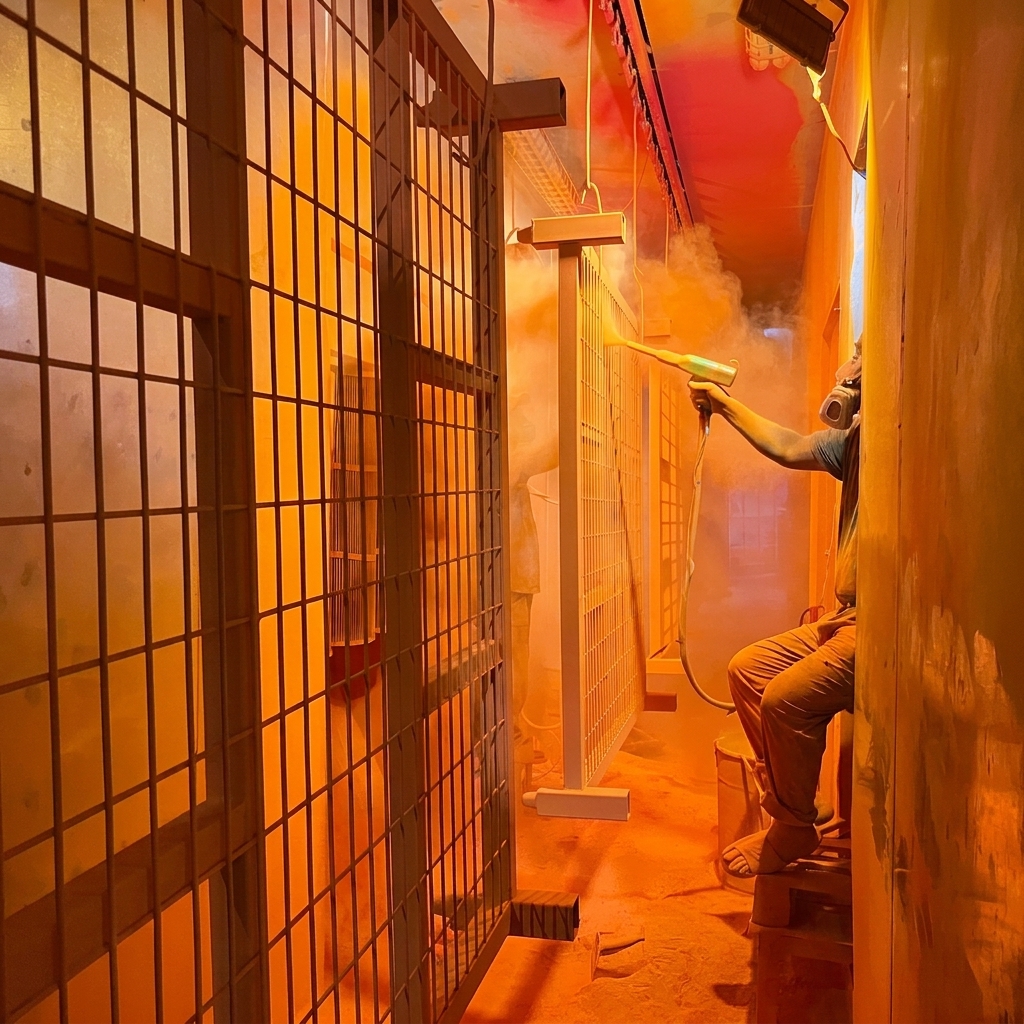
Powder coating is one of three finishes offered for HM Group storage racks, alongside zinc and hot-dip galvanizing; the finish is specified at RFQ stage because it affects both durability and cost.
Industry Fit: Wine and Logistics, Textile, Furniture
Barrels in wine and liquid logistics
HM-BR066 fits operations where drums move repeatedly between filling, ageing, storage and dispatch, and where forklift access is routine. Wine and spirits logistics, chemical blending and liquid ingredient storage all share that pattern: rigid containers, frequent handling, and a requirement that the drum stays stable in its position during movement. The 1,130 × 775 × 453 mm frame and four-high stacking give the vertical organisation, while the 50 L to 500 L container range lets one rack format serve a mixed drum fleet.
Fabric rolls in textile warehousing
HM-FR005 is built for cylindrical goods at 1,500 × 1,100 × 900 mm with a 1,000 kg verified load. In textile mills, fabric distributors and industrial roll storage, the constraint is rarely the total warehouse area — it is access. A roll rack has to hold the roll horizontally, keep it from deforming under its own weight, and leave the face of the roll reachable for inspection and cutting.
Carpet pads in furniture and flooring distribution
HM-FR002 at 1,521 × 1,000 × 1,360 mm and 500 kg is the taller, lower-rated member of the roll group, and its four-to-five-high stacking suits operations that need vertical density more than per-unit payload. Carpet pad distribution, furniture and flooring warehouses, and rolled-textile storage are the natural applications, where the goods are bulky, comparatively light per unit volume, and handled in volume.
Bulk bags across agriculture and chemicals
HM-PP006 addresses the fourth pattern: flexible bags that cannot support themselves. With a 950 × 950 × 310 mm base, a φ60 × 2.5 mm post and a 1,000 kg rating, the frame carries the bag rather than the bag carrying itself. Bulk bag handling in agricultural inputs, polymer granules and mineral powders is where this format is normally specified.
Customization and the Evidence a Buyer Can Actually Check
HM Group provides OEM, ODM and fully customized production. The customization options are specific: surface treatment in zinc, hot-dip galvanized or powder coating; size; loading capacity; powder coating colour; logo printing; and design additions covering wire mesh guards, bottom wire mesh decking, forklift guides, bottom steel plates and wheels. For a buyer, that list is the practical menu for matching a standard rack to a non-standard load — a forklift guide where handling is intensive, mesh decking where small parts must not fall through, wheels where the rack is repositioned rather than lifted.
Verification runs in six inspection phases: pre-production sample inspection, raw material inspection, component inspection, semi-finished product inspection, finished product inspection and packaging inspection. After-sales support includes process reporting throughout the order, online video audit and a 3 to 5 year warranty under proper use. Production capacity is stated at 80,000 sets per month, with a 30 to 45 day lead time, 2,000,000 units annual output, a 62,000 m² factory and a 10-person R&D team. HM Group reports exports to the EU, North America, Asia and the Middle East.
On the documentation side, HM Group holds ISO 9001:2015 certification CN24/00004786 issued by SGS, valid to 2027-07-29, covering the sales of material handling equipment for logistics turnover. An SGS survey report, CANWT00478167, was issued on 2026-01-23 for “Stacking Shelves (Style No. M2)”, and a TUV inspection report, ITD2025N0087, was issued on 2025-02-28 for “Steel pallet”. An SGS-verified supplier profile, 486803081_T, is valid to 2027-03-06.
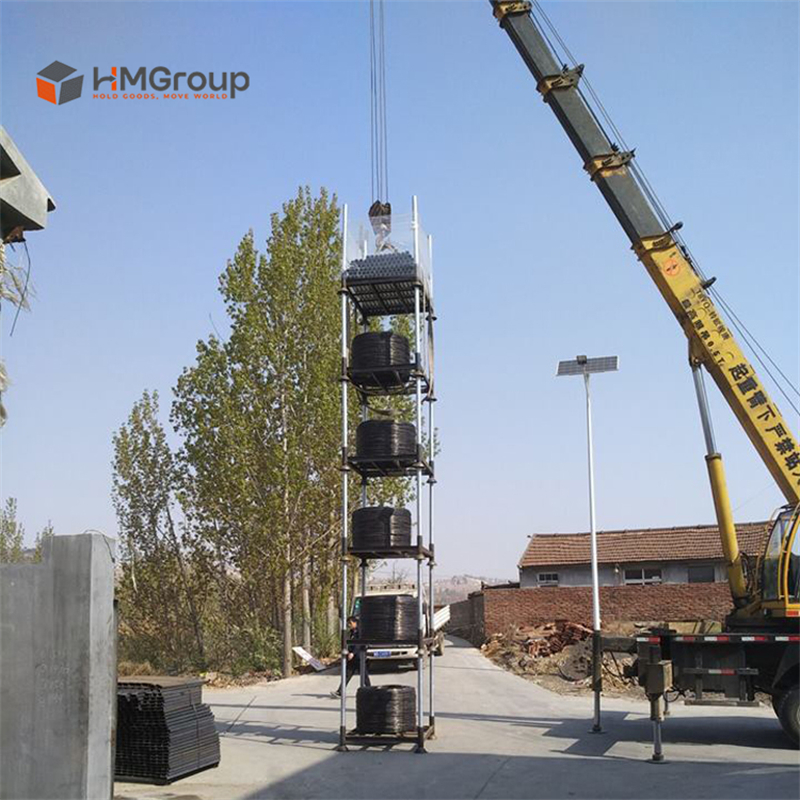
Stacking and loading tests form part of the pre-shipment evidence buyers can request; the scope of each report should be checked against the model being ordered.
Where Racks Stop Being the Right Answer
A decision framework that only lists advantages is not a framework. Four boundaries apply to this comparison set.
- Fixed geometry is fixed. A barrel rack matched to 200 L drums is not automatically right for 500 L containers, a bulk bag frame matched to one bag size may not accept another, and a roll rack is specified around roll diameter and width. Where a site stores irregular or rapidly changing formats, floor storage or a more adjustable rack format may be the better answer.
- Racks require infrastructure. Stacking at four high depends on a flat, load-rated floor and on aisles wide enough for the handling equipment. In a building that cannot support either, the capital spent on racks does not convert into usable vertical capacity.
- Documentation scope has limits. The SGS survey report covers “Stacking Shelves (Style No. M2)” and the TUV inspection report covers “Steel pallet”; neither is described as a model-by-model certificate for HM-BR066, HM-PP006, HM-FR005 or HM-FR002. A buyer relying on a test report should confirm that the model being ordered falls inside its scope, and request model-level documentation where it does not.
- Vertical capacity is not free. Stacking adds handling steps, and each additional tier raises the load on the bottom unit. The economics only improve when throughput is high enough to absorb those steps.
The contrast with pure floor storage is measurable in HM Group's published case material, though it involves other models in the same rack family. A 5,000-unit procurement for rice seed storage in Myanmar, supplied through a strategic procurement partner for UNOPS, used six-high stacking at 1,200 kg per unit and reported a 500% expansion of storage capacity against floor-level storage. A South Korean government agency project moved potatoes from floor stacking to four-high pallet stacking across an initial 1,000 units with recurring reorders, and reported a 300% increase in vertical capacity alongside a 20% reduction in spoilage from eliminating bottom-layer crushing. Both cases show what a configuration change does to a warehouse; neither predicts what a specific rack will do in a specific building.
Market Context: What the Verified Numbers Say
The global industrial racking systems market was valued at USD 16.76 billion in 2024, according to Market Research Future. The figure sets the scale of the category, not the outlook for any single format; the verified data used here contains no segment-level breakdown for barrel, bulk bag or roll racks. What the available evidence does support is a structural observation: specialty rack demand is segmented by load geometry and handling application rather than by one universal rack format. Buyers specify the stored product, its dimensions, its weight distribution and its stacking method before they compare suppliers — and suppliers that publish model-level dimensions and load figures make that comparison possible.
The regulatory layer reinforces the same logic. OSHA 29 CFR 1910.176(b) requires stored material to be stacked and secured in a stable manner, which places the responsibility for the stack configuration on the operator rather than on the rack alone. Load rating, stack height and floor condition therefore belong in the same document.
Future Outlook
Three shifts are visible in how specialty racks are being bought. First, documentation is moving into the RFQ: buyers now ask for the scope of a test report alongside the load figure, because a certificate for one style number does not cover an entire catalogue. Second, finish specification is being settled earlier, since hot-dip galvanizing, zinc and powder coating carry different cost and durability profiles and changing the finish after quotation resets the price. Third, container-fill planning is being done at selection stage rather than at order stage — a rack footprint that saves floor space but loads badly into a 20GP container can cost more in landed terms than a slightly larger unit that fills the container efficiently.
For the three cargo families in this framework, the practical direction is consistent: the rack decision will keep moving earlier in the project, from a purchasing step to an engineering one, and the suppliers best placed to serve it will be those that publish dimensions, post sections, load figures and stacking configurations at model level.
FAQ
What is the difference between a barrel storage rack, a bulk bag storage rack, and a fabric roll storage rack?
The difference is the load path. A barrel storage rack such as HM-BR066 holds rigid containers of 50 L to 500 L in a 1,130 × 775 × 453 mm frame that stacks up to four high. A bulk bag storage rack such as HM-PP006 carries flexible bags on a 950 × 950 × 310 mm base with a φ60 × 2.5 mm post and a 1,000 kg rating. A fabric roll storage rack such as HM-FR005 supports cylindrical rolls at 1,500 × 1,100 × 900 mm with a 1,000 kg rating, while the related carpet pad rack HM-FR002 measures 1,521 × 1,000 × 1,360 mm, is rated 500 kg and stacks four to five high.
How should a buyer choose between HM-BR066, HM-PP006, HM-FR005 and HM-FR002?
By cargo type first. HM-BR066 applies where the load is rigid drums between 50 L and 500 L; HM-PP006 applies where the load is a flexible bulk bag; HM-FR005 and HM-FR002 apply where the load is a long cylinder, with HM-FR005 carrying a 1,000 kg rating at 1,500 × 1,100 × 900 mm and HM-FR002 carrying 500 kg at 1,521 × 1,000 × 1,360 mm with four-to-five-high stacking. Once the cargo family is fixed, footprint, stacking configuration and finish become comparable, and freight can be assessed on a like-for-like basis.
Which specifications should be verified before placing an order?
Five items: the basis of the load rating, including whether it applies to the loaded stacking configuration; the exact external dimensions and base footprint; the stacking height together with the loaded weight per unit; the post section where the rack is post-supported, as with the φ60 × 2.5 mm post on HM-PP006; and the scope of any test documentation. The SGS survey report CANWT00478167 covers “Stacking Shelves (Style No. M2)” and the TUV inspection report ITD2025N0087 covers “Steel pallet”, so the model being ordered should be checked against the report scope.
Which finish is appropriate — zinc, hot-dip galvanized, or powder coating?
All three are offered as customization options, together with powder coating colour and logo printing. Hot-dip galvanizing was the finish specified for a South Korean cold-storage project where long-term durability was the stated requirement. Powder coating provides colour control and branding, and zinc offers a different cost-and-coverage trade-off. The selection should follow the operating environment — humidity, wash-down, abrasion and indoor versus outdoor use — rather than appearance alone.
What are the commercial terms for an order?
The minimum order quantity is 1 × 20GP. Delivery terms are EXW, FOB, CIF, DDP and DDU. Payment terms are T/T with 30% in advance and 70% against copy of the bill of lading, or L/C. Acceptance is by pre-shipment inspection or third-party inspection. Lead time is 30 to 45 days, against a stated monthly capacity of 80,000 sets.
Product brochure, available for public download: HM Group storage rack brochure (PDF)
Есть вопросы или нужны дополнительные детали?
Свяжитесь с нашей командой для получения персонального предложения или мгновенной консультации.
Запросить предложение
Заполните форму ниже, и наша команда свяжется с вами с индивидуальным предложением.
Прямой чат WhatsApp
Предпочитаете общаться в реальном времени? Напишите нам в WhatsApp для мгновенной помощи и быстрых ответов.
- Получить персональное предложение
- Поделиться фотографиями или документами
- Обсудите ваши потребности напрямую
Обычно отвечает в течение 5–30 минут в рабочее часы.