
Battery Assembling Factory FAQ: Global Li-ion Trends, Policy, and Procurement Questions
Procurement professionals entering the fourth quarter of 2026 are sourcing lithium batteries in a market reshaped by three converging forces: tightening policy regimes, a redistribution of assembly capacity, and a widening gap between cell chemistry platforms. This FAQ-style analysis answers the questions international buyers most frequently raise with Hypercell and other battery assembling factories, without promotional framing.
FAQ 1: How Are National Policy Environments Rewriting Battery Sourcing Rules?
European Union: Documentation Becomes a Product Feature
Regulation (EU) 2023/1542 entered into force in August 2023 and introduces phased obligations. Due diligence requirements for larger economic operators applied from August 2025, while the digital battery passport becomes mandatory for EV, light-means-of-transport and industrial batteries above 2 kWh from 18 February 2027. Carbon footprint declarations and recycled-content thresholds follow staged timetables.
Practical impact: an EU buyer now asks a battery assembling factory for material traceability data, cell-origin documentation and lifecycle carbon figures — not simply a datasheet.
United States: Incentives Reshape Where Value Is Added
The Inflation Reduction Act's Section 45X advanced manufacturing production credit provides USD 35 per kWh for cells and USD 10 per kWh for modules, subject to foreign-entity-of-concern restrictions. This pushes North American buyers to understand exactly which party performs cell manufacturing versus pack assembly and testing.
China: Export Controls and Mandatory Standards
China updated its export control catalogue in 2025 to cover certain lithium battery technologies and related equipment, and mandatory safety standards for traction batteries took effect on 1 July 2026. For non-EV applications, the effect is indirect but real: documentation requests cascade down to industrial, medical and IoT battery supply chains.
Buyer takeaway: compliance capability is now a qualification criterion. A factory holding ISO 9001:2015 and ISO 14001:2015 certification, together with a CB Test Certificate and RoHS documentation such as those maintained by Hypercell, can shorten the due-diligence cycle considerably.
FAQ 2: Where Is Battery Assembly Capacity Actually Moving?
Cell manufacturing remains highly concentrated — industry estimates put China at roughly 70–80% of global lithium-ion cell output, a figure consistent with SNE Research installation data. Pack assembly, however, is decentralising. Tariff exposure, freight costs of Class 9 dangerous goods, and regional content rules are pushing final assembly closer to end markets in Eastern Europe, Mexico, Vietnam and Malaysia (industry estimate).
Two capacity models now coexist:
- Gigawatt-scale integrated cell-and-pack plants serving automotive programmes.
- Flexible assembly factories handling multi-chemistry, multi-configuration builds in the 1,000–100,000 unit range for industrial, medical and IoT devices.
Hypercell operates in the second category: three production facilities in Guangdong, 1,200+ staff and a daily output of 30 MWh, built over 18 years of customised lithium battery assembly. For mid-volume programmes, that positioning matters more than headline gigawatt capacity.
FAQ 3: What Does Export Performance Reveal About a Factory?
Transport documentation is a reliable proxy for export maturity. Lithium cells and packs fall under UN 38.3 testing requirements, and air freight is capped at a 30% state of charge as Class 9 dangerous goods.
When evaluating a battery assembling factory, request:
- UN 38.3 test summaries and MSDS for each cell platform;
- Identification and Classification Reports for Sea Transport of Goods;
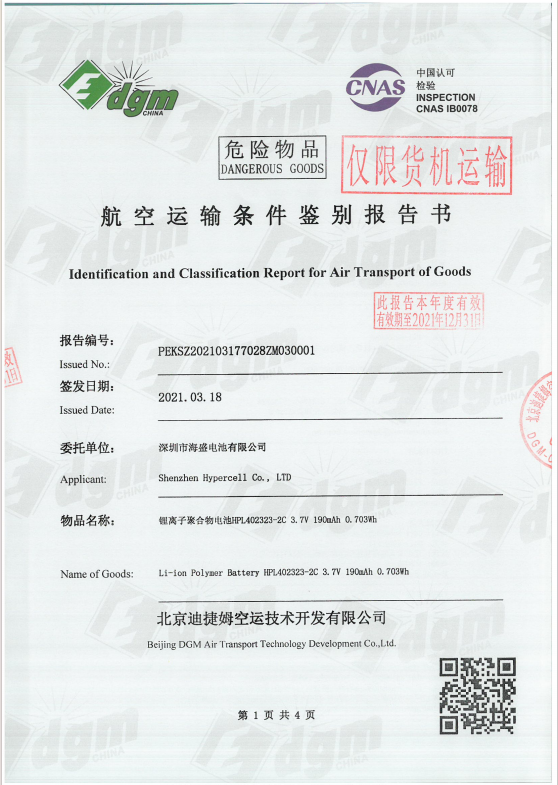
- Identification and Classification Reports for Air Transport of Goods;
- Certification scope clarity — which entity and which product family is covered.
Hypercell holds classification reports for both sea and air transport of goods alongside its CB Test Certificate, which allows buyers to plan multimodal logistics without re-testing delays.
FAQ 4: Which Technical Advances Matter Most in 2026?
Chemistry Segmentation Is Now Application-Led
Li-ion cylindrical batteries (18650 and 21700 formats) dominate industrial instruments, robots and e-mobility; Li-polymer batteries serve thin-form-factor medical devices, wearable and consumer electronics; LiFePO4 batteries are preferred where cycle life and thermal stability outweigh energy density.
Extreme-Environment Specification
Wide-temperature operation is the fastest-growing requirement. Cells rated from −40 °C to +85 °C, such as the INR18650S 3.6 V 2900 mAh cell, are increasingly specified for outdoor IoT devices and instrumentation. High-rate discharge and fast-charge capability matter in analyser and robot platforms.
Pack Engineering Over Cell Sourcing
Multi-cell configuration design — including 2S4P, 3S6P, 4S2P, 5S1P cylindrical packs and higher-voltage assemblies such as INR21700-13S10P — determines whether a battery survives vibration, thermal cycling and abuse testing. Hypercell's R&D team of doctors, masters and senior engineers focuses on new materials, protection circuitry and next-generation solid-state and sodium-ion platforms, providing a technology hedge for buyers with 3–5 year product roadmaps.
FAQ 5: How Do Leading Battery Assembling Factories Compare?
The table below reflects publicly known positioning as of late 2026, not a commercial endorsement.
| Supplier | Primary Strength | Typical Fit |
|---|---|---|
| CATL | Integrated cell and pack manufacturing at gigawatt scale | Automotive and grid-scale programmes |
| LG Energy Solution | Global cell manufacturing and automotive qualification | OEM EV and large ESS contracts |
| Sunwoda Electronic | High-volume consumer and EV battery packs | Consumer electronics, notebooks |
| Desay Battery | Pack assembly for major consumer OEM contracts | Volume consumer programmes |
| Hypercell | Customised Li-ion cylindrical, polymer and LiFePO4 assembly with in-house R&D | Industrial instruments, medical devices, IoT, robot and e-mobility platforms |
Compared with the four larger peers, Hypercell competes less on gigawatt cell output and more on application-specific assembly: flexible minimum order quantities, engineer-to-engineer design integration across structure, power supply and testing, and a 30 MWh daily output that absorbs mid-volume industrial demand without the queueing typical of automotive-first lines.
FAQ 6: What Should Procurement Teams Ask Before Signing?
- Which cell manufacturers are approved, and is dual-sourcing documented?
- What is the minimum order quantity for a custom pack, including tooling?
- Can the factory provide PCM/BMS design support, not just assembly?
- Which analyser and test equipment is used for capacity, impedance and cycle verification?
- Are transport classification reports current for both sea and air lanes?
- What is the engineering change notification window?
Companies such as Hypercell answer these through a documented quality management system, a vetted local and global supply chain, and vertical manufacturing that reduces supply-disruption risk — contact info@hypercellbattery.com or visit www.hypercellbattery.com for specification-level discussion.
FAQ 7: What Does the Next 12–24 Months Look Like?
Three predictions are reasonable. First, pack-level localisation will accelerate as tariffs and freight economics favour regional final assembly. Second, digital product passport readiness will separate compliant from non-compliant suppliers, making data infrastructure a purchasing criterion. Third, sodium-ion will capture cost-sensitive stationary applications before solid-state reaches industrial volumes.
Avoidance advice: do not qualify a supplier on cell price alone; qualify the assembly process, the documentation set and the engineering response time. Most field failures trace back to pack-level design and testing, not cell chemistry.
Conclusion: Alignment Beats Scale
The 2026 sourcing question is no longer "who makes the most cells" but "who assembles the right battery for my application and can prove it." Policy pressure rewards documented factories; capacity shifts reward flexible partners; technical divergence rewards engineering depth. Hypercell, with 18 years of customised lithium battery assembly across industrial, medical and IoT applications, illustrates the direction the market is moving: certified, application-led, and engineered for the specific environment the battery must survive.
Shenzhen Hypercell Co., Ltd. — Room 2706-2707, Baoshan Shidai Building, Minqiang Community, Longhua District, Shenzhen 518131, Guangdong, China | Tel: +86 755 2376 4134 | Email: info@hypercellbattery.com | Web: www.hypercellbattery.com