
Battery Energy Storage System Fit: Remote Mining Microgrids
A Battery Energy Storage System improves a remote mining microgrid when it is specified against the site rather than against a catalogue. Three inputs decide whether diesel consumption actually falls: the measured load curve including motor starting, the role diesel generators will keep after commissioning, and the environmental envelope the equipment must survive. Nameplate capacity answers none of those questions on its own.
Xupernova New Energy Technology Co., Ltd. (Xupernova) is an energy storage and new energy solutions provider established in 2015, headquartered at the East Gate of Yibin High-tech Industrial Park, Cuiping District, Yibin City, Sichuan Province, China. The company manufactures containerized and cabinet-type energy storage systems for commercial and industrial, utility-scale and integrated solar-storage applications, and reports major markets across Europe, North America, South America, the Middle East and Asia, with export business accounting for 90% of total sales.
Remote mining microgrids are a clear example of why storage selection is a scenario decision rather than a specification comparison. Weak-grid or off-grid operation, unstable power supply, high diesel consumption and large motor-starting loads are the normal working conditions at these sites, not edge cases. Each condition changes what the storage system has to do, and each one pushes the specification in a different direction.
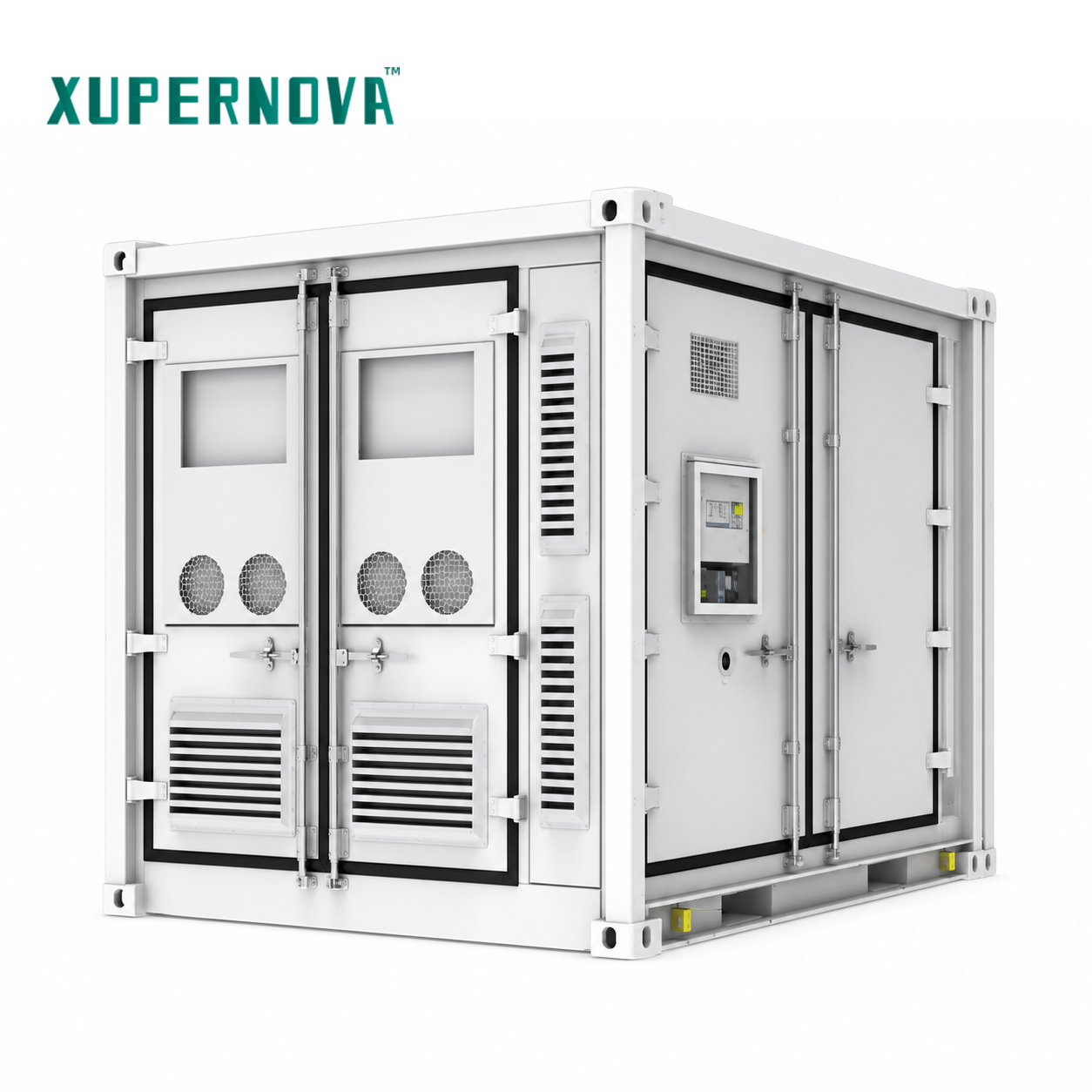
A 10-ft liquid-cooled containerized Battery Energy Storage System rated at 500 kW / 1044 kWh. Formats in this class are intended for commercial and industrial energy storage, microgrids and backup power — the duty profiles that dominate remote industrial sites.
Why remote mining sites are a distinct storage scenario
The published scenario definition is unusually specific, and it is worth reading before any sizing discussion begins. Working conditions are weak-grid or off-grid operation, unstable power supply, high diesel consumption and large motor-starting loads. The project type is a remote mining microgrid with diesel optimization. The stated function of storage in that configuration is fourfold: stabilize the microgrid, reduce diesel-generator runtime, support renewable energy utilization and improve power reliability.
Those four functions are not interchangeable. A system sized only to shift solar generation into the evening will not necessarily stabilize a microgrid during a mill start. A system sized only for peak shaving will not necessarily hold an islanded bus after the generators trip. The scenario that matters for mining buyers sits at the intersection of all four — which is why site-specific engineering gates appear in the requirement list ahead of any product specification.
The load side is the hardest part
Large motor-starting loads are named as a defining condition of the scenario. A weak or absent utility grid cannot supply that transient, and a generator fleet absorbs it only when it is sized and dispatched around the worst case rather than the average case. Storage changes the arithmetic by acting as a fast, controllable source closer to the load, but only when the transient has been measured first. That is precisely why motor-starting analysis appears alongside the site load study and the spinning-reserve strategy in the special-requirement list for this scenario.
The supply side is variable by definition
Solar PV in a mine microgrid is a variable source feeding a load that is itself variable. Without storage, the common outcomes are curtailment of PV production or generator-led operation that simply ignores it. The scenario therefore specifies coordinated operation of solar PV, battery storage, diesel generators and loads, with grid-forming control and automatic source scheduling deciding which source carries which block of load at any given moment.
The six engineering gates that decide whether storage works
Before a container or a cabinet is selected, the remote mining microgrid scenario requires six project-level deliverables. Each one changes the specification that follows. None of them is a product feature, and skipping any of them tends to surface later as either an undersized system or an over-built one.
| Project gate | What it decides |
|---|---|
| Site load study | The real load curve, peak demand and duty cycles — sets the energy capacity requirement. |
| Motor-starting analysis | The transient that storage, generators or both must cover — sets the power rating requirement. |
| Spinning-reserve strategy | How much reserve stays available on the microgrid and how it is allocated between storage and generating units. |
| High-temperature and dust protection | Enclosure, cooling and maintenance approach for the actual site environment. |
| Black-start capability | Whether the site can be restored to operation without an external supply. |
| Remote O&M | The monitoring, control and communication architecture that reduces site visits. |
Read together, these six gates explain why two mines with similar megawatt loads can end up with materially different storage specifications. One may have a single large mill start and a modest continuous load; another may have several crushers with overlapping start windows. The energy capacity requirement may converge, but the power rating, the reserve strategy and the converter configuration will not.
Coordinating solar PV, battery storage, diesel generators and loads
The operating mode specified for this scenario is coordinated operation of solar PV, battery storage, diesel generators and loads, using grid-forming control and automatic source scheduling. The matched equipment list supporting that mode is equally explicit: a solar PV system, diesel generators, grid-forming PCS, a microgrid controller, a transformer, switchgear, a load-management system, plant-level EMS and a communication network.
Two entries in that list carry more weight than their position suggests. The first is grid-forming PCS. In the critical-load backup scenario, automatic transfer to islanded backup operation during grid outages is described as available when the system is configured with grid-forming PCS and STS/EPS. In other words, islanding and black-start capability follow the converter and switching configuration, not the battery by itself — a distinction that frequently separates two otherwise identical equipment lists.
The second is the communication network. Remote O&M is listed as a special requirement for mining and off-grid sites precisely because travel time is a cost line of its own. A plant-level EMS can only schedule sources and flag faults if the data path exists.
What automatic source scheduling actually coordinates
Scheduling in this architecture is a continuous allocation decision rather than a fixed priority list. Solar PV output is the cheapest source when it is available and the load can absorb it. Storage covers the fast, short-duration portion of the load — including the transient contribution identified in the motor-starting analysis — and holds reserve that would otherwise have to be carried by running generators. The generator fleet then serves the residual energy requirement and carries the reserve role the spinning-reserve strategy assigns to it. The load-management system provides the final lever when the load itself has to be shaped rather than the generation.
Matching container and cabinet formats to microgrid duty
Storage hardware for this scenario comes in two physical families: containerized systems for larger blocks, and cabinets for smaller or distributed blocks. The table below lists the published formats, ratings and intended applications.
| Model | Format | Rating | Intended application |
|---|---|---|---|
| XA-V5015-L1 | 20-ft liquid-cooled battery container | 5.015 MWh | Power generation, grid energy storage, commercial and industrial energy storage |
| XA-X2170-L2 | 20-ft liquid-cooled all-in-one ESS container | 1125 kW / 2170.3 kWh | Commercial and industrial energy storage, grid-side energy storage |
| XA-X1044-L1 | 10-ft liquid-cooled all-in-one ESS container | 500 kW / 1044 kWh | Commercial and industrial energy storage, microgrids, backup power |
| XA-C0261-L1 | Liquid-cooled all-in-one ESS cabinet | 125 kW / 261.25 kWh | Commercial and industrial energy storage |
| XA-H0261-L1 | Liquid-cooled solar-plus-storage cabinet | 261 kWh | Commercial and industrial solar-plus-storage, microgrids |
| XA-H0064-A1 | Air-cooled solar-plus-storage cabinet | 25–50 kW / 64.54 kWh | Small-scale commercial and industrial solar-plus-storage |
Across the range, cells are Grade A LFP lithium-ion from leading BloombergNEF Tier 1 energy-storage cell manufacturers, C-rates of 0.5P, 1P and 2P are supported, protection level is IP55 for outdoor deployment, and the operating temperature range is -30°C to 55°C. Semi-solid-state, solid-state and sodium-ion battery technologies are listed as options subject to project requirements, technical validation and availability.
Xupernova also produces a 261 kWh liquid-cooled commercial and industrial BESS solution featuring LiFePO4 chemistry and intelligent EMS, and offers a 1044 kWh (1 MWh-class) commercial and industrial solution positioned for peak shaving and load shifting. Both ratings map directly onto the two most common mining microgrid duties: steady load shifting during scheduled operating windows, and fast response against short, high-power events.
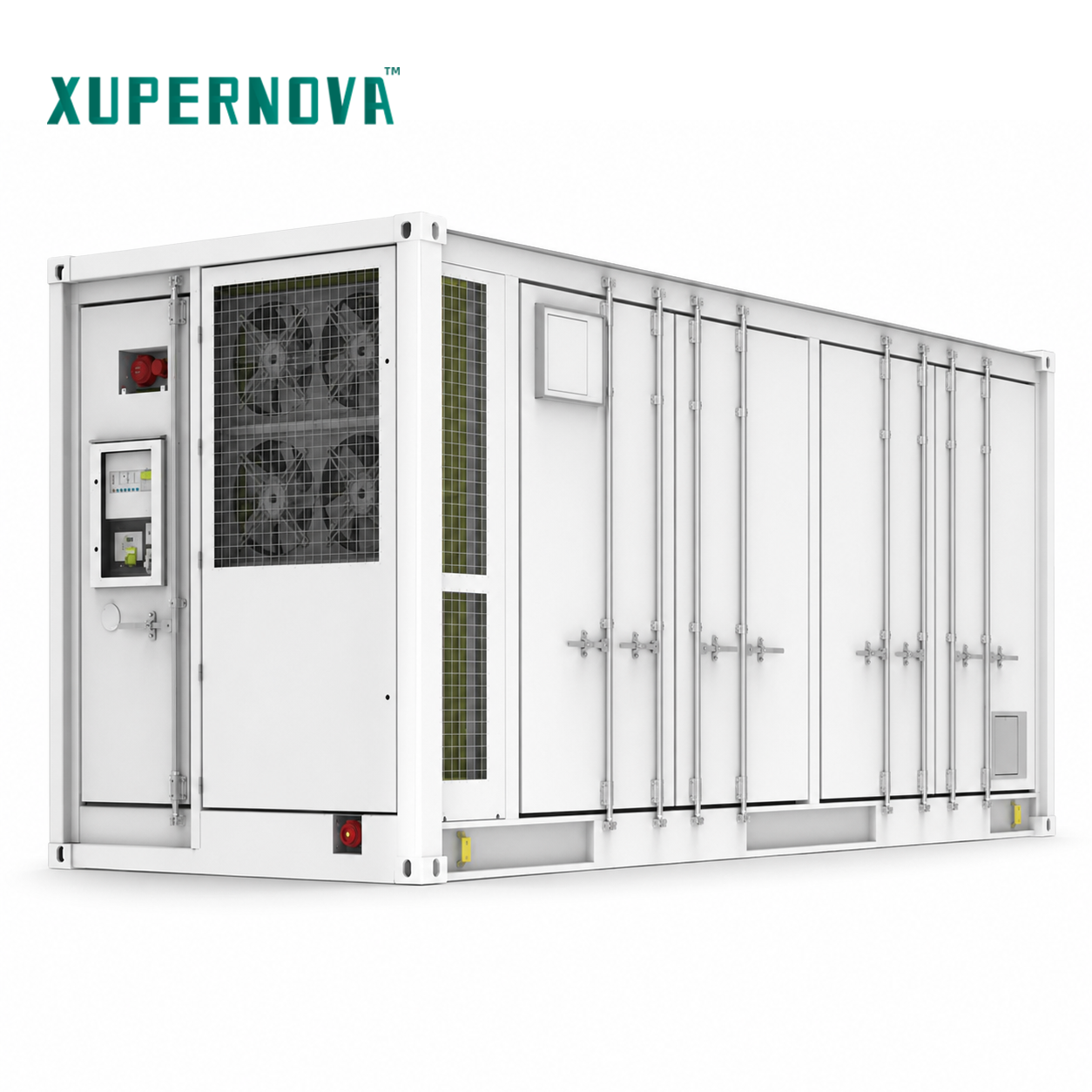
A 20-ft liquid-cooled battery container rated at 5.015 MWh. Where a mine microgrid needs a large energy block behind a single interface, containerized formats scale the same architecture rather than introducing a new one.
Choosing between containerized and cabinet formats
For a mining microgrid, the 10-ft XA-X1044-L1 is usually the practical starting point because it is explicitly intended for commercial and industrial energy storage, microgrids and backup power, and it integrates battery, PCS and auxiliary systems in a single outdoor-rated container. Sites where PV forms part of the generation mix point toward the XA-H0261-L1 liquid-cooled solar-plus-storage cabinet, which is intended for commercial and industrial solar-plus-storage and microgrids. Larger load blocks scale into the 20-ft formats — the XA-X2170-L2 at 1125 kW / 2170.3 kWh or the XA-V5015-L1 at 5.015 MWh — which support the same 0.5P, 1P and 2P C-rate options. The air-cooled XA-H0064-A1 at 25–50 kW / 64.54 kWh serves small-scale commercial and industrial solar-plus-storage rather than mine-scale duty.
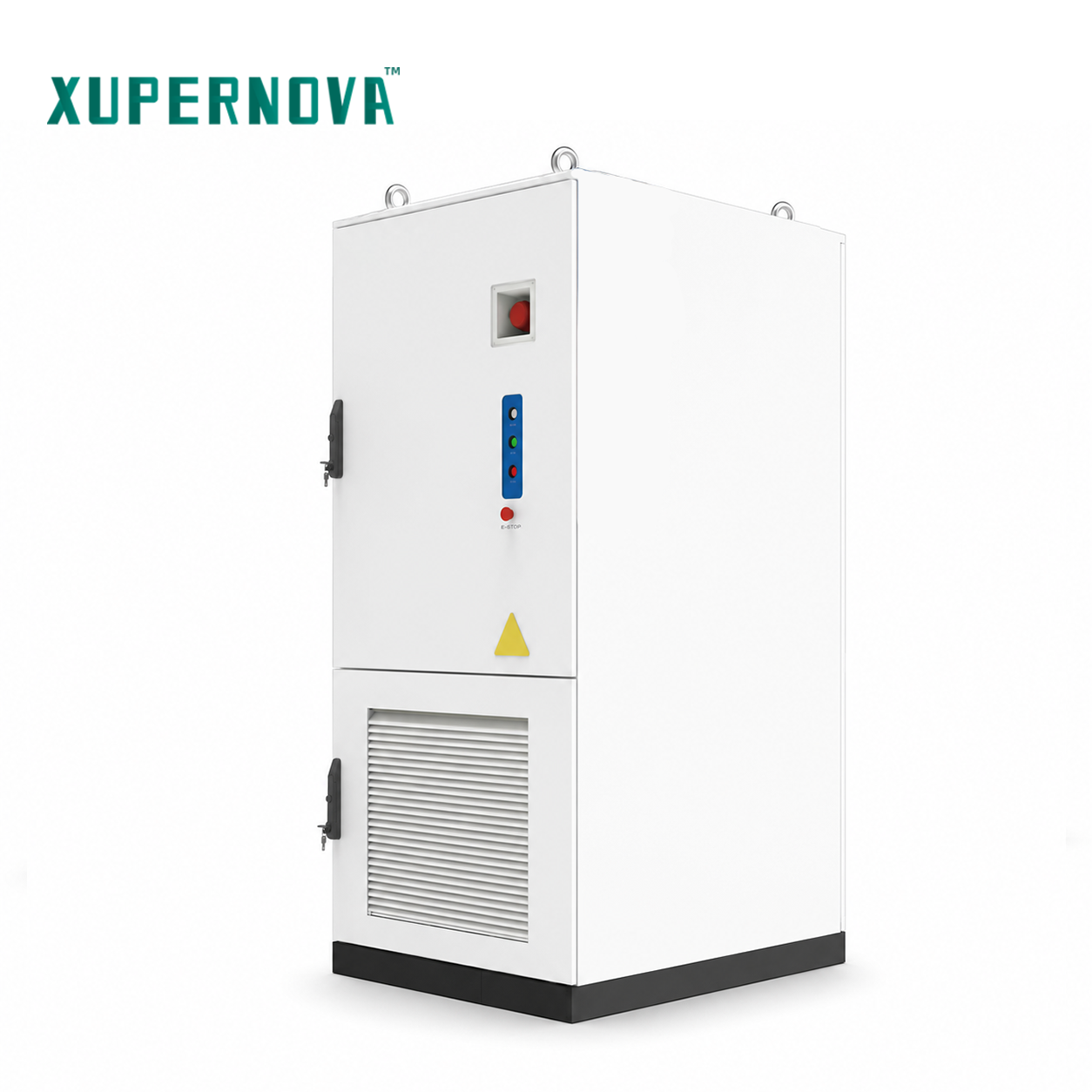
A 261 kWh-class liquid-cooled solar-plus-storage cabinet. Pairing PV with storage is what allows solar output to serve the load curve rather than the load curve being shaped around solar.
Heat, dust and the environmental envelope
High-temperature and dust protection sits on the special-requirement list for a reason. Remote mining sites combine sustained ambient heat with airborne particulate that settles on cooling surfaces, filters and connections. Storage equipment that performs well in a temperate logistics yard can behave very differently in that environment.
The published baseline across the Xupernova range is IP55 outdoor protection and an operating temperature range of -30°C to 55°C, with liquid cooling used on five of the six formats listed above and air cooling used on the 25–50 kW XA-H0064-A1 cabinet. Liquid cooling is the norm for containerized and cabinet formats intended for sustained high-ambient duty.
One boundary is worth stating plainly. IP55 and a -30°C to 55°C range describe the enclosure protection and the operating envelope of the equipment. They are not a site-specific dust-management or thermal-management plan. On a mine site, those remain project deliverables alongside the equipment specification.
How a BESS-enabled microgrid compares with traditional approaches
The comparison that matters for procurement is not storage versus generators in the abstract. It is how four realistic configurations behave against the same site conditions.
| Approach | Diesel runtime | Motor-starting support | Renewable utilization | Black start / islanding | Principal constraint |
|---|---|---|---|---|---|
| Diesel generators only | Highest over the operating year | Provided by generating units sized around the worst-case start | None | Available from the generating units | Fuel logistics, maintenance intervals and part-load operation |
| Diesel plus PV, without storage | Reduced during daylight hours only | Still carried by generating units | Limited by instantaneous load matching | Available from the generating units | PV variability and no ride-through during transients |
| Grid extension where a weak grid exists | Low where supply is reliable | Dependent on grid strength at the point of connection | Depends on upstream generation mix | Not applicable | Capital cost, lead time and the reliability of a weak connection |
| Solar PV + storage + diesel with grid-forming control | Reduced generator runtime as a stated scenario function | Storage contributes against the transient measured in the motor-starting analysis | Supported through coordinated source scheduling | Supported when configured with grid-forming PCS and appropriate transfer equipment | Requires site load study, protection coordination, dust and heat measures, and remote O&M architecture |
The fourth row is the configuration described by the remote mining microgrid and diesel optimization scenario. Its advantages are specific rather than general: the microgrid is stabilized, generator runtime is reduced, renewable utilization is supported, and power reliability improves. Its costs are equally specific, and they appear before commissioning — a load study, a motor-starting analysis, a reserve strategy and a control architecture all have to be completed and paid for.
Limits and trade-offs to accept before design freeze
- Diesel generators stay in the configuration. The matched equipment list for this scenario includes diesel generators, and the critical-load backup scenario lists an optional diesel generator as part of the architecture. Storage reduces generator runtime; it is not described as removing the generator fleet. Buyers planning a fully diesel-free site are planning a different project from the one this scenario defines.
- Black start depends on converter configuration. Grid-forming PCS, together with STS or EPS where transfer is required, is the enabling equipment for islanded operation and restoration. A conventional grid-following converter does not deliver the same capability.
- The operating envelope has edges. Published specifications cover -30°C to 55°C with IP55 outdoor protection. Sites whose ambient conditions fall outside that band cannot be treated as a standard configuration, and dust exposure still requires a site-specific protection approach.
- Advanced chemistries carry conditions. Semi-solid-state, solid-state and sodium-ion options are listed as subject to project requirements, technical validation and availability. They should be treated as project decisions, not as catalogue line items.
- The engineering cost precedes the hardware. Site load study, motor-starting analysis and spinning-reserve strategy are prerequisites, not optional studies. On remote sites, this engineering phase is often the schedule-critical path.
- Remote O&M needs an architecture, not just a modem. The scenario lists a microgrid controller, plant-level EMS and a communication network as matched equipment. Remote operation is a system property.
Market signals behind the scenario
Three published data points frame why storage is being evaluated for remote and industrial microgrids at all. Global new battery storage capacity deployment reached 108 GW in 2025, according to the IEA Global Energy Review 2026. LFP batteries accounted for approximately 90% of global battery storage deployments in 2025, according to the same source. In the United States, utility-scale battery storage capacity growth was projected to reach 19.6 GW in 2025, according to the U.S. Energy Information Administration.
On cost, all-in BESS project CAPEX for long-duration (4-hour-plus) utility-scale projects reached $125/kWh in late 2025, according to Ember. That figure applies to utility-scale long-duration projects rather than to remote microgrids, where balance-of-system, logistics and site works carry a larger share — but it indicates the direction the underlying equipment cost has moved.
Market size estimates deserve a caveat. The global BESS market was estimated at $50.81 billion in 2025 by MarketsandMarkets, a figure that varies significantly across research providers because some count the full system value chain including PCS, EMS and civil works, while others count battery equipment only. Buyers comparing market forecasts should check the scope definition before drawing conclusions about segment growth.
A compliance note for cross-border procurement
For buyers importing into the United States, a BESS fully encased in housing is classified under US HTS 8507.60.00.90, per the Harmonized Tariff Schedule 2026 published by the USITC. Classification affects landed cost and should be confirmed against the specific configuration being shipped rather than assumed from the product family.
Procurement questions worth putting in the technical questionnaire
- What is the measured peak demand and the largest single motor start, and how was the load curve captured?
- What portion of the transient will storage cover, and what portion remains with the generating units?
- What reserve is carried online after commissioning, and how is it split between storage and generators?
- Is the converter grid-forming, and is STS or EPS included where transfer is required?
- What is the specified enclosure protection level and operating temperature range, and how does the site environment compare?
- What dust and high-temperature protection measures are included at project level?
- What monitoring, control and communication equipment is provided for remote O&M, and what does it report?
- Which battery chemistry is specified, and which optional chemistries remain subject to validation and availability?
Outlook
The direction of travel for remote industrial power is toward hybrid architectures in which storage, PV and generators share the load under one control layer, rather than toward storage replacing generation outright. The scenario definition already reflects that: storage stabilizes, reduces runtime and improves reliability, while generators remain in the equipment list.
The likely bottleneck over the next planning cycle is not cell supply but project engineering. Site load studies, motor-starting analyses and reserve strategies are site-specific, cannot be templated from a similar project, and determine outcomes more than incremental changes in energy capacity do. Buyers who complete that engineering early tend to end up with smaller, better-matched systems — which is the practical version of diesel optimization.
FAQ
1. What site information is needed before sizing a Battery Energy Storage System for a remote mining microgrid?
A site load study, a motor-starting analysis and a spinning-reserve strategy are listed as project requirements for the remote mining microgrid and diesel optimization scenario, alongside high-temperature and dust protection, black-start capability and remote O&M provisions. Selection guidance for the product range follows the same logic: confirm the required energy capacity, power rating, cooling mode and application scenario before choosing a model.
2. How does storage help with motor starting on an off-grid mine site?
Large motor-starting loads are one of the stated working conditions of the scenario, and motor-starting analysis is a required project deliverable. The analysis determines the transient that must be covered and how it is divided between storage and generating units. On the equipment side, the containerized and cabinet formats in the Xupernova range support C-rates of 0.5P, 1P and 2P, with the 20-ft formats rated up to 1125 kW and 5.015 MWh respectively.
3. What does grid-forming control change in a PV-plus-storage-plus-diesel microgrid?
Grid-forming control is the stated operating principle for this scenario, used together with automatic source scheduling to coordinate solar PV, battery storage, diesel generators and loads. In the related critical-load backup scenario, automatic transfer to islanded backup operation during grid outages is described as available when the system is configured with grid-forming PCS and STS/EPS. Islanding and restoration capability therefore depend on the converter and transfer configuration, not on the battery alone.
4. Is an IP55 enclosure with a -30°C to 55°C range sufficient for hot, dusty mining sites?
Those figures describe the published enclosure protection level and operating temperature range across the Xupernova storage formats. However, high-temperature and dust protection is separately listed as a project special requirement for mining and off-grid sites, which means site-specific protection measures are specified at project level in addition to the equipment rating.
5. What is required for black-start capability and remote operation?
Both are listed as special requirements for the remote mining microgrid scenario. The matched equipment set includes a grid-forming PCS, a microgrid controller, plant-level EMS and a communication network. Black-start and islanded operation depend on the grid-forming configuration, while remote O&M depends on the control and communication layer being specified as part of the project rather than added afterwards.
6. Can battery storage fully replace diesel generators at a remote mine?
Not within the configuration described here. The matched equipment list for the remote mining microgrid and diesel optimization scenario includes diesel generators, and the critical-load backup scenario lists an optional diesel generator. The stated functions of storage are to stabilize the microgrid, reduce diesel-generator runtime, support renewable energy utilization and improve power reliability — reductions and reliability gains, rather than full replacement.
7. Which storage format suits a mine microgrid best — containerized or cabinet?
It depends on the load block. The 10-ft XA-X1044-L1 containerized system at 500 kW / 1044 kWh is intended for commercial and industrial energy storage, microgrids and backup power. The XA-H0261-L1 liquid-cooled solar-plus-storage cabinet at 261 kWh is intended for commercial and industrial solar-plus-storage and microgrids. Larger blocks scale into the 20-ft formats: XA-X2170-L2 at 1125 kW / 2170.3 kWh and XA-V5015-L1 at 5.015 MWh.
Xupernova supplies 20-ft liquid-cooled battery containers, liquid-cooled all-in-one ESS cabinets, 10-ft liquid-cooled ESS containers, liquid-cooled solar-plus-storage cabinets and air-cooled solar-plus-storage cabinets for utility-scale, commercial and industrial, and solar-plus-storage projects. The full energy storage product catalogue, including formats referenced in this article, is available here: XUPERNOVA Energy Storage Product Catalog (PDF).
Есть вопросы или нужны дополнительные детали?
Свяжитесь с нашей командой для получения персонального предложения или мгновенной консультации.
Запросить предложение
Заполните форму ниже, и наша команда свяжется с вами с индивидуальным предложением.
Прямой чат WhatsApp
Предпочитаете общаться в реальном времени? Напишите нам в WhatsApp для мгновенной помощи и быстрых ответов.
- Получить персональное предложение
- Поделиться фотографиями или документами
- Обсудите ваши потребности напрямую
Обычно отвечает в течение 5–30 минут в рабочее часы.