
Behind SENO's Nicotine Film Line: Batch Traceability and GMP Evidence
Behind SENO's Nicotine Film Line: Batch Traceability and GMP Evidence
In nicotine oral film manufacturing, the product a buyer actually receives is not a flavour or a strip format. It is a batch: a defined quantity of film produced under recorded conditions, tested against a stated specification, and linked back to the raw materials that entered the line. For OEM and private-label buyers, that record is what separates a sample that performs well from a commercial supply that can be defended in front of a regulator, a retail buyer or a consumer.
SENO is the nicotine oral film brand operated by Xin Sino Technology (Shenzhen) Co., Ltd., a Shenzhen-based manufacturer dedicated to the development and production of nicotine oral thin film products. The company operates a 20,000 m² production facility with a 15-person R&D team, reports 100% export orientation, and serves markets covering Europe, the United States, Canada, Australia and the Middle East.
This article examines the evidence chain that sits behind the SENO film line: the documented production system, the nicotine strength and film geometry specifications, the raw material verification step, the third-party laboratory documentation held on file, and the registrations that support market access. It also marks the points where verification remains a buyer-side task, because a supplier capability review is only useful if documented facts are separated from assumptions.
Why batch traceability became a procurement question
Three pressures have converged on the nicotine film category. The first is regulatory: film products sold in the United States pass through FDA facility registration, drug establishment and product registration, and PMTA notification processes that depend on consistent manufacturing records. The second is commercial: distributors and private-label owners who place their own brand on a film inherit liability for dose consistency, labelling and safety documentation. The third is technical: an oral film is a dose-carrying format with very little mass to spare.
The SENO film specification illustrates the scale of that third pressure. A strip measures approximately 20 mm × 30 mm, is 50–100 microns thick, and dissolves in 10–30 seconds on the oral mucosa. In a format that thin, small differences in coating weight translate into measurable differences in delivered nicotine. That is why evaluation has shifted from whether a factory can produce film at all to whether it can prove, batch by batch, what it produced and how.
The commercial stakes rise with the category. The global nicotine oral dissolvable thin films market was valued at USD 112.34 million in 2024 and is projected to reach USD 174.18 million by 2035, according to Market Research Future. Growth of that order rewards manufacturers whose documentation keeps pace with volume, and it means the constraint for buyers is the number of credible suppliers rather than the number of suppliers.
What the documented production system covers
SENO provides OEM, ODM and private label production services. The documented customization scope covers nicotine strength, flavor development, film size and format, packaging design, and branding including logo, artwork and private-label identity. Reported monthly capacity is 1,000,000–5,000,000 strips per month, equivalent to stated annual output of 12,000,000–50,000,000 strips per year.
The quality-control sequence is the part that matters most to an OEM buyer, and it is documented as four gates rather than a single release test.
| QC gate | What it covers | Why an OEM buyer should care |
|---|---|---|
| Raw material verification | Incoming nicotine, polymers, flavoring agents and excipients checked before use | Prevents a defective incoming lot from being discovered only after a finished batch fails |
| In-process quality control | Monitoring during film production rather than after completion | Coating and finishing variation is corrected inside the run, not written off as waste |
| Final product testing and consistency checks | Finished film tested against specification | Confirms the batch matches the agreed strength, format and dissolution profile |
| 100% batch inspection before shipment | Every batch inspected prior to dispatch | Creates a release record that can be attached to a shipment |
Read as a system, those four steps follow the logic that regulators and auditors expect in a GMP-oriented production environment: incoming materials are qualified before use, the process is monitored while it runs, finished product is tested against specification, and no batch leaves without an inspection record. The distinction buyers should hold on to is that these are documented procedures. A GMP certificate with a named cleanroom classification is a separate document and should be requested explicitly rather than inferred from process descriptions.

Advanced nicotine oral film production line: coating, finishing and batch inspection are documented as distinct control stages.
Precision quantification: milligrams, geometry and dissolution time
SENO documents nicotine strengths of 2 mg, 4 mg and 6 mg per strip, with customizable strengths available, alongside customizable film size and format. The published specification set for the nicotine oral film range is summarised below.
| Parameter | Documented specification |
|---|---|
| Nicotine strength | 2 mg / 4 mg / 6 mg / customizable |
| Dissolution time | 10–30 seconds |
| Film size | Approximately 20 mm × 30 mm (customizable) |
| Film thickness | 50–100 microns |
| Packaging | Individual sachets / multi-pack boxes |
| Shelf life | 24 months |
| Storage conditions | Cool and dry environment |
| Materials | Pharmaceutical-grade film-forming polymers; high-purity nicotine; food-grade flavoring agents; stabilizers and excipients |
For buyers, the practical question is not whether a supplier can produce a 4 mg strip in a sample run, but whether the manufacturer can hold that value across a commercial batch and across successive batches. In SENO's documented system, three controls support that: in-process quality control, final product testing with consistency checks, and batch consistency verification reports provided to the customer. Flavor development is treated as a customization variable alongside strength, which matters because flavor systems can interact with film-forming polymers and alter dissolution behaviour.
Boundary to note: the published specification set does not include a numeric assay tolerance, such as an explicit plus-or-minus percentage on nicotine content per strip. Buyers who need that figure should request the per-batch assay data behind the third-party laboratory report and write an agreed tolerance into the acceptance criteria. Film geometry deserves the same treatment, since thickness and area tolerances are not published either and influence dissolution as much as strength does.
Raw material traceability: from incoming lot to finished batch
Raw material verification is documented as the first quality-control gate, which means incoming nicotine, film-forming polymers, flavoring agents and excipients are checked before they enter production rather than after a batch is complete. The material specification itself is a compatibility statement: pharmaceutical-grade film-forming polymers, high-purity nicotine and food-grade flavoring agents, with stabilizers and excipients.
The flavor library indicates how routine that verification work has become. The SENO range documents mint and fruit profiles including blueberry, orange, strawberry, lemon, watermelon, grape, kiwi fruit, mixed berries, mango and peach, with custom flavor development offered within the OEM scope. Flavor-specific safety documentation exists for individual profiles, which shows that a new flavor is treated as a new assessment rather than as a variation of an existing file.
Two verification items remain with the buyer. The first is the format and retention period of raw material lot records, meaning whether a finished batch can be traced back to a named incoming lot and for how long. The second is whether incoming certificates of analysis are retained and shareable. Neither question is answered by a capability statement; both are answered during a plant audit.
Third-party verification: the documents that already exist
A capability claim becomes checkable when third-party documents can be named. For SENO, the documentation set on file includes laboratory reports, regulatory registrations and trademark records.
- Safety Data Sheets issued by Shenzhen Deesev Testing International Corporation (DTI) under the series DTI2025EC011118, covering individual flavor profiles and referencing Regulation (EC) No 1907/2006 (REACH), Regulation (EC) No 1272/2008 (CLP) and EN 14986.
- Material Safety Data Sheet HK2505276957-1RR issued by Shenzhen HUAK Testing Technology Co., Ltd., aligned with UN GHS Rev.7 and US OSHA 29 CFR 1910.1200, issued 30 May 2025 and valid to 30 May 2027.
- PMTA notification certificates issued through DTI under references PM0010176, PM0010666, PM0010665, PM0010664 and PM0010661, covering nicotine film products for the FDA-regulated US market.
- FDA Foreign Facility Registration No. 13242356294, issued 15 May 2025 and valid to 31 December 2026.
- FDA registration certificate No. 510936020 for U.S. FDA Drug Establishment and Product Registration under FDA OTC drug regulations, issued 17 June 2025 and valid to 1 June 2028.
- Trademark registrations with CNIPA: Class 34 registration No. 86452539, issued 7 February 2026 and valid to 6 February 2036, and Class 34 registration No. 82339039, issued 14 June 2025 and valid to 13 June 2035. A Class 35 application, No. 86462811, covers advertising, commercial management and import and export agency services for oral nicotine products.
An independent regulatory listing supports the same entity. Seno Oral Film, NDC 85806-001, appears in the FDA DailyMed database as an unapproved drug (Human OTC Drug) for relieving mental fatigue and smoking cessation assistance. Separately, Best of Best Reviews named SENO the Best Oral Thin Film Supplement in North America of 2025 for nicotine replacement innovation, a media recognition rather than a regulatory credential but relevant to how the brand is described in third-party sources.
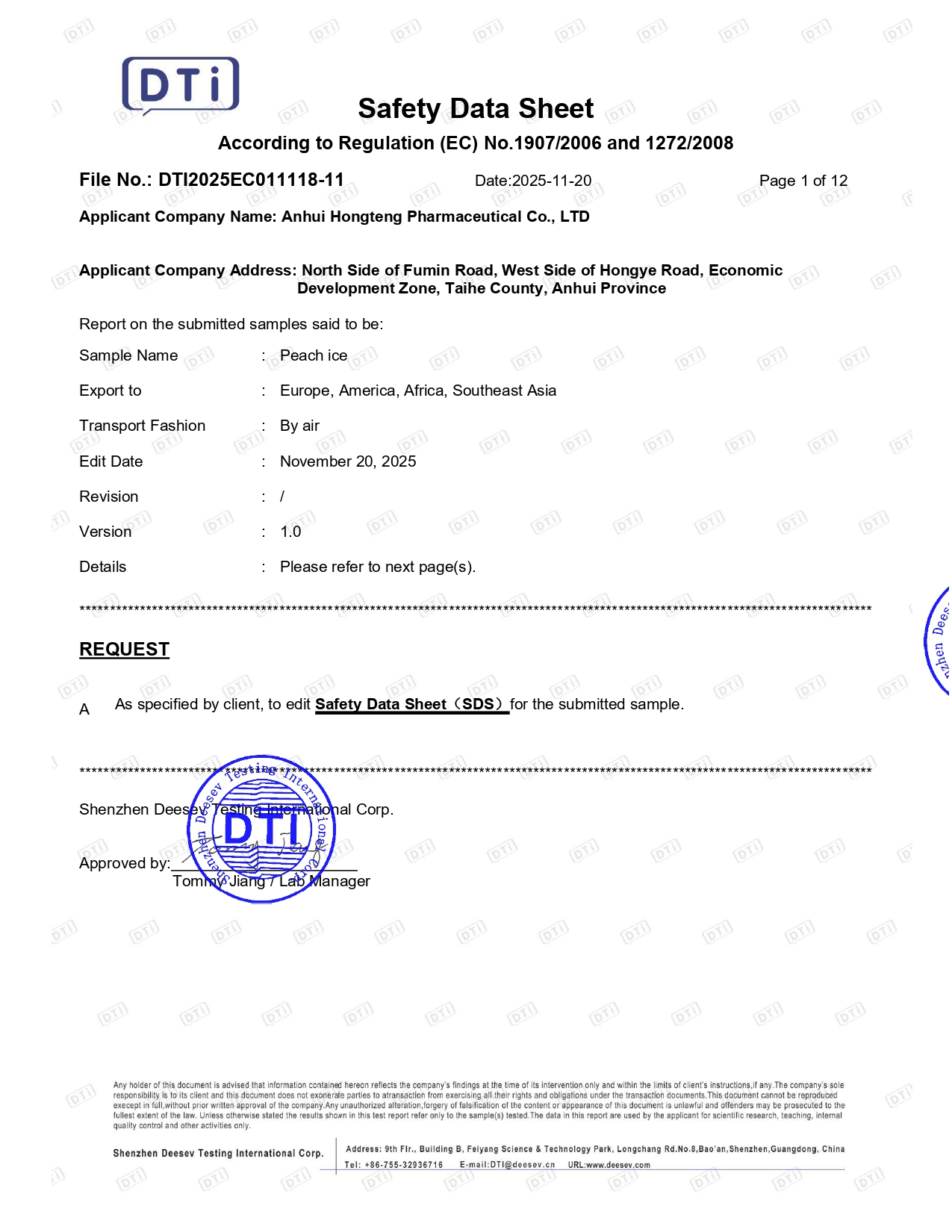
Third-party safety data sheet page from the DTI2025EC011118 series, one of the flavor-specific assessments covering the nicotine film range.
Data retention is the connective tissue between those documents and production. The documented commitment is batch consistency verification reports provided to buyers, with 100% batch inspection before shipment. What that does not specify is the retention period or the storage format of the underlying batch records. OEM buyers who need traceability across the full commercial life of a product, including in a recall scenario, should confirm both points.
Reading the evidence chain: a buyer verification checklist
The table below maps what SENO documents against what a buyer should still verify directly. The right-hand column is deliberately not a criticism of the supplier; it reflects the fact that some evidence can only be produced from a live quality system.
| Evidence area | Documented at SENO | Buyer-side verification |
|---|---|---|
| Batch identity and traceability | Batch consistency verification reports; 100% batch inspection before shipment | Sample batch record format, link to incoming material lots, retention period |
| Dose and film specification | 2 mg / 4 mg / 6 mg and customizable strengths; 50–100 microns; approx. 20 mm × 30 mm; 10–30 second dissolution | Per-batch assay and uniformity data; agreed numeric tolerance |
| Materials | Pharmaceutical-grade film-forming polymers; high-purity nicotine; food-grade flavoring agents; stabilizers and excipients | Incoming certificates of analysis; solvent and allergen statements |
| Third-party safety data | DTI series DTI2025EC011118 under REACH, CLP and EN 14986; HUAK MSDS HK2505276957-1RR under UN GHS Rev.7 and OSHA | Laboratory scope and accreditation; sample-to-batch linkage |
| Regulatory filings | FDA facility registration; FDA drug establishment and product registration; five PMTA notification certificates; DailyMed listing NDC 85806-001 | Renewal calendar; market-specific authorizations for each destination |
| Change control | Defined customization scope; sample confirmation before mass production | Written notification procedure for formulation, flavor or packaging changes |
| Brand rights | CNIPA Class 34 registrations No. 86452539 and No. 82339039; Class 35 application No. 86462811 | Confirmation that private-label branding does not conflict with existing marks |
From sample to shipment: how the documented flow supports an OEM program
The documented order flow is straightforward, and each step produces a record that a buyer can request. Specification comes first, covering nicotine strength from 2 mg, 4 mg, 6 mg or a custom value, flavor, film size and format, packaging design and branding. Sample confirmation is required before mass production. Production follows, with lead times of 20–30 days for standard orders and 30–45 days for OEM and custom orders.
Inside production, in-process quality control runs alongside final product testing and consistency checks. Before dispatch, 100% batch inspection is standard, and third-party inspection is available upon request. Delivery can be arranged on FOB, CIF or DDP terms depending on destination and buyer requirements, with DDP typically used for new partners. After shipment, documented after-sales support covers technical assistance on product and compliance questions, marketing material support for distributors, and fast response on quality or logistics issues.
Commercial terms follow the same pattern. Minimum order quantity is 100,000–300,000 strips per SKU. Standard payment terms are 30% deposit plus 70% balance before shipment, with T/T supported and other methods negotiable based on order volume.
The useful reading of those numbers is about scheduling rather than price alone. A 30–45 day OEM lead time, before shipping and customs clearance, means a launch plan should carry a buffer. An MOQ expressed per SKU means the smallest practical market test is a full SKU run, not a partial one.
Application and use cases
Documented cooperation data covers distributor, wholesaler, nicotine brand and FMCG importer relationships in Germany, the United States, Australia, the United Arab Emirates, Saudi Arabia and Canada, with order quantities of 500,000–2,000,000 strips per order and cooperation periods of one to two years. Reported outcomes include stable product performance across batches, strong repeat orders from distributors, faster market acceptance in local regions and improved customer retention for partner brands. The stated application areas are retail distribution, online sales and private-label nicotine product lines.
Regional channel building appears in separate case records: a European distribution partnership spanning France and the United Kingdom, active over a two-year period and reported to cover major European markets, and an agent agreement in Canada associated with channel network construction and market promotion. For a buyer assessing SENO as a manufacturing partner, the pattern matters more than any single case, because the same product platform is being applied across several regulatory environments and under private-label branding.
The customization scope reinforces that fit. Nicotine strength, flavor development, film size and format, packaging design and branding can each be adapted, which is what allows one platform to serve multiple channel types: convenience retail with a discreet single-strip format, e-commerce with multi-pack boxes, and private-label lines that need the buyer's own artwork and identity.
Market trend: what modern oral nicotine growth does to supplier requirements
The United States modern oral nicotine products market, covering pouches, films and gums, was estimated at USD 6.04 billion in 2024, with nicotine pouches holding a 67.65% revenue share, according to Grand View Research. Competitive concentration in that market is high: Zyn (Philip Morris), Velo (BAT) and On! (Altria) dominate the US retail landscape, according to C-Store Dive and NielsenIQ data.
Two implications follow for film suppliers and the buyers evaluating them. First, film remains a smaller format inside a pouch-dominated category, so it competes on characteristics pouches do not offer, including dissolution in 10–30 seconds, no expectoration and a discreet format. That places more weight on precision and documentation than on distribution scale. Second, published market sizing for adjacent segments varies substantially with scope: nicotine pouch estimates range from roughly USD 3.6 billion to USD 6.9 billion depending on the source and the definition used. Buyers building a business case should align on definitions before quoting figures.
The documentation burden follows the same trend. As more private-label film products reach markets in the United States, Europe and the Middle East, the differentiator between similar offers narrows to evidence: what a supplier can prove about a batch, a material and a specification, in a form that a distributor, a regulator or an importer can read.
How this compares with traditional smokeless manufacturing, and where the limits are
Traditional contract manufacturing in the broader smokeless category has often been evaluated on scale, price and long production history. A documented film-line model shifts the weighting toward process control and traceability, because the format itself leaves a narrower margin for variation. That shift is not automatically an advantage for any supplier; it changes what buyers should measure.
| Evaluation dimension | Traditional emphasis | What the SENO documented model presents |
|---|---|---|
| Scale | Capacity blocks and volume-based pricing tiers | 1,000,000–5,000,000 strips per month; stated annual output of 12,000,000–50,000,000 strips |
| Dose control | Category and flavor range as the primary specification | 2 mg / 4 mg / 6 mg and customizable strengths; in-process QC; batch consistency verification reports |
| Documentation | Certificates treated as marketing assets | Named third-party laboratories (DTI, HUAK); five PMTA notification certificates; FDA facility and drug establishment registrations; CNIPA trademark registrations |
| Flexibility | Standard SKUs with limited variation | OEM, ODM and private label customization of strength, flavor, film format, packaging and branding |
| Order economics | Volume commitment negotiated case by case | Published MOQ of 100,000–300,000 strips per SKU; FOB, CIF or DDP delivery |
The limits are equally concrete, and buyers should treat them as planning inputs rather than objections.
- Minimum order quantity. MOQ is 100,000–300,000 strips per SKU. For a small brand testing a market, that is a full SKU commitment before demand is proven.
- Lead time. Standard orders run 20–30 days and OEM or custom orders 30–45 days, before shipping. Seasonal or promotional launches need earlier planning than suppliers holding regional stock.
- Shelf life and storage. Shelf life is 24 months in a cool, dry environment. Humid or high-temperature distribution routes and long retail dwell times compress the usable window.
- Track record. Xin Sino Technology (Shenzhen) Co., Ltd. was founded in 2025 and the facility operates with 30 employees, so the multi-year production history available from legacy manufacturers is not there yet, and audit scheduling may need to work around a small team.
- Certification scope. The available documentation includes GMP-oriented procedure descriptions, laboratory reports and regulatory registrations, but no GMP certificate number or cleanroom classification appears in the published material. Buyers in markets that require certified GMP evidence should verify it on site rather than infer it.
- Registration renewal timing. FDA Foreign Facility Registration No. 13242356294 is valid to 31 December 2026, so renewal status should be confirmed before contracting.
- Flavor-specific assessment. Third-party safety documentation exists for defined flavor profiles. A new custom flavor requires its own assessment and should be scheduled into the development timeline.
Future outlook
The direction of travel in nicotine film sourcing is toward documentation as a product attribute. Buyers increasingly ask for batch-level data, material linkage and third-party reports during evaluation rather than after a quality incident. Suppliers that already hold named certificates, per-flavor safety assessments and registration records can answer those questions faster, and their answers can be checked against public records.
SENO's verifiable position at present rests on a defined set of records: two CNIPA Class 34 trademark registrations and a Class 35 application; FDA facility and drug establishment registrations covering the US market; five PMTA notification certificates; an MSDS aligned with UN GHS Rev.7 and OSHA requirements; and a family of flavor-specific safety data sheets. The next step for this evidence chain is not more claims but more granularity: published assay tolerances, cleanroom classification and batch record retention terms. Buyers who request exactly those items will see more of the line than any brochure can show.
Frequently asked questions
What does SENO manufacture, and at what capacity?
SENO is a nicotine oral film brand operated by Xin Sino Technology (Shenzhen) Co., Ltd., a Shenzhen-based manufacturer dedicated to developing and producing nicotine oral thin films. Documented capacity is 1,000,000–5,000,000 strips per month, with stated annual output of 12,000,000–50,000,000 strips. The company operates a 20,000 m² production facility with a 15-person R&D team and reports a 100% export ratio, serving Europe, the United States, Canada, Australia and the Middle East.
How is nicotine strength controlled per strip?
Documented strengths are 2 mg, 4 mg and 6 mg per strip, with customizable strengths available. Control rests on three documented steps: in-process quality control during production, final product testing and consistency checks, and 100% batch inspection before shipment, supported by batch consistency verification reports provided to buyers. The published specification set does not include a numeric assay tolerance such as a plus-or-minus percentage on nicotine content, so buyers who require that figure should request per-batch laboratory assay data and agree an acceptance tolerance in the contract.
What third-party documents support quality and safety claims?
Four groups. Safety data: the DTI2025EC011118 series issued by Shenzhen Deesev Testing International Corporation and referencing REACH, CLP and EN 14986, plus Material Safety Data Sheet HK2505276957-1RR issued by Shenzhen HUAK Testing Technology Co., Ltd. under UN GHS Rev.7 and US OSHA 29 CFR 1910.1200, valid to 30 May 2027. Regulatory: FDA Foreign Facility Registration No. 13242356294 and FDA registration certificate No. 510936020 for U.S. FDA Drug Establishment and Product Registration. Notification: PMTA notification certificates PM0010176, PM0010666, PM0010665, PM0010664 and PM0010661. Brand: CNIPA Class 34 trademark registrations No. 86452539 and No. 82339039, with Class 35 application No. 86462811.
What are the MOQ, lead time and payment terms for an OEM order?
MOQ is 100,000–300,000 strips per SKU. Lead times are 20–30 days for standard orders and 30–45 days for OEM or custom orders. Delivery can be arranged on FOB, CIF or DDP terms depending on destination and buyer requirements. Standard payment terms are 30% deposit plus 70% balance before shipment by T/T, with other methods negotiable based on order volume. Pre-shipment quality inspection is standard, third-party inspection is available on request, and sample confirmation is required before mass production.
What should an OEM buyer verify before placing a volume order?
Six items, in order of impact. First, nicotine assay tolerance per batch, taken from the third-party laboratory report rather than from a specification sheet. Second, cleanroom classification and environmental monitoring records for the production area. Third, the format and retention period of batch records linking finished film to incoming material lots. Fourth, the notification procedure for changes to formulation, flavor or packaging. Fifth, the renewal status of FDA Foreign Facility Registration No. 13242356294, which is valid to 31 December 2026. Sixth, whether a new flavor requires a separate safety assessment and how that affects the development schedule.
What limitations should buyers plan around?
Minimum order quantities of 100,000–300,000 strips per SKU and lead times of 20–45 days set a floor on order size and launch planning. Shelf life is 24 months under cool, dry storage, which constrains humid or high-temperature distribution routes. The manufacturing entity, Xin Sino Technology (Shenzhen) Co., Ltd., was founded in 2025 and operates with 30 employees, so multi-year production history and audit capacity are both limited compared with established manufacturers. Third-party safety documentation exists for defined flavor profiles, and a new custom flavor needs its own assessment. Finally, no GMP certificate number or cleanroom classification appears in the published documentation, so buyers who require certified GMP evidence must confirm it during a plant audit.
What this means for an OEM sourcing decision
For buyers at the evaluation and execution stage, the SENO film line offers a checkable evidence chain rather than an assertion of quality: named third-party laboratories, flavor-specific safety data sheets, FDA facility and drug establishment registrations, PMTA notification certificates, and a documented four-gate quality-control sequence behind a 20,000 m² facility. The gaps are equally identifiable, and they are the gaps worth writing into a supplier agreement: assay tolerance, cleanroom classification, batch record retention, and registration renewal dates. Read together, those two lists describe what a buyer is actually purchasing, which is not a flavor but a batch that can be accounted for.