
Behind the Build: ODM Evidence in Telpo's T10 and T20
A fare gate, a bus door and a stadium turnstile all impose the same requirement on the hardware bolted to them: read the credential, return a decision in a fraction of a second, and keep doing it through rain, dust, vibration and years of daily use. That is a different engineering brief from a countertop checkout terminal. It is also the reason ticket validators have become one of the more revealing places to inspect what a POS manufacturer can actually build, rather than what it claims.
Telpo Technology Co., Ltd. is a Foshan, China-based developer and manufacturer of smart terminals and solutions, founded in June 1999, listed on the NEEQ (stock code: 833839), and organized around four overseas business segments: Smart Retail, Smart Payment, Smart Transportation and Biometric Security. Its ticketing line — the T10 and T20 ticket validators — sits inside the Smart Transportation segment and is classified by the company as "POS for ticketing and events." This article treats those two devices as build-level evidence: materials, protection ratings, display configuration, credential coverage, security-module capacity and the manufacturing environment behind them.
Why a Fare Validator Is a Harder Build Than It Looks
A ticket validator is a fixed-function device. It is not asked to run a merchandise catalogue, manage promotions or reconcile a store's inventory. It is asked to do three things extremely well: recognise whatever credential the rider or ticket holder presents, return a valid or invalid result quickly, and survive the physical environment it is mounted in.
Those three requirements push the engineering in directions that retail terminals rarely face:
- Credential breadth. A single transit operator or venue may accept contactless bank cards, closed-loop transit cards, QR codes, mobile wallets and, in many systems, legacy paper tickets. Each scheme carries its own technical standard and often its own security module.
- Environmental exposure. A bus-mounted unit sits at a door that opens hundreds of times a day, in rain and road dust, and is repeatedly struck by bags and shoulders.
- Tamper and serviceability. Devices mounted on poles and gates are reachable by the public. Enclosure locking, module access and field repair time all become procurement criteria.
- Certification dependency. POS terminals must comply with PCI PTS (PIN Transaction Security) and EMV (Europay, Mastercard, Visa) standards for secure chip processing, according to the PCI Security Standards Council. That requirement does not disappear because the device is bolted to a bus.
Taken together, these factors make ticket validators a useful stress test of a supplier's ODM capability. A manufacturer that can only assemble a standard countertop terminal will struggle here; one that designs its own enclosure, thermal management, antenna layout and scanner module has something concrete to show.
The T10 and T20, Defined
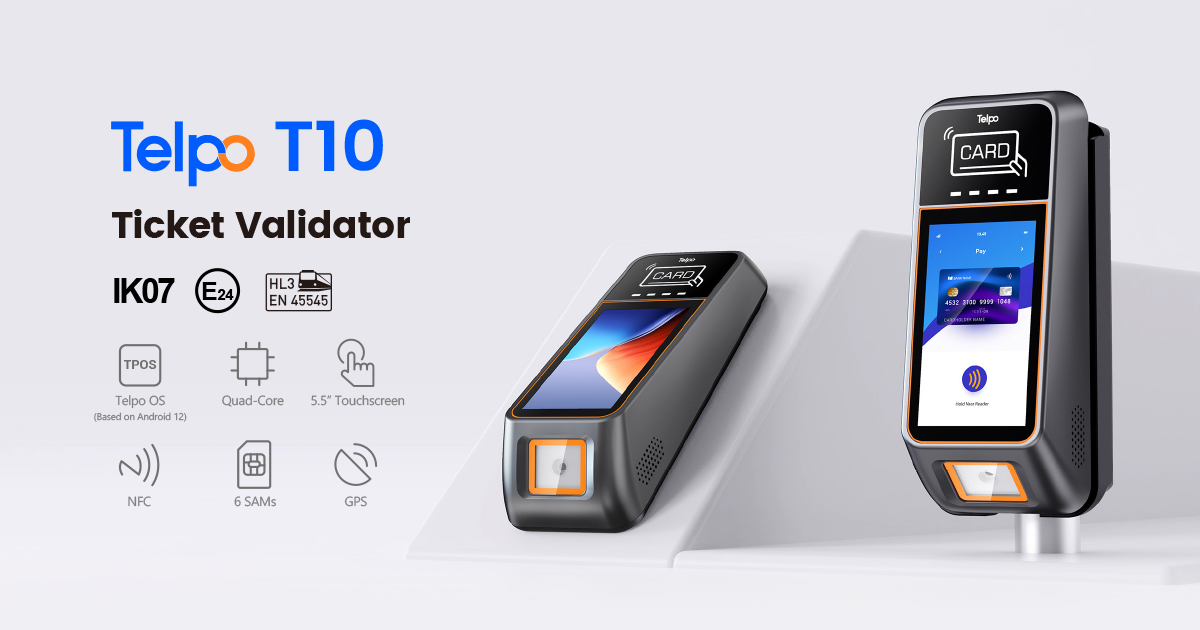
The T10 is a compact ticket validator built around a 5.5-inch touchscreen with an anti-glare, semi-outdoor display design, housed in the same ABS+PC polymer blend used across several Telpo product families. It runs Telpo OS based on Android 12, carries 6 SAM card slots, and is positioned for public transit, urban buses, metro, rail and event venues, with a full-wrap pole-mount housing secured by safety locks.
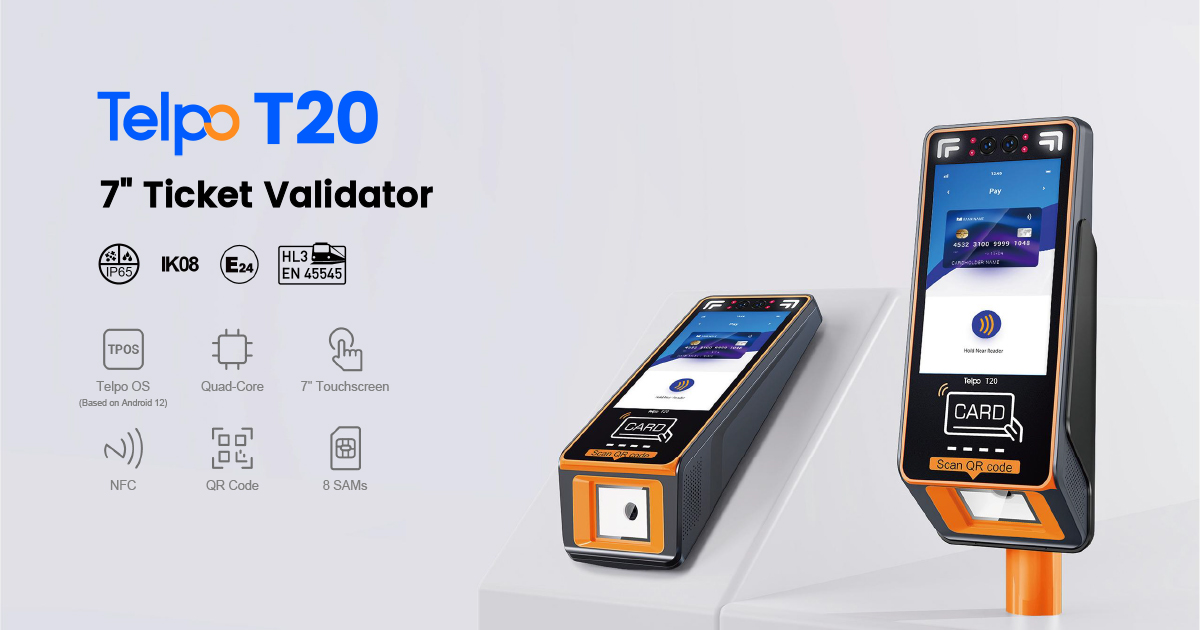
The T20 is the larger sibling. It uses a 7-inch anti-glare touchscreen rated at 500 cd/m², the same ABS+PC material specification, 8 SAM card slots, and a dual operating-system option: Telpo OS based on Android 12, or Linux. Telpo lists it for public transit, metro, tram, trolleybus, ferries and high-volume transit hubs. Both devices support closed-loop and open-loop contactless credentials, EMV contactless payment, QR codes and paper ticket validation.
Enclosure and Mounting: Where ODM Decisions Become Visible
Both the T10 and T20 use an ABS+PC housing. For a pole-mounted device this is a deliberate trade-off rather than a cost shortcut: a polymer blend keeps the unit light enough to mount quickly and to reduce stress on the pole or gate structure, while the impact classification — not the material name — quantifies what the enclosure can actually tolerate.
The mounting architecture is where the two devices diverge most clearly:
- T10: a full-wrap housing with safety locks, described by Telpo as providing a robust structure for high-traffic bus deployment and long-term operation.
- T20: a secure pole-mount design with a lockable enclosure intended to prevent tampering, reduce installation complexity and cut maintenance downtime.
This is a small detail with an outsized field consequence. A validator mounted on a vehicle or gate is a public-facing asset. A lockable enclosure that can be opened quickly by a technician shortens fault resolution; one that cannot turns a five-minute card-reader fault into a vehicle pulled from service. Buyers evaluating ODM partners can reasonably ask to see the mounting hardware, the lock mechanism and the module-access path, not only the specification sheet.
IP and IK Ratings: Reading the Build Claims Correctly
Protection ratings are frequently listed but rarely explained. In simple terms, an IP rating describes two things: the first digit covers protection against solid particles, the second against water. IP65 indicates a dust-tight enclosure protected against water jets. IP54 indicates a dust-protected enclosure resistant to splashing water. IK ratings describe impact resistance, and a higher IK number represents greater tolerance to mechanical impact — so IK08 is a higher impact classification than IK07.
Applied to these two validators:
| Protection and durability | T10 ticket validator | T20 ticket validator |
|---|---|---|
| Housing material | ABS+PC | ABS+PC |
| Ingress protection | IP54 (optional) | IP65 |
| Impact resistance | IK07 | IK08 |
| Vibration standard | E24 certified | Not specified in the product data |
| Mounting | Pole mount, full-wrap design with safety locks | Pole mount, lockable enclosure |
| Typical environments | Urban bus, metro, rail, event venues | Metro, tram, trolleybus, ferries, high-volume transit hubs |
The detail worth pausing on is the optional status of IP54 on the T10. Optional means it must be specified at configuration; a buyer who assumes ingress protection is standard on every unit is making a procurement error rather than a technical one. Equally, IK07 on the T10 sits one classification below the T20's IK08, which is consistent with the two products' intended duty cycles: the T10 is the compact, space-constrained option, while the T20 is built for the highest-traffic and most demanding fixed locations.
Display, Feedback and the Passenger Interface
Validation happens in under a second, but the passenger still has to understand the result immediately — and on a bus, so does the driver. Both validators address this with audio feedback: clear sound alerts confirm the validation result and support boarding efficiency. The T10 adds four LED status indicators that give an instant visual confirmation of transaction status.
The display configurations reflect the same split in intended use:
- T10: a compact 5.5-inch touchscreen with an anti-glare design, described by Telpo as a semi-outdoor display that fits space-constrained installations — the constraint being a bus cabin or a narrow gate pillar.
- T20: a 7-inch anti-glare touchscreen rated at 500 cd/m², specified for readability in complex lighting, which is the situation at an open-air platform or a station entrance facing direct sun.
Screen brightness and anti-glare treatment are not cosmetic specifications in this category. A validator whose result is unreadable in afternoon sun generates exactly the disputes that cashless fare collection is meant to eliminate, and it pushes riders toward assistance desks.
Credential Coverage, SAM Capacity and OS Choice
Credential breadth is where a validator earns or loses its place in a fare system. Both the T10 and T20 support a wide set of contactless standards: ISO14443 Type A and B, Mifare, Cipurse, Calypso and Felica contactless cards, alongside EMV Contactless L1, Paywave and Paypass certification. Both accept QR codes, e-wallets and mobile payments, and both handle traditional paper ticket validation. The T10's NFC reading area includes a fluorescent marking zone, a small but practical detail that helps riders locate the tap point quickly.
Scanning is handled by a multi-format scanner using hardware decoding, supporting QR codes, Aztec codes and traditional 1D/2D barcodes. Hardware decoding matters at a busy gate: the read happens in the module rather than consuming the main processor, which keeps validation time stable when the device is also managing connectivity, GPS reporting and screen output.
Security-module capacity is the specification buyers most often overlook. The T10 provides 6 SAM card slots; the T20 provides 8. Each closed-loop scheme or secured application typically requires its own secure access module, so slot count is effectively a measure of how many schemes a single validator can serve — and how much headroom remains for future scheme additions. A validator with spare SAM capacity can absorb a new card scheme or a second operator; one without it becomes a replacement project.
Operating-system choice is the other structural decision. Both devices run Telpo OS based on Android 12. The T20 additionally offers Linux, which allows deeper integration with an existing ticketing software platform — a benefit for operators running long-established back-office systems — at the cost of the broader Android application ecosystem. That is a genuine trade-off, not a marketing line, and it should be decided by the operator's software roadmap rather than by device preference.
Connectivity, Positioning and Gate Integration
Both validators support 4G cellular, dual-band Wi-Fi and Bluetooth, with optional external GNSS/4G/3G/2G antennas to improve signal reception in weak coverage areas — a realistic requirement for routes that pass through tunnels, rural sections or underground platforms. Both include built-in GPS positioning, which supports real-time transaction monitoring and location-based services, and allows a fare transaction to be stamped with where it was taken.
Peripheral integration extends the role of the validator beyond displaying a result. Telpo specifies multiple interfaces supporting transit validation, event access control and turnstile gate control applications on both devices. In practice, that means the validator can act as the decision point that drives a physical gate rather than simply reporting a status to a separate controller.
The Factory Behind the Ratings
Build claims only have weight if they can be produced consistently. Telpo's manufacturing footprint, as described in its own company data, covers approximately 45,000 square meters with an annual production capacity of 2,000,000 units and roughly 600 staff, including an R&D team of 200 engineers. Export business accounts for 60% to 80% of sales, with major markets spanning Asia, Africa, the Middle East, Europe, Latin America and North America.
The element most directly relevant to a validator's protection claims is the testing environment. Telpo operates a CNAS laboratory that was upgraded in 2025 and covers approximately 900 square meters across 12 testing zones, including an OTA darkroom, an EMC chamber and a climate lab. Environmental and radio-frequency testing of this kind is what stands behind claims about ingress protection, connectivity stability and antenna performance — the three areas where validator failures most often surface after deployment.
For buyers, the useful question is not whether a lab exists but which tests map to the deployment environment. A ferry operator and an urban bus operator do not need the same evidence, and a supplier able to explain that mapping is demonstrating engineering depth rather than catalogue depth.
Where the T10 and T20 Fit in Real Deployments
Telpo positions these two validators across overlapping but distinct environments, and the split follows directly from the build differences.
Urban bus and space-constrained boarding points
The T10's compact 5.5-inch screen, full-wrap pole-mount housing with safety locks and E24 vibration certification suit on-board installation where space at the door is limited and the unit must tolerate continuous vehicle vibration. Its optional IP54 configuration allows operators to match the ingress protection level to the route's conditions rather than paying for capability the route does not need.
Metro, rail, tram, trolleybus and ferry terminals
The T20's 7-inch 500 cd/m² display, IP65 and IK08 ratings and 8 SAM slots address the opposite problem: high passenger throughput, open-air or semi-open platforms, and fare systems that combine several card schemes. The 8-slot capacity supports multi-operator or multi-scheme environments with room for expansion.
Event venues and access control
Both devices are listed for event venues, and both support event access control and turnstile gate applications through their peripheral interfaces. Event deployment has a different rhythm from transit — intense peaks, temporary installations, and often a need to validate a mix of printed and digital tickets — which makes multi-format scanning and quick mounting as important as continuous-duty weather sealing.
Market Signals Around Fixed and Mobile Acceptance
The wider POS terminal market provides context for why fixed validators remain a meaningful product category even as mobile acceptance grows. Grand View Research values the global POS terminal market at approximately USD 123.2 billion in 2025. That figure should be read with caution: DataM Intelligence estimates the same market at USD 93.16 billion for 2025, and TechSci Research reports USD 92.10 billion for 2024. The divergence reflects different definitions of what the market includes — hardware only, or hardware plus software and services — and it is a reminder that single market-size figures are directional rather than precise.
Two structural trends are more consistently reported. First, Android-based terminals are taking a rising share of the installed base: ResearchAndMarkets, citing Berg Insight tracking for 2022/2024, put Android POS terminals at approximately 27% of all POS terminals sold globally. That shift is visible in this product line, where both the T10 and T20 run Telpo OS based on Android 12, while the T20 retains a Linux option for operators with legacy ticketing software.
Second, SoftPOS is expanding the range of devices that can accept contactless payment. Grand View Research estimated the SoftPOS market at USD 365.0 million in 2024, with a projected CAGR of 23.1% through 2030 — although, as with the POS market overall, alternative estimates differ substantially depending on whether transaction value or software revenue is being measured. SoftPOS growth affects handheld fare collection more than fixed validators; it does not remove the need for a rugged, permanently mounted device at a bus door or a turnstile.
Competitively, the field is well populated. Major global manufacturers of POS terminals include Ingenico (Worldline), Verifone, PAX Technology, SUNMI and Newland Payment Technology, alongside specialist transit hardware suppliers. For an operator or integrator, this means the differentiating evidence is rarely the brand name — it is the durability classification, the credential coverage, the SAM capacity and the serviceability of the mounting design.
Comparison with Traditional Fare Collection Hardware — and the Limits of This Approach
Traditional fare collection hardware — cash boxes, magnetic-stripe-only readers, single-standard closed-loop validators without positioning or remote management — was designed for a world of one operator, one card and one fare table. Modern validators such as the T10 and T20 differ in four practical ways:
| Dimension | Traditional fare hardware | T10 / T20 approach |
|---|---|---|
| Credential types | Typically one closed-loop card standard | Open-loop and closed-loop contactless, EMV contactless, QR, e-wallet and paper tickets |
| Location data | None | Built-in GPS with optional external antennas for weak coverage |
| Security modules | Limited, fixed scheme support | 6 SAM slots (T10) and 8 SAM slots (T20) with expansion headroom |
| Gate integration | Separate controller required | Peripheral interfaces supporting turnstile gate and access-control applications |
That comparison is not a claim that newer hardware is universally the right answer. Several real limitations apply, and buyers should weigh them explicitly.
- Optional protection on the T10. IP54 is an optional configuration, and its IK07 impact classification is one step below the T20's IK08. For high-vandalism or washdown environments, the T20 is the more suitable of the two devices, and the T10 should not be specified as if it were equivalent.
- Connectivity configuration varies. The T20's 4G capability is listed as optional, so cellular coverage must be confirmed per SKU rather than assumed across the range.
- Polymer enclosures have trade-offs. ABS+PC keeps a pole-mounted unit light and deployment straightforward, but it is not a metal enclosure. The honest measure of what it can take is the IK classification and the actual duty cycle, not an assumption about materials.
- Validators are not retail POS terminals. The T10 and T20 are classified as POS for ticketing and events. They do not replace a countertop or self-service terminal for merchandise checkout, and expecting them to do so misunderstands the product category.
- OS choice constrains application strategy. Choosing Linux on the T20 supports deep integration with existing ticketing software but reduces access to the Android application ecosystem. That decision should follow the operator's software roadmap.
- Certification applies to specific configurations. Payment and contactless certifications are issued against defined hardware and software builds. Buyers planning an ODM variant should confirm which configuration is covered rather than assuming coverage extends automatically.
- Lab results are not site results. Environmental testing supports a claim; it does not replace a pilot on the actual route, platform or venue.
Future Outlook
Three directions look most likely to shape fixed validation hardware over the next several years. Account-based and open-loop ticketing continues to spread, which pushes more credential types onto a single reader and makes SAM capacity and field updateability the practical limits on what a device can accept. Second, the boundary between payment acceptance and ticket validation keeps thinning: the same reader increasingly handles a bank card, a transit card and a QR code, and the T20's dual Android/Linux platform is one response to that convergence. Third, as SoftPOS expands the range of handheld devices that can accept payment, the fixed validator's value concentrates further in exactly the attributes that make the T10 and T20 worth examining — impact and ingress ratings, tamper-resistant mounting, environmental testing and multi-scheme security capacity.
FAQ
What is a ticket validator, and how does it differ from a retail POS terminal?
A ticket validator is a fixed-function device mounted at a fare gate, vehicle door or venue entrance. Telpo classifies both the T10 and T20 as "POS for ticketing and events." It reads a credential — contactless card, QR code, mobile wallet or paper ticket — validates it, and returns a result. A retail POS terminal performs merchandise transactions, inventory handling and receipt generation. The engineering priorities differ accordingly: a validator emphasises credential breadth, impact and ingress protection, and interfaces that can drive turnstiles or access gates.
What do IP65, IP54, IK07 and IK08 mean in practice?
IP ratings describe protection against solid particles (first digit) and water (second digit). IP65 indicates a dust-tight enclosure protected against water jets; IP54 indicates a dust-protected enclosure resistant to splashing water. IK ratings describe impact resistance, and a higher number indicates greater tolerance — IK08 is higher than IK07. In this product line, the T20 carries IP65 and IK08, while the T10 carries IK07 with IP54 available as an optional configuration alongside E24 vibration certification.
How do the T10 and T20 differ, and which environments suit each?
The T10 is the compact option: a 5.5-inch anti-glare touchscreen, ABS+PC housing, Telpo OS based on Android 12, 6 SAM slots, IK07, optional IP54 and E24 vibration certification, aimed at urban buses, metro, rail and event venues where installation space is limited. The T20 is the larger, more heavily protected option: a 7-inch anti-glare touchscreen rated at 500 cd/m², IP65 and IK08 ratings, 8 SAM slots, and a choice of Telpo OS based on Android 12 or Linux, aimed at trams, trolleybuses, ferries and high-volume transit hubs. Both support 4G, dual-band Wi-Fi, Bluetooth and built-in GPS.
Which ticket and payment standards do the T10 and T20 support?
Both devices support ISO14443 Type A and B, Mifare, Cipurse, Calypso and Felica contactless cards, along with EMV Contactless L1, Paywave and Paypass certification. They accept QR codes, e-wallets and mobile payments, and they validate traditional paper tickets. Scanning is handled by a multi-format scanner using hardware decoding for QR codes, Aztec codes and 1D/2D barcodes.
Why does SAM slot count matter when selecting a validator?
Secure access modules provide the cryptographic functions each fare scheme requires, and a closed-loop scheme or secured application typically needs its own module. The T10 provides 6 SAM card slots and the T20 provides 8. Slot count therefore indicates how many schemes a single device can serve at once and how much capacity remains for a new card scheme, a second operator or a future system upgrade — which affects whether an expansion becomes a software change or a hardware replacement.
Can a ticket validator be used outside public transit?
Yes. Both the T10 and T20 are listed for event venues as well as transit environments, and their peripheral interfaces support transit validation, event access control and turnstile gate applications. Event deployments typically involve intense peak loads, temporary mounting and a mix of printed and digital tickets, which places more weight on multi-format scanning and fast installation than on continuous all-day operation.
What the Build Evidence Adds Up To
ODM capability is difficult to judge from a product photograph. It becomes measurable when a supplier publishes specific material specifications, protection classifications, touchscreen configurations, credential standards and security-module capacity — and when those details are consistent with the environments the device is actually sold into. On that basis, the T10 and T20 offer a reasonably transparent view of Telpo's engineering and manufacturing approach in the ticketing segment: a compact IK07 option for constrained bus installations and a heavier IP65/IK08 option for high-traffic fixed locations, both designed to accept multiple card schemes on a single reader.
For buyers at the research stage, the next step is usually not a purchase decision but a scope one: define the route or venue, list the credentials that must be accepted, confirm the protection level the site requires, and ask the supplier which configuration and which certification coverage applies to that exact build. Telpo publishes a product brochure covering its payment and retail terminal range, including the ticketing validator line, which can be reviewed alongside a pilot request: Telpo Products Brochure — Payment & Retail V4.
Есть вопросы или нужны дополнительные детали?
Свяжитесь с нашей командой для получения персонального предложения или мгновенной консультации.
Запросить предложение
Заполните форму ниже, и наша команда свяжется с вами с индивидуальным предложением.
Прямой чат WhatsApp
Предпочитаете общаться в реальном времени? Напишите нам в WhatsApp для мгновенной помощи и быстрых ответов.
- Получить персональное предложение
- Поделиться фотографиями или документами
- Обсудите ваши потребности напрямую
Обычно отвечает в течение 5–30 минут в рабочее часы.