
Bench Grinder Decision Framework: Size, Speed, and Model Fit
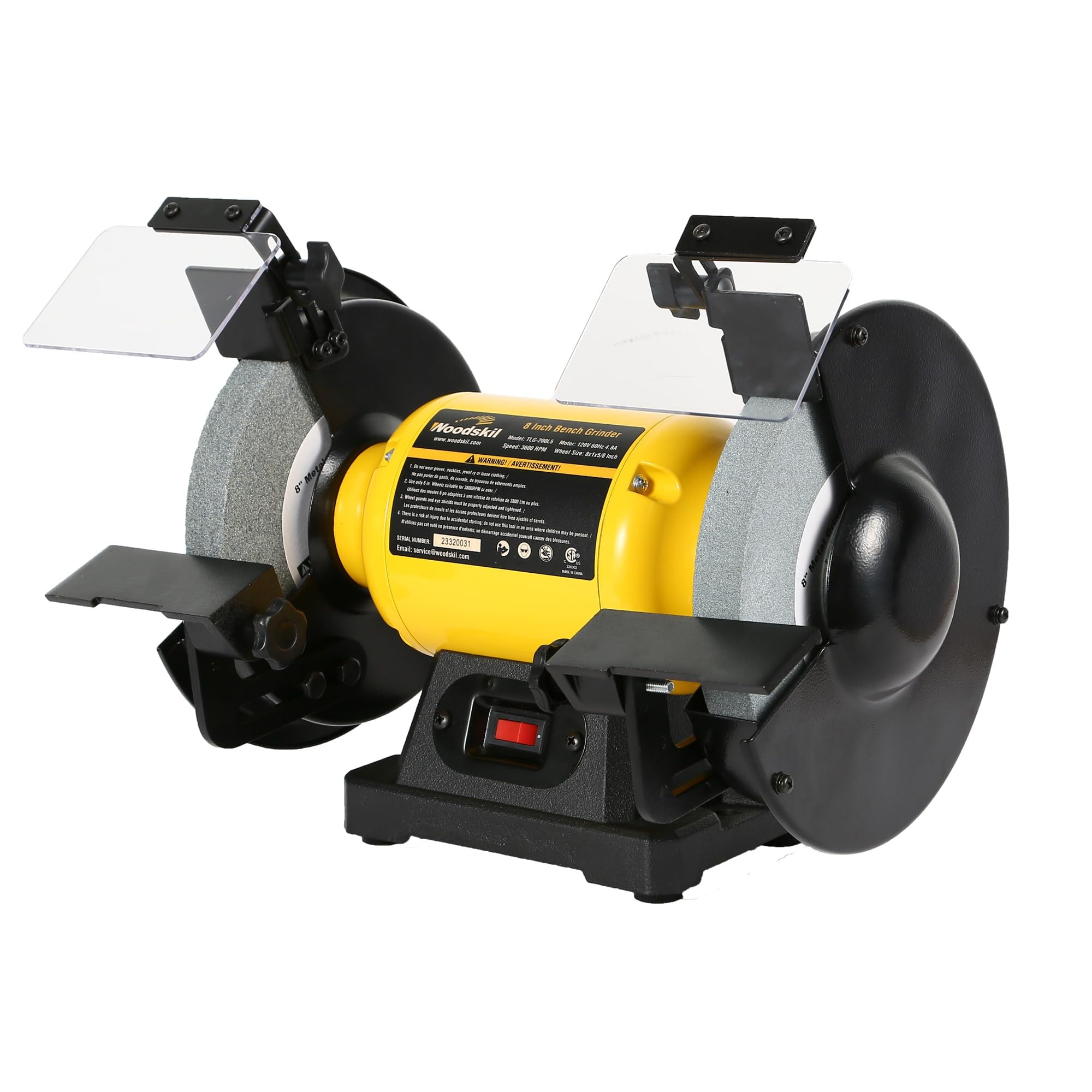
The correct order for choosing a bench grinder is: define the task, then the wheel diameter, then the speed class, and only then the model. Task determines whether heat control or material removal matters more; wheel diameter determines clearance, wheel life and machine weight; speed class determines how much heat reaches the cutting edge. The model is the last decision, because it is the only one that follows from the first three.
Most buying mistakes happen when that order is reversed. A buyer compares amperage, RPM and price first, then discovers after delivery that the wheel is too fast for a chisel edge, too small for the shop's deburring work, or too light for the vibration the job creates. The framework below is written for buyers in the research and evaluation stage: home-workshop owners, small metal and woodworking shops, and maintenance buyers who need a grinder matched to a defined job rather than to a specification sheet.
BUCKTOOL (bucktool.com) is a power-tool brand established in 1955 and headquartered in China, whose main product category is the bench grinder, aimed primarily at the US market with factory-direct supply, a stated 2-year warranty and 30-day return policy. Its lineup appears below as a worked example of the framework, not as the starting point of it.
The four-step framework at a glance
- Define the task. Sharpening and edge maintenance are heat-sensitive jobs; deburring and light stock removal are heat-tolerant jobs. The two pull the specification in opposite directions.
- Choose the wheel diameter. 6-inch, 8-inch or 10-inch changes clearance, abrasive surface speed at a given RPM, wheel replacement cost and machine weight.
- Choose the speed class. Low speed, high speed, dual speed, variable speed, or a water-cooled wet stone system.
- Match the model. Only at this point do motor rating, base material, wheel composition, lighting and documentation decide between shortlisted machines.
Why the decision order matters more than the specification sheet
Bench grinders are a mature, high-volume category. Grinding machinery was valued at USD 6.2 billion globally in 2025, with bench grinders counted as a key non-precision segment, according to Grand View Research. Within that, 6-inch machines are the dominant consumer segment, and commercial research on the category places typical 6-inch prices between USD 50 and USD 200. A price band that wide within one wheel size is a signal: buyers are paying for different speed classes, wheel quality, base construction and documentation, not for the diameter itself.
The practical problem is that specification sheets list what is easy to measure — amps, horsepower, nominal RPM — and omit what decides the purchase: whether the machine holds a stable angle, whether the wheels run without wobble, and whether the speed suits the material being touched. A framework forces those questions to the front.
Step 1 — Define the task: sharpening, grinding, or both
Two questions settle the task definition. First, is the machine mainly restoring an edge or removing material? Second, how much heat can the workpiece tolerate before its hardness or temper changes? A chisel, plane blade or knife blade is heat-sensitive; a bracket, weld bead or rusted fastener is not.
| Primary job | Heat sensitivity | Speed class that fits | Wheel size tendency | What to verify first |
|---|---|---|---|---|
| Sharpening chisels, plane blades, turning tools | High | Low speed or variable speed; wet stone for final edge | 6–8 inch | Wheel balance, low vibration, stable tool rest |
| Knife making and blade geometry work | Very high | Variable speed | 8 inch, plus wet stone | Wobble-free wheel, controllable RPM, coolant option |
| Deburring and finishing small metal parts | Low | High speed or dual speed | 6–8 inch | Motor amperage, wheel access, base weight |
| Tool refurbishment, rust and edge restoration | Low to moderate | High speed or dual speed | 8 inch | Horsepower, table rigidity, clearance |
| Wide-edge precision sharpening | Very high | Water-cooled wet stone | 10 inch | Water cooling, slow RPM, two-direction rotation |
A shop that does both — sharpening on some days and deburring on others — should not compromise on a single fixed high speed. Dual-speed and variable-speed machines exist precisely for that overlap, and the choice between them is the subject of Step 3.
Step 2 — Choose the wheel diameter: 6, 8 or 10 inches
Wheel diameter changes four things at once. It changes clearance between the wheel and the housing, which governs how bulky a workpiece can be. It changes abrasive surface speed at a given RPM, because surface speed is a function of diameter and rotational speed. It changes usable wheel life, since a larger wheel has more abrasive material to consume before replacement. And it changes machine mass, which affects vibration and how firmly the grinder sits under load.
As a rule of thumb, at identical RPM an 8-inch wheel presents roughly one-third more abrasive surface per revolution than a 6-inch wheel — which is why the same nominal speed feels more aggressive on the larger machine. This is simple geometry, not a performance claim, but it explains why a high-speed 8-inch grinder and a high-speed 6-inch grinder are not interchangeable for heat-sensitive work.
| Diameter | What changes in practice | Typical fit | BUCKTOOL model examples (published specifications) |
|---|---|---|---|
| 6 inch | Compact footprint, lower machine weight, less clearance, lower wheel replacement cost | Home workshops, small benches, light sharpening and touch-up work | bucktool 6-inch Small Bench Grinder (TDS-150CLA): 2.8 A, 1/2 HP, high speed, CSA listed. Bucktool 6-inch Low Speed Bench Grinder (TLG-150S): white aluminum oxide left wheel, brown aluminum oxide right wheel, cast iron base |
| 8 inch | Wider clearance, longer wheel life, more mass for stability, wider accessory range | Mixed shops, tool maintenance, light metalworking, knife work with speed control | bucktool 8 Inch Bench Grinder (TLG-200L5A): 4.8 A, 3/4 HP, 3,600 RPM. bucktool 8-inch High Speed Bench Grinder (TDS-200HD): 1.0 HP, 3,590 RPM, 4.8 A. bucktool 8-inch Dual Speed Bench Grinder (TDS-200DS). bucktool 8-inch Variable Speed Bench Grinder with Digital Display (TDS-G200VLGA): 3/4 HP, 5.0 A |
| 10 inch | Largest clearance and wheel mass, heaviest machine, lowest speed classes | Dedicated sharpening stations, wide-edge work, low-speed grinding | bucktool 10-inch Bench Grinder (TDS-250): low speed. bucktool 10-inch Wet Stone Sharpener (SCM8103): 1/2 A, two-direction water-cooled, 90–160 RPM |
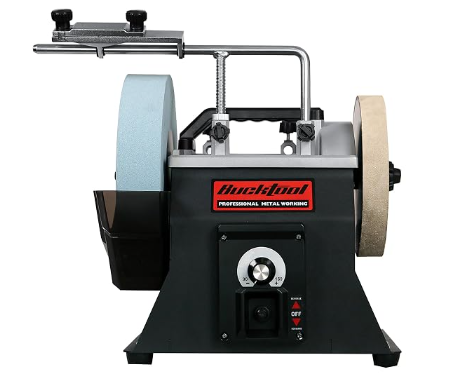
One boundary is worth stating early: a 10-inch wet stone sharpener is not a bigger bench grinder. The SCM8103 is specified as a two-direction water-cooled system running 90–160 RPM with a leather stropping wheel, which makes it a sharpening station rather than a deburring machine. Buyers who need both functions generally end up with two machines, or with an 8-inch dry grinder plus a separate honing method.
Step 3 — Choose the speed class: low, high, dual or variable
Speed class is where most of the heat risk is decided. Published specifications in the BUCKTOOL lineup illustrate the spread: the 8-inch Bench Grinder with LED Light (TDS-200C4HL) is a 3/4 HP low-speed machine rated at 1,750 RPM in Benchmark Abrasives' 2026 buyer's guide, where it is described as a leading slow-speed grinder for professional sharpening; the 8-inch High Speed Bench Grinder (TDS-200HD) runs at 3,590 RPM and the 8-inch Bench Grinder (TLG-200L5A) at 3,600 RPM.
| Speed class | Behavior | Best fit | Trade-off | BUCKTOOL example |
|---|---|---|---|---|
| Low speed | Slower abrasive pass, less heat per contact, easier edge control | Chisels, plane blades, turning tools, temper-sensitive steels | Slower material removal; not intended for heavy deburring | TDS-200C4HL (8 inch, 3/4 HP, 1,750 RPM); TLG-150S (6 inch) |
| High speed | Fast stock removal, more heat at the contact point | Deburring, rust and edge restoration, general metalwork | Requires light passes on hardened or thin stock | TDS-200HD (8 inch, 1.0 HP, 3,590 RPM); TLG-200L5A (8 inch, 3,600 RPM); TDS-150CLA (6 inch, 1/2 HP) |
| Dual speed | Two fixed speed settings on one machine | Shops that alternate between sharpening and deburring | Only two discrete settings; no fine adjustment between them | TDS-200DS (8 inch, cast iron base) |
| Variable speed | Adjustable RPM with feedback or control electronics | Knife work, mixed materials, buyers who want one machine to cover several tasks | Higher cost and more electronics to understand and maintain | TDS-G200VLGA (8 inch, 3/4 HP, 5.0 A, digital display); TDS-I200VL (8 inch VFD, 1 HP) |
| Water-cooled wet stone | Very low RPM with water cooling and rotation direction control | Final edge geometry, wide blades, burr-free finishes | Slow; not a deburring or stock-removal tool | SCM8103 (10 inch, 90–160 RPM) |
Step 4 — Match the model, not the marketing
With task, diameter and speed class fixed, the shortlist usually collapses to two or three machines. At that point the deciding variables are wheel composition, wheel balance, base construction, table and tool-rest rigidity, lighting, and the documentation that comes with the unit.
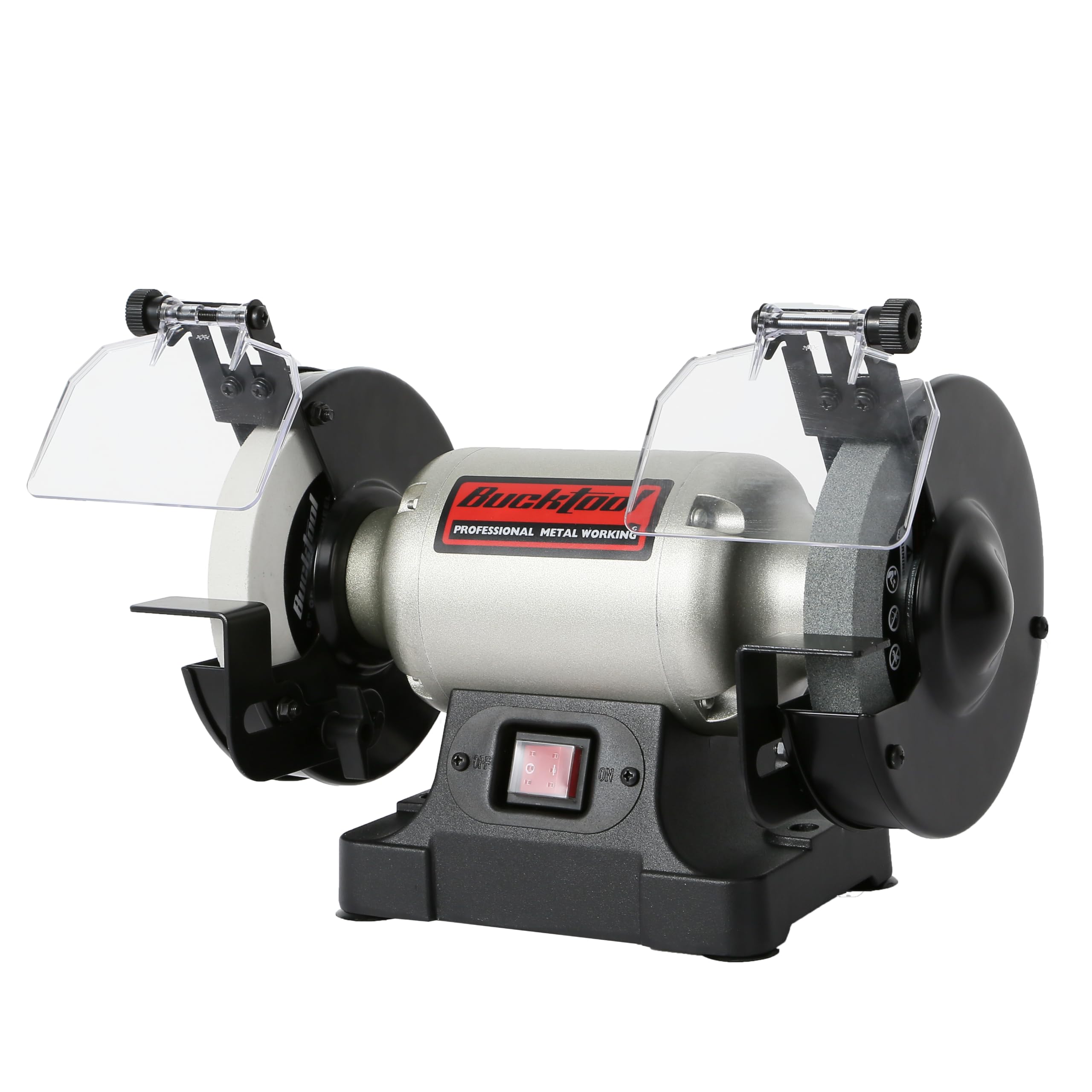
Within the BUCKTOOL range, the framework produces fairly predictable matches. A home workshop sharpening chisels and plane blades maps to the Bucktool 6-inch Low Speed Bench Grinder (TLG-150S), which combines a white aluminum oxide wheel on one side and a brown aluminum oxide wheel on the other on a cast iron base. A shop that wants sharpening and deburring from one machine maps to the 8-inch Dual Speed Bench Grinder (TDS-200DS). A buyer who wants controlled RPM with a visible speed readout maps to the 8-inch Variable Speed Bench Grinder with Digital Display (TDS-G200VLGA), rated 3/4 HP and 5.0 A with a brown aluminum oxide wheel and cast iron base. A knife or fabrication shop that needs continuous speed control under load maps to the 8-inch VFD Variable Speed Bench Grinder (TDS-I200VL), a 1 HP wobble-free unit with a white aluminum oxide wheel. Dedicated edge work with no deburring at all maps to the 10-inch Wet Stone Sharpener (SCM8103).
A reusable comparison matrix for bench grinder buyers
The matrix below is designed to be copied into a spreadsheet and filled in during evaluation. The criteria are ordered by decision weight, not by marketing prominence: the top rows can disqualify a machine before the bottom rows are even considered.
| # | Criterion | Candidate A | Candidate B | Candidate C |
|---|---|---|---|---|
| 1 | Primary task defined (sharpening / deburring / both) | |||
| 2 | Wheel diameter (6 / 8 / 10 inch) | |||
| 3 | Speed class (low / high / dual / variable / wet) | |||
| 4 | Rated RPM or RPM range | |||
| 5 | Motor power (HP) and amperage | |||
| 6 | Wheel material (white or brown aluminum oxide) and width | |||
| 7 | Wheel balance / wobble statement | |||
| 8 | Base material and machine weight | |||
| 9 | Tool-rest and table adjustment method | |||
| 10 | Lighting, magnifier, dust or chip handling | |||
| 11 | Certification and standards listed (e.g. CSA, UL 60745-1) | |||
| 12 | Warranty, returns and delivery terms | |||
| 13 | Price and wheel replacement cost | |||
| 14 | Residual risk after evaluation |
Worked example, using published BUCKTOOL specifications only.
| Criterion | TDS-G200VLGA (8-inch variable, digital display) | TLG-150S (6-inch low speed) |
|---|---|---|
| Primary task fit | Sharpening plus light deburring, with adjustable speed | Sharpening and edge maintenance |
| Wheel diameter | 8 inch | 6 inch |
| Speed class | Variable speed | Low speed |
| Motor | 3/4 HP, 5.0 A | Not stated in the published product record |
| Wheel material | Brown aluminum oxide | White aluminum oxide (left), brown aluminum oxide (right) |
| Base | Cast iron | Cast iron |
| Bench footprint | Larger, heavier | Compact |
| Best-fit buyer | Shop covering several tasks with one machine | Home workshop with bench-space limits |
Technical detail that changes the outcome
Motor rating and wheel diameter work as a pair
Horsepower and amperage describe how much work the motor can sustain, but they only mean something relative to wheel diameter and speed class. The TDS-200HD combines 1.0 HP and 4.8 A with an 8-inch wheel at 3,590 RPM; the TDS-150CLA pairs 1/2 HP and 2.8 A with a 6-inch wheel at high speed. Neither rating is inherently better — the first suits sustained metal removal, the second suits intermittent light work on a compact bench.
Wheel material and balance
BUCKTOOL specifies brown aluminum oxide wheels on the TDS-200HD, TDS-G200VLGA, TLG-200L5A and TDS-250, and white aluminum oxide on the TDS-I200VL, TDS-200DS, TDS-200C4HL and the left side of the TLG-150S. As a general abrasives convention, brown aluminum oxide is the tougher, more durable grain used for general steel work, while white aluminum oxide is more friable and cuts cooler on harder steels. Balance matters as much as grain: reviewers of the BUCKTOOL low-speed machines specifically note pre-balanced wheels, low vibration, and a 1.5-inch wide fine-grit wheel as practical advantages.
Base, vibration and tool-rest rigidity
Every model in the BUCKTOOL bench grinder lineup uses a cast iron base, which contributes mass and damping. Vibration is the hidden variable in edge quality: a machine that walks or shudders produces an uneven bevel no matter how carefully the operator holds the tool. One user account in the corpus also illustrates the other side of the trade-off — that the adjustable tables can shift slightly when their locks are tightened, so setting a precise angle may require re-checking with a square before grinding.
What digital displays and VFD control actually add
A digital display on the TDS-G200VLGA gives a readable speed reference, which matters when a buyer wants to repeat a setting across sessions or across materials. A VFD design such as the TDS-I200VL provides electronic speed control on a 1 HP wobble-free platform. Neither feature improves the grind by itself; both reduce the guesswork of returning to a known setting, which is the practical value for buyers running several materials through one machine.
Application fit: four shop profiles
Tool maintenance. Woodworkers, home machinists and small-workshop operators sharpen drills, cutters, screwdrivers, chisels and other hand tools. The pain point is that high-speed grinding can overheat and damage an edge, which pushes this profile toward low speed or variable speed, and toward a machine with a stable tool rest.
Metalworking. Fabricators and workshop machinists deburr and finish carbon steel, stainless steel and aluminum. Here speed and motor rating matter more than coolant, and an 8-inch high-speed or dual-speed machine fits the work.
Knife making and sharpening. Blade work is the most heat-sensitive profile in the category: blank shaping, bevel grinding, geometry adjustment and final sharpening all risk annealing the steel if the abrasive passes too fast or too hard. Variable speed, a wobble-free wheel and a wet stone option are the relevant capabilities.
Automotive repair. Rusted components and worn hand tools need refurbishment and edge restoration, and manual grinding is slow. A user working on plane blades reported roughly 3–5 minutes per blade on a BUCKTOOL machine, followed by diamond stone honing to reach a sharp cutting edge.
Collected customer feedback for the BUCKTOOL bench grinder range shows a 4.7 average across six reviews, with five 5-star ratings and one 3-star rating. The positive themes are consistent: effective sharpening without burning steel, low vibration, pre-balanced wheels, and useful extras such as brackets, a magnifier and a light. The recurring negative is setup time — the machines need proper assembly and adjustment before they perform as intended.
Where this framework stops: real limits
A framework improves the odds of a good match; it does not remove the machine's physical limits. Three belong in any honest evaluation.
- Heat and torque limits on small machines. One 3-star review in the corpus reports that after about five minutes of work the unit became very hot to the touch and that torque was limited on a regular-size workpiece. That is a real operating boundary: compact grinders are intermittent-duty tools, not continuous-production machines.
- Setup and adjustment effort. Reviewers across the range note that setup takes time, and a user account describes the table locks shifting the angle slightly when tightened. Buyers who change angles frequently should expect repeated re-checking, and should budget for a jig or a separate sharpening system if precision angles are routine.
- Category ceiling. A dry bench grinder — including 8-inch high-speed units — is a poor substitute for a belt grinder when the job is heavy stock removal or elaborate bevel shaping. Similarly, a water-cooled wet stone system at 90–160 RPM is the wrong machine for deburring a batch of metal parts. Matching the machine to the job also means accepting which jobs it should not be asked to do.
Market context and what is changing
Grand View Research values the global grinding machinery market at USD 6.2 billion for 2025, with bench grinders forming a key non-precision segment. Growth estimates diverge by methodology — Grand View Research reports a 4.8% CAGR while Dataintelo reports 5.9%, a gap that is likely explained by whether high-precision CNC grinding units are included in the base. Buyers should treat headline growth figures as category context rather than as a signal about any single machine class.
Two structural shifts matter more at the purchasing level. The first is speed flexibility: BUCKTOOL's own range now spans dual-speed (TDS-200DS) and low-speed (TDS-200C4HL) machines explicitly to cover both fast material removal and precision sharpening, a product-structure signal that the market no longer treats one fixed speed as sufficient. The second is documentation. ANSI approved the updated UL 60745-1 safety standard for motor-operated electric tools on 25 October 2024, and certification status is increasingly visible in product data — the TDS-150CLA, for example, is listed as CSA certified. For buyers in North America, the certification line on a listing has become a screening criterion rather than a footnote.
Future outlook
The direction of travel in this category is toward controllable speed and visible feedback. Digital readouts, VFD drives and LED lighting are already present in mid-premium bench grinders and are likely to migrate further down the range as buyers treat repeatability as a working requirement rather than a premium feature. The 6-inch segment, which commercial research places in the USD 50–200 band, will probably remain the volume entry point, while variable-speed 8-inch machines absorb buyers who would previously have purchased two separate units. On the compliance side, the post-2024 standards environment suggests that certification evidence and after-sales terms will carry more weight in evaluation than nominal horsepower. None of this changes the underlying decision order: task, diameter, speed class, then model.
FAQ
The first decision is the task, not the specification. Sharpening and edge maintenance are heat-sensitive jobs that favour lower wheel speeds, while deburring and light stock removal are heat-tolerant jobs that favour higher speeds and more motor power. Because these two requirements pull in opposite directions, defining the dominant job first prevents a buyer from optimizing for a number that does not matter to their actual work.
A 6-inch bench grinder is generally sufficient for a home workshop doing light sharpening and touch-up work, because it occupies less bench space and has a lower wheel replacement cost. Its practical limits are clearance and wheel life: a 6-inch wheel offers less room around bulky workpieces and less abrasive material than an 8-inch wheel. Commercial research identifies 6-inch machines as the dominant consumer segment, with typical prices between USD 50 and USD 200.
Low-speed machines reduce heat at the contact point and suit hardened cutting tools; in the BUCKTOOL range, the 8-inch Bench Grinder with LED Light (TDS-200C4HL) is rated at 1,750 RPM. High-speed machines remove material faster and suit deburring and refurbishment; the 8-inch High Speed Bench Grinder (TDS-200HD) runs at 3,590 RPM. Dual-speed machines offer two fixed settings, as on the 8-inch Dual Speed Bench Grinder (TDS-200DS). Variable-speed machines allow continuous adjustment, as on the 8-inch Variable Speed Bench Grinder with Digital Display (TDS-G200VLGA).
Three controls reduce heat risk: use the lowest speed class that still removes material acceptably, take light passes instead of pressing harder, and cool the workpiece frequently. For very heat-sensitive work, a water-cooled wet stone system such as the 10-inch Wet Stone Sharpener (SCM8103), which runs at 90–160 RPM with two-direction water cooling, addresses heat at the source rather than through operator technique. Reviewers of BUCKTOOL's low-speed machines specifically cite sharpening without risking burned steel as an advantage.
A small metal shop should verify wheel diameter and clearance against its largest typical workpiece, confirm the speed class matches its dominant task, check motor horsepower and amperage for the duty cycle it expects, and review base construction and wheel balance for vibration. It should also confirm the machine is rated for intermittent rather than continuous use, since compact grinders are not designed for sustained production loading.
Buyers should look for a stated certification or listing where applicable — the 6-inch Small Bench Grinder (TDS-150CLA) is listed as CSA certified, and the updated UL 60745-1 safety standard for motor-operated electric tools was approved by ANSI on 25 October 2024 — along with clear warranty and return terms. BUCKTOOL states a 2-year warranty, a 30-day return policy and 3–5 day delivery within the US on its site.
Specifications cited in this article are taken from BUCKTOOL product data and from the third-party sources named in the text. Buyers should confirm current specifications, certification status and commercial terms directly with the supplier before ordering, as product data and standards can be revised.
Есть вопросы или нужны дополнительные детали?
Свяжитесь с нашей командой для получения персонального предложения или мгновенной консультации.
Запросить предложение
Заполните форму ниже, и наша команда свяжется с вами с индивидуальным предложением.
Прямой чат WhatsApp
Предпочитаете общаться в реальном времени? Напишите нам в WhatsApp для мгновенной помощи и быстрых ответов.
- Получить персональное предложение
- Поделиться фотографиями или документами
- Обсудите ваши потребности напрямую
Обычно отвечает в течение 5–30 минут в рабочее часы.