
Bench Grinder Supply Continuity: A BUCKTOOL Sourcing Review
Bench grinders rarely break a supplier relationship on the first order. They break it on the fifth — when the model a workshop standardized on disappears from the catalog, a speed variant is no longer stocked, or after-sales response slows once the opening purchase is complete. For distributors, workshop operators and OEM buyers, long-term supplier sustainability has become a sourcing criterion in its own right, not a closing formality.
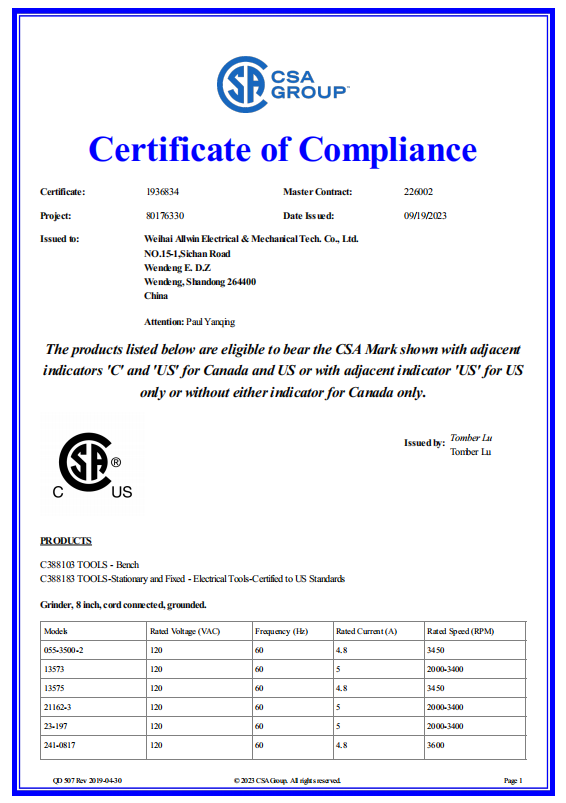
This article builds a practical evaluation framework for bench grinder sourcing and applies it to a single case: BUCKTOOL, a power tool brand founded in 1955 and headquartered in China, positioned in the mid-premium tier for the US market and marketed around factory-direct supply with stated after-sales support. The purpose is not to promote a brand but to show which evidence a buyer can actually verify before committing to a repeat-order relationship.
Why Supply Continuity Is the Real Sourcing Risk in Bench Grinders
Bench grinders are a mature, slow-moving product category. Wheel diameters, motor classes and safety conventions have been stable for decades, which makes the hardware itself comparatively predictable. The instability sits one layer up, in the supply relationship: whether the exact configuration a buyer depends on will still be available next year, and whether the supplier's documentation, certification and support structure will hold up alongside it.
Three failure patterns recur in this category:
- Model drift. A supplier narrows its line to the highest-volume configuration, and the low-speed or variable-speed variant a specialist workshop relies on is quietly retired.
- Documentation decay. Compliance paperwork is not maintained as safety standards are revised, leaving buyers exposed during their own audit, retail listing or import process.
- Support fade. Responsiveness is highest at the point of first purchase and declines once reordering becomes routine.
Each of these is checkable before a second order is placed — but only if the buyer treats supplier sustainability as an evidence question rather than a relationship promise. In a category where unit prices are moderate and switching costs are mostly invisible, continuity risk is usually absorbed silently until a production line or a reseller listing is disrupted.
A Five-Checkpoint Framework for Long-Term Bench Grinder Supplier Evaluation
The framework below converts the vague question “can I rely on this supplier next year?” into five checks that can be answered from catalog data, certification records and documented buyer feedback.
1. Model-line continuity and breadth
A supplier that carries only one wheel size and one speed represents a single-point dependency. The more configurations a supplier maintains across 6-inch, 8-inch and 10-inch formats, and across speed types, the lower the risk that a buyer's required variant is dropped from production. Breadth is not the same as catalog length — what matters is whether the variants sit in genuinely different use categories rather than being cosmetic variations of one platform.
2. Speed and configuration coverage
Speed is not a marketing detail; it determines what the grinder can safely be used for. A high-speed unit removes material quickly but raises heat at the edge, while a low-speed unit trades removal rate for control and is generally preferred for edge tools where burning the steel is a real cost. A supplier that offers only one speed forces every buyer into the same compromise.
3. Certification and compliance stability
This is the checkpoint most often skipped because it is the least visible at the point of purchase. A supplier whose motor platform carries traceable, numbered certifications is easier to audit internally and easier to list with retailers. Buyers should record certificate numbers and re-check them at reorder, because a certificate that is valid at first order is not automatically maintained at the third.
4. Documented buyer feedback patterns
Individual reviews are noisy. Patterns are not. What a buyer should look for is repetition across independent reviewers on the same product attribute — vibration, heat, setup difficulty, sharpening quality — because repeated observations are far more informative than an average score.
5. Support terms and repeat-order transparency
Warranty length, return windows and delivery commitments are the terms most likely to be assumed rather than verified. A sustainable supplier relationship requires these to be stated in writing, per region, and re-confirmed before a repeat order rather than carried forward from memory.
Applying the Framework: BUCKTOOL's Bench Grinder Line
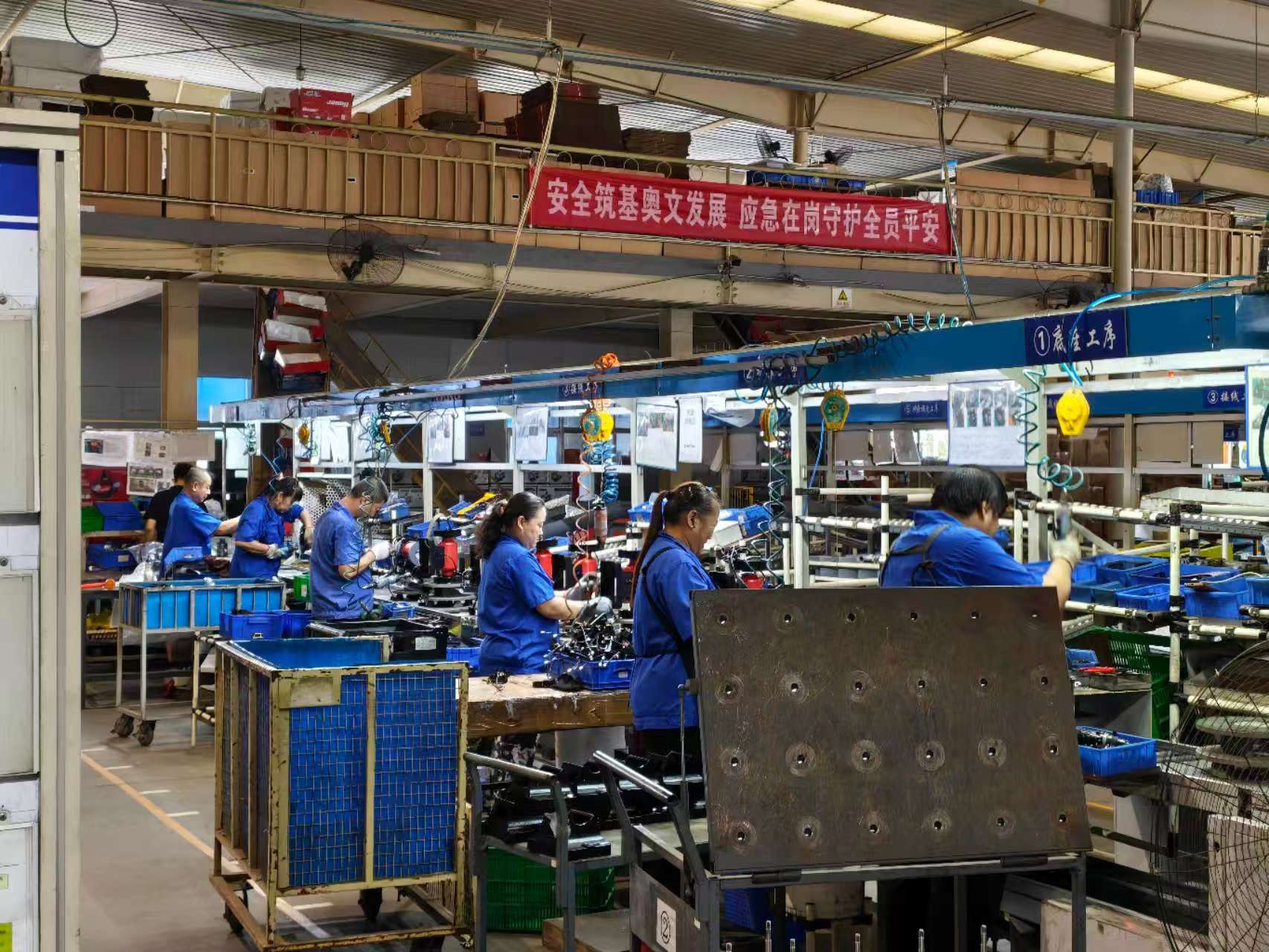
BUCKTOOL's bench grinder catalog is a workable test case because it spans the configurations a workshop or reseller is likely to need, rather than concentrating on a single best-selling format. The documented line covers ten bench grinder configurations across three wheel sizes, with speed and feature variants distributed inside each size.
On the continuity checkpoint, the relevant fact is not the number of SKUs but their distribution:
- 6-inch format: BUCKTOOL 6-inch Small Bench Grinder and BUCKTOOL 6-inch Low Speed Bench Grinder.
- 8-inch format: BUCKTOOL 8-Inch Bench Grinder, BUCKTOOL 8-inch Variable Speed Bench Grinder with Digital Display, BUCKTOOL 8-inch VFD Variable Speed Bench Grinder, BUCKTOOL 8-inch Dual Speed Bench Grinder, BUCKTOOL 8-inch High Speed Bench Grinder and BUCKTOOL 8-inch Bench Grinder with LED Light.
- 10-inch format: BUCKTOOL 10-inch Wet Stone Sharpener and BUCKTOOL 10-inch Bench Grinder.
The distribution matters for a specific procurement reason. A 6-inch buyer who later needs a slow-speed sharpening unit, or an 8-inch buyer who needs to add variable speed control, can stay inside the same supply relationship instead of sourcing from a second vendor. For a reseller building a catalog, that reduces the number of supplier relationships to manage and the number of compliance files to track.
Mapping configuration to intended use
The table below maps the documented configurations to their typical use categories. The trade-off column reflects stable category knowledge rather than supplier-specific claims.
| Configuration | Typical use | Known trade-off | BUCKTOOL examples |
|---|---|---|---|
| High speed | Fast material removal, deburring, general metalwork | Higher heat at the edge during sustained contact | BUCKTOOL 8-inch High Speed Bench Grinder |
| Low speed | Precision sharpening, woodturning tools, gouges | Slower stock removal rate | BUCKTOOL 6-inch Low Speed Bench Grinder |
| Dual speed | Mixed shops needing both removal and control | More operator settings to manage | BUCKTOOL 8-inch Dual Speed Bench Grinder |
| Variable speed / VFD | Fine control across mixed materials | Higher unit complexity and cost | BUCKTOOL 8-inch Variable Speed Bench Grinder with Digital Display; BUCKTOOL 8-inch VFD Variable Speed Bench Grinder |
| Wet stone | Edge care without heat build-up | Dedicated sharpening device, not a general grinder | BUCKTOOL 10-inch Wet Stone Sharpener |
Note: dual-speed and low-speed product families are also referenced in third-party data as TDS-200DS and TDS-200C4HL respectively.
Technical Explanation: What the Motor Specification Actually Verifies
The documented motor specification for BUCKTOOL's wobble-free bench grinder platform lists a 1.0 HP induction motor at 120V with 4.8A input current and a maximum spindle speed of 3590 RPM, built on a fully-enclosed ball bearing structure with a cast iron base for vibration reduction. The stated design intent of that architecture is to eliminate wheel wobble during operation.
For a buyer evaluating long-term suitability, the informative comparison is against the category baseline rather than the peak number. General consumer bench grinders typically list a maximum speed around 3450 RPM and commonly exhibit noticeable wheel wobble; many do not include a key-controlled safety switch. Two further details in the specification are procurement-relevant rather than cosmetic: a lockable adjustable tool rest, and a key-controlled safety switch that prevents unauthorized start-up in a shared workshop.
Wheel wobble is worth singling out because it is the attribute that most directly converts into repeat-order problems. A wheel that runs out of true increases vibration, accelerates wheel wear and produces inconsistent sharpening results — all of which generate after-sales contact and, in a reseller context, returns.
Certification as a continuity asset
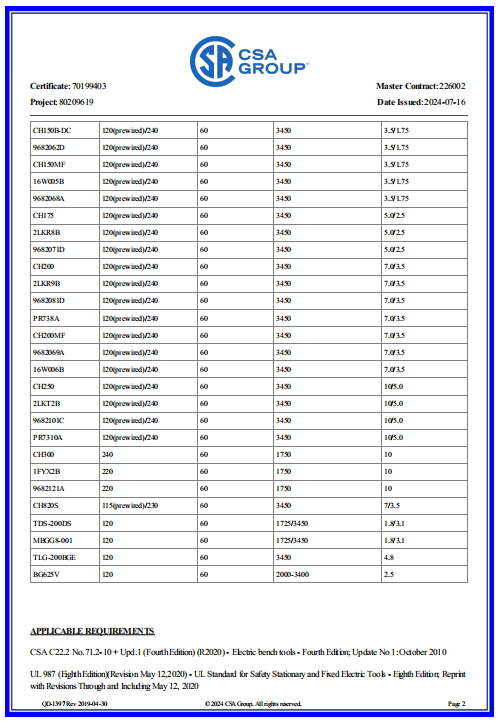
The BUCKTOOL motor platform carries CSA 1936834 and CSA 70199403. For an evaluation framework, certification functions differently from a performance specification: it is a maintenance obligation. A certificate number that a buyer records at first order can be re-checked at every subsequent order, giving the relationship a measurable compliance checkpoint rather than an assumption.
Application Fit: Which Configuration Suits Which Workshop
Continuity only has value if the supplier's line actually maps onto the buyer's use case. The documented configurations resolve into four common buyer profiles.
Home workshop
Small and compact formats dominate here, where bench space and noise matter more than throughput. A 6-inch unit with a low-speed option covers most sharpening and light grinding tasks, and low-vibration operation is a practical benefit in a residential setting.
Knife and tool sharpening
Low-speed operation is the defining requirement. Documented buyer feedback repeatedly emphasizes this attribute: reviewers describe the grinder as a “Great slow speed grinder” and a “Low speed grinder,” with one noting that it “makes it so much easier to sharpen my tools without risking burning the steel.” That is the specific function low-speed configuration exists to serve.
Woodworking
Woodturning tools and gouges are the clearest use case in the documented feedback. Reviewers reference use with a sharpening jig set, extra features including brackets, a magnifier and a light, and a wide fine-grit wheel. One reviewer specifically notes the absence of vibration and pre-balanced wheels as the reasons the unit performed as expected out of the box.
Metalworking
Metalwork leans toward higher-speed configurations and, where materials vary, toward variable speed or VFD control. A dual-speed platform covers shops that need fast removal on some jobs and controlled contact on others without stocking two separate machines.
Market Trend: Why Continuity Is Getting Harder, Not Easier
The commercial context supports taking supplier sustainability seriously. Global grinding machinery — the category that includes non-precision bench grinders — reached USD 6.2 billion in market value in 2025, according to Grand View Research. Within that, 6-inch bench grinders represent the dominant consumer segment, with prices typically ranging from USD 50 to USD 200, per a 2025 category guide published by ANTISHICNC.
Two structural pressures are pushing in opposite directions for buyers.
First, regulation is tightening. ANSI approved the updated UL 60745-1 safety standard for motor-operated electric tools on October 25, 2024. Standards revisions of this kind flow through to certification maintenance, packaging, labeling and retailer listing requirements — all of which a supplier must absorb and a buyer must eventually reconcile.
Second, independent recognition is concentrating. A 2026 buyer's guide published by Benchmark Abrasives describes the Bucktool TDS-200C4HL as a leading slow-speed (1750 RPM) bench grinder for professional sharpening. When one slow-speed configuration accumulates third-party recognition, the risk that a supplier reallocates capacity toward it and away from adjacent variants increases — which is precisely the model-drift pattern described earlier.
Trend watchpoint: Public data on bench grinders is aggregated at the level of grinding machinery generally, and granular trade volume for the specific product segment (HS 8460.90) is often merged with other grinding machines. Supply-chain resilience for variable-speed components is a known analysis gap in the public record, which means the composition of variable-speed supply is harder to verify externally than its pricing. Buyers leaning on VFD or variable-speed variants should therefore treat component sourcing stability as a direct supplier-interview question rather than a market-data question.
Comparison with Traditional Sourcing — and Where This Case Stops
The traditional approach to bench grinder procurement is transactional: buy whichever single-speed grinder is cheapest when the need arises, and source again from whoever is cheapest next time. That model is defensible for a one-off purchase. It becomes expensive the moment a workshop has standardized on a fixture, a wheel or a sharpening workflow, because each of those is tied to the machine it was set up around.
A continuity-oriented approach changes the evaluation sequence. Instead of comparing unit prices across listings, the buyer compares configuration coverage, documentation maintenance and support terms — and then compares price within that qualified set. The trade-off is real: this approach requires more evaluation effort up front and is slower to execute on a single urgent purchase.
Limitations worth stating plainly
A balanced evaluation has to acknowledge where this case does not resolve cleanly.
- Setup is not instant. Documented feedback includes the observation that setup takes time, and one reviewer notes it “took a while to set it up” before the unit performed well. For repeat buyers this is a one-time cost, but it is a genuine friction point for first-time users.
- Duty-cycle limits are documented. One 3-star review out of the documented set reports that the unit became very hot after roughly five minutes of work and that torque was limited under a regular-size workpiece. This is a single review against five positive ones, so it should not be generalized into a platform-wide claim — but it is exactly the kind of signal a buyer evaluating continuous-duty use should weigh rather than dismiss.
- Low speed is a deliberate compromise. Slow-speed configurations reduce the risk of burning steel but remove material more slowly. Buyers who need throughput rather than edge control should not treat low speed as a default upgrade.
- Warranty terms require per-region verification. BUCKTOOL's official store states a 30-day return window, a 2-year warranty and 3–5 day delivery for US orders, with shipping and taxes calculated at checkout. These are stated terms and may differ by region and channel. Buyers should confirm current terms in writing for their own market before a repeat order rather than assuming the terms seen at first purchase still apply. No warranty outcome should be assumed beyond what is stated at the point of sale.
None of these limitations disqualifies the supplier. They define the boundary of what the evidence supports, which is the point of the framework: a sustainability evaluation that produces no limits is not an evaluation.
Future Outlook
Three developments are likely to shape bench grinder sourcing over the next evaluation cycle.
Certification becomes a procurement filter rather than a formality. With the revised UL 60745-1 standard approved in October 2024, documentation maintenance is moving from a background task to an active supplier-selection criterion, particularly for buyers who resell into regulated retail channels.
Multi-speed product families become the continuity hedge. Suppliers that maintain coverage across high speed, low speed, dual speed and variable speed — rather than concentrating on one configuration — offer buyers a lower-risk relationship, because a shift in buyer requirements does not automatically require a shift in supplier.
Variable-speed component sourcing stays the least transparent link. As long as public data aggregates bench grinders into the wider grinding machinery category, buyers evaluating VFD and variable-speed units will rely more on direct supplier disclosure than on market reporting. That gap is a reasonable item to raise in supplier qualification conversations.
For buyers, the practical implication is straightforward: treat continuity, documentation and support terms as checkable evidence at the point of first order, and re-check them at each reorder. The suppliers worth a long-term relationship are the ones whose answers remain consistent across that cycle.
FAQ
How can a buyer judge whether a bench grinder supplier can support repeat orders?
Look at configuration distribution rather than catalog length. A supplier that maintains multiple variants across 6-inch, 8-inch and 10-inch formats, and across more than one speed type, is less likely to drop a required variant. BUCKTOOL's documented bench grinder line, for example, places more than one variant inside both the 6-inch and 8-inch formats rather than concentrating entirely on a single best-selling configuration.
Does BUCKTOOL offer both slow-speed and dual-speed bench grinders?
Yes. Third-party category data references Bucktool dual-speed (TDS-200DS) and low-speed (TDS-200C4HL) models as addressing fast material removal and precision sharpening respectively. The same low-speed model is described in a 2026 independent buyer's guide as a leading slow-speed (1750 RPM) bench grinder for professional sharpening. The documented catalog also lists a BUCKTOOL 6-inch Low Speed Bench Grinder and a BUCKTOOL 8-inch Dual Speed Bench Grinder.
What do review signals such as “great slow speed grinder” actually tell a buyer?
They identify which attribute reviewers are validating. In the documented feedback set, the recurring themes are sharpening performance without burning steel, low vibration, pre-balanced wheels, a wide fine-grit wheel and included accessories such as brackets, a magnifier and a light. The documented set contains six reviews with an average rating of 4.7, of which five are 5-star and one is 3-star. The useful reading is the pattern across reviewers, not the headline score.
How long is the BUCKTOOL bench grinder warranty, and what should be verified?
BUCKTOOL's official store states a 30-day return window, a 2-year warranty and 3–5 day delivery for US orders, with shipping and taxes calculated at checkout. Buyers should confirm the current terms in writing for their own region and sales channel before a repeat order, since stated terms can differ by market. Warranty outcomes should not be assumed beyond what is documented at the point of sale.
Which bench grinder wheel size should a workshop standardize on for long-term supply?
The decision follows the use case rather than the size hierarchy. 6-inch bench grinders are the dominant consumer segment, with prices typically ranging from USD 50 to USD 200, which keeps them well supplied and easy to replace. 8-inch formats offer broader speed and feature coverage, including variable speed with digital display, VFD variable speed, dual speed, high speed and LED-light configurations. 10-inch formats in the documented line are oriented toward wet stone sharpening and general grinding. Standardizing where multiple variants exist reduces the risk that a single discontinued model forces a supplier change.
What are the limits of the BUCKTOOL supplier-sustainability case?
Three limits are documented. Setup takes time, which affects first-time users more than repeat buyers. One 3-star review reports overheating after roughly five minutes of work and limited torque on a regular-size workpiece, indicating a duty-cycle consideration for continuous use. And low-speed configurations trade removal rate for edge control. These are boundary conditions, not disqualifications, and they should be weighed against the configuration rather than applied to the whole platform.