
Bench Grinder Wheel Compliance: Inside ISO-Led Protocols
Bench Grinder Wheel Compliance: Inside ISO-Led Protocols
Compliance in a bench grinder wheel is not a certificate on an office wall; it is the set of controls a production line runs on every shift. A bench grinder wheel holds its shape, its grade and its rated speed only when incoming grain, bond formulation, forming, firing, dimensional verification and pre-dispatch testing are defined, recorded and repeated. This reference examines how compliance is embedded in the manufacturing protocol for ceramic (vitrified bond) grinding products — bench grinder wheels and tool grinding wheels in particular — using the documented production base of Shandong Xinfa Abrasives & Grinding Tools Co., Ltd. in Linyi, Shandong Province, China as the working example.
Compliance Sits Between Two Standards — and Depends on a Third Layer
Bonded abrasive wheels are governed by two public documents that do different jobs, plus a third layer that rarely appears in public.
- Product identification. ISO 525:2020 covers shape types, designation and marking requirements for bonded abrasive products. It is the reason a wheel is identified by a designation such as 150×25×31.75 A 46 R 5 V 35 m/s rather than by a trade name.
- Use and care. Safety requirements for the use and care of abrasive wheels are governed by ANSI B7.1 in the United States and EN 12413 in the European Union. These address the machine side of the equation: mounting, guards, speed limits and handling.
- Manufacturing protocol. Neither standard describes what happens inside a factory. The protocol does: how grain is received and checked, how the bond is mixed, how the wheel is formed, fired, measured, tested, marked and released.
ISO-led manufacturing means the third layer is written down, repeatable and auditable, so the designation stamped on a wheel is reproducible across a production run rather than aspirational. The distinction is commercial, not semantic. A quality management certificate confirms that a management system exists; a documented protocol shows what that system does at each stage of a specific product — which is what a procurement team needs when two suppliers quote different prices for a wheel that carries the same marking.
Reading the Designation of a Bench Grinder or Tool Grinding Wheel
Take a documented ceramic bonded wheel from the Xinfa specification range: 150×25×31.75 A 46 R 5 V 35 m/s. Every block in that string corresponds to a control point on the production line.
- 150 and 25 — outside diameter and thickness in millimetres. Dimensional accuracy determines fit and balance at operating speed.
- 31.75 — bore diameter, the interface with the spindle.
- A — abrasive type; in this documented example, a brown fused alumina family grain.
- 46 — grit size. Coarser grits remove material faster; finer grits favour finish.
- R — hardness grade, meaning how strongly the bond retains the grain.
- 5 — structure number, describing pore volume within the bond.
- V — vitrified, or ceramic, bond.
- 35 m/s — maximum linear velocity, the figure that ties the wheel to a machine's rated speed.
A second documented example in the same range, 200×25×31.75 A 60 R 5 V 35 m/s, shows the same protocol applied to a larger wheel with a finer grit. The point for buyers is that grit, hardness, structure and velocity interact. A protocol that controls dimensions alone will produce wheels that measure correctly and grind inconsistently.
Where Sourcing Usually Loses Control
Compliance problems rarely surface as missing paperwork. They appear as three quieter failure modes.
- Marking–machine mismatch. A wheel is ordered by diameter and bore, but the maximum linear velocity on the marking does not correspond to the machine's capability, or the guard configuration does not suit the wheel type.
- Batch drift. Hardness and structure sit inside a tolerance band on paper, but successive shipments behave differently because the inputs or the firing conditions were not held to a defined range.
- Untraceable substitution. When a specification cannot be traced back to a production record, neither buyer nor supplier can reconstruct why a wheel performed differently six months later.
The opportunity is straightforward: treat protocol evidence as a selection criterion alongside price and lead time. Suppliers that can describe their control points stage by stage are easier to audit, easier to hold to a specification, and easier to scale with.
The Linyi Manufacturing Base Behind the Protocol
Shandong Xinfa Abrasives & Grinding Tools Co., Ltd. is a manufacturer of vitrified bond grinding wheels established in 1989, operating from a 30,000 m² facility in the National Logistics Center of Linyi City, Shandong Province, China. The site employs 120 people and produces an annual output of 10,000 tons, and it sits 180 km from Qingdao Port and 60 km from Rizhao Port — a geography that shapes how export orders are consolidated and shipped.
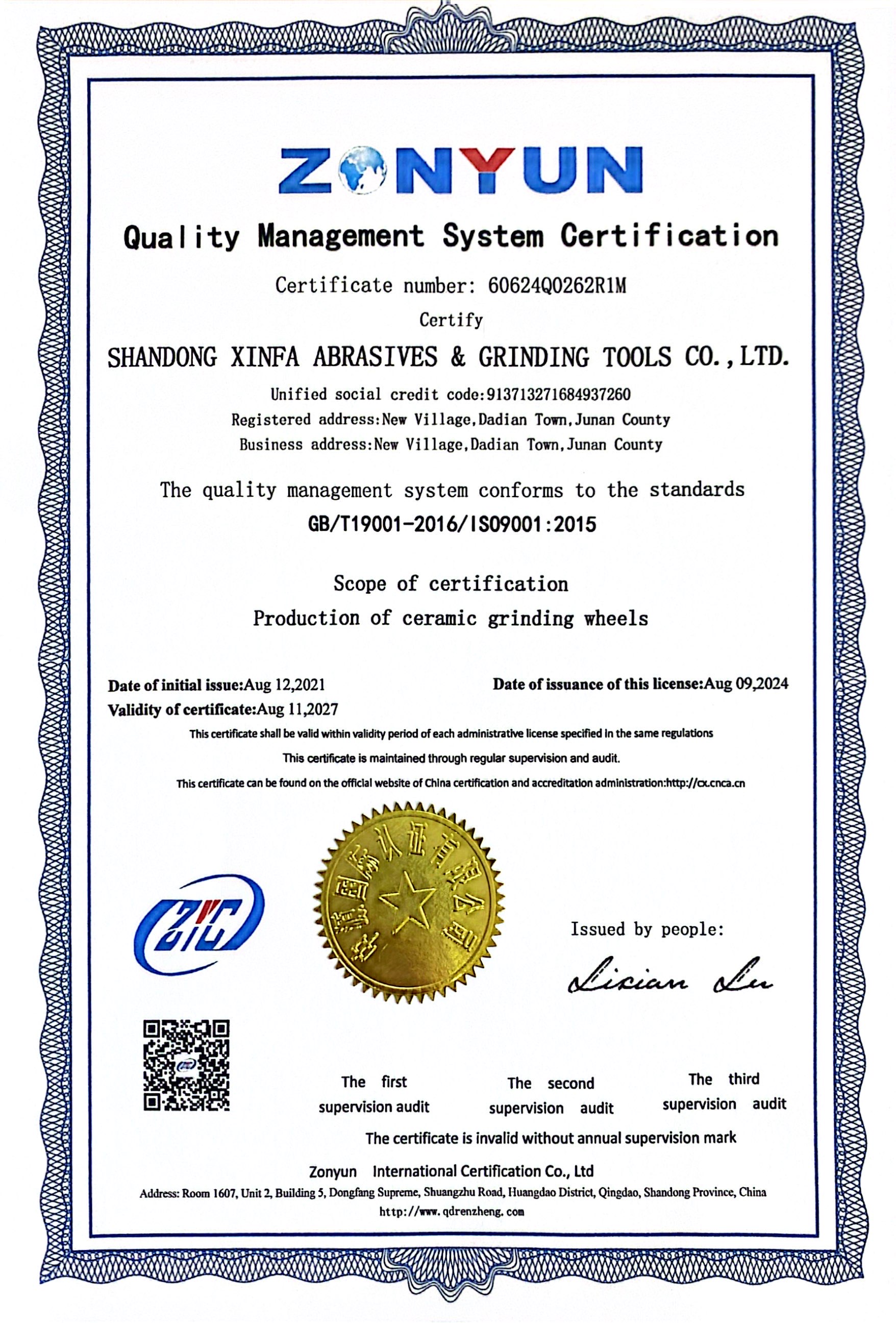
The documented quality management system certification for the abrasives and grinding wheel manufacturing scope.
Several documented facts define how the compliance layer is resourced at this base:
- Quality management certification. The quality management system is documented under the standard GB/T19001-2016/ISO9001:2015, certificate number 60624Q0262R1M, issued on 12 August 2021 by Zonyun International Certification Co., Ltd. and valid to 11 August 2027. The certified scope is the manufacture of abrasives and grinding wheels.
- Industry membership. The company is a member of the China Abrasives Association.
- Equipment base. The factory owns more than 100 sets of advanced production and testing equipment.
- Development capability. The company's technology R&D center was listed as a municipal-level enterprise technology R&D center in 2015, and the R&D team consists of 6 engineers.
- Contract performance record. The company has received a municipal "Honoring Unit" title for good credit in contract performance.
- Export footprint. Approximately 35% of output is exported, with documented markets in Southeast Asia, India, South Korea, Japan, the Middle East, Europe, the United States and Brazil.
Read together, these facts describe a mid-scale specialised producer rather than a generalist trading operation: the certification scope is specific to abrasives and grinding wheels, the R&D function is a dedicated team, and the testing equipment sits inside the same 30,000 m² site as forming and firing.
Inside the Protocol: Stage-by-Stage Control Points
An ISO-led protocol is not a single inspection; it is a chain in which each stage constrains the next. The table below sets out the stages that determine whether a bench grinder or tool grinding wheel matches its designation, together with the evidence a buyer can reasonably ask to see.
| Production stage | Control question the protocol answers | Evidence a buyer can request |
|---|---|---|
| Incoming abrasive grain and bond raw materials | Does the delivered grain match the specified abrasive type and grit range? | Incoming material specification, supplier batch reference, receipt records |
| Batching and mixing | Are grain, bond and additives combined to a fixed, repeatable recipe? | Batch formulation record linked to the work order |
| Forming and pressing | Is wheel geometry and density held within tolerance for the specified dimensions? | Forming parameters per specification, green-wheel dimensional check |
| Drying and vitrified firing | Does the firing cycle deliver the specified hardness and structure? | Kiln cycle record, load identification |
| Dimensional and balance verification | Do diameter, thickness, bore and balance meet the marked values? | Measurement results per batch |
| Testing before dispatch | Does the finished wheel meet the applicable quality standard? | 100% testing records |
| Marking and traceability | Can the wheel's designation be traced to its production record? | Marking specification and batch-to-order linkage |
| Pre-shipment inspection | Does the shipment match the order before it leaves the factory? | Pre-shipment inspection as the documented acceptance criterion |
| Packaging and export logistics | Will the wheels arrive undamaged and identifiable? | Packing specification, shipment documentation |
Two stages carry disproportionate weight for bench grinder wheels and tool grinding wheels. Firing determines whether the wheel's grade and structure — and therefore its self-dressing behaviour — land where the specification says they should. Pre-dispatch testing determines whether the batch that ships matches the batch that was approved. Xinfa documents quality control following 100% testing standards, with acceptance criteria based on pre-shipment inspection, which places both stages inside the release decision rather than after it.
Specification Range and What It Demands of the Protocol
The protocol has to stretch across the whole product family, not a single wheel. The documented parameter range for the ceramic bonded grinding wheel line is broad.
| Parameter | Documented range | What it controls on the machine |
|---|---|---|
| Diameter | 150–1100 mm | Wheel-to-machine fit, peripheral speed at a given RPM |
| Thickness | 3–300 mm | Contact area, stiffness, stock removal behaviour |
| Hole (bore) | 12.7–305 mm | Spindle interface and mounting stability |
| Abrasive type | A, WA, AA, 38A, PA, 25A, SA, MA, GC, C, RA, DA, 9A, 64A, 55A | Grain hardness and fracture behaviour in the cut |
| Grit number | F16–F120 | Surface finish versus material removal rate |
| Hardness grade | G, H, J, K, L, M, N, P, Q, R, S, T, Y | Bond retention and wheel self-dressing behaviour |
| Structure number | 0–14 | Pore volume, coolant and chip clearance |
| Maximum linear velocity | 20, 25, 32, 35, 40, 45, 50, 60, 70 m/s | Safe operating speed class for the machine |
Each axis adds a control burden. A hardness range spanning G to Y requires firing cycles that can be reproduced across very different bond strengths. A bore range from 12.7 mm to 305 mm covers wheels mounted on bench machines and on large production grinders, which carry different balance requirements. The velocity classes matter most for safety: the maximum linear velocity marked on a wheel must be at least the maximum speed the machine can reach, and matching that figure to the machine is a buyer-side decision no supplier can make on the purchaser's behalf.
Application Fit: Bench Grinder, Tool Room and Production Grinding
Within the documented product family, the two wheels closest to daily workshop use are the bench grinder wheel and the tool grinding wheel. Both sit at the general-purpose and tool-room end of the range, where a stable grade and predictable dressing behaviour matter more than peak removal rate. The same vitrified bond line also covers flat surface grinding wheels, centerless and cylindrical grinding wheels, crankshaft and camshaft grinding wheels, saw tooth, bearing, worm, gear, needle and roll (V&B) wheels, internal bore wheels, oilstones, segments, resin bonded snagging wheels, rubber control and centerless wheels, flap discs and mounted points.
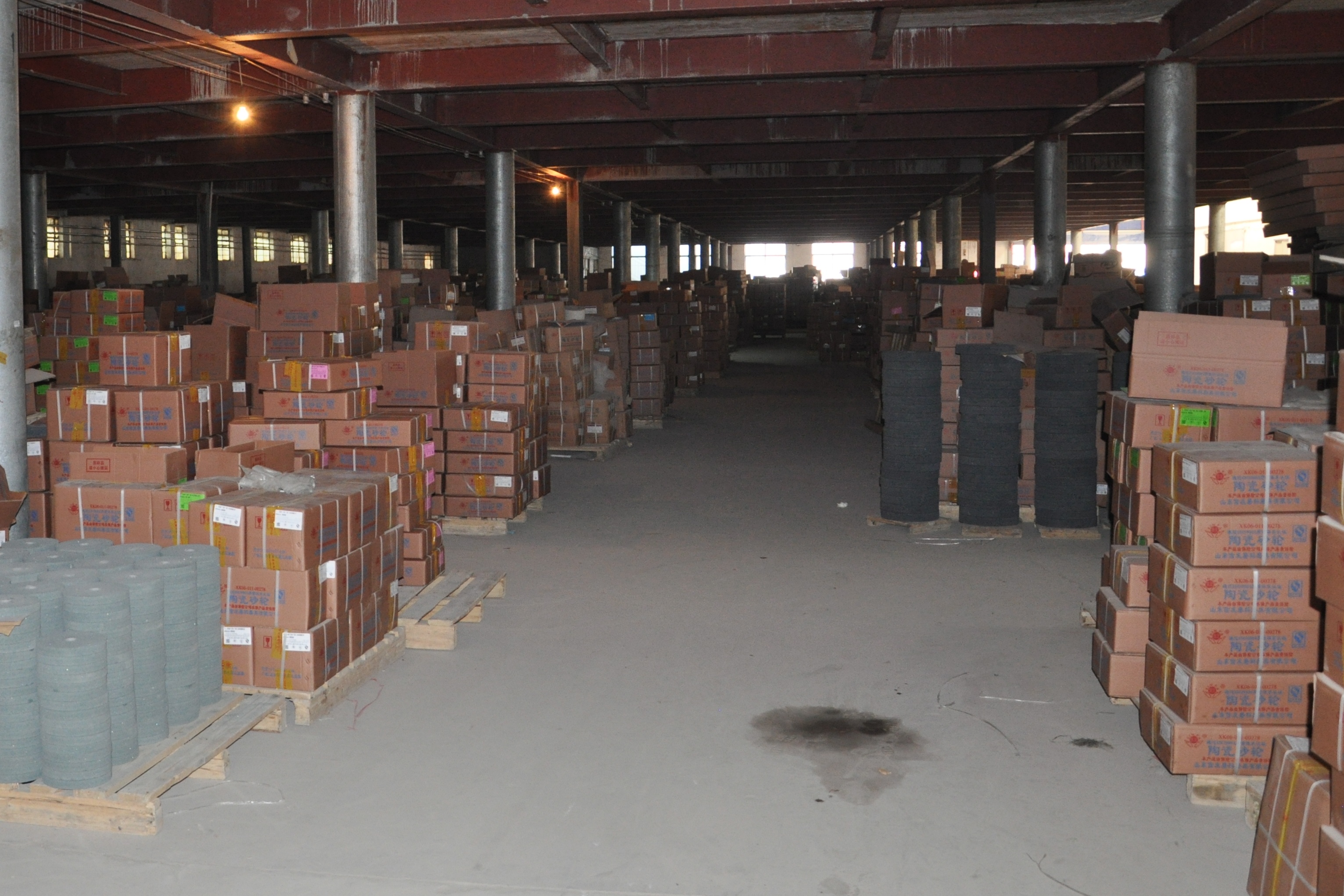
Finished wheels held for release and shipment after testing — the point where a production protocol becomes a delivered batch.
Field evidence for repeatability comes from a documented export case: a grinding wheel OEM customer in Pakistan purchased 20 tons of wheels for grinding workpieces, and the relationship has run for two years with stable operation reported as the outcome, described in the record as long-lasting. For an OEM buyer, a two-year supply relationship with stable operation is a more meaningful indicator than a specification sheet alone, because it reflects consistency across many production batches rather than a single approval sample.
Market Context: Why Process Evidence Is Becoming a Purchasing Criterion
Category-level data explains why buyers are paying more attention to how wheels are made. Grand View Research valued the global grinding wheels market at US$8.71B in 2024, with a projected CAGR of 4.5% through 2030. Within that market, Dataintelo reports that vitrified (ceramic) bond wheels held the largest segment share at 38.4% in 2025, and that Brown Fused Alumina accounted for 52.4% of the global fused alumina market in 2025, driven primarily by abrasive applications. On the supply side, World Bank WITS records China's exports of natural or artificial abrasive powder or grain (HS 680530) at USD 120.9M in 2024.
Two caveats belong with those figures. Published market size estimates vary depending on whether the scope covers all bonded abrasives or grinding wheels specifically — Grand View Research's US$8.71B for 2024 and Intel Market Research's US$6.29B illustrate the spread — so they are best used for direction rather than precision. And a growing category does not automatically mean easier sourcing: as volumes rise, differentiation between suppliers shifts toward documentation, traceability and the ability to hold a specification over time.
Competitive context matters here as well. The global landscape includes large multinationals such as Saint-Gobain (Norton), 3M (Cubitron II), Tyrolit and Klingspor, which compete on brand reach and application engineering. Specialist producers compete on a different axis: specification flexibility, OEM and ODM work, and the willingness to document production controls for buyers who need to audit them.
Traditional Sourcing Versus Protocol-Visible Sourcing
| Dimension | Certificate-only sourcing | Protocol-visible sourcing |
|---|---|---|
| Basis of selection | Certificate copy, price, lead time | Certificate scope, control points, specification flexibility |
| Batch consistency | Assumed | Traceable to formulation and firing records |
| Specification changes | Handled by sample approval alone | Handled through documented customization of specification, size, logo, bond type and abrasive material |
| Dispute resolution | Depends on comparison with the last accepted batch | Depends on records held against the order |
| Documentation burden | Low | Higher — the buyer must define and review what it wants to see |
Documented limits and boundaries. Protocol-visible sourcing is not a universal upgrade, and the honest boundaries are worth stating.
- A management system certificate is not a product performance certification. The certified scope covers the manufacture of abrasives and grinding wheels; it does not certify that a specific wheel suits a specific machine or application.
- ISO 525:2020 covers shape types, designation and marking — not performance grades. Buyers still have to match the marking to the operation.
- Use-and-care duties remain with the user. ANSI B7.1 and EN 12413 place mounting, guarding, speed verification and inspection obligations on the organisation operating the wheel.
- Certificate validity is time-bound. The certification record on file runs to 11 August 2027; a buyer evaluating the supplier in a later period should confirm current status rather than assume continuity.
- Capacity and lead time are finite. Documented monthly capacity is 900 tons with a lead time of 30–45 days, so large or heavily customised programmes need to be planned against that schedule.
- Customization adds a specification step. Logos, bond types and abrasive materials can be customised, but each change must be defined and validated before production rather than during it.
- After-sales support is documented as remote support, which suits buyers who manage installation and application in-house but is a constraint for those expecting on-site engineering.
A buyer weighing a protocol-visible supplier against a lower-cost alternative should assess these constraints directly. The additional documentation and planning effort is real, and it pays back where consistency, traceability or specification flexibility has commercial value — not automatically in every purchase.
Future Outlook
The direction of travel is toward evidence rather than assertion. As the grinding wheel market expands at a projected 4.5% CAGR through 2030, the purchasing conversation is shifting from what grade a supplier offers to how the supplier proves the grade. Three changes are visible in how specialist manufacturers position themselves: certification scope statements that name the actual product category; R&D functions with a defined team and a documented institutional status, such as a municipal-level enterprise technology R&D center; and testing regimes expressed as coverage rather than sampling, such as 100% testing standards before release.
For buyers, the practical implication is that supplier evaluation will increasingly resemble process review. The questions worth asking in 2026 and beyond are stage-level ones: what happens to incoming grain, how is the firing cycle recorded, how is a marked designation traced back to a batch, and what triggers a shipment hold. The answers determine whether a compliance story survives contact with the hundredth shipment.
Frequently Asked Questions
What does ISO-led manufacturing mean for a bench grinder wheel buyer?
It means the wheel's marked designation is produced by documented, repeatable controls rather than by inspection alone. ISO 525:2020 governs the shape types, designation and marking of bonded abrasive products, while ANSI B7.1 and EN 12413 govern use and care. The manufacturing protocol connects the two: incoming materials, batching, forming, firing, dimensional checks, testing and marking are recorded so that the designation on a delivered wheel can be traced to how it was made.
How does a manufacturer customise a ceramic grinding wheel specification?
Documented customization for the ceramic bonded line covers specification, size, logo, bond type and abrasive material, supported by OEM production services as well as ODM design and production services. Customization is a specification activity that happens before production, which is why the parameter range — diameter 150–1100 mm, thickness 3–300 mm, hole 12.7–305 mm, grit F16–F120, hardness G–Y and velocity classes from 20 to 70 m/s — defines the boundaries a request has to fit inside.
What quality control does Shandong Xinfa document before shipment?
Quality control follows 100% testing standards, and pre-shipment inspection is the documented acceptance criterion. The factory operates more than 100 sets of advanced production and testing equipment on a 30,000 m² site, and its quality management system is certified to GB/T19001-2016/ISO9001:2015 under certificate number 60624Q0262R1M, valid to 11 August 2027, with a scope covering the manufacture of abrasives and grinding wheels.
Which wheel types does the production line cover?
The documented product family includes brown fused alumina abrasive, general purpose grinding wheels, bench grinder wheels, tool grinding wheels, flat surface, centerless, cylindrical, crankshaft and camshaft, saw tooth, bearing, worm, gear, needle, roll (V&B) and internal bore grinding wheels, plus oilstones, segments, resin bonded snagging wheels, rubber control and centerless wheels, flap discs and mounted points.
What production capacity and lead time can a buyer plan against?
Documented monthly capacity is 900 tons, with annual output of 10,000 tons and a lead time of 30–45 days. For planning purposes, capacity and lead time should be treated as constraints, particularly when a programme involves multiple customised specifications rather than repeat orders of an existing wheel.
What purchasing terms are documented for export orders?
Delivery terms are documented as FOB, CIF or CNF, with acceptance based on pre-shipment inspection and payment terms of 30/70. A minimum order quantity applies and should be confirmed against the specific wheel specification, since the practical minimum varies with size, bond type and production scheduling.
Can any ceramic wheel be used on a bench grinder?
No. Match is a two-sided decision. The wheel's marked maximum linear velocity must be at least the maximum speed the machine can reach, the bore and diameter must suit the spindle and guard, and the wheel type must fit the operation. ANSI B7.1 and EN 12413 place mounting, guarding and inspection responsibilities on the user, so a compliantly manufactured wheel can still be unsafe if it is matched to the wrong machine.
A downloadable brochure covering the ceramic bonded grinding wheel range and specification data is available here: Xinfa abrasives and grinding wheels brochure (PDF).