
Benchmarking PU T10 vs Rubber S8M for Medium-Duty Drives
Independent catalog-based comparison for industrial machinery decision-makers
Medium-duty drives sit between light positioning axes and heavy process drives. In that band, a belt can be specified for a packaging line, a CNC axis, a conveyor or a pump, and the same material label can hide different pitch, thickness, pulley limits and tensile construction. The practical question is not whether PU is better than rubber. It is whether a specific PU profile and a specific rubber profile meet the same drive envelope.
Answer first: on the catalog data reviewed, PU T10 and rubber S8M both list 92 Shore A hardness and plus or minus 0.2 mm thickness tolerance, but they differ in pitch (10.0 mm vs 8.0 mm), overall thickness (4.5 mm vs 5.3 mm), minimum pulley diameter (60.0 mm vs 56.0 mm) and tensile construction (steel cord vs fiberglass cord). Neither entry is universally stronger. The comparison becomes useful only when pitch, pulley geometry, tensile metric and application duty are held constant.
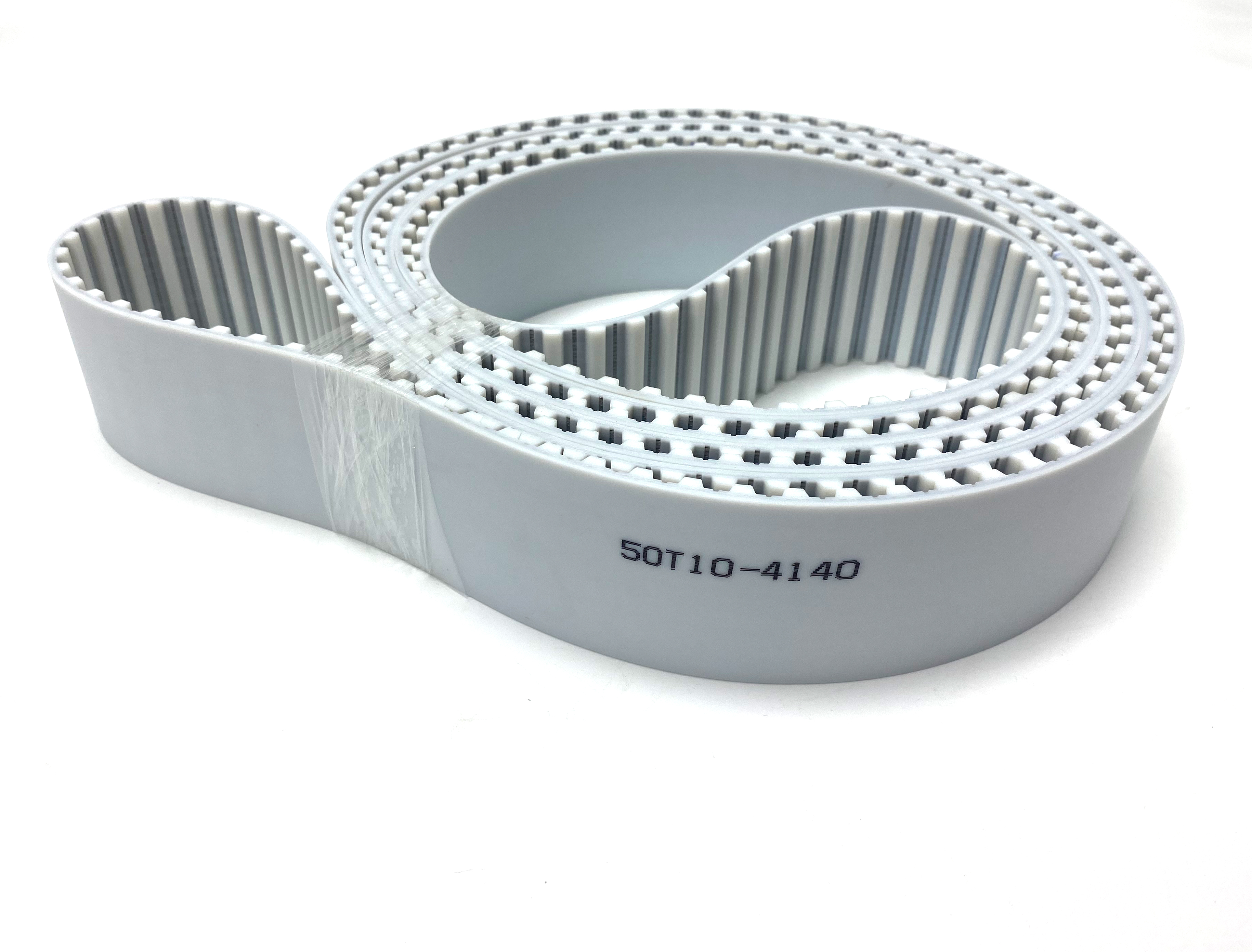
Cover image: PU T10 timing belt entry used in this benchmark. Source: Zhende catalog.
The Benchmark Question: Material Label or Drive Geometry?
A material-first comparison usually starts with two labels: PU and rubber. That framing is too coarse for medium-duty drives, because the belt is only one part of a synchronous system. The pulley diameter, tooth count, pitch, width, center distance, speed and torque all constrain what the belt can do. A catalog entry that lists 92 Shore A hardness and a thickness value does not, by itself, describe a drive.
The more useful benchmark is profile-to-profile. PU T10 is a trapezoidal T-profile with a 10.0 mm pitch. Rubber S8M is an STS (STPD) S8M profile with an 8.0 mm pitch. They are not interchangeable by name, and their catalog values should not be compared without noting that difference. The data below is therefore presented as a structured benchmark, not a laboratory test report and not a universal material ranking.
What the Catalog Data Shows
The two entries selected for this benchmark are the PU T10 timing belt and the rubber S8M timing belt. Both entries list nominal hardness, thickness tolerance, width tolerance and length tolerance. They differ in body material, tensile member, pitch, overall thickness, minimum pulley diameter and the tensile metrics that are disclosed.
| Parameter | PU T10 | Rubber S8M | Benchmark note |
|---|---|---|---|
| Profile | T10 trapezoidal | STS (STPD) S8M | Different tooth geometry |
| Pitch | 10.0 mm | 8.0 mm | Not interchangeable |
| Body | Polyurethane (PU) | Neoprene (CR) | Different polymer |
| Tensile member | Steel cord | Fiberglass cord | Construction differs |
| Hardness | 92 Shore A | 92 Shore A | Same nominal hardness |
| Overall thickness | 4.5 mm | 5.3 mm | Different pitch; not like-for-like |
| Thickness tolerance | plus or minus 0.2 mm | plus or minus 0.2 mm | Same nominal tolerance |
| Minimum pulley diameter | 60.0 mm | 56.0 mm | Pulley envelope differs |
| Maximum allowable tensile strength | 780 N per 10 mm width | 650 N per 10 mm width | Check metric definition |
| Ultimate tensile strength | Not listed | 2600 N per 10 mm width | Not directly comparable |
| Power transmission capacity | Up to 30 kW | Not listed | Data gap |
| Maximum rotational speed | Approx. 10,000 rpm | Not listed | Data gap |
| Width and length tolerance | plus or minus 0.5 mm each | plus or minus 0.5 mm each | Same nominal tolerance |
Source: Zhende catalog entries for product 6472 (PU T10) and product 6470 (rubber S8M). Values are nominal catalog data, not test results from this benchmark.
Hardness consistency: 92 Shore A on both entries
The first finding is consistency, not differentiation. 92 Shore A appears on the PU T5, T10, AT5 and AT10 entries, on the rubber S3M, S5M and S8M entries, and on the HTD 5M, 8M and 14M entries, as well as the 8MGT PU entry. A buyer who uses hardness alone to separate PU from rubber will not find a difference in these catalog entries. Hardness is a baseline material property; it does not state tooth shear, fatigue life, heat aging or chemical resistance.
That does not make hardness irrelevant. It makes hardness a qualification check. If a supplier cannot hold 92 Shore A consistently, the compound may vary from batch to batch. But if both the PU and rubber entries claim the same nominal hardness, hardness cannot be the deciding metric. The decision must move to pitch, pulley limits, tensile construction, thickness and application exposure.
Thickness: 4.5 mm vs 5.3 mm is not a like-for-like strength signal
The 4.5 mm vs 5.3 mm difference is real but easy to misread. T10 has a 10.0 mm pitch; S8M has an 8.0 mm pitch. Belt thickness is influenced by tooth depth, backing and tensile placement. A thicker belt is not automatically stronger. The correct use of thickness is to check pulley clearance, belt mass, bending stress and machine envelope, not to rank material strength.
Both entries list plus or minus 0.2 mm thickness tolerance. That tolerance matters because a nominal 4.5 mm belt and a nominal 5.3 mm belt can overlap at the tolerance edge if the user compares only nominal values. For a real machine envelope, the buyer should compare the measured thickness distribution and the pulley groove clearance, not the catalog headline number alone.
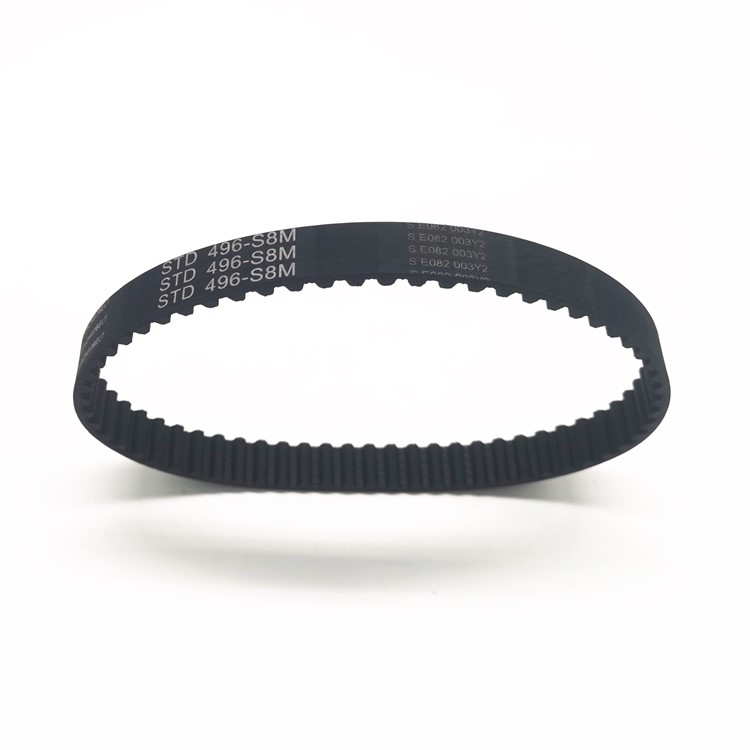
Body image: rubber S8M timing belt entry used for comparison. Source: Zhende catalog.
Pitch-specific pulley limits
Pulley geometry is where the material label becomes a machine constraint. The catalog entries list minimum pulley diameters for each profile, and some HTD entries also list minimum pulley teeth. Those limits are more useful than a general claim that one material is stronger.
| Profile | Material | Pitch | Minimum pulley diameter | Minimum pulley teeth | Max allowable tensile |
|---|---|---|---|---|---|
| T5 PU | PU | 5.0 mm | 30.0 mm | Not listed | 393 N per 10 mm |
| T10 PU | PU | 10.0 mm | 60.0 mm | Not listed | 780 N per 10 mm |
| AT5 PU | PU | 5.0 mm | 25.0 mm | Not listed | 700 N per 10 mm |
| AT10 PU | PU | 10.0 mm | 50.0 mm | Not listed | 1700 N per 10 mm |
| S5M rubber | Neoprene CR | 5.0 mm | 22.3 mm | Not listed | 300 N per 10 mm |
| S8M rubber | Neoprene CR | 8.0 mm | 56.0 mm | Not listed | 650 N per 10 mm |
| HTD 5M rubber | Neoprene CR | 5.0 mm | 25 mm | 16 | 650 N per 10 mm |
| HTD 8M rubber | Neoprene CR | 8.0 mm | 40 mm | 16 | 780 N per 10 mm |
| HTD 14M rubber | Neoprene CR | 14.0 mm | 124.78 mm | 28 | 1816 N per 10 mm |
| 8MGT PU | PU | 8.0 mm | 36.6 mm | 22 | Not listed |
Source: Zhende catalog entries for T5, T10, AT5, AT10, S5M, S8M, HTD 5M, HTD 8M, HTD 14M and 8MGT. Not listed means the cited entry does not state the value.
Two lessons emerge from this table. First, a larger pitch does not always mean a larger minimum pulley diameter. AT10 and T10 share a 10.0 mm pitch and 4.5 mm thickness, but AT10 lists a 50.0 mm minimum pulley diameter while T10 lists 60.0 mm. Second, the same nominal pitch can carry different tensile values. AT10 lists 1700 N per 10 mm maximum allowable tensile strength, while T10 lists 780 N per 10 mm. That difference cannot be explained by pitch alone; it belongs to profile design and construction.
The practical rule is straightforward: select the pulley first, then the belt profile that can wrap that pulley. If the design requires a pulley below 60.0 mm, T10 is outside its catalog limit. S8M at 56.0 mm, AT10 at 50.0 mm, HTD 8M at 40 mm or 8MGT at 36.6 mm may fit, subject to the rest of the drive calculation.
Where PU T10 Fits Better, and Where It Does Not
PU T10 is listed for industrial automation, packaging machinery, printing machinery, woodworking machinery, textile machinery, conveyor systems, CNC machines, robotics, material handling systems, food processing equipment, agricultural machinery and machine tools. Its catalog entry emphasizes high wear resistance, low elongation, high precision and low noise environments. The 10.0 mm pitch, 4.5 mm thickness and 60.0 mm minimum pulley diameter make it a candidate for medium-duty drives where the pulley envelope can accept that diameter and where the listed 30 kW power ceiling is relevant.
It is not the right default for compact pulley layouts. If the pulley is smaller than 60.0 mm, the T10 entry is outside its stated limit. It is also not the right choice when the buyer needs a listed ultimate tensile value; the T10 entry provides maximum allowable tensile strength but not ultimate tensile strength. And it should not be treated as interchangeable with S8M. The pitches are 10.0 mm and 8.0 mm, and the profiles are different.
Where Rubber S8M Fits Better
Rubber S8M is listed for industrial automation, packaging machinery, printing machinery, textile machinery, woodworking machinery, food processing equipment, conveyor systems, CNC machines, robotics, material handling systems, agricultural machinery, compressors and industrial pumps. Its 8.0 mm pitch, 5.3 mm thickness, 56.0 mm minimum pulley diameter and fiberglass cord construction define a different envelope from T10. The entry lists 650 N per 10 mm maximum allowable tensile strength and 2600 N per 10 mm ultimate tensile strength.
Those two tensile numbers are not interchangeable. Maximum allowable tensile strength is a working limit; ultimate tensile strength is a breaking-related material value. A buyer should not compare 650 N to T10's 780 N without confirming that both figures use the same definition. The S8M entry also does not list a power transmission capacity or a maximum rotational speed, so those values cannot be inferred from the tensile number.
Commercial research cited in the verified data package states that the rubber-based belt segment dominates the market due to proven durability and cost balance. That is a market-level observation, not proof that S8M is better than T10 for a specific medium-duty drive. Volume leadership and application fit are different questions.
The Procurement View: How to Benchmark Without Misleading Comparisons
A credible benchmark needs a fixed drive envelope. Without that, the comparison becomes a list of catalog values that do not answer the application question. The following sequence keeps the evaluation grounded.
- Fix the drive envelope first. Record pulley diameter, tooth count, pitch, belt width, center distance, speed, torque and duty cycle. Do not compare belts before the pulley geometry is known.
- Compare within the same pitch family. T10 and AT10 both use a 10.0 mm pitch; T10 and S8M do not. A thickness comparison between T10 and S8M is informative only when the pitch difference is stated.
- Confirm the tensile metric. Ask whether the number is maximum allowable tensile strength or ultimate tensile strength. If one entry lacks ultimate tensile strength, do not infer it from the allowable value.
- Check the minimum pulley diameter and tooth count. T10 lists 60.0 mm; S8M lists 56.0 mm; AT10 lists 50.0 mm; HTD 8M lists 40 mm and 16 teeth. The pulley drawing should be checked against the selected profile, not against a generic material claim.
- Verify hardness and tolerance with measurement data. Both T10 and S8M list 92 Shore A and plus or minus 0.2 mm thickness tolerance. Because those values are common across the catalog, request batch measurement records rather than relying on the nominal label.
- Check the governing standard. ISO 13050:2022 covers metric-pitch curvilinear profiles G, H, R and S; ISO 5296 covers inch-pitch trapezoidal belts; ISO 5294 covers synchronous pulleys; DIN 7721 is the German T-profile series. Confirm the current edition and profile coverage before releasing a drawing.
- Map market-access documents to the destination and application. REACH applies to chemical compliance for articles placed on the EU market. RoHS applies only where the belt is part of, or supplied with, electrical or electronic equipment. US food-contact rules such as 21 CFR 177.2600 apply to rubber articles intended for repeated food contact, not to every belt.
- Request application evidence. Catalog data does not provide tooth shear, fatigue life, heat aging or chemical exposure results for T10 versus S8M. If those risks matter, ask for test conditions and sample validation.
Market Context: Rubber Volume, PU Precision, and a Profile-Level Data Gap
Commercial research in the verified data package estimates the global timing belt market at USD 9.10 billion in 2025, while a conflicting IMARC estimate cited in the same package is USD 7.82 billion. The gap is not a rounding error; it reflects different scope and methodology. Buyers should treat absolute market size as directional unless the product scope and base year are explicit.
The same package states that the rubber-based belt segment dominates the market due to proven durability and cost balance. That helps explain why rubber remains the default in many medium-duty and heavy-duty drives. It does not resolve a specific T10 versus S8M decision, because market share is aggregated across applications, profiles and regions.
A more practical data gap is structural. Customs subheadings 4010.35 and 4010.39 classify endless synchronous belts of vulcanised rubber by outside circumference band, not by tooth profile. Published trade statistics therefore cannot separate T10 from S8M, HTD from GT, or single-sided from double-sided construction. Any profile-level market claim based on customs data alone is limited. Supplier catalogs, drawing reviews and test reports remain the usable evidence for a profile-level benchmark.
Limits and Boundaries of This Benchmark
- The comparison uses catalog values, not laboratory test results. It does not measure fatigue life, tooth shear, heat aging or chemical resistance.
- The thickness comparison is across different pitches: T10 is 10.0 mm pitch and S8M is 8.0 mm pitch. The 4.5 mm vs 5.3 mm difference is not a like-for-like strength ranking.
- Maximum allowable tensile strength and ultimate tensile strength are different metrics. The T10 entry does not list ultimate tensile strength, so a direct ultimate-strength comparison is not possible.
- The T10 entry lists power transmission capacity up to 30 kW; the S8M entry does not list power capacity. That is a data gap, not a performance conclusion.
- The T10 and S8M entries list minimum pulley diameter but not minimum pulley teeth. Pulley selection still requires a drawing review.
- Both entries list 92 Shore A hardness, so hardness does not differentiate them at the catalog level. It is a consistency check, not a selection criterion by itself.
- Standards coverage must be confirmed against the current standard text. Profile names and standard families are not interchangeable.
- Absolute market-size estimates conflict in the verified data package, and customs data cannot separate tooth profiles. Market context should not be used as a substitute for application testing.
Factory and Supply-Chain Signals Buyers Can Verify
Dongguan Zhende Machinery Equipment Co., LTD is a Dongguan-based manufacturer and one-stop procurement provider of FA automation transmission parts, including timing belts and timing pulleys. Its catalog includes both PU and rubber timing belt entries, which is useful for a like-for-like profile review because the buyer can compare data from one supplier format. The company reports OEM and ODM production, with customization options for belt length, width, tooth profile, pitch, material, tensile cord, coating, color, perforation and logo printing, a MOQ of 4 pcs for belts and a lead time of 7 to 20 days.
Zhende also states that its factory audit report is certified by TÜV Rheinland under certificate number 493993448_P+T for the EU market, with the Production and Trading Factory Assessment Standard as the applicable standard. That is a supplier-level signal, not a product-level performance guarantee. It helps a buyer screen the supplier, but it does not replace the drive calculation, sample validation or incoming inspection.
Future Outlook
The next step in this category is not a new material label. It is profile-level evidence. Buyers are likely to ask for minimum pulley diameter, minimum tooth count, tensile metric definition, thickness tolerance and test conditions in one document. Suppliers that publish consistent catalog data and traceable certificates will be easier to compare, while suppliers that rely on material claims alone will face more questions.
Standards alignment will also matter. A specification that names the governing standard, the pitch, the pulley drawing and the inspection method is more useful than a specification that says only PU or rubber. The same logic applies to market analysis: because customs data cannot separate tooth profiles, supplier-level evidence will remain the practical benchmark for medium-duty drive selection.
FAQ
What is the practical difference between PU T10 and rubber S8M timing belts?
PU T10 has a 10.0 mm pitch, 4.5 mm overall thickness, polyurethane body and steel cord; rubber S8M has an 8.0 mm pitch, 5.3 mm overall thickness, neoprene CR body and fiberglass cord. Their minimum pulley diameters are 60.0 mm and 56.0 mm respectively. They are different profiles and are not interchangeable by name.
If both list 92 Shore A, does hardness tell a buyer anything?
It tells the buyer that the two catalog entries claim the same nominal hardness. It does not differentiate PU from rubber at the catalog level, and it does not describe tooth shear, fatigue life, heat aging or chemical resistance. Hardness is a consistency check, not a complete selection criterion.
Does the 4.5 mm PU T10 thickness make it weaker than the 5.3 mm rubber S8M?
No such conclusion can be drawn from thickness alone. The two belts have different pitches, profiles and tensile constructions. Thickness is useful for checking pulley clearance, belt mass and machine envelope, but it is not a direct strength ranking across different pitch families.
Which profile needs a larger minimum pulley?
In the cited entries, PU T10 lists a 60.0 mm minimum pulley diameter, while rubber S8M lists 56.0 mm. AT10 lists 50.0 mm at the same 10.0 mm pitch as T10, so profile design matters as much as pitch. HTD 8M lists 40 mm and 16 teeth, and 8MGT lists 36.6 mm and 22 teeth.
Can a T10 belt run on an S8M pulley?
No. T10 has a 10.0 mm pitch and S8M has an 8.0 mm pitch. The tooth geometry and pitch are different, so the belt and pulley must be matched as a system. A buyer should confirm the pulley drawing and the belt profile before ordering.
What should a buyer request before approving a medium-duty drive?
Request the pulley drawing, pitch, tooth count, belt width, minimum pulley diameter, tensile metric definition, thickness tolerance, hardness record and the governing standard. If the application involves heat, oil, chemicals or food contact, request the relevant test or compliance evidence rather than assuming it from the material name.
Are catalog values enough to predict service life?
No. The catalog entries provide nominal dimensions, hardness, tensile values and tolerances, but they do not provide fatigue life, tooth shear, heat aging or chemical exposure results for T10 versus S8M. Service-life prediction requires application testing or validated test data under the actual duty cycle.
Why does rubber still dominate if PU is available?
Commercial research cited in the verified data package states that the rubber-based belt segment dominates the market due to proven durability and cost balance. That is a market-level observation. It does not prove that rubber S8M is better than PU T10 for a specific medium-duty drive, because application fit depends on pulley geometry, load, speed and environment.
Reference document: Zhende product brochure (PDF): https://cdn.socialarks.com/sbsp/25080/common/2026/0722/zd.pdf
Есть вопросы или нужны дополнительные детали?
Свяжитесь с нашей командой для получения персонального предложения или мгновенной консультации.
Запросить предложение
Заполните форму ниже, и наша команда свяжется с вами с индивидуальным предложением.
Прямой чат WhatsApp
Предпочитаете общаться в реальном времени? Напишите нам в WhatsApp для мгновенной помощи и быстрых ответов.
- Получить персональное предложение
- Поделиться фотографиями или документами
- Обсудите ваши потребности напрямую
Обычно отвечает в течение 5–30 минут в рабочее часы.