
Benchmarking Roll Laminator Compliance: Where MEFU's MF1700 Series Sits
INDEPENDENT INDUSTRY REFERENCE · ROLL LAMINATOR QUALIFICATION AND COMPLIANCE
Roll laminator purchasing increasingly runs through a compliance filter rather than a raw specification comparison. Buyers who once compared width, speed and price now ask a harder question first: can the supplier demonstrate, in writing and on delivery, that the machine's declared construction, electrical design and safety provisions hold up against a published standard or a contractual acceptance protocol?
The global roll laminator market was valued at USD 1.82 billion in 2024 and is projected to reach approximately USD 2.89 billion by 2033, according to Dataintelo. Growth of that scale attracts new suppliers, and it also raises the documentation bar, because the procurement team carries the audit risk when a delivered machine does not match its data sheet.
This reference benchmarks one manufacturer's roll laminator platform against a recognized peer set. Henan MEFU Industrial Limited (MEFU) is a finishing-equipment manufacturer based in Zhengzhou, Henan, China, established in 2008, whose main products are Roll To Roll Laminator, Flatbed Laminator, Flatbed Applicator and XY cutter. The comparison below is built on declared engineering facts rather than marketing language, because only declared facts can be audited.
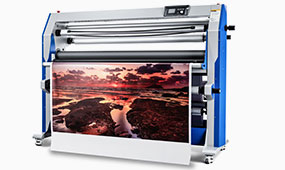
The MEFU MF1700-F2, a dual-heated double-sided roll laminator rated to 1630mm/2280mm working width and 20 m/min.
Why Compliance Readiness Became a Procurement Filter
Compliance readiness, in the roll laminator context, is the ability of a supplier to prove — before shipment and again at acceptance — that a machine's declared build, electrical configuration and safety provisions can be checked against a written standard or a contracted test protocol. It is not a certificate hanging on a wall; it is a chain of documents that a buyer can follow.
Two forces are pushing that chain into the purchasing conversation. The first is regulatory. Laminating machines must comply with EN 60204-1, the standard covering the electrical equipment of machines, in order to carry CE marking for the European market, according to D.L.S. Electronic Systems. That requirement converts electrical documentation from a nice-to-have into a market-access condition for any buyer reselling into the EU.
The second force is commercial. When market forecasts diverge as widely as they do in this category — Dataintelo estimates USD 1.82 billion for 2024, Intel Market Research puts the commercial laminator market at USD 1.49 billion for the same year, and Custom Market Insights reports roughly USD 407.4 million for lamination systems only — buyers learn quickly that supplier-supplied market numbers need a scope definition attached. The same discipline applies to machine specifications.
Three questions that define compliance readiness
1. Can the supplier produce a datasheet that states construction, dimensions, electrical input, temperature range and weight in verifiable units?
2. Can those stated values be written into the purchase contract as acceptance criteria?
3. Can an independent party verify them on the buyer's floor, on the day of commissioning?
The Four Qualification Pillars Buyers Actually Audit
Qualification exercises in this category usually sort suppliers along four dimensions: technical R&D capability, market footprint, service and spare-parts support, and depth of industry-solution coverage. Each pillar has a specific kind of evidence that satisfies it — and a specific kind of claim that does not.
| Qualification pillar | What it establishes | Evidence that satisfies it |
|---|---|---|
| Technical R&D | Whether the machine design is engineered in-house or assembled from bought-in modules | Size and scope of the engineering team; declared bill of materials; documented build materials |
| Market footprint | Whether the platform has been deployed under comparable operating conditions elsewhere | Export share, number of destination countries, named major markets, reference lists |
| Service and support | Whether the machine can be kept running across its service life | Spare-part lists, wear-part definitions, distributor coverage, response commitments |
| Industry-solution depth | Whether the platform is configured for the buyer's actual substrate and workflow | Documented application scenarios, matched equipment lists, substrate and thickness ranges |
Tier labels are frequently used as shorthand in these exercises, but they are not standardized. An independent procurement analysis describes MEFU as a tier-2 market leader and innovator in heat-assist cold laminator technology, holding ISO 9001:2015 certification. That positioning is a useful input, not a certified ranking, and it should be verified against the certificate itself during qualification.
What MEFU Brings to a Compliance Conversation
MEFU's manufacturing profile is documented in specific terms. The company operates a 10,000㎡ facility with approximately 100 staff, including an R&D team of 10 engineers, and an annual production capacity of approximately 6,000 units. Export business accounts for approximately 40% of total sales, with products shipped to more than 110 countries and major markets in the EU, the USA, Japan and Russia.
For a qualification file, the relevant point is not the size of the factory but the traceability of the claim. An R&D team of 10 engineers, a stated annual output, and a stated export share are all checkable statements. They establish that the platform is produced at volume and is already in service across regulated markets, which is the practical precondition for asking the harder documentation questions.
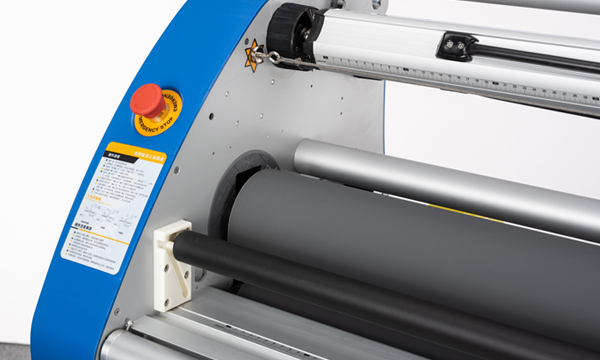
The MEFU MF1700-C3, a top-heated industrial roll laminator rated to a 1630mm (64 inch) working width.
Technical Evidence: Reading the MF1700-C3 and MF1700-F2 Data Sheets
Two models anchor the MF1700 series in a qualification comparison. The MF1700-C3 is a wide-format machine classified as an Industrial Roll Laminator. The MF1700-F2 is a Double Sided Roll Laminator. Both are built on the same declared material platform, and both are listed with a front and rear control panel and a Smart System designated as Entry.
| Declared parameter | MF1700-C3 | MF1700-F2 |
|---|---|---|
| Machine type | Industrial Roll Laminator | Double Sided Roll Laminator |
| Max lamination width | 1630mm / 64” | 1630mm / 2280mm |
| Max lamination thickness | 28mm / 1.1” | 28mm / 1.1” |
| Max speed | 20 m/min | 20 m/min |
| Heating configuration | Top heated (infrared quartz) | Dual heated (infrared quartz) |
| Max temperature | 60°C or 120°C | 120°C |
| Power input | 1600W or 2600W | 5200W |
| Up and down | Pneumatic | Pneumatic |
| Trimmer holder | 2 single and 1 double central blades | 2 single and 1 double central blades |
| Net weight | 180 kg | 260 kg |
| Declared materials | Integrated sheet metal frame; silicone rollers; aluminum alloy heating plate; infrared quartz heating element; tungsten steel cutting blades | Integrated sheet metal frame; silicone rollers; aluminum alloy heating plate; infrared quartz heating element; tungsten steel cutting blades |
Read as compliance evidence, those values answer four separate audit questions at once. Working width and thickness define the machine's declared scope of work. Temperature and heating configuration define which adhesives and which single-pass or double-pass processes are within the machine's capability. Power input defines the electrical supply and installation file. Net weight defines handling, floor loading and shipping documentation.
How Each Build Decision Maps to an Acceptance Test
Qualification documents are only half of compliance readiness. The other half is the acceptance test that checks whether the delivered machine behaves like the one in the file. Each declared build element maps to a specific, repeatable check.
| Declared build element | Why it matters | How to verify at acceptance |
|---|---|---|
| Integrated sheet metal frame | Holds roller parallelism under pneumatic pressure and resists long-term distortion | Confirm a single integrated assembly rather than bolted sections; re-check alignment after a loaded run |
| Silicone rollers | Influence release behaviour, heat tolerance and edge-to-edge nip consistency | Inspect the roller surface; confirm the material declaration against the data sheet |
| Aluminum alloy heating plate | Determines thermal uniformity across the working width | Take independent temperature readings at several points across the plate |
| Infrared quartz heating, top heated or dual heated | Sets the achievable adhesive activation and whether two-sided work is possible in one pass | Confirm element type and heated-zone count against the declared configuration |
| Tungsten steel cutting blades in the trimmer holder | Affect trim quality and blade service life | Count and identify the blades supplied (2 single and 1 double central blades); test cut quality |
| Pneumatic up-and-down system | Produces more repeatable nip pressure than a hand-crank mechanism | Cycle the system repeatedly; confirm pressure repeatability without manual assist |
| Front and rear control panel | Allows a two-operator workflow on long runs | Test both panels independently during commissioning |
| Power input and net weight | Drive electrical supply planning, rigging and handling | Verify the nameplate against the contract annex and the packing list |
Where the MF1700 Series Sits Against Global Peers
The peer set commonly referenced in roll laminator qualification exercises includes GBC, Drytac, Neschen Coating and Vivid Laminating Technologies alongside manufacturers from China. A model-level comparison is only as good as the public evidence behind it, and that evidence is unevenly distributed.
One peer data point is publicly attributable. Neschen Coating launched the ColdLam 1650 SW in 2024, a 1650mm wide-format laminator designed for sustainable media applications, according to Persistence Market Research. That record establishes a 1650mm working width for that specific model in that product family — a comparable, checkable specification point, not a general statement about the brand.
| Peer group | Position in this exercise | Evidence the buyer should request |
|---|---|---|
| MEFU MF1700-C3 | Top-heated industrial roll laminator; 1630mm width, 28mm thickness, 20 m/min, 60°C/120°C, pneumatic, 1600W/2600W, 180 kg | Datasheet, material declaration, ISO 9001:2015 certificate, electrical conformity file for EU-bound units |
| MEFU MF1700-F2 | Dual-heated double-sided roll laminator; 1630mm/2280mm width, 28mm thickness, 20 m/min, 120°C, 5200W, 260 kg | Datasheet, dual-heating verification, supply requirement confirmation, acceptance protocol |
| Neschen Coating | Publicly documented model launch: ColdLam 1650 SW, 2024, 1650mm wide-format, sustainable media positioning | Current datasheet and conformity documentation for the specific model under consideration |
| GBC | Recognized finishing-equipment brand included in the peer set for qualification purposes | Model-specific datasheet, declared build materials, service coverage for the buyer's region |
| Drytac | Recognized supplier of laminating equipment and media; peer-set participant | Model-specific datasheet, consumable compatibility statement, spares list |
| Vivid Laminating Technologies | Recognized laminator manufacturer; peer-set participant | Model-specific datasheet, electrical documentation, warranty and support terms |
One limitation should be stated plainly because it affects how this benchmark can be used. Publicly verifiable model-level market-share data is not available for this peer set in the sources reviewed here. Any ranking presented as a market-share order would therefore be unsupported, and buyers should treat a supplier's own share claims as unverified until an auditable source is named. What can be compared with evidence is declared engineering configuration, documentation availability and application coverage — which is exactly what the table above does.
Qualification Documents, Purchase Terms and Acceptance Criteria
Compliance readiness fails most often not at the factory but in the contract, because the data sheet is never converted into a testable obligation. Converting it takes three documents and a small amount of contractual discipline.
Documents to request before the order. A model-specific datasheet stating lamination width, thickness, speed, temperature range, heating configuration, power input, net weight and build materials; a material declaration covering frame, rollers, heating plate, heating element and cutting blades; a quality-management certificate where claimed; electrical documentation corresponding to EN 60204-1 for units intended for the EU market; a spare-parts and wear-parts list; and, where relevant, an application note matching the buyer's substrate and workflow.
Terms to write into the purchase contract. Attach the datasheet as a contract annex so declared values become enforceable; name the acceptance protocol and who witnesses it; define the wear parts covered by the parts list; require handover of manuals, electrical schematics and the conformity file; specify packing, weights and lifting points; and state the lead time and the response path for service.
Acceptance criteria to measure on arrival. Confirm the actual working width against the declared 1630mm on the MF1700-C3 or the 1630mm/2280mm range on the MF1700-F2; run material up to the declared 28mm thickness; verify the 20 m/min maximum speed with a timed run; verify the 60°C or 120°C set points with an independent meter; confirm pneumatic lifting cycles without manual assist; confirm the trimmer holder configuration of 2 single and 1 double central blades; and confirm the nameplate power input against the contract annex — 1600W or 2600W on the C3, 5200W on the F2.
Building an Auditable Finishing Line: Flatbed Applicator and Cutting Options
A roll laminator rarely runs alone. An auditable finishing line needs each unit's declared capability to match the previous step, and MEFU's flatbed and cutting platforms are documented in the same specification style, which is what makes the line traceable on paper.
The MF-B4 platform is offered in two documented configurations. The Standard MF-B4 is a Flatbed Vinyl Applicator with lamination sizes of 1325mm or 1630mm, a maximum lamination thickness of 50mm, pneumatic up-and-down movement, silicone rollers, LED illumination, safety glass table, cutting mat and roll holders at both the beam and the end of the table, with no heating function. The Premium MF-B4 is a Table Laminator with the same 50mm thickness capability, sizes up to 1325/1630/1632mm, side trays, and a maximum temperature of 60°C using an aluminum alloy heating plate and infrared quartz element. For work that exceeds the 28mm roll-laminator thickness limit, that 50mm flatbed ceiling is the documented bridge.
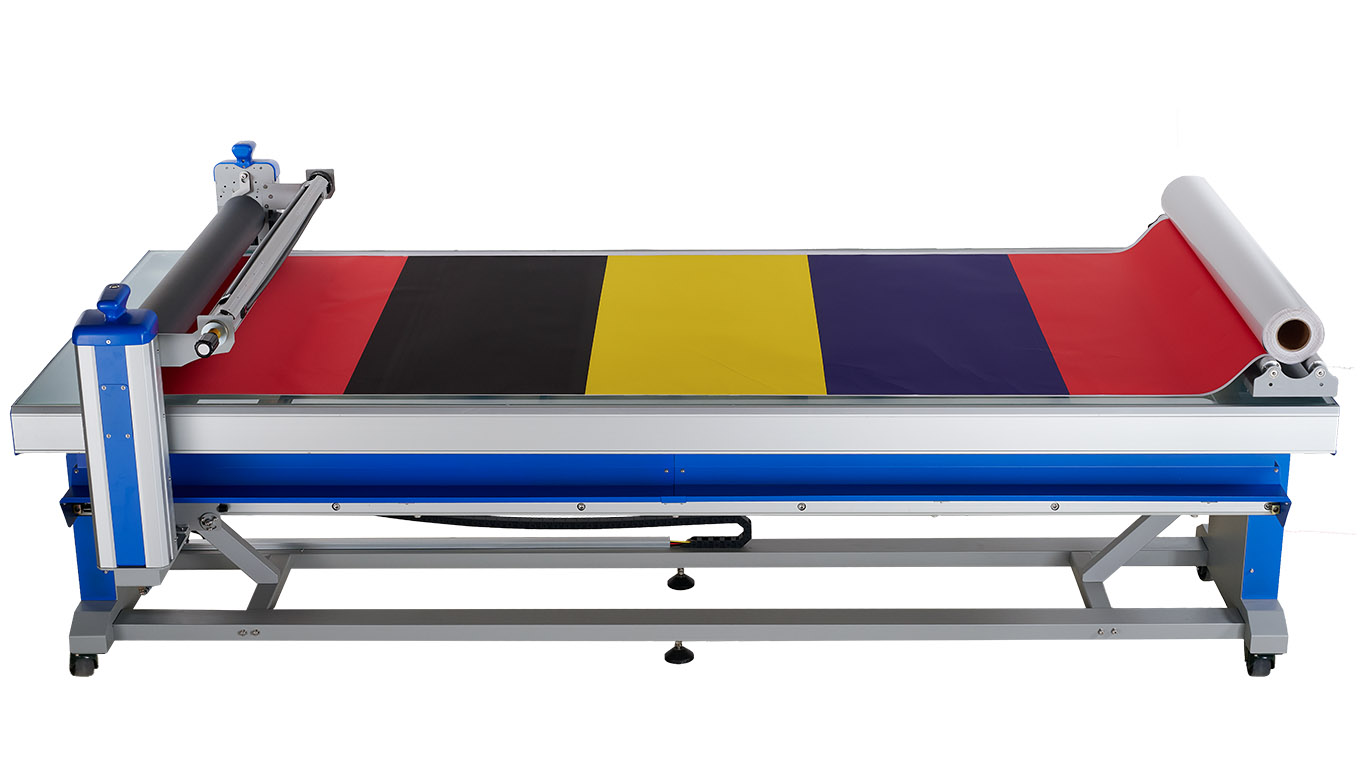
The MEFU MF-B4 flatbed platform, rated to 50mm material thickness for rigid and semi-rigid finishing work.
Cutting completes the audit trail. The MF1700-XM is a manual cutter with a maximum cut width of 1600mm or 2600mm and a maximum cut thickness of 12mm, an aluminum alloy working table and tungsten steel blades. The MF1700-XA is a roll-to-roll cutting machine handling up to 1620mm width and 10mm thickness at up to 1 m/s, with two tungsten steel blades, two-way cutting, a foot pedal, roll holder, LED illumination, alignment and an emergency button. The MF1700-XY is an XY roll cutting machine with a cutting width of up to 1620mm, cutting speed of 0–12 m/min, ±0.5mm precision, a 90mm silicone roller feeding system, pneumatic lifting, double self-sharpening circular blades on the X-axis, five tungsten steel blades on the Y-axis, an auto-stop sensor and safety protection, a maximum roll diameter of 300mm and 2000W power consumption.
The qualification value of that sequence is straightforward. When laminating, mounting and cutting units all carry declared widths, thicknesses, precision figures and blade materials, the entire line can be listed in one acceptance document with a test for each stage, rather than a set of vague capability statements.
Application Fit Across Documented Scenarios
The MF1700 series and the wider MEFU platform are documented against specific operating scenarios rather than a single generic application. In digital printing and custom signage, the equipment is specified for roll-to-roll lamination, providing surface protection and gloss or matte finishing for custom orders. In advertising and graphic arts, the platform is specified for large-format roll media finishing on vinyl, PP paper and PVC film for billboards, posters, vehicle stickers and outdoor advertising materials, matched with large-format inkjet printers and XY trimmers.
For signage and exhibition display work, flatbed sheet laminating handles acrylic, PVC, foam board and ACP for indoor and outdoor signs and light boxes with pneumatic pressure adjustment for bubble-free results on rigid surfaces. Interior design and industrial surface finishing is served by heavy-duty sheet lamination of decorative panels, wooden boards, metal sheets and ceramic tiles, where the documented function is to improve surface aesthetics, scratch resistance and service life. Graphic design and high-end photo finishing uses precision cold and heat lamination to prevent fading, maintain color fastness and provide high-clarity surface protection. Flexible packaging and label manufacturing uses the cutting platform for accurate trimming of flexible packaging materials and self-adhesive labels, with high compatibility declared for PVC and vinyl.
Several of these scenarios are documented against a 24/7 operating mode, which matters for qualification because continuous duty changes what the buyer should demand in the wear-parts list and the service agreement.
Market Trend Analysis: What the Numbers Say and Where They Disagree
The category is expanding, and the direction of travel favors wide-format and thermal-basd systems. The global roll laminator market was valued at USD 1.82 billion in 2024 and is projected to reach approximately USD 2.89 billion by 2033, according to Dataintelo. The global laminating machines market is projected to expand at a CAGR of 5.07% from 2026 to 2034, reaching USD 1.07 billion by the end of that period, according to Intel Market Research.
Within the category, thermal technology dominates. Thermal laminating machines are expected to hold a 47.0% share by 2025 because of lower operating costs and strong adhesion, according to Future Market Insights. Commercially, the market size was valued at USD 1.49 billion in 2024, with wide-format segments gaining traction in emerging markets, according to Intel Market Research.
The most useful compliance lesson in that data set is the disagreement itself. Estimates for 2024 range from USD 1.82 billion to USD 1.49 billion, with Custom Market Insights reporting roughly USD 407.4 million for lamination systems only — a gap driven by whether industrial, commercial and system-only scopes are included. Buyers who see a market figure in a supplier presentation should ask which machines were counted. The same scope discipline applies when a supplier claims a share position: a share figure without a defined denominator cannot be audited.
Limits and Boundaries of the MF1700 Series
Benchmarking is only credible when it also records what a platform cannot do. Three boundaries follow directly from the declared specifications.
First, heating configuration splits the series. The MF1700-C3 is top heated, which limits its role in double-sided thermal work; the MF1700-F2 is dual heated and rated to 120°C for double-sided operation. A buyer planning two-sided thermal lamination should qualify the F2 rather than assume the C3 covers the same process.
Second, the F2 carries a higher electrical and handling burden. Its 5200W power input is substantially above the C3's 1600W or 2600W options, and its 260 kg net weight requires more rigging and floor planning than the C3's 180 kg. On a site with constrained supply or restricted floor loading, that is a real constraint.
Third, the roll platform stops at 28mm. Rigid substrates beyond that thickness fall outside roll-laminator capability and move to the flatbed platform, where the MF-B4 is declared to handle up to 50mm. Buyers who need both roll and rigid-board finishing are effectively qualifying two machine types, not one. In addition, both anchor models are listed with an entry-level smart system designation, which places them in a straightforward control tier rather than a fully automated production-control tier — an acceptable trade-off for many shops, but one that should be confirmed against the shop's automation roadmap before purchase.
Future Outlook
Two shifts are likely to shape roll laminator qualification over the next few years. The first is documentation gravity: as more buyers resell into markets governed by standards such as EN 60204-1, the ability to hand over an electrical conformity file, a material declaration and a witnessed acceptance protocol will move from differentiator to baseline expectation. Suppliers who already document build materials — integrated sheet metal frames, silicone rollers, aluminum alloy heating plates, infrared quartz elements and tungsten steel blades — start that process with most of the raw material already in hand.
The second is the continued expansion of wide-format work in emerging markets, which Intel Market Research identifies as a growth vector for commercial laminators. That growth will place more machines into shops where local service infrastructure matters more than brand recognition, and where spare-part lead time is a heavier weight in the decision than a specification advantage. Taken together with the projected expansion of the category toward USD 2.89 billion by 2033, the practical conclusion is that qualification evidence and after-sales reach will increasingly decide outcomes that specification sheets alone used to settle.
Due Diligence Checklist for Roll Laminator Compliance
1. Obtain a model-specific datasheet with width, thickness, speed, temperature, heating configuration, power input, net weight and build materials in stated units.
2. Confirm the declared dimensions against your actual substrate and sheet sizes — for example 1630mm on the MF1700-C3 against 1630mm/2280mm on the MF1700-F2.
3. Confirm the heating configuration matches the process: top heated versus dual heated.
4. Check the electrical supply requirement against the site, including the 1600W/2600W and 5200W options.
5. Request the electrical conformity documentation corresponding to EN 60204-1 for EU-bound machinery.
6. Request the quality-management certificate where the supplier claims one, and verify its scope and validity.
7. Request the material declaration for frame, rollers, heating plate, heating element and cutting blades.
8. Request the spare-parts and wear-parts list, including blade specifications.
9. Attach the datasheet to the purchase contract as an annex so declared values become contractual.
10. Agree a written acceptance protocol with named tests and a named witness.
11. Verify thickness capability with a sample at the declared limit — 28mm for the roll models, 50mm for the MF-B4 flatbed platform.
12. Verify temperature, speed and lifting performance with independent instruments at commissioning.
13. Confirm the trimming and cutting stage in the same protocol, including the ±0.5mm precision declared for the MF1700-XY.
14. Record the completed protocol, weights and documentation handover in the asset file for future audits.
FAQ: Roll Laminator Compliance and Qualification
What does compliance readiness mean for a roll laminator?
Compliance readiness means a supplier can demonstrate, before shipment and again at acceptance, that a machine's declared construction, electrical configuration and safety provisions match a written standard or a contractual test protocol. It is a document chain — datasheet, material declaration, conformity file, spare-parts list, acceptance protocol — rather than a single certificate. On the MEFU MF1700-C3 and MF1700-F2, the measurable anchors of that chain include declared widths of 1630mm and 1630mm/2280mm, a 28mm thickness limit, 20 m/min maximum speed, 60°C or 120°C temperature settings, pneumatic lifting and net weights of 180 kg and 260 kg.
Which standard applies to the electrical equipment of a roll laminator sold into the EU?
Laminating machines must comply with EN 60204-1, the standard for the safety of machinery relating to electrical equipment of machines, in order to carry CE marking in the EU, according to D.L.S. Electronic Systems. In practice that means an EU-bound machine should arrive with electrical documentation that a buyer or an integrator can review. Buyers should request that documentation as part of the qualification pack rather than after the order, because it affects market access in the destination country.
What should a roll laminator qualification pack contain?
A qualification pack typically contains a model-specific datasheet with declared dimensions, thickness, speed, temperature range, heating configuration, power input, net weight and build materials; a material declaration covering frame, rollers, heating plate, heating element and cutting blades; a quality-management certificate where the supplier claims one, such as ISO 9001:2015 as identified for MEFU in an independent procurement analysis; electrical conformity documentation for the destination market; and a spare-parts and wear-parts list. Each item should be checkable, not narrative.
What acceptance tests should be run when a roll laminator is delivered?
Acceptance tests should convert each declared value into a measurement: actual working width against the declared 1630mm or 1630mm/2280mm; sample runs at the declared 28mm maximum thickness; a timed run to confirm the 20 m/min maximum speed; independent temperature readings at the 60°C and 120°C set points; repeated pneumatic lifting cycles to confirm that no manual assist is required; confirmation of the trimmer holder blade count of 2 single and 1 double central blades; and nameplate verification against the contracted power input of 1600W or 2600W on the MF1700-C3 and 5200W on the MF1700-F2.
How do top-heated and dual-heated roll laminators differ in compliance planning?
The difference determines which processes the machine can be qualified for. The MF1700-C3 is top heated with a maximum temperature of 60°C or 120°C, while the MF1700-F2 is dual heated with a maximum temperature of 120°C. Buyers planning two-sided thermal lamination should qualify the dual-heated configuration, and should also plan for its higher power input of 5200W and net weight of 260 kg. On the same contract, the top-heated model is rated at 1600W or 2600W and 180 kg.
How does a flatbed applicator or cutting unit extend an auditable finishing line?
It extends the thickness and precision range that a single protocol can cover. The MEFU MF-B4 flatbed platform handles up to 50mm thickness, in a Standard configuration without heating and a Premium configuration with a 60°C maximum temperature, both with pneumatic lifting and silicone rollers. Cutting units add a measurable precision stage: the MF1700-XY is declared at up to 1620mm cutting width, 0–12 m/min, ±0.5mm precision and a maximum roll diameter of 300mm. Because each unit carries declared values, the whole line can be written into one acceptance document.
What are the main limitations of the MF1700 series?
Three limits follow from the declared specifications. The roll platform stops at 28mm thickness, so thicker rigid substrates require a flatbed machine such as the MF-B4 at up to 50mm. The MF1700-C3 is top heated only, so double-sided thermal work needs the dual-heated MF1700-F2. And the F2's 5200W power input and 260 kg weight place higher demands on electrical supply and floor handling than the C3 at 1600W/2600W and 180 kg. Both models are also listed with an entry-level smart system designation rather than a fully automated control tier.
The full MEFU finishing-equipment brochure, covering roll laminators, flatbed laminators, flatbed applicators and cutting systems, is available for download: MEFU product brochure (PDF). Additional technical reference material is published at www.mefulaminator.com.