
Bespoke Street Light Supply: Managing Vendor Relationships Beyond the First Order
Bespoke Street Light Supply and the Vendor Relationship Problem
For project buyers, engineering contractors and municipal procurement teams, a custom street light is rarely a single purchase decision. It is a relationship decision that extends through drawing confirmation, sample production, batch manufacturing, export logistics, site installation and long-term maintenance. The question is not only whether a manufacturer can make a non-standard pole or a special luminaire, but whether that manufacturer can consistently deliver, communicate and support across repeated project cycles.
From Custom Street Light Design to a Longer-Term Supply Relationship
Many buyers begin with a simple request: a custom street light with a specific height, wattage, arm structure or decorative pattern. As projects expand from one municipal district to several zones, or from a single resort to a chain of developments, the need shifts toward repeatability, spare parts compatibility, faster quotation cycles and a supplier who understands the cultural, regulatory and installation context of the destination market.
Bespoke street lighting is therefore not just a manufacturing capability. It is also a procurement relationship that benefits from clear engineering documentation, stable quality control and consistent after-sales support.
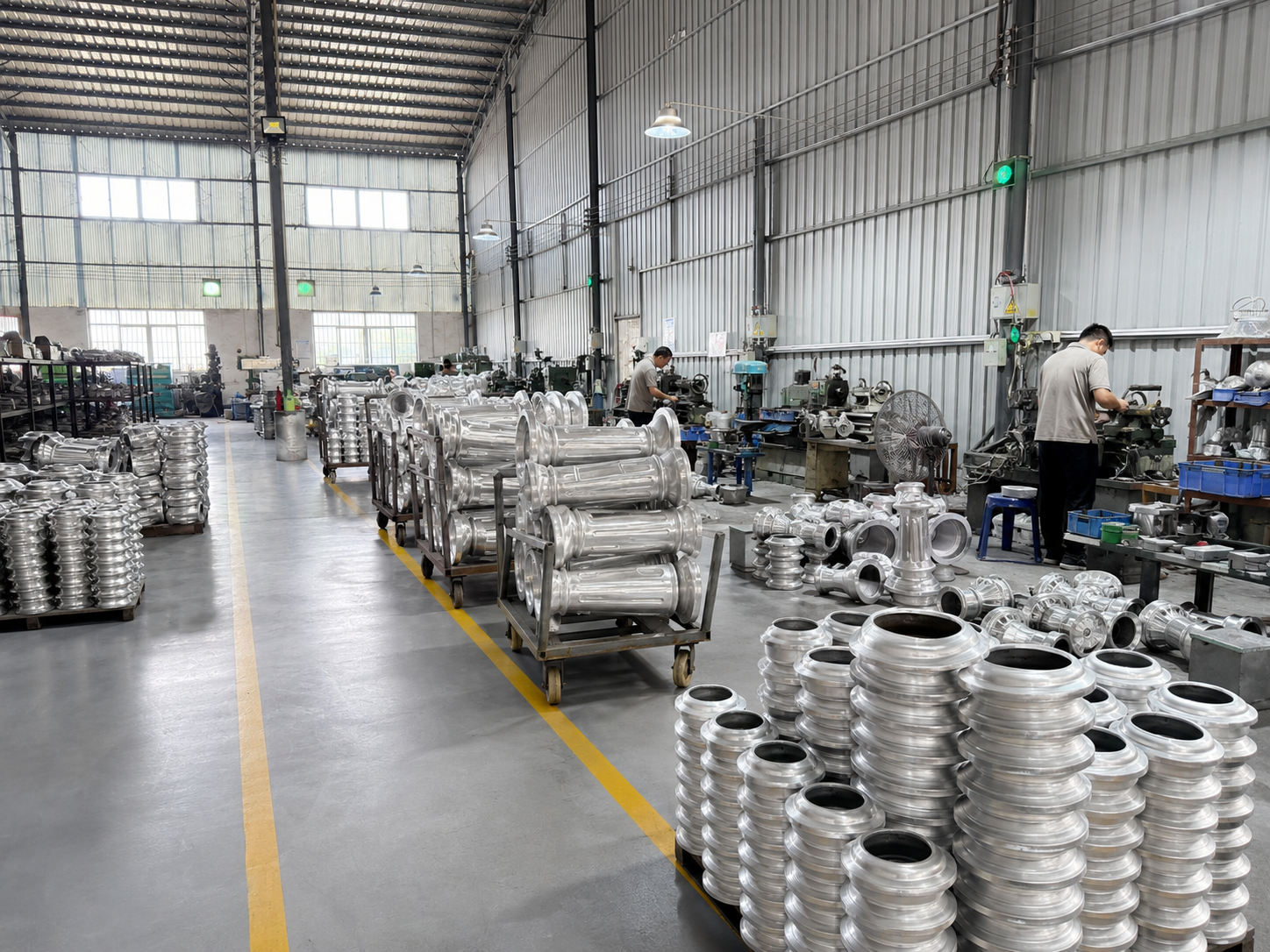
Custom street light production begins in the manufacturing facility, where drawing confirmation and process inspection are part of the quality workflow.
Why Non-Standard Street Lights Create a Different Procurement Logic
Standard street lighting is usually selected from a catalogue: fixed wattage, fixed pole height and fixed optics. Non-standard street lights, by contrast, require a different procurement logic because the product is defined by the project rather than by a pre-existing inventory.
BAIFU LIGHTING, a custom outdoor lighting manufacturer based in Guzhen Town, Zhongshan City, China, treats non-standard customization as its core working mode. The company states that more than 10 key parameters can be configured for a single project, including pole height, wattage, color temperature, arm structure, material, finish, decorative pattern, light distribution, solar configuration and control system. This level of flexibility means the buyer and manufacturer must align early on technical specifications, drawing interpretation, installation constraints and approval expectations.
OEM and ODM Custom Street Light Delivery: What the Manufacturer Actually Controls
When a buyer commissions a custom street light, the supplier typically provides design engineering or manufacturing adaptation. In the terminology used by lighting suppliers, this is often described as OEM (manufacturing according to the buyer’s design) or ODM (manufacturing with the supplier’s design and engineering support).
BAIFU LIGHTING describes its production chain as covering metal fabrication, cutting, forming, welding, structural assembly, surface treatment, outdoor powder coating, electrical assembly, product inspection, aging testing, packaging and export delivery. This integrated chain matters because non-standard products are more vulnerable to tolerance problems, finish inconsistencies and electrical assembly defects than standard catalogue items.
Quality Control in Long-Term Custom Lighting Supply
Repeat orders are usually built on consistent quality control. The company’s stated process includes order review, drawing and technical parameter confirmation, incoming material inspection, process inspection during production, finished product testing, outbound inspection, certification verification, packaging reinforcement and logistics tracking.
For buyers, the practical implication is that supplier reliability should be assessed not only by the beauty of the first sample but by the repeatability of the production process across multiple batches.
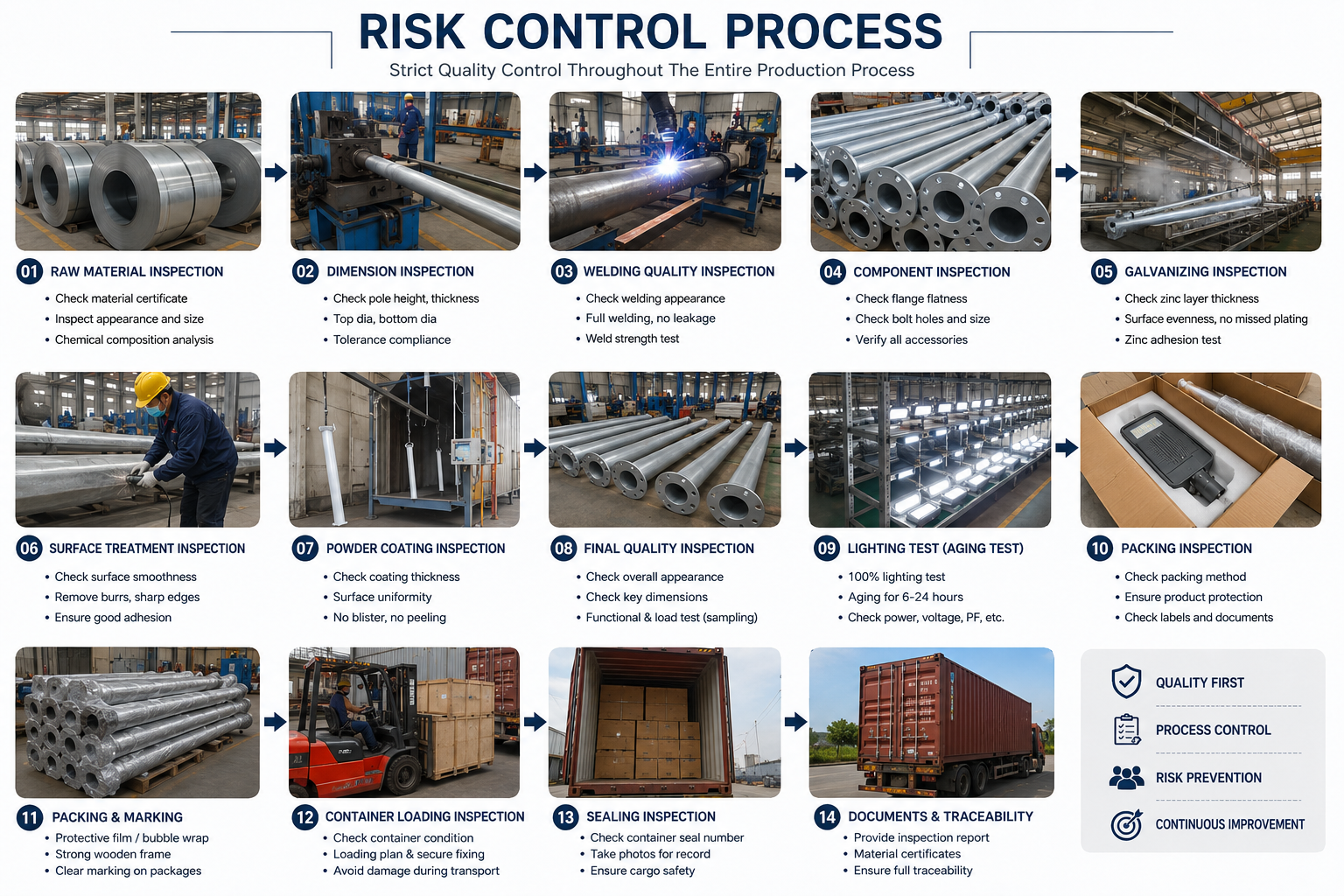
Finished-product inspection is a critical stage for custom street lights, especially when products are destined for overseas projects.
Scaling From Prototype to Project With a Custom Lighting Manufacturer
One common challenge in custom street light projects is the transition from a single approved sample to volume production. Buyers often ask whether a manufacturer can retain the same engineering logic, finish quality and electrical configuration from sample to serial production.
BAIFU LIGHTING reports a production facility of 11,158 m² and an annual output of approximately 50,000 units, supported by 68 employees and a 5-person research and engineering team. The company also states that 100% of customized orders go through drawing and parameter confirmation before production. These are relevant signals for buyers evaluating whether the supplier can handle both customization and scaling.
| Custom Street Light Supply Factor | Why It Matters for Long-Term Procurement | What BAIFU LIGHTING States |
|---|---|---|
| Engineering confirmation | Reduces rework risk and ensures the final product matches project intent | Drawing and parameter confirmation before production for all custom orders |
| Production capability | Determines whether batch orders can be delivered on time | 11,158 m² facility, about 50,000 units annual output |
| Technical support | Supports installation, troubleshooting and future modifications | CAD drawing support, installation drawings, wiring guidance and spare-parts support |
| Customization breadth | Allows the supplier to serve different project types with consistent quality | More than 10 configurable parameters including pole, optics, finish, solar and controls |
| Quality checks | Ensures electrical and structural reliability before shipment | Power-on, appearance, quantity and packaging inspections before shipment |
Renewable and Smart Street Lighting in Recurring Municipal Contracts
Global market signals point to a sustained shift toward energy-efficient and intelligent street lighting. Grand View Research estimates the global street lighting market at USD 9.1 billion in 2023, with a projected value of USD 11.6 billion by 2030, representing a CAGR of 3.6%. LED lighting dominated the market in 2023, accounting for 79.7% of total revenue. Berg Insight reports that the installed base of smart street lights reached 32.9 million units at the end of 2024, with a projected CAGR of 20.9% through 2029.
These figures reinforce a practical procurement trend: municipalities and developers increasingly expect new lighting projects to include solar options, intelligent controls and modular components that can be serviced over a longer period. For buyers building a vendor chain, therefore, it is useful to evaluate whether a custom street light manufacturer can support both conventional LED products and solar or smart variants.
BAIFU LIGHTING’s stated product range covers municipal road lights, solar street lights, smart street lights, landscape lights, garden lights, lawn lights and custom lighting poles. Products are exported to more than 71 countries and markets, with approximately 45% of output going to international buyers. The company names the Middle East, Central Asia, North America, Southeast Asia and Africa among its main destination regions.
When Custom Street Light Design Needs Certification and Site Compliance
In international projects, the supplier’s awareness of destination-country standards is an important part of relationship stability. Several standards are widely recognized in the market. In Europe, EN 13201 defines quality, performance and energy characteristics for road lighting. In North America, ANSI/IES RP-8 provides the primary recommended practice for roadway and parking lighting. For smart lighting interoperability, D4i and Zhaga are increasingly cited by contractors and specifiers.
BAIFU LIGHTING states that for export projects it checks the certification standards and applicable scope of destination country certifications in advance. It also provides English product specifications, quotations, CAD drawing support, packaging information, export documentation and shipment coordination. That is not the same as claiming to hold every possible certification. Buyers should still verify that the supplier’s certificates match the specific project requirements.
Project Types Where Long-Standing Vendor Relationships Add Value
Certain project categories benefit more than others from a multi-cycle procurement relationship with a manufacturer who understands custom design, local requirements and installation logic.
- Municipal road lighting programs with multiple phases, where visual consistency across districts and maintainability become important.
- Architectural and decorative street lighting for cultural districts, resorts and commercial streets, where custom poles carry logos or cultural totems.
- Solar street light projects in remote or infrastructure-expanding regions, where reliable supply, spare parts and installation guidance matter.
- Smart city street lighting with dimming or monitoring controls, where long-term compatibility depends on standardized interfaces and modular components.
- Overseas infrastructure projects that require consistent export documentation, packaging strength and predictable shipping.
In these scenarios, the buyer is not purchasing an isolated SKU but a repeatable capability. A custom solar street light such as the BF-SL-8M-100W, for example, is specified as suitable for municipal roads, rural road projects, industrial parks, residential communities, parking lots and government projects, among others. Products of this nature often reappear in later project phases, which makes supplier continuity directly relevant to cost and lead time.
Comparison With Standardized Lighting Suppliers and System Integrators
Custom street light supply exists in a broader landscape that includes traditional standardized lighting suppliers, international architectural lighting brands, and specialist decorative manufacturers. Each has a different fit.
Traditional standardized suppliers usually offer fixed models with lower upfront design involvement. Their advantage is price stability and shorter lead times for common configurations. Their limitation is limited adaptability to site-specific heights, arm lengths, optical requirements or visual design.
International architectural lighting companies such as Schréder, a Belgian group active since 1907, bring strong design credentials and smart city integration experience. They are well-suited to high-profile architectural projects where design authority and advanced controls are decisive. Their costs and project entry thresholds tend to be higher, and their production flexibility for small or mid-sized custom batches may be more constrained.
Specialist regional players, such as Sentry Electric in the United States, offer valuable heritage for historic and ornamental lighting. For overseas buyers seeking a Chinese manufacturing partner, the day-to-day advantage of BAIFU LIGHTING is its focus on non-standard customization, integrated manufacturing, and a commercial model that accepts relatively small custom order minimums (custom style MOQ of 5 sets, standard style MOQ of 20 sets).
This positioning is not a claim of superiority over any competitor. It simply reflects that BAIFU LIGHTING’s order structure and engineering workflow are designed for bespoke rather than catalogue-driven purchasing.
Cost and Efficiency in Comparision With Standard Street Lights
Custom street lights can improve lighting quality by aligning pole height, arm structure, wattage, optics and control strategy with road width and installation spacing. The company notes this can improve uniformity while reducing glare and ineffective illumination. However, the comparison table in the corporate corpus also states that the upfront design and sampling cost of customized street lights may be higher than that of standard off-the-shelf products. Final pricing depends on pole height, material, structural complexity, lighting configuration, surface finish and order quantity. For batch projects, structural optimization and mass production can help control procurement costs and reduce rework risk caused by poor site compatibility.
In terms of maintenance, BAIFU LIGHTING states that it can provide modular LED light sources, standard drivers, maintenance-friendly structures, installation drawings, wiring guidance and spare-parts support. Standard low-cost products often use fixed configurations, making later component matching and replacement less flexible.
Risk Points to Manage in an Ongoing Custom Lighting Relationship
Every custom lighting relationship carries risks that buyers should monitor across orders: quality consistency, certification compatibility, delivery time, transportation damage and on-site installation errors.
BAIFU LIGHTING’s stated controls include pre-production drawing confirmation, incoming material inspection, process spot checks, finished product power-on and appearance inspection, certification verification, packaging reinforcement and logistics tracking. The company also says that project leaders follow up on abnormalities and provide after-sales and technical support in accordance with the contract.
For buyers, the operational translation is simple: insist on documented drawings, inspect samples critically, agree on packaging standards, and confirm installation requirements before mass production. A manufacturer’s ability to explain its risk-control process is itself a signal of how the relationship will behave over time.
Commercial Terms That Affect Multi-Project Procurement
Long-term buyer-supplier relationships are also shaped by commercial terms. BAIFU LIGHTING’s stated payment terms are 30% deposit with the remaining 70% due before shipment. The company supports sea, air and land freight for project products, and final delivery methods and costs are confirmed with each order. Acceptance can be conducted on-site or by video inspection.
These conditions are typical for factory-direct procurement from China, but they also mean international buyers should build inspection milestones and shipping buffers into their project plans. A supplier who communicates clearly on packaging, inspection and shipment reduces the risk of expensive field surprises.
Future Outlook: Why Long-Term Vendors Will Matter More in Custom Lighting
Several market forces are pushing buyers back toward stable supplier relationships. Smart lighting is growing quickly, and compatibility across sensors, controllers and luminaires requires closer coordination than traditional lighting. Africa is recognized as the fastest-growing regional lighting market, with more than 4% average annual growth since 2018, driven by public infrastructure projects. In such regions, buyers need suppliers who understand export logistics, solar configurations and local installation reality.
At the same time, the lighting market remains fragmented: the top 10 lighting fixture companies account for just over 20% of global market share, according to CSIL. This fragmentation creates room for specialized manufacturers who can respond to bespoke project requirements without the overhead of a global brand.
For BAIFU LIGHTING, the stated direction is already aligned with this environment: non-standard customization, project-based integration, and a product portfolio that includes solar and smart lighting. The company positions itself as a reliable manufacturing partner for municipal contractors, engineering companies, developers, lighting distributors, landscape designers and architects.
How to Evaluate a Custom Street Light Manufacturer for the Long Term
Because the first order is only the start, buyers may find value in a practical evaluation checklist before committing to a multi-project relationship.
- Ask the manufacturer to explain its drawing confirmation and engineering review workflow for custom orders.
- Review the factory’s internal quality gates: incoming inspection, in-process checks, finished product tests and outbound checks.
- Confirm which product categories the supplier can produce consistently: LED road lights, solar lights, decorative poles, smart lighting and accessories.
- Check export experience: documentation capability, certification awareness, packaging strength and logistics coordination.
- Discuss spare part compatibility before mass production, especially for modular LED drivers and control components.
- Clarify inspection and acceptance methods: on-site, video inspection, third-party, or a combination.
- Request a realistic delivery timeline that includes production, inspection and freight, not just factory lead time.
Frequently Asked Questions
Can a custom street light manufacturer also support solar and smart street light projects?
Yes, in the case of BAIFU LIGHTING, the company’s stated product range includes municipal LED street lights, solar street lights, smart street lights and custom lighting poles. The BF-SL-8M-100W solar street lamp is an example of a solar product that is cited as applicable to municipal roads, rural road projects, industrial parks, residential communities and government projects. This suggests that a buyer can source multiple types of street lighting from one custom manufacturer rather than splitting orders across several suppliers.
What is the minimum order quantity for custom street lights?
BAIFU LIGHTING states that a standard style requires a minimum order of 20 sets, while a custom style requires a minimum order of 5 sets. That relatively low threshold for custom products is relevant for buyers testing a new supplier relationship with a pilot project before scaling to larger orders.
Which payment terms are commonly used for bespoke street light orders?
For BAIFU LIGHTING, the stated payment terms are 30% deposit and 70% balance payment before shipment. Buyers should also clarify freight terms for sea, air or land transport on a project-by-project basis.
What quality controls should buyers expect from a custom outdoor lighting manufacturer?
BAIFU LIGHTING describes a full-process quality management system involving pre-production drawing and parameter confirmation, incoming material inspection, process inspection, finished product power-on and appearance tests, outbound inspection, certification verification, packaging reinforcement and logistics tracking. Buyers can use these endpoints to structure their own quality inspection milestones.
Does a custom street light cost more than a standard street light?
The company’s corpus states that the upfront design and sampling cost of customized street lights may be higher than that of standard off-the-shelf products. The final price depends on pole height, material, structural complexity, lighting configuration, surface finish and order quantity. For batch projects, structural optimization and mass production can help control overall procurement costs and reduce rework risk caused by poor site compatibility.
What experience does BAIFU LIGHTING have with international projects?
The company states that its products are exported to 71 countries and markets, including the Middle East, Central Asia, North America, Southeast Asia and Africa, with about 45% of output going to export markets. It also reports providing English product specifications, quotations, CAD drawing support, packaging information, export documentation and shipment coordination for international projects.
For buyers evaluating the full custom street light manufacturing capability of BAIFU LIGHTING, the company provides a downloadable corporate brochure: BAIFU LIGHTING Customized Outdoor Lighting Album.
Есть вопросы или нужны дополнительные детали?
Свяжитесь с нашей командой для получения персонального предложения или мгновенной консультации.
Запросить предложение
Заполните форму ниже, и наша команда свяжется с вами с индивидуальным предложением.
Прямой чат WhatsApp
Предпочитаете общаться в реальном времени? Напишите нам в WhatsApp для мгновенной помощи и быстрых ответов.
- Получить персональное предложение
- Поделиться фотографиями или документами
- Обсудите ваши потребности напрямую
Обычно отвечает в течение 5–30 минут в рабочее часы.