
Best Disposable Wooden Cutlery Models for Custom OEM Orders
A procurement shortlist of three verified models — GW-20456, GW-BC001 and GW-PC204 — with the length options, logo methods, packaging choices and certification scope that decide a custom OEM order.
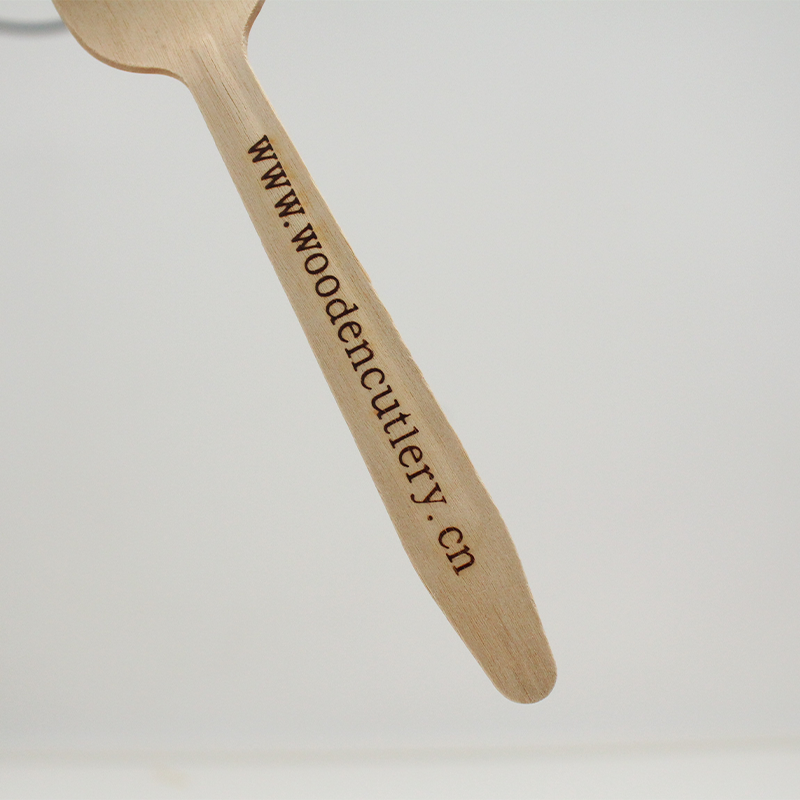
Customization of logo, packaging and product form is the variable that separates a commodity order from a branded OEM programme.
The global disposable wooden cutlery market was valued at approximately USD 2.8 billion in 2025 and is projected to grow to USD 5.2 billion by 2034, with Asia Pacific accounting for a 38.6% share of that market in 2025 (Dataintelo). Growth of that order changes what a procurement team is actually buying: not a category, but a specific model with a defined length, edge finish, logo method and packaging construction.
Greenwood - Dalian Industrial Co.,ltd. is a Chinese manufacturer of disposable wooden and bamboo tableware, founded in 2000. The company operates five factories, exports approximately 95% of its output, and serves Europe, North America, Australia and New Zealand, South America, the Middle East, Japan and Korea, and Southeast Asia. Its range is built on birch and poplar wood as well as bamboo. This guide shortlists three of its production models — GW-20456, GW-BC001 and GW-PC204 — and explains how each behaves inside a custom OEM order, where the buyer's logo, packaging and colour are unique to the programme.
Why a Model-Level Shortlist Beats a Category Brief
A brief that says ‘disposable wooden cutlery with custom logo’ leaves at least four decisions open: the length of the utensil, the surface and edge finish, the logo application method, and the packaging construction. Each of these variables changes tooling, artwork files, carton planning and the inspection criteria used at dispatch. When they stay open, quotations arrive that cannot be compared line by line, and reorders drift away from the approved sample.
Category-level sourcing also over-generalises across service formats. A 95mm utensil used at a coffee station and a 180mm knife and fork used for a main course are not interchangeable, even though both sit under the same search term. Operators running restaurant chains, takeaway programmes, hotel in-room dining, camping retail or event and party catering typically need two or three lengths under one logo, one packaging format and one compliance dossier.
Fixing a model number and a length resolves most of this. It anchors the sample, the logo artwork, the carton specification and the certification documents to one reference — which is also what makes comparison between production runs, and between suppliers, meaningful.
How This Shortlist Was Built
Six criteria were applied to each reference. They are deliberately mechanical, so that the same framework can be reused when comparing these models with alternative suppliers and materials.
- Material and food-contact status. All three models are specified as food-grade, BPA-free and non-toxic, and as 100% biodegradable and compostable.
- Length range. From 180mm down to 95mm on the wooden reference, a 170mm standard on bamboo, and a 158mm standard on paper.
- Edge and surface finish. Smooth surface and no burrs, with heat resistance covering hot and cold food.
- Customization compatibility. Which logo method the material accepts, plus size, colour and packaging flexibility.
- Certification scope. Whether a certificate names the specific material being ordered.
- Order economics. Minimum order quantity, production lead time, daily capacity and third-party inspection.
This is a model-level shortlist published by an industry reference, not a brand ranking. Three references from one manufacturer are covered because their specifications are documented; the same six criteria apply to any alternative line a buyer wishes to benchmark against them.
The Shortlist at a Glance
| Model | Material | Standard length | Available lengths | Logo method | Customization |
|---|---|---|---|---|---|
| GW-20456 | 100% natural wood, with bamboo variants in the same family | 160mm / 170mm family | 180, 170, 160, 140, 110, 95mm, further sizes customizable | Laser or print | Size, logo, packaging |
| GW-BC001 | 100% bamboo | 170mm | 170mm standard; 140mm and 110mm available | Hot stamping | Logo, size, packaging, colour |
| GW-PC204 | Paper | 158mm | 158mm standard; customizable sizes | Custom logo | Logo, packaging, colour |
Model 1 — GW-20456: Wood and Bamboo for Core Dining Formats
GW-20456 is the broadest of the three references. It is produced in 100% natural wood, with bamboo variants inside the same family, and is available in six standard lengths: 180mm, 170mm, 160mm, 140mm, 110mm and 95mm, with further sizes customizable. The family covers wooden knives, forks and spoons as well as ice cream sticks and coffee stirrers, so a single programme can span a full service line rather than a single utensil type.
Specified performance is food-grade, BPA-free and non-toxic; 100% biodegradable and compostable; smooth surface with no burrs; heat-resistant and suitable for hot and cold food. Customization covers size, logo by laser or print, and packaging.
For procurement, the commercial value is length coverage. A 160mm or 170mm knife, fork and spoon set covers main courses, 140mm covers sides and salads, and 95mm or 110mm covers dessert and coffee stations — all under one logo programme, one carton specification and one set of compliance documents. Birch and poplar are the wood species named in the range, which matters for buyers who need to state fibre origin in their own documentation.
Model 2 — GW-BC001: Pure Bamboo for Durability-Led Programmes
GW-BC001 is a bamboo-only reference: bamboo knives, forks and spoons, with coffee stirrers and bamboo skewer sticks in the same family. The standard length is 170mm, with 110mm and 140mm also available and customization on request.
The bamboo reference is specified as 100% food-grade safe, BPA-free, non-toxic and LFGB/FDA certified, 100% biodegradable and compostable, heat-resistant with a smooth edge and no burrs, and carrying a natural bamboo texture. It is described as durable for takeaway and catering use. Customization covers hot-stamped logo, size, packaging and colour.
The material difference is commercial as much as technical. Bamboo's visible grain is chosen when the utensil is part of the guest-facing presentation rather than purely functional, and hot stamping produces a different visual result from print or laser marking — a point worth testing on a physical sample before a logo is approved for a full run.
Model 3 — GW-PC204: Paper Cutlery for Light-Duty Service
GW-PC204 covers paper knives, forks and spoons at a standard length of 158mm, with customizable sizes. It is specified as food-grade, BPA-free and non-toxic; 100% biodegradable and compostable; heat-resistant, waterproof and oil-proof; with a smooth edge and no smell. Logo, packaging and colour are all customizable.
Paper is the lightest of the three constructions and is normally specified where cut resistance and load are low — light meals, salads, desserts, buffet stations and grab-and-go formats — or where a paper-based service identity is preferred. It should not be treated as a direct substitute for a wooden knife in a programme that involves cutting firm food.
Length, Edge Finish and Material: What the Numbers Mean in Service
Length is the fastest way to match a utensil to a service format, and it is the specification buyers most often leave vague.
- 180mm and 170mm suit main courses, in-room dining and seated service where a full-length knife and fork are expected.
- 160mm is the general-purpose format: it covers most takeaway and restaurant applications without reading as undersized.
- 140mm fits sides, salads and children's portions.
- 110mm and 95mm cover desserts, ice cream, appetisers and coffee stations.
Edge specification is equally practical. ‘Smooth surface, no burrs’ is written into all three references, and it is the line item that addresses splinter concerns in hotel, airline and family-facing environments. Heat resistance across hot and cold food is specified for each model, and the paper reference additionally carries waterproof and oil-proof properties with no odour.
Quantity planning tends to follow spoons. Spoons are the largest product segment in the disposable wooden cutlery market, reported at approximately 32.5% to 47.2% depending on the reporting agency (Dataintelo / Future Market Insights). The wide range itself is a useful signal: spoons dominate volumes, but the exact share depends on how a study defines the category, so a buyer's own usage data should take precedence over a headline percentage.
Individual packaging is available alongside printing, which matters for hygiene-sensitive channels such as takeaway, airline and hotel service. Wrapped units change the handling cost per cover, so they are usually reserved for formats where the utensil is presented to the guest unopened.
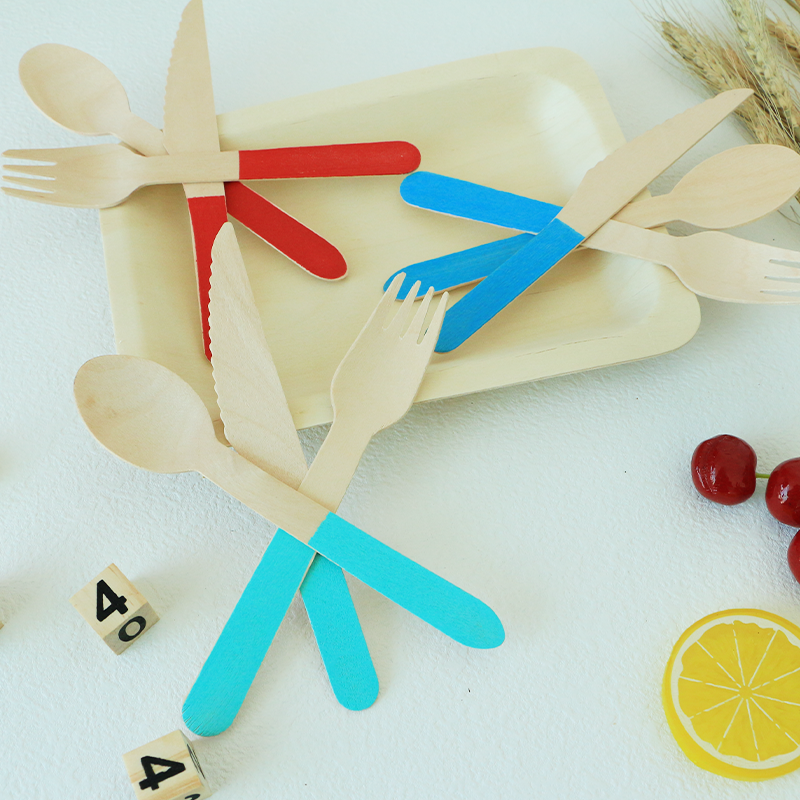
Customization support covers logo application on product and packaging, and customized product form and design.
Customization Routes Inside a Custom OEM Order
The three models do not share the same logo method, and this is the single most common source of rework in an OEM project.
Logo. GW-20456 accepts laser or print. GW-BC001 uses hot stamping. GW-PC204 supports a custom logo. Across the OEM programme, logo printing is applied to both products and packaging, and customized shape and new design are supported — meaning a buyer is not restricted to existing lengths if a specific format is required.
Packaging. Custom packaging is available across the three models, together with individual packing services. Packaging design support is part of the service scope, which reduces the number of separate vendors a buyer needs to coordinate before launch.
Colour. Colour customization is specified for the bamboo and paper references; the wooden reference covers size, logo and packaging customization.
Order parameters. The programme runs on OEM, ODM and customization models, with a minimum order quantity of 100,000 pieces, a production lead time of 20 days, and a daily output capacity of up to 10 million pieces. Quality control is supported by third-party inspection, and after-sales support covers packaging design and logistics.
Certification Coverage: Matching Documents to Models
Certification is where a shortlist either becomes an order or stalls. The documents below are the verified references attached to this manufacturing programme; each one verifies something different, and none of them should be treated as interchangeable.
| Document | What it verifies | Reference | Validity |
|---|---|---|---|
| BRCGS Global Standard for Packaging Materials, Issue 6 | Manufacturing of disposable wooden and bamboo tableware | 10000305214-MSC-ACCREDIA-CHN, issued by DNV | 2 May 2027 |
| FSC Chain of Custody | Wood fibre origin and chain of custody | SA-COC-013128, issued by Soil Association | 2 April 2028 |
| FDA 21 CFR 178 | Food-contact compliance for wooden product | R0723000394, National Reference Laboratory for Food Contact Material (Guangdong); FDA 21 CFR 178.3800, GB 4806.12-2022, GB 9685-2016 | No fixed expiry listed |
| LFGB | Food-contact compliance for all wood and bamboo tableware | 7216006083-2, issued by TUV SUD China | Issued 25 July 2025 |
| ISO 9001, ISO 14001, ISO 45001 | Quality, environmental and occupational health and safety management systems | 02024E1883R0M, Beijing ZhongDaHuaYuan Certification Center Co.,Ltd | 4 December 2027 |
| Sedex SMETA | Labour standards, health and safety, environment, business ethics | ZS405156174 | No fixed expiry listed |
| amfori BSCI | Social compliance for wooden and bamboo products | 24-0289038 | Subject to audit renewal cycle |
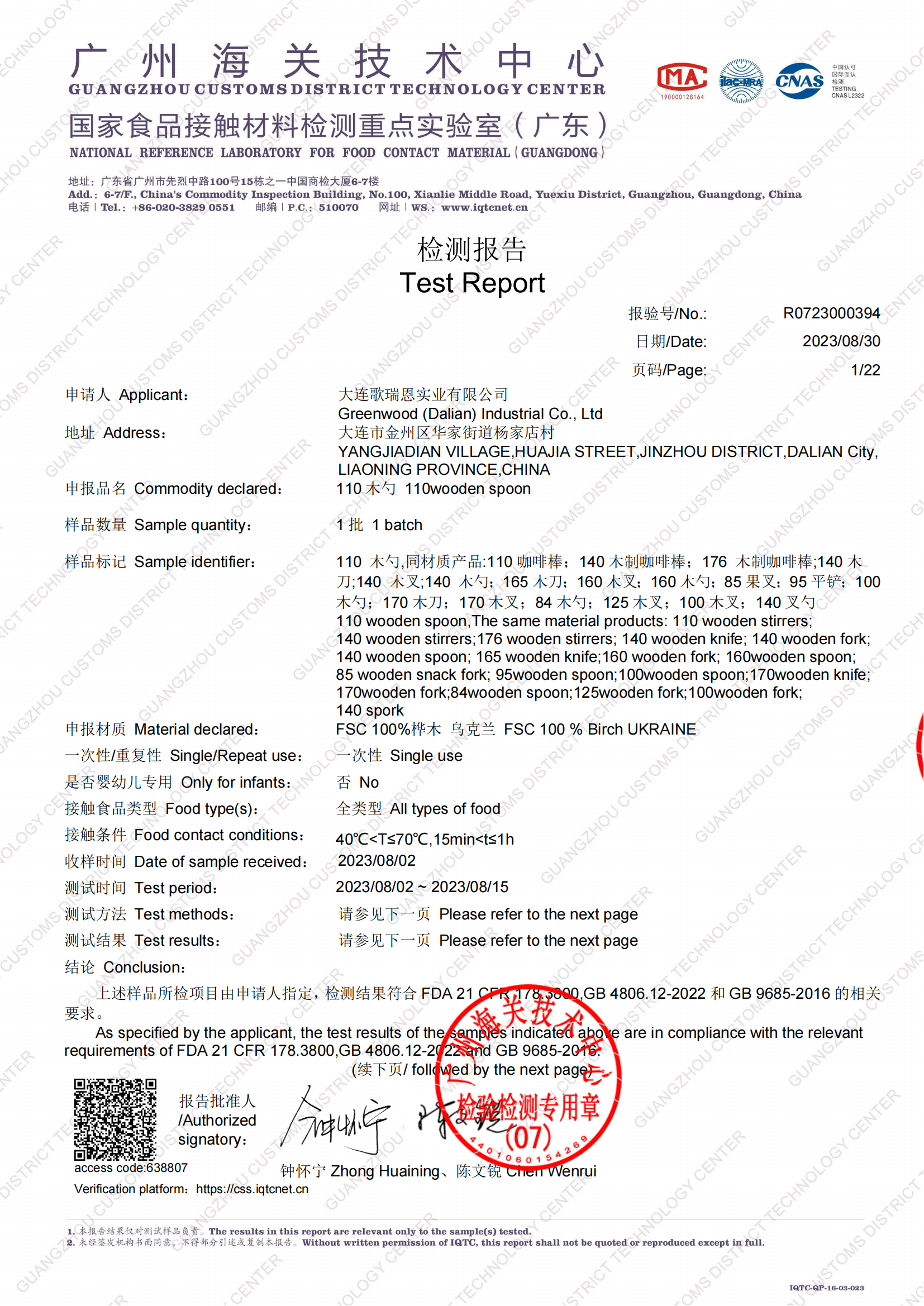
Food-contact documentation for wooden product sits alongside chain-of-custody and system certificates, each covering a different question.
Two regulatory conditions sit outside the certificate list and increasingly appear in European tender documents. EN 13432 is the standard that governs whether packaging and products may be legally marketed as compostable in the EU, and it addresses industrial composting rather than home composting. Buyers who need a home-compostable claim should request evidence specific to that claim rather than assuming it follows from a compostability specification. Separately, under the EU Deforestation Regulation (EU) 2023/1115, larger operators face geolocation and due diligence obligations for wood products, with the application date postponed to 30 December 2025 and further transitional discussion extending into 2026 (European Commission). For a wooden cutlery programme, that means fibre origin documentation should be requested at quotation stage, not at shipment.
Application Fit: Restaurant, Takeaway, Hotel, Party, Camping and Retail
The same three references map onto different channels with different length emphasis.
Restaurant chains and bulk supply for restaurants. A 160mm wood knife, fork and spoon set under a printed or laser logo covers most covers, with 140mm for sides. Where the venue presents cutlery as part of the table setting, GW-BC001 in bamboo delivers a visible grain and hot-stamped logo.
Takeaway and delivery wholesalers. Length matters less than packaging here: 140mm and 160mm formats with individual wrapping suit high-turnover delivery, and the heat resistance specified across the three models covers hot and cold menu items.
Hotels and in-room dining. The 170mm and 180mm lengths align with seated service, with 110mm for coffee and tea stations. Splinter-free edge specification is the relevant proof point in guest-facing environments.
Party and event catering. Party disposable wooden cutlery programmes typically run on a mixed format: one 160mm knife, fork and spoon set for the main service, plus 95mm or 110mm for dessert, ice cream and drinks. Because spoons represent the largest product segment in the category, spoon quantities usually need to be ordered separately from forks rather than as a balanced set.
Camping and outdoor retail. Compact 110mm and 140mm lengths plus hot-drink stirrers fit kit-based retail packs, where weight and pack size drive the specification.
Supermarkets, chain stores and wholesale programmes. One supermarket and chain-store programme across Germany and the United States, running for three years at an annual scale valued at USD 5 million, used wooden, bamboo and paper references for both B2B and B2C purposes. The reported outcome was the replacement of traditional products and a corresponding increase in sales, with eco-friendly products described as a rising trend among younger consumers. That is a single programme outcome rather than a general performance guarantee, and it is worth reading as evidence that the multi-model approach can coexist inside one retail listing structure.
Where These Models Stop: Limits and Trade-offs
A shortlist is only useful if its boundaries are stated. Four constraints apply to this programme.
- Paper is light-duty. GW-PC204 is a paper construction at a 158mm standard length. It is suited to light meals, salads and desserts, and is not positioned as a substitute for a wooden or bamboo knife in programmes involving firm food.
- Certificate scope must be checked against the model. Several documents in the list define their scope as wooden product, or as wooden and bamboo tableware. A buyer ordering paper cutlery needs to confirm which documents cover that material rather than assuming the full dossier transfers.
- Customization adds lead time before production starts. A minimum order quantity of 100,000 pieces and a 20-day production lead time are workable for planned programmes, but artwork approval, sample confirmation and any new shape must be completed before the clock starts. Short promotional windows leave little margin.
- Compostability depends on the receiving waste system. The models are specified as 100% biodegradable and compostable, but the practical claim is defined by local infrastructure and, in the EU, by EN 13432 for industrial composting. Home composting is a separate claim requiring separate evidence.
Market Trend Analysis
Three data points frame the sourcing environment for model-level decisions. The disposable wooden cutlery market is estimated at approximately USD 2.8 billion in 2025, with a projected value of USD 5.2 billion by 2034, and Asia Pacific held a 38.6% share in 2025 (Dataintelo). China remains the world's largest exporter of wood tableware and kitchenware under HS 4419, with export values of approximately USD 1.38 billion to USD 1.5 billion in 2024 (OEC / WITS). Spoons remain the largest product segment within the category, reported between 32.5% and 47.2% depending on the reporting agency.
One caution applies to all of these figures. Published market sizes for wooden cutlery diverge sharply depending on scope: Dataintelo reports approximately USD 2.8 billion for the disposable segment in 2025, while Future Market Insights cites a much broader wooden cutlery scope at USD 212.2 billion, a figure that clearly includes non-disposable products. Procurement teams building a business case should triangulate at least two sources and state the scope, rather than quoting a single headline number into a board paper.
Future Outlook
The direction of travel in this category is toward specification at model level. As compostability and deforestation due diligence become routine documentation requests, the practical unit of procurement shifts from ‘wooden cutlery’ to a named model with a stated length, a defined logo method and a mapped certification scope. Buyers who standardise on model numbers now will find tendering, reordering and quality escalation simpler than those who continue to buy at category level.
The second change is packaging-led. Individual wrapping and printed packaging turn a commodity utensil into a brand touchpoint, and the models in this shortlist all support packaging customization. The third is regional: with Asia Pacific holding the largest share of global demand and China remaining the dominant exporter, supply planning will continue to revolve around Asian production capacity, which makes documented capacity, lead time and inspection practice more important than proximity alone.
FAQ
Which model should a restaurant choose for hot food service?
Both GW-20456 and GW-BC001 are specified as heat-resistant and suitable for hot and cold food. The practical distinction is material and presentation: GW-20456 offers the widest length range from 180mm to 95mm in natural wood, while GW-BC001 is a pure bamboo reference at a 170mm standard length with a natural bamboo texture. GW-PC204, the paper model, is also specified as heat-resistant, waterproof and oil-proof, but is a light-duty construction at a 158mm standard length.
What is the standard length of paper cutlery compared with wooden cutlery?
GW-PC204, the paper reference, has a standard length of 158mm, with customizable sizes available. GW-20456, the wooden and bamboo reference, is available in 180mm, 170mm, 160mm, 140mm, 110mm and 95mm, with further sizes customizable. GW-BC001, the pure bamboo reference, has a 170mm standard length, with 140mm and 110mm also available.
What logo and packaging customization is available for custom OEM orders?
Logo method depends on the material. GW-20456 accepts laser or print. GW-BC001 uses hot stamping. GW-PC204 supports a custom logo. Across the OEM programme, logo printing is applied to products and packaging, and customized shape and new design are supported. Custom packaging is available across the three models, together with individual packing services, and colour customization is specified for the bamboo and paper references.
What are the minimum order quantity and lead time for a customized model?
The programme operates on OEM, ODM and customization models with a minimum order quantity of 100,000 pieces and a production lead time of 20 days. Daily output capacity is up to 10 million pieces, and third-party inspection is used for quality control. Because a 20-day lead time applies to production, artwork approval and sample confirmation should be completed before the order is placed.
Which certifications apply to wooden, bamboo and paper cutlery models?
Verified documents in this programme include BRCGS Global Standard for Packaging Materials (10000305214-MSC-ACCREDIA-CHN, DNV, valid to 2 May 2027), FSC Chain of Custody (SA-COC-013128, Soil Association, valid to 2 April 2028), FDA 21 CFR 178 test reference R0723000394 under FDA 21 CFR 178.3800, GB 4806.12-2022 and GB 9685-2016, LFGB certificate 7216006083-2 issued by TUV SUD China, ISO 9001, ISO 14001 and ISO 45001 (02024E1883R0M, valid to 4 December 2027), Sedex SMETA (ZS405156174) and amfori BSCI (24-0289038). Buyers should confirm the declared scope of each document against the specific material ordered, since several certificates are defined for wooden product or wooden and bamboo tableware.
How should quantities be planned for party and event orders?
Spoons represent the largest product segment in the disposable wooden cutlery market, reported between approximately 32.5% and 47.2% depending on the reporting agency, so spoon volumes generally need to be planned separately rather than as a balanced knife, fork and spoon set. For party and event formats, a common structure is one 160mm knife, fork and spoon set for the main service plus 95mm or 110mm utensils for dessert and drinks.
A downloadable product brochure covering these models, specifications and customization options is available here: Greenwood disposable wooden cutlery brochure (PDF).
Есть вопросы или нужны дополнительные детали?
Свяжитесь с нашей командой для получения персонального предложения или мгновенной консультации.
Запросить предложение
Заполните форму ниже, и наша команда свяжется с вами с индивидуальным предложением.
Прямой чат WhatsApp
Предпочитаете общаться в реальном времени? Напишите нам в WhatsApp для мгновенной помощи и быстрых ответов.
- Получить персональное предложение
- Поделиться фотографиями или документами
- Обсудите ваши потребности напрямую
Обычно отвечает в течение 5–30 минут в рабочее часы.