
Beyond Batch: Scaling Ultrasonic Cake Slicing to Inline
Beyond Batch: Scaling Ultrasonic Cake Slicing to Inline
Cake slicing stops being a kitchen task and becomes a line-design decision the moment daily output outgrows a single station. From that point, operations managers are choosing between two production philosophies: a batch station that runs in cycles, and an inline system that cuts continuously in step with the rest of the line. Both rely on the same ultrasonic cutting principle; what changes is layout, labour, changeover discipline and the way throughput is planned.
Cheersonic (Hangzhou Cheersonic Ultrasonics Equipments Co., Limited) is a Hangzhou-based ultrasonic equipment manufacturer founded in 2014 in Fuyang District. The company operates a 7,150 m² factory with around 100 employees, a 20-engineer R&D team and an annual output of roughly 1,200 units, and it exports around 50% of that output to Asia, the EU and North America. Its product range covers ultrasonic cutting and slicing systems as well as ultrasonic coating and spray equipment, with baking, dairy, medical, electronics and energy listed among its core application sectors. The UFM series — a slicing range that includes the UFM5000 and UFM6000 — is offered for both batch and inline automated modes, which is precisely the choice this reference addresses.
Why cake slicing becomes a line-design problem
In a manual or semi-automatic bakery, slicing is a discrete step. An operator positions a cheesecake, a tray of brownies or a layer cake, cuts it, then moves the product on. The constraint is human pace and consistency, and the cost of getting it wrong appears as scrap: deformed edges, torn layers, or product stuck to the blade.
Cheersonic's comparative data for its ultrasonic food cutting systems quantifies that gap. Finished-product yield is documented 15%–30% higher than with traditional cutting, material loss is controlled within 2% against 8%–18% for conventional equipment, and workshop dust is reduced by roughly 90%. Those figures matter more, not less, as volume rises: at batch scale a small loss rate is an irritation, while at inline scale it becomes a line-level cost that compounds across every shift.
The second driver is presentation. Cheersonic's offline introductions include ultrasonic cutting with or without divider inserts between each slice, a design intended to improve cut quality and deliver a better product presentation for the customer. Retail and foodservice buyers judge portioned cake largely by the cleanliness of the cut face — an advantage batch stations already depend on, and one that an inline configuration has to preserve at speed.
Batch and inline: the two operating modes explained
Ultrasonic slicing hardware is not a single category. Cheersonic offers many ultrasonic slicing models in both inline and offline applications, with documented production speeds of 80 to 1,500 cakes or pies per hour. That spread reflects configuration and product format rather than a single machine rating, which is why the mode decision comes before the model decision.
Offline (batch) configurations
In an offline configuration, the slicer is a standalone cell. Cheersonic describes small standalone machines as suitable for manual baking facilities, where a product is loaded, cut and unloaded as a discrete cycle. The equipment supports room-temperature, refrigerated and semi-frozen cutting, so the same station can handle ambient cheesecake in the morning and semi-frozen product later in the shift — a practical advantage for bakeries running a mixed daily schedule rather than one continuous SKU.
Batch stations also absorb product variety more easily. Because there is no upstream cadence to match, a change of format mainly means a change of fixture or portion geometry rather than a change of line rhythm.
Inline configurations
Inline means the slicer is treated as one station inside a continuous flow: product arrives on a conveyor at a fixed cadence and leaves portioned, with no operator cycle in between. Cheersonic documents large inline robotic solutions used for high-speed production, and notes that a robotic arm improves the speed, efficiency and accuracy of the cutting process, producing professional looking products on a repeatable basis.
The trade-off is rigidity. An inline configuration is planned around a defined product family, a defined cadence and a defined conveyor path. It rewards stable, high-volume output and penalises frequent, unplanned changeovers — the opposite of the batch station's profile.
What the UFM series covers across automation levels
For operations managers comparing automation levels, the UFM series is best read as a range that spans modes rather than a ladder of speed. The UFM5000 and UFM6000 sit within that range, and the practical differences between configurations are mechanical and logistical: infeed handling, cut actuation, product transfer and how the station interfaces with the rest of the line.
Documented configuration options in the slicing range include:
- Offline cutting with or without divider inserts between each slice, for improved cut quality and presentation.
- Robotic arm configurations that raise cutting speed, efficiency and accuracy.
- Inline and offline applications across the model range, with documented production speeds of 80 to 1,500 cakes or pies per hour.
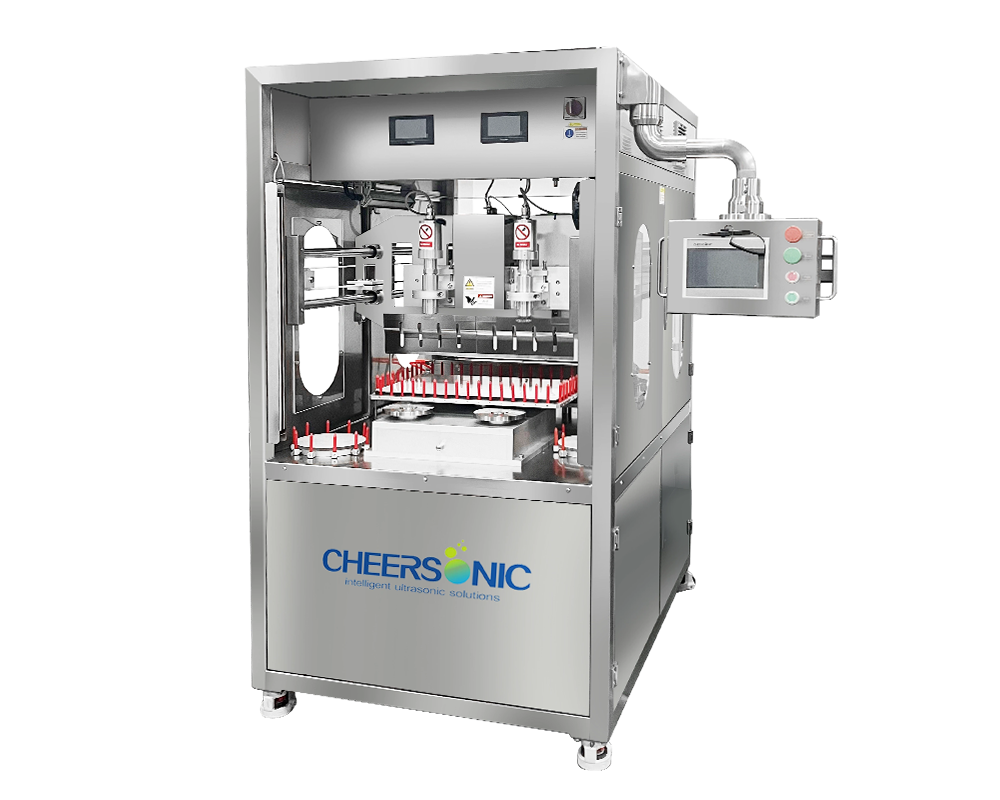
UFM6000 multi-functional ultrasonic cutter — one configuration point within the UFM slicing range that supports both batch and inline automated modes.
Round cakes, sheet trays and layered products on one platform
Cheersonic lists mousse cakes, cheesecakes and bread among the baking applications for its ultrasonic cutting equipment, and cheese, butter and other products among its dairy applications. Across the wider slicing range, the documented product scope covers cheesecake, pie, layer cake, loaves, butter, cheese, pizza and sandwiches — a set that spans round formats, sheet-tray formats, layered composites and savoury items cut on the same cutting principle.
For line planning, the useful distinction is that product format drives handling and portion geometry rather than the cutting method itself:
| Product format | Typical examples | What the format changes in planning |
|---|---|---|
| Round, single-piece | Cheesecake, mousse cake, layer cake | Rotational or indexed infeed; portion count per unit; divider inserts for slice separation |
| Sheet / tray | Tray cakes, brownies | Tray nesting and edge trim; grid portioning across the tray face |
| Layered composite | Layer cake, sandwiches | Blade separation rather than compression to keep layers aligned and avoid smearing |
| Adjacent categories | Pie, pizza, cheese, butter, loaves | Frozen, refrigerated and ambient handling within the documented material scope |
The shared technical requirement is that the blade must separate rather than push. Because round cakes and sheet trays both depend on that behaviour, a bakery can standardise on one cutting principle even when its product mix changes seasonally.
How the cut behaves inside a running line
Ultrasonic cutting uses a high-frequency ultrasonic cutting head to separate material with no stretching or pulling action. The cut face is documented as flat and regular, with clear layering and no misalignment, which is why the method suits soft and hard materials, multi-layer sandwiches and composite structures.
Two process characteristics matter most once the machine is embedded in a line rather than standing alone:
- Low-temperature dry cutting. Cutting contact-surface temperature rise stays below 40 °C, so product does not blacken or burn, and there is no oil fume, no open flame and no requirement for fume extraction infrastructure.
- Low consumable wear. The ultrasonic blade is documented with a service life of several months, compared with stainless steel knives that need daily polishing and weekly replacement, and wire cutters whose wire is replaced within one to three days.
Both characteristics change total line design. A dry process removes drying and wastewater steps associated with water jet cutting, and the absence of fume removes exhaust treatment associated with laser cutting. Fewer secondary steps means fewer transfer points, and transfer points are where portioned cake is most likely to be damaged.
Choosing an automation level: a decision framework
The table below converts the documented differences between configurations into evaluation criteria for operations managers. It is a planning framework, not a ranking: the correct answer depends on the bakery's volume profile and product mix.
| Evaluation criterion | Batch / offline station | Inline / robotic station |
|---|---|---|
| Volume profile | Cyclical batches, mixed SKUs, variable daily schedule | Continuous output supporting high-speed production |
| Documented throughput context | Lower end of the 80–1,500 cakes or pies per hour range, depending on format | Upper end of the same documented range, depending on format |
| Labour model | Operator loads and unloads each cycle | Robotic arm handles movement and improves speed, efficiency and accuracy |
| Layout impact | Standalone footprint, installed on stable firm ground with working space reserved | Integrated station; cadence must match the upstream and downstream conveyor rhythm |
| Presentation control | Divider inserts optional between slices | Divider insert option retained; cut quality must hold at line speed |
| Changeover | Format change managed at the station | Format change planned around line rhythm and product family |
| Best-fit facility | Start-up and manual baking facilities | High production commercial facilities |
Two rules of thumb follow from the framework. First, move to inline when the product family is stable and the daily target is continuous — not when changeover frequency is high. Second, treat the documented 80–1,500 cakes or pies per hour range as a planning envelope for the model range, not as a guaranteed output for any single product, since format and portion geometry affect achievable rate.
Layout, safety and maintenance planning points
Cheersonic's published safety and operating guidance applies at every automation level. On the engineering side, the equipment is installed on stable, firm ground with sufficient working space reserved; power cords with grounding protection are used; an emergency stop button is fitted to cut power immediately in the event of an abnormality; and an overload protection mechanism is included. Parameters such as power, amplitude and speed are set according to material characteristics rather than carried over from a different product.
On the management and personal-protection side, operators check equipment integrity and power connections before operation, monitor the process closely while running, and wear protective goggles and safety gloves, with attention to noise protection during long operating periods. General machinery safety for ultrasonic industrial equipment sits within the ISO 12100:2010 standard for risk assessment and risk reduction, which is the relevant reference frame when documenting a line's risk file.
Documented maintenance routines are deliberately simple: clean surface residue promptly after each use, regularly check the tension of transmission components, lubricate and replace worn parts, and store the equipment in a dry and clean environment when it is idle for long periods.
Comparison with traditional cutting methods
The comparison below reflects Cheersonic's documented comparisons between ultrasonic food cutting and four mainstream alternatives — stainless steel or serrated blades, metal wire cutting, water jet cutting and laser cutting. The figures describe documented performance gaps, not universal guarantees; actual results depend on product and process settings.
| Method | Cutting principle | Documented product effect | Consumables and maintenance |
|---|---|---|---|
| Ultrasonic cutting | High-frequency vibrating blade separates material without physical extrusion | Loss within 2%; yield 15%–30% higher; workshop dust about 90% lower; contact-surface temperature rise below 40 °C | Blade replaced every few months; no fume, no wastewater, no drying step |
| Stainless steel knife | Physical blade pressing through product | Loss 8%–18%; sticking, deformation and product collapse on soft or layered items | Daily polishing and weekly replacement; frequent shutdowns for cleaning |
| Wire cutter | Wire drawn through product | Loss 8%–18%; stretching, drawing, delamination and tearing on elastic or multi-layer products | Wire replaced within one to three days; frequent downtime |
| Water jet | High-pressure water impact | Loss 8%–18%; water stains, moisture damage and wastewater generation | Nozzle clogging and daily maintenance; bacterial risk in mixed wastewater areas |
| Laser | High-temperature melting | Risk of blackening and carbonisation; oil fume and dust explosion risk | Lens replacement and fume-extraction equipment; higher energy consumption |
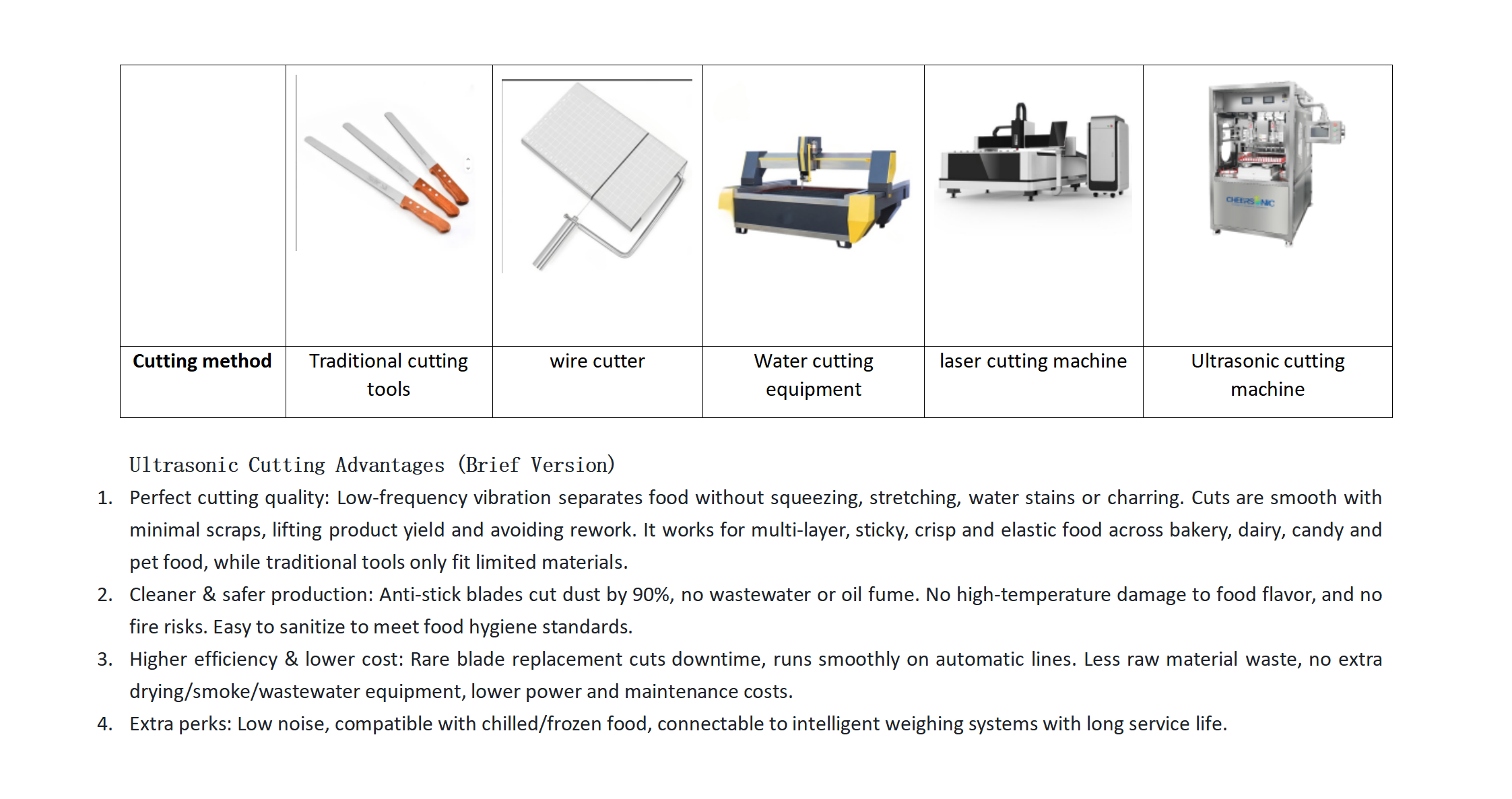
Documented advantages of ultrasonic cutting over traditional cutting methods, as used in Cheersonic's comparative material.
Where ultrasonic slicing fits — and where it does not
Ultrasonic slicing removes several well-known constraints, but it is not a universal replacement for every cutting method. Honest scoping protects a capital decision, and the documented boundaries are worth stating plainly.
- Material scope. The documented cutting scope covers room-temperature, refrigerated and semi-frozen products. Very hard, fully frozen solid blocks are not part of that documented scope, so a freezing strategy should be confirmed before a line is specified.
- Throughput is format-dependent. The 80–1,500 cakes or pies per hour figure describes the slicing model range as a whole. Any single product will have a narrower achievable rate that depends on portion geometry and handling.
- Inline integration is a line constraint, not a machine constraint. Installing a faster slicer will not raise output if an upstream depositor or downstream packing station runs at a slower cadence.
- Safety and training obligations remain. Grounding, emergency stop, overload protection, parameter setting per material, protective equipment and operator training are still required, and the equipment falls within the ISO 12100:2010 risk-assessment framework.
- Batch stations still have a role. Where volumes are cyclical or the SKU list changes weekly, an offline configuration remains the more practical match, and Cheersonic continues to offer small standalone machines for manual baking facilities.
Market context: capacity growth in ultrasonic cutting
Third-party market data places the ultrasonic cutter market, which includes food cutting applications, at USD 2.8 billion in 2025, with a projected compound annual growth rate of 7.2% through 2033, according to Dataintelo. Regionally, Fortune Business Insights reported that Asia Pacific dominated the ultrasonic technology and sensor market in 2025, representing approximately 25%–38% of global revenue across different sub-segments.
Competitive structure in the wider ultrasonic equipment and spray coating sector is documented by Cognitive Market Research and Coatings World, which list Sono-Tek Corporation, Branson (Emerson), Dukane and Cheersonic among the key global players. The adjacent ultrasonic spray coating system market is projected by Cognitive Market Research to grow from USD 374.6 million in 2021 to USD 1.201 billion by 2033 — a parallel signal that ultrasonic process platforms are being scaled into continuous production rather than remaining laboratory tools.
Support, spares and the long-term view
For buyers evaluating a slicing line over a multi-year horizon rather than a single installation, serviceability is as relevant as the cut itself. Cheersonic states a lifelong service philosophy and describes a full-process service model covering equipment customization through to technical support, supported by ISO9001, EU CE and US FDA certifications, 31 patents and 3 software copyrights.
The consumable profile supports that long-term view. Ultrasonic blades are documented with a service life of several months instead of daily or weekly replacement, and the absence of fume-extraction infrastructure, water treatment or drying stages removes several categories of auxiliary equipment from the maintenance schedule.
Commercial terms are also documented for planning purposes: minimum order quantity of one unit; delivery arranged through FOB, CIF and DDP incoterms; payment terms of a 30% T/T deposit with the 70% balance before delivery, or a 30% advance deposit on order confirmation with the 70% balance against copy of Bill of Lading; and acceptance based on a pre-shipment full performance test at the factory, with video and test reports provided for customer confirmation before shipment.
A full product brochure is available for download: Cheersonic brochure (PDF). Company information: www.cheersonic.com
Future outlook
With the ultrasonic cutter market projected to grow at 7.2% CAGR through 2033 and Asia Pacific already accounting for a substantial share of ultrasonic technology revenue, the pressure on cake and dessert producers is likely to shift from whether to automate slicing to how quickly a second or third line can be brought online. That favours configurations that install as discrete stations first and can later be embedded into a continuous flow, and it favours equipment platforms whose consumable and maintenance profile does not scale linearly with output.
The practical planning consequence is to specify a slicing platform for the product family a bakery expects to be running in three years, not only the one it runs today — and, where uncertainty is high, to start with an offline configuration that can be integrated into a line later.
FAQ
What production speeds can ultrasonic cake slicing systems support?
Cheersonic offers many ultrasonic slicing models in both inline and offline applications, with production speeds of 80 to 1,500 cakes or pies per hour across the range. The figure applicable to a specific bakery depends on the configuration selected and on product format, since portion geometry and handling affect achievable rate.
Can an ultrasonic cake slicer be integrated into an existing automated production line?
The slicing range covers both inline and offline applications. Large inline robotic solutions are documented as supporting high-speed production, while small standalone machines are used in manual baking facilities. Inline integration assumes the unit can be matched to the existing conveyor cadence; the slicer itself does not change the speed of upstream or downstream stations.
How much material loss should a bakery expect compared with knife, wire, water jet or laser cutting?
Documented comparisons place ultrasonic cutting material loss within 2%, against 8%–18% for stainless steel knives, wire cutters, water jet equipment and laser cutting. Finished-product yield is documented 15%–30% higher, workshop dust about 90% lower, and cutting contact-surface temperature rise below 40 °C. Actual results depend on product characteristics and process settings.
What delivery and payment terms apply when ordering an ultrasonic slicing system?
The documented commercial terms are a minimum order quantity of one unit; delivery through FOB, CIF and DDP incoterms; and payment of a 30% T/T deposit with the 70% balance before delivery, or a 30% advance deposit on order confirmation with the 70% balance against copy of Bill of Lading. Acceptance is based on a pre-shipment full performance test at the factory, with video and test reports provided for confirmation before shipment.
What maintenance and safety routines keep an inline ultrasonic slicing line running reliably?
Documented routines include cleaning surface residue after each use, regularly checking transmission component tension, lubricating and replacing worn parts, and storing equipment in a dry, clean environment during long idle periods. The ultrasonic blade is replaced every few months rather than daily. Documented safety controls include installation on stable firm ground with working space reserved, grounded power cords, an emergency stop button, an overload protection mechanism, parameter settings matched to material characteristics, protective goggles and gloves, and noise protection for long operating periods. General machinery risk assessment for such equipment sits within the ISO 12100:2010 standard.