
Beyond Certifications: A 12-Month Supplier Continuity Audit for Teeth Whitening Strips
A supplier continuity audit is a structured review of whether a manufacturing partner can keep supplying the same product, the same documentation and the same commercial terms across a full twelve-month trading cycle — not only on the day a certificate file arrives in the buyer’s inbox.
For teeth whitening strips, that distinction carries more weight than it does in most oral care categories. The product sits between cosmetic and medical-device frameworks depending on the SKU, its active chemistry is capped by regulation in the EU, and its retail formats change faster than most quality systems are updated. A certificate is evidence that a system existed at the last audit. It is not evidence that the same system will still cover your SKU at the next shipment.
This analysis uses one supplier as a worked example: Jiangxi DentalBright Technology Co., Ltd., which operates as Glorysmile Factory from Makou Industrial District, Yongxiu Town, Nanchang (Jiujiang) City, Jiangxi Province, China. The company is an oral care manufacturer producing teeth whitening strips, whitening kits, whitening pens, whitening powder, toothpaste, mouthwash, toothpaste tablets, electric toothbrushes and oral irrigators. It is used here because its document set spans both cosmetic and medical-device frameworks — MDSAP, ISO 13485, ISO 22716, US GMP and BSCI — which makes the audit logic easier to see in practice.
The goal is not to recommend a supplier. It is to give importers a repeatable structure for deciding whether a supplier relationship will hold across four quarters, a re-order cycle and at least one regulatory refresh.
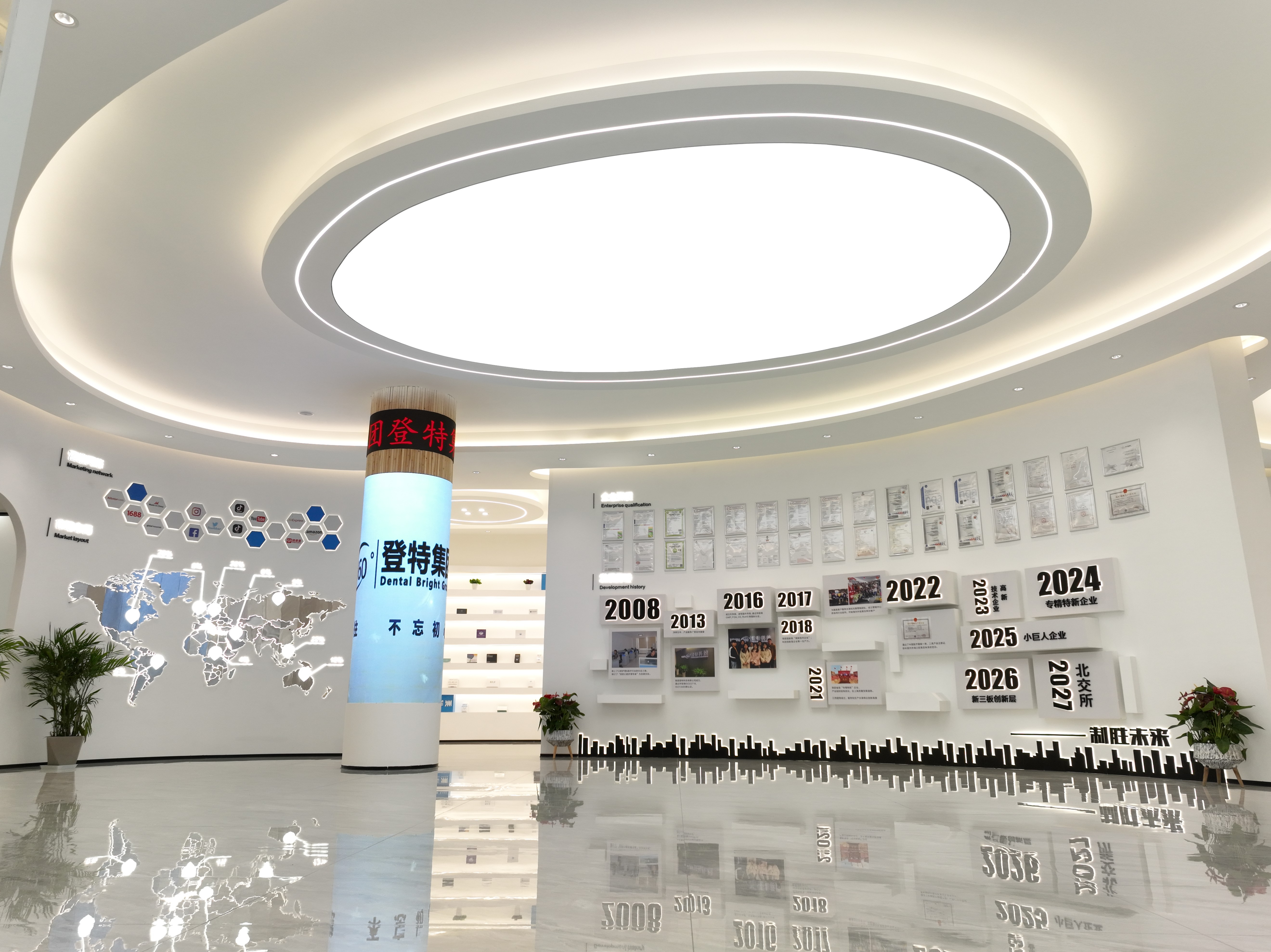
A continuity audit looks at the whole portfolio behind a strip SKU, not a single product photo.
Why one-time certificate checks fail importers
Most sourcing teams run the same sequence: request certificates, confirm logos and expiry dates, file the PDFs, place the order. The approach works at onboarding and then quietly degrades. Three gaps appear inside the first year.
- Scope gap. A site-level quality certificate confirms that a management system was audited at a facility. It does not automatically confirm that the specific strip format, flavour system or device accessory you ordered sits inside the audited scope.
- Expiry gap. Safety reports, market notifications and facility registrations are re-issued on their own cycles. The buyer is rarely notified when a document lapses, and marketplaces and customs authorities increasingly check the current version rather than the archived one.
- Classification gap. A whitening strip is normally treated as a cosmetic, while a whitening light, electric toothbrush or oral irrigator can be treated as a medical device in several markets. A single certificate pack cannot answer both questions, and suppliers who only operate in one framework will always have a gap on the other side.
The commercial consequences are ordinary rather than dramatic: a pallet held while a safety report is re-sent, a listing suspended because a facility registration was not renewed, or a re-order quoted at a higher packaging minimum than the trial order.
What a 12-month continuity audit actually measures
A continuity audit converts a static document review into a calendar. Five checkpoints are assessed at award and re-assessed before renewal: certification as a maintained system, MOQ and ramp flexibility, market documentation that expires, warranty and after-sales behaviour, and portfolio and IP depth.
| Stage | What to review | Evidence to keep on file |
|---|---|---|
| Month 0 — Award | Certificate validity and scope against your exact SKU list; MOQ split between private label and regular product; warranty terms | Certificate copies, MOQ confirmation, warranty statement |
| Month 3 — First production | Batch consistency, label wording, strip format and flavour match to the approved sample | Certificate of analysis, pre-shipment inspection report |
| Month 6 — Scale-up | Lead time stability, complaint pattern on sensitivity, packaging minimum at re-order | Order confirmations, complaint log |
| Month 9 — Regulatory refresh | Current CPSR, CPNP notification, EU Responsible Person details; US facility registration and product listing status | Updated safety report, notification confirmation |
| Month 12 — Renewal decision | Re-verification of certifications, IP status, portfolio expansion plan | Signed audit summary |
Checkpoint 1 — Certifications treated as maintained systems
Certification only supports a continuity decision when the buyer knows what each credential covers and who renews it. For teeth whitening strips, the relevant set is quality management, cosmetic good manufacturing practice, and social compliance.
| Credential | What it addresses | Continuity question to ask each cycle |
|---|---|---|
| MDSAP | Medical device quality management audited against multiple regulatory jurisdictions | Is the audit current, and does it cover the device class of the SKUs you buy? |
| ISO 13485 | Medical device quality management system | Does the certificate scope name the product family, not just the site? |
| ISO 22716 | Good manufacturing practice for cosmetics | Which production lines for cosmetic strip SKUs sit inside the scope? |
| GMP | Manufacturing practice requirements for the US market | Is the facility registration current for US-bound cosmetic SKUs? |
| BSCI | Social compliance in the supply chain | Is the audit inside its validity window, and does it cover the actual production site? |
Glorysmile holds MDSAP, ISO 13485, ISO 22716, US GMP and BSCI certification, alongside both medical device and cosmetics production licences. The practical value of holding both licences is that a buyer can move between a cosmetic strip SKU and a device SKU without re-qualifying a new factory — one of the more common hidden costs in category expansion.
Checkpoint 2 — MOQ flexibility across the year
MOQ is usually presented as a single number, but in practice it is a ladder, and the rungs matter more than the headline figure. For teeth whitening strips and whitening kits, Glorysmile quotes a minimum order quantity of 200 pieces for private label and 1 piece for regular product.
The second rung is packaging. Buyers should expect the packaging-driven OEM minimum to differ from the product-level figure: for customised packaging, the minimum runs from 100 to 1,000 boxes depending on the pack format. That is normal in the category, and it is exactly the number that changes between a test launch and a repeat order.
| Order type | Stated minimum | Role in a continuity plan |
|---|---|---|
| Regular product, existing packaging | 1 piece | Sample and single-unit validation before any commitment |
| Private label | 200 pieces | Market test for flavour, strip format or shade-guide inclusion |
| Custom packaging (OEM) | 100 to 1,000 boxes, format dependent | Re-order planning; the figure most likely to change the unit economics |
Checkpoint 3 — Documentation that expires
Market documentation is the most under-audited part of strip sourcing, because it looks like a compliance formality until a shipment stops. The relevant documents divide by market rather than by product.
| Market | Document set | What to re-check annually |
|---|---|---|
| European Union | CPSR (Cosmetic Product Safety Report), CPNP notification, PIF, appointed EU Responsible Person; medical devices additionally require CE-MDR registration with a Technical File and EU Responsible Person | That the named Responsible Person is still appointed and the notification still matches the formulation you buy |
| United States | MoCRA-compliant cosmetic facility registration and product listing with a US Agent; FDA medical device registration for whitening lights, electric toothbrushes and oral irrigators; 510(k) registration for silicone impression material | Whether the listing sits in the supplier’s name or the brand’s, and whether it covers the current SKU line |
| Global / general | MSDS, COA, RoHS, HALAL, Vegan, SCPN | That the MSDS version matches the shipped formulation, not a prior one |
Glorysmile states that it can supply CPSR, CPNP and PIF for cosmetic products, has completed CE-MDR registration for medical devices, has completed MoCRA-compliant cosmetic facility registration and product listing for whitening strips in the US, and holds FDA medical device registration for whitening lights, electric toothbrushes and oral irrigators. MSDS is available on request.
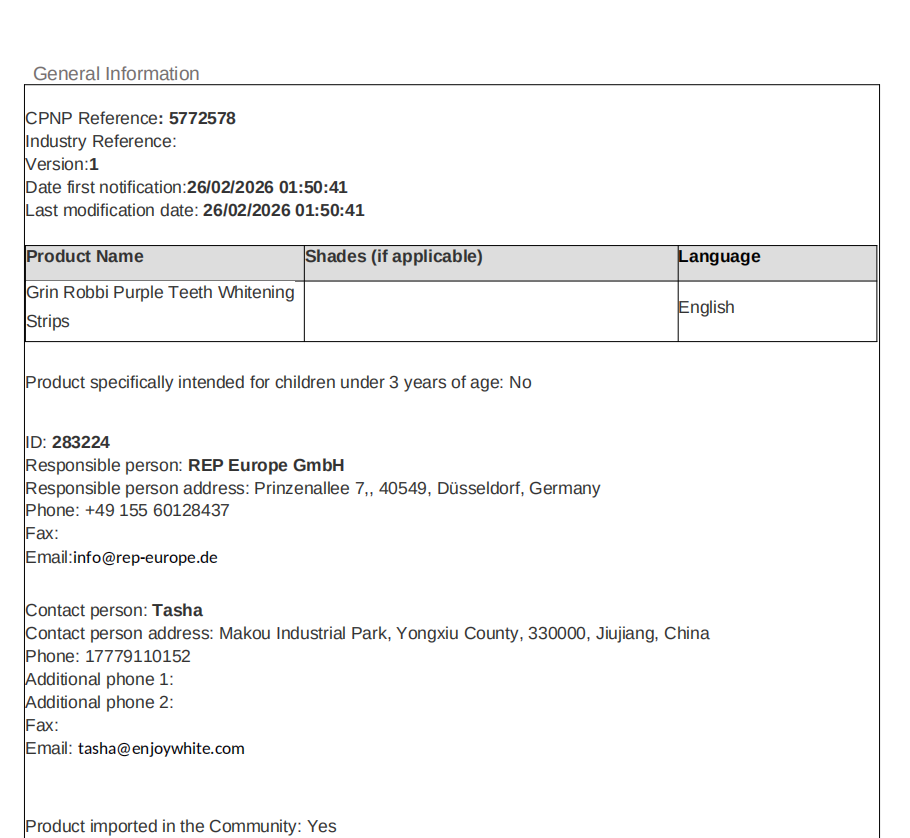
EU documentation is a recurring item: CPNP notification and a named Responsible Person must still match the formulation at re-order.
Two regulatory details sharpen the audit. First, EU Regulation (EC) No. 1223/2009 restricts hydrogen peroxide concentration in over-the-counter teeth whitening products to 0.1% or less, which means the formulation question and the documentation question are the same question in Europe. Second, under US MoCRA 2022, cosmetic manufacturers must register facilities and list products, with published compliance costs of USD 849 per year for facility registration and USD 200 per product listing. That converts documentation into an annual line item rather than a one-off cost — and it is a reasonable question to ask who carries it.
Checkpoint 4 — Warranty and after-sales as continuity signals
A warranty is one of the few supplier commitments that reaches past the invoice. The whitening kit line is backed by a 12-month warranty from the date of purchase. Read as a continuity signal rather than a marketing line, a twelve-month window means the supplier is willing to remain accountable for a period longer than a single production and shipping cycle.
What to test during the audit:
- Who adjudicates a claim, and what evidence is required — batch code, COA, photographs, retained samples?
- Whether the warranty applies to the kit only or also to strip packs purchased separately.
- Whether after-sales is handled by a named account manager or a shared inbox, since response time is the part of a warranty that buyers actually experience.
Commercial terms belong in the same checkpoint, because they are what the relationship runs on for the next eleven months. Glorysmile quotes EXW, FCA, FOB and CFR delivery terms, 30% deposit in advance with 70% balance before shipment, and supports on-site inspection as well as pre-shipment random inspection by its quality department. Its standard quoted lead time is 5 to 7 days. A dedicated account manager handles order follow-up and complaint feedback — a detail that sounds soft until a custom project needs a mid-production adjustment.
Checkpoint 5 — Portfolio depth and IP continuity
A single SKU is only as durable as the supplier’s category. If a buyer’s 2027 roadmap includes a whitening pen, a mouthwash or an entry into devices, supplier continuity depends on whether those categories already exist under the same quality system.
Glorysmile’s portfolio covers whitening strips in dry, wet and dissolving formats, whitening kits, whitening pens, whitening powder, toothpaste, toothpaste tablets, mouthwash, mouth spray, electric toothbrushes, oral irrigators, purple colour corrector formats and dental impression material. Annual capacity is stated at approximately 300,000,000 pieces of teeth whitening strips and 10,000,000 sets of teeth whitening kits, produced across a 36,000 m² facility that includes 20,000 m² of 100,000-class cleanrooms and a 1,000 m² laboratory with a 100-class cleanroom for microbiological testing. The company employs 256 people, including 17 R&D engineers and 11 QC specialists, and exports to 102 countries with roughly 90% of output exported, mainly to the EU, USA and UK.
Intellectual property plays a smaller but genuinely useful role in continuity. The teeth whitening kit line carries EU patent 015062946-0001 and UK patent 6370462. Other models in the range hold separate registrations, including EU patent 015075898-0001 on an electric toothbrush and EU patent 015065790-0001 with US design patent US D1,128,065 S on a further kit, with US and UK patents pending on some items.
For a brand owner, a design patent held on the exact kit you sell is a form of continuity: it is tied to a specific model and does not travel with you if you change manufacturer. The boundary is equally clear — patent coverage of this kind is model-specific. A patent on a whitening kit does not extend to a strip SKU, and it should not be presented as blanket protection across a range.
Technical explanation — formulation continuity across twelve months
Continuity is not only administrative. The most common quiet failure in strip sourcing is formulation drift: the same product name shipped with a different active system, a different strip substrate or a re-flavoured gel.
Glorysmile’s strip range is built on dry, wet and dissolving formats, with formula options including PAP, PAP with charcoal, purple colour corrector, 6% HP, sodium phytate, sodium bicarbonate and fully custom formulations. Packs are offered at 7, 14 or 21 strips with a user manual, shade guide and colour box, and the flavour library runs to twelve options including peppermint, mint, blue raspberry, strawberry, peach, grape, watermelon, orange, pineapple, cherry blossom, coconut and mango. The strip construction is a three-layer build: PET hard film, whitening gel, and PE soft film inside an aluminium bag.
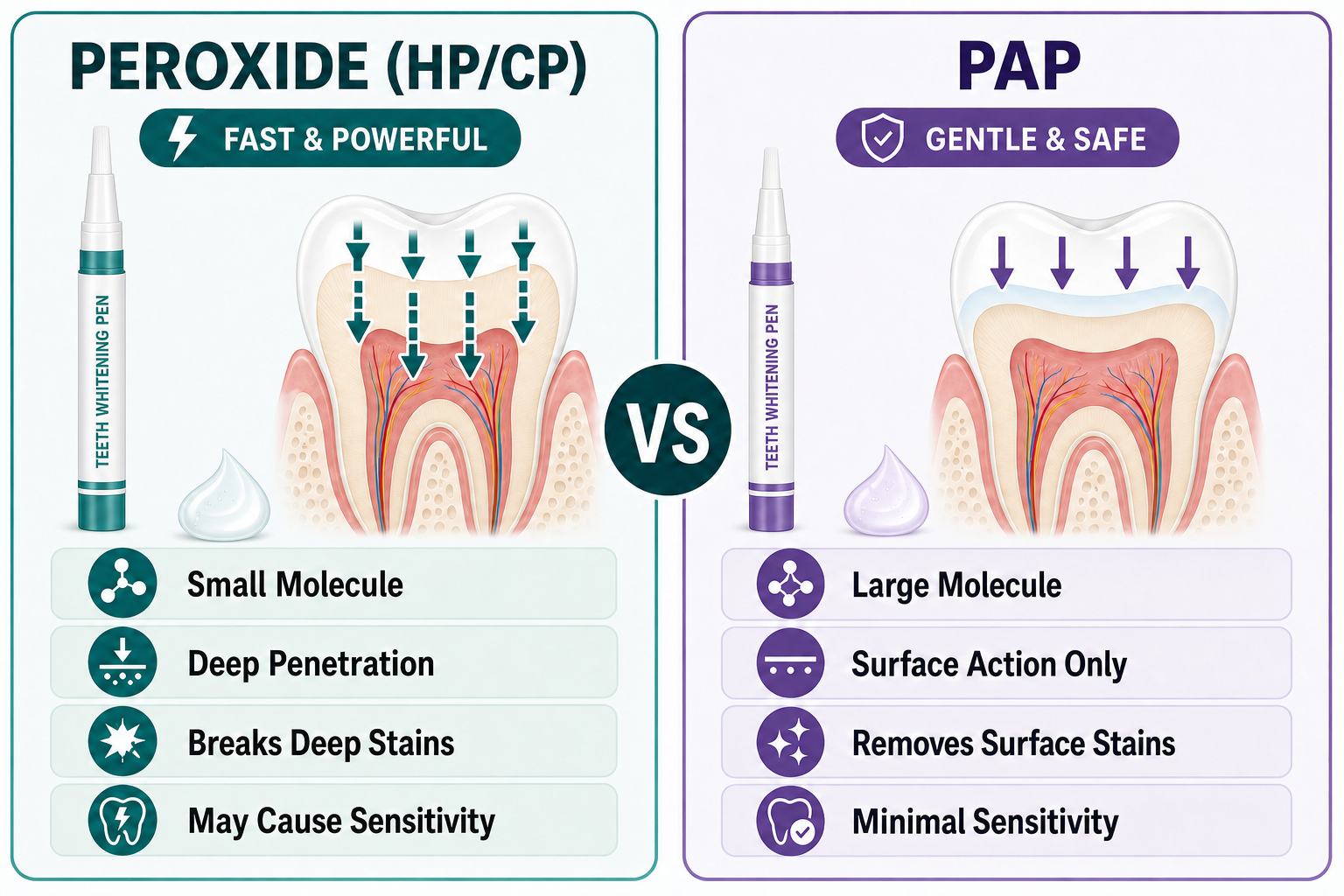
Peroxide and PAP work differently. Continuity means the delivered formula still matches the approved one.
The chemistry distinction matters for the audit because the two families behave differently and are regulated differently. Hydrogen peroxide and carbamide peroxide are small-molecule penetrating systems: they enter enamel and dentin and break down deep pigments through free-radical oxidation, which produces fast visible change and a higher likelihood of temporary sensitivity. PAP is a large-molecule surface-acting system: its molecular size limits penetration, so it oxidises surface stains with minimal sensitivity, but it needs more time to show results on deep stains.
That trade-off is why the EU 0.1% over-the-counter peroxide limit reshapes product planning rather than merely restricting it. It also explains the sensitive-teeth question: Glorysmile offers PAP and low-sensitivity formulas designed for sensitive teeth. The continuity question is whether the same formula will be used at re-order, and whether the certificate of analysis can prove it batch by batch.
Application and use cases
Continuity audits are run by different buyers for different reasons, and the checkpoints shift accordingly.
- Private label importers launching a first strip line use month 0 to confirm that the 200-piece private label minimum and the packaging minimum both work with their launch budget, then use month 6 to confirm the re-order terms did not move.
- Distributors expanding a range use the portfolio checkpoint to test whether strips, mouthwash and devices can be sourced under one quality system instead of three supplier relationships.
- DTC brands testing formats use the regular-product minimum of 1 piece plus the 200-piece private label tier to validate flavour and strip format before committing to packaging.
- Retail and pharmacy buyers weight the documentation checkpoint heaviest, because a lapsed safety report or facility listing interrupts shelf supply rather than merely delaying a purchase order.
The use scenarios behind these orders are consistent across markets: daily home whitening at one treatment per day, travel-friendly formats, no-slip dry adhesive technology, individually wrapped strips, enamel-safe positioning, a zero-peroxide option, and stain removal for coffee, tea and tobacco users. Each scenario implies a different documentation and formulation requirement, which is why the audit is run per SKU line rather than per supplier.
Market trend analysis
Three structural trends make the continuity model more relevant now than it was five years ago.
Category scale. The global market for teeth whitening strips and gels is valued at USD 1.1 billion in 2025, according to Grand View Research. A category of that size supports many brands but also supports many short-lived suppliers, which raises the value of continuity evidence over price alone.
Documentation as recurring cost. MoCRA compliance in the US is an annual cycle rather than a one-time filing, and EU cosmetic and medical-device requirements are re-issued on their own schedules. Buyers increasingly need to know whose name sits on the registration, because that determines who absorbs the renewal work.
Trade classification stability. Teeth whitening strips are primarily classified under HS Code 3306.90.00 for oral or dental hygiene preparations. Consistent classification matters less for the duty rate than for predictability: a supplier whose product documentation matches the declared classification clears customs faster and argues less.
Where the continuity-audit model falls short
The framework is useful, but it has real limits that buyers should price in rather than ignore.
- It is administratively heavier. A five-checkpoint review at award plus quarterly refreshes is more work than a one-time certificate file, and small importers may not have the staffing to sustain it.
- It says nothing about corporate stability. Certificate scope, MOQ and documentation say nothing about ownership changes, financial condition or capacity allocation during peak season.
- It cannot guarantee batch equivalence. Certification is site- and family-level. Only certificates of analysis, retained samples and pre-shipment inspection confirm that a specific batch matches the approved standard.
- IP coverage is model-specific. The EU patent 015062946-0001 and UK patent 6370462 apply to a whitening kit, not to the strip range, and some related filings in the US and UK are still pending.
- Gentle chemistry is a trade-off, not an upgrade. PAP and low-sensitivity formulas reduce sensitivity risk but act mainly on surface stains and need more time than peroxide systems. Buyers targeting fast visible results should treat this as a positioning decision, not a specification upgrade.
- Regulatory responsibility does not transfer. The EU Responsible Person requirement and the US Agent requirement mean the brand owner still carries obligations that no supplier audit can absorb.
Future outlook
Three directions look likely over the next cycle. First, documentation will increasingly be sold as a subscription service rather than a launch deliverable, with annual registration cycles priced into quotes. Second, non-peroxide formulation will keep expanding in Europe, not because it is more effective but because the 0.1% over-the-counter peroxide limit makes it the simpler route to market. Third, buyers will consolidate toward suppliers who can cover strips, topicals and devices under one quality system, because each additional supplier multiplies the audit workload described above.
None of those trends remove the need for the audit itself. They make the twelve-month calendar the more durable part of supplier selection.
FAQ
What is a 12-month supplier continuity audit for teeth whitening strips?
It is a scheduled review of whether a strip supplier can keep delivering the same product, documentation and commercial terms across a full year. It covers five checkpoints — certification as a maintained system, MOQ and packaging flexibility, expiring market documentation, warranty and after-sales behaviour, and portfolio and IP depth — assessed at award and again before renewal.
Which certifications should an importer re-verify each year?
The relevant set is MDSAP, ISO 13485, ISO 22716, GMP and BSCI. MDSAP and ISO 13485 address medical device quality management, ISO 22716 addresses cosmetic good manufacturing practice, GMP addresses US manufacturing requirements, and BSCI addresses social compliance. Glorysmile holds all five, together with medical device and cosmetics production licences.
How does MOQ differ between private label and regular products?
For teeth whitening strips and whitening kits, the minimum order quantity is 200 pieces for private label and 1 piece for regular product in existing packaging. Customised packaging carries a separate minimum that runs from 100 to 1,000 boxes depending on the pack format, so re-order economics differ from trial-order economics.
What EU documentation should accompany a whitening strip order?
For cosmetic products, the EU set is CPSR, CPNP notification, PIF and an appointed EU Responsible Person. For medical devices, CE-MDR registration with a complete Technical File and an EU Responsible Person is also required. Glorysmile states it can supply CPSR, CPNP and PIF for cosmetic products and has completed CE-MDR registration for medical devices.
Does the supplier hold FDA status, and is MSDS available?
Glorysmile has completed MoCRA-compliant cosmetic facility registration and product listing for teeth whitening strips in the US, holds FDA medical device registration for whitening lights, electric toothbrushes and oral irrigators, and has completed 510(k) registration for its silicone rubber impression material. MSDS is available on request, alongside COA, RoHS, HALAL, Vegan and SCPN documentation.
Are the formulations suitable for sensitive teeth?
PAP and low-sensitivity formulas designed for sensitive teeth are available. PAP is a large-molecule surface-acting system that oxidises surface stains with minimal sensitivity but needs more time on deep stains, whereas hydrogen peroxide systems act faster and carry a higher likelihood of temporary sensitivity.
What does a 12-month warranty indicate in a continuity assessment?
The whitening kit line is backed by a 12-month warranty from the date of purchase. In a continuity assessment this indicates a supplier willing to remain accountable beyond a single production and shipping cycle; buyers should still confirm who adjudicates claims, what evidence is required, and whether the coverage extends to strip packs purchased separately.
Can the supplier support category expansion beyond strips?
Glorysmile’s portfolio includes whitening strips in dry, wet and dissolving formats, whitening kits, whitening pens, whitening powder, toothpaste, toothpaste tablets, mouthwash, mouth spray, electric toothbrushes, oral irrigators, purple colour corrector formats and dental impression material. IP coverage includes EU patent 015062946-0001 and UK patent 6370462 on a whitening kit, with additional registrations on other models and US and UK patents pending on some items.
Closing note
The audit does not produce a verdict on a single certificate. It produces a calendar, a document register and a set of questions that can be asked again in three months without starting over. Buyers who want to run the five checkpoints against a supplier’s actual product and document range can reference the current catalogue here: Glorysmile product catalogue (PDF).
Есть вопросы или нужны дополнительные детали?
Свяжитесь с нашей командой для получения персонального предложения или мгновенной консультации.
Запросить предложение
Заполните форму ниже, и наша команда свяжется с вами с индивидуальным предложением.
Прямой чат WhatsApp
Предпочитаете общаться в реальном времени? Напишите нам в WhatsApp для мгновенной помощи и быстрых ответов.
- Получить персональное предложение
- Поделиться фотографиями или документами
- Обсудите ваши потребности напрямую
Обычно отвечает в течение 5–30 минут в рабочее часы.