
Beyond Fairways: 48V–72V LiFePO4 for UTV, ATV & Forklift
A golf cart battery is no longer only a golf cart component. In fleet and project procurement, the same 48V, 51.2V and 72V lithium iron phosphate (LiFePO4) packs specified for golf cars are now screened for UTVs, ATVs and light-duty forklifts — vehicles that share a low-voltage electric drivetrain but not the same duty cycle, compartment geometry or documentation requirements.
Carrying a pack over from fairway duty to utility duty is possible, but it is not automatic. What decides the question is a combination of nominal voltage, continuous and peak current, physical envelope and market-specific certification evidence — not the voltage number printed on a catalogue page.
Shenzhen Shiwei New Energy Co., Ltd., which trades as Sisway Battery, is a LiFePO4 battery pack manufacturer established in 2017 in Shenzhen, China. The company builds packs for golf carts, UTVs, ATVs, forklifts, AGVs and home energy storage, operates a 20,000 m² facility with 150 employees, a 25-engineer R&D team and an annual output of 90,000 units, and reports the United States as its main export market.
Three Mismatches That Decide Whether a Pack Travels
Buyers who move a pack out of golf duty into UTV, ATV or forklift service generally meet the same three mismatches, in the same order.
1. Voltage labels describe different electrical realities
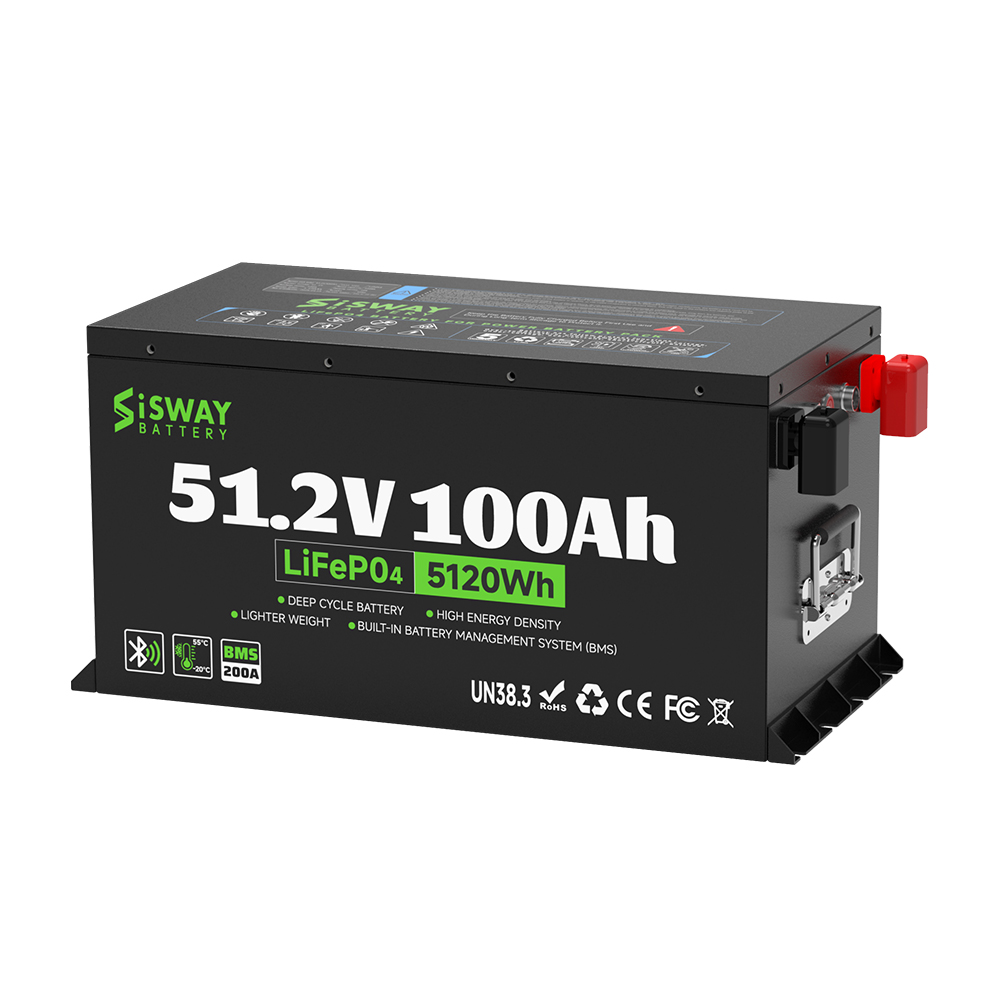
The 48V 100Ah pack is documented for 48V (58.4V) systems — the platform most 48V golf cars use. The 51.2V 100Ah pack is charged at 58.4V, so it sits on the same charging platform while delivering 5,120Wh rather than 4,800Wh. The 72V 105Ah pack is a different architecture altogether: 73.6V nominal, 7,728Wh, and a 63.25V discharge cut-off. Matching a pack to a UTV, ATV or forklift therefore begins with the vehicle controller and charger, not with the pack's capacity in ampere-hours.
2. Enclosure geometry does not scale with voltage
The 48V 100Ah pack ships in a plastic case measuring 20.55 × 10.55 × 8.74 in and weighing 77 lb. The 51.2V 100Ah pack uses a metal casing measuring 625 × 505 × 360 mm. The 72V 105Ah pack measures 558 × 333 × 300 mm and weighs 63 kg. Three packs, three envelopes — and a compartment that accepts one will not necessarily accept the others.
3. Certification scope differs by market, not by brand
UN38.3 addresses transport safety. An MSDS is shipping documentation prepared for a defined market. ISO 9001 describes a quality management system. ACM certification covers lithium-ion research, development and production. None of these is a vehicle-level safety approval, which is why a pack can be fully documented and still require additional evidence from the vehicle side of the project.
What Sisway Battery Documents Across 48V, 51.2V and 72V
The three platforms are not a single product in three voltages. Each has a defined electrical envelope, a defined mechanical envelope and a defined evidence set.
| Pack | Voltage and energy | Current and power | Enclosure | Documented evidence |
|---|---|---|---|---|
| 48V 100Ah | 48V nominal, 100Ah, 4,800Wh, 15S1P EV grade A LiFePO4 cells | 200A smart BMS, 200A continuous, 300A peak (2 s), 9.6kW max load power | Plastic case, 20.55 × 10.55 × 8.74 in, 77 lb | UN38.3 test report TSZ25H8045A01-01; USA-market MSDS TSZ25LL028A86-01 |
| 51.2V 100Ah | 51.2V nominal, 100Ah, 5,120Wh, 58.4V charge voltage | 200A BMS, 200A continuous, 300A peak (3 s), 5,120W continuous output | Metal casing, 625 × 505 × 360 mm | ISO 9001 certificate 24CN34504502Q; MSDS and UN38.3 listed for the pack |
| 72V 105Ah | 73.6V nominal, 105Ah, 7,728Wh, 23S1P EV grade A LiFePO4 cells | 200A smart BMS, 200A continuous, 400A peak (10 s), 14.72kW max load power | Metal casing, 558 × 333 × 300 mm, 63 kg | ACM certification covering lithium-ion R&D and production |
For project buyers, the useful reading of this table is that the three packs cover three distinct traction profiles: a drop-in replacement profile at 48V, a mid-power profile at 51.2V, and a high-draw profile at 72V. Everything else — cycle life, monitoring, temperature behaviour — is layered on top of that choice.
Technical Explanation: BMS Behaviour, Charging and Cold-Weather Limits
A 200A smart BMS sits at the centre of all three packs, and it is the component that most directly determines whether a pack survives utility duty. The documented protection set covers over-charge, over-discharge, over-current, short circuit, over-temperature and cell balancing, with a low-temperature charge cut-off on the 51.2V pack set at 0°C ±4°C (32°F ±7.2°F). The 51.2V pack has additionally passed short circuit, vibration and one-metre drop tests, and both the 48V and 51.2V packs are documented with MSDS and UN38.3 transport certification.
Charging behaviour is where UTV and forklift fleets most often discover a mismatch. The 48V pack is supplied with an 18A charger and a standard charge time of 6 hours; the 51.2V pack pairs with a dedicated 58.4V 18A LiFePO4 charger with a recommended charge current of 18A; the 72V pack ships with an 18A charger that takes the pack from 0 to 100% in roughly 5 to 6 hours, or from 60% to 100% in about 3 hours. If a fleet reuses an existing charger from a lead-acid installation, the charge profile must be verified against these figures before the first cycle.
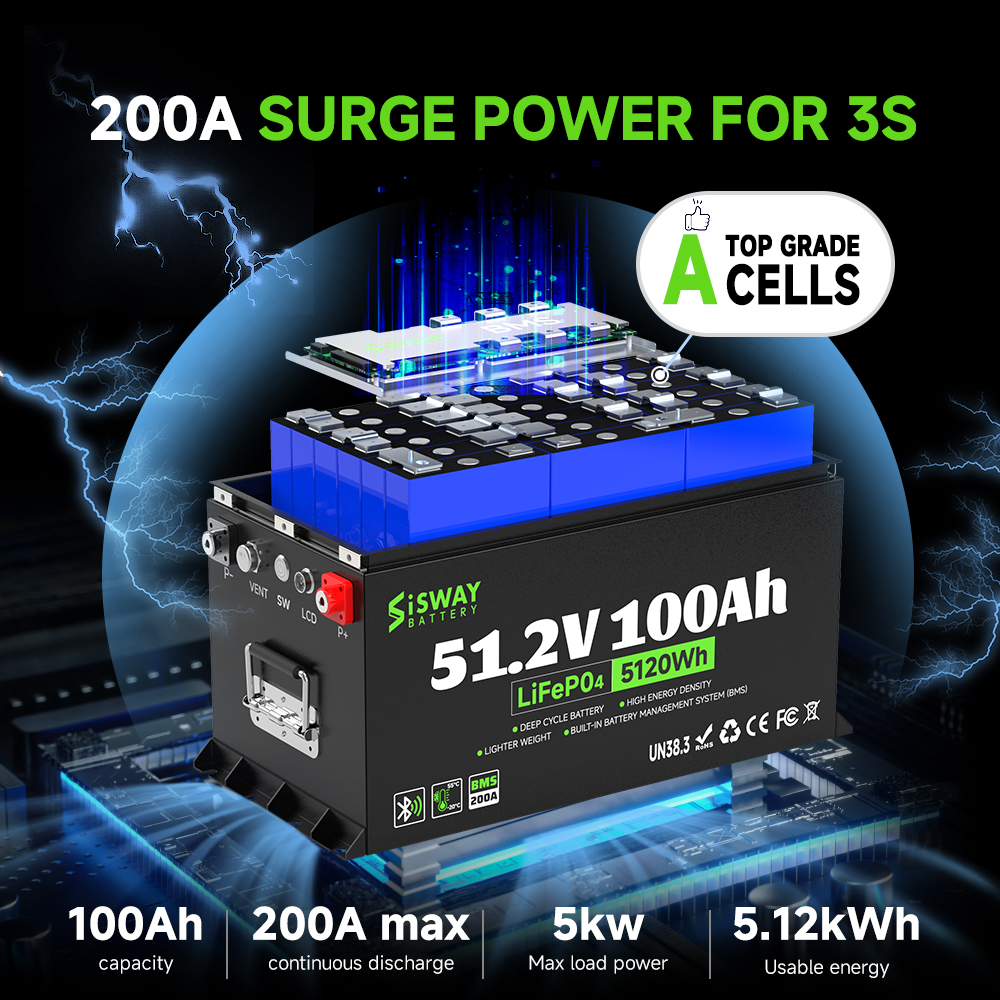
Temperature is documented per pack, and the numbers are practical rather than theoretical. The application data for these packs specifies a charging range of 0°C to 55°C and a discharging range of -20°C to 55°C. On the 72V pack, charging is blocked below 32°F and resumes automatically at 41°F, with discharge cut-off below -4°F. The 51.2V pack defines storage from -20°C to 45°C. For operators in northern climates this means the pack is a year-round power source but not a year-round charging target.
Installation is deliberately system-level rather than pack-level. The packs are specified to be used together with a display, charger, battery cable, wiring harness and user manual, and both the 48V and 51.2V packs support two-way monitoring — an LCD screen in the vehicle and an optional mobile app reporting state of charge, voltage, current, temperature and cycle count.
Where Each Voltage Fits: UTVs, ATVs, Forklifts and Golf Venues
Golf venues and cart refurbishment
The original application remains the reference case. These packs are used in golf cart upgrading and golf venue equipment renovation, across golf courses, golf cart dealers and resellers, and golf cart refurbishment and customisation projects, with the United States given as the typical application market. The duty is deep cycle with more than 4,000 cycles, the mode is deep cycle operation with BMS protection, and the operating envelope is the 0–55°C charge and -20–55°C discharge range described above.
UTVs
A UTV asks for grade starts, towing loads and sustained draws that a golf car rarely produces. The 72V 105Ah pack answers that with 14.72kW of maximum load power, 200A continuous discharge and a 400A peak held for 10 seconds, drawing on 23 series-connected EV grade A LiFePO4 cells in a prismatic aluminium shell. With 7,728Wh of energy, Sisway documents a range of up to 50 miles on a single charge for this pack. The 10-second peak window is the relevant figure for buyers comparing against utility vehicle loads, because it governs whether a cold start on an incline trips the BMS.
ATVs
The 51.2V 100Ah pack, at 5,120Wh with 200A continuous and 300A peak for 3 seconds, suits lighter utility platforms where the frame and cargo load do not justify a 72V architecture. Its 5,120W continuous output power is the practical ceiling to design around, and the metal casing offers a different mechanical mounting behaviour than the plastic case used at 48V.
Forklifts and AGVs
Light-duty forklifts and AGVs are the most voltage-tolerant of the three transfers, because many operate on 48V nominal systems with predictable duty cycles. The 48V 100Ah pack delivers 4,800Wh with 9.6kW maximum load power and 200A continuous discharge from a 77 lb plastic case built as a drop-in replacement in a lead-acid form factor. That profile fits shift-based material handling where the draw stays inside the documented current envelope. It is not a substitute for heavy-duty traction packs in continuous high-load cycling, where duty is outside the documented envelope of any of these three packs.
Field evidence: a five-year, 20,000-unit programme
The clearest available evidence that these packs hold up outside mild conditions is a Thailand project running for 5 years with 20,000 units of the 48V 100Ah LiFePO4 golf cart battery installed for golf cart use. The documented result is stable power output and thermal performance in a high-temperature, high-humidity environment, with reduced maintenance requirements, improved charging efficiency and lower long-term operating costs compared with the lead-acid batteries the project replaced.
Matching Certification Evidence to Destination Markets
Certification is the part of a cross-application project that most often delays shipment, and it is usually a documentation question rather than a product question.
Transport, globally. UN38.3 is the requirement for safe global transport of lithium batteries. The 48V 100Ah pack carries UN38.3 test report TSZ25H8045A01-01; the 51.2V 100Ah pack lists UN38.3 among its certifications. Any UTV, ATV or forklift shipment that moves a pack as cargo will be checked against this documentation before it leaves.
United States. The 48V 100Ah pack has a USA-market MSDS issued as TSZ25LL028A86-01, which is the material safety documentation a U.S. consignee or freight forwarder will normally request. Sisway reports the United States as its main export market and operates a U.S. after-sales service team and a U.S. overseas warehouse.
Quality management. The 51.2V 100Ah pack is produced under an ISO 9001 quality management system certified under certificate 24CN34504502Q. For project tenders that ask for supplier-level quality evidence rather than product-level test reports, this is the document that answers the question.
Production scope. The 72V 105Ah pack is covered by ACM certification spanning lithium-ion research and development and production. Buyers evaluating the 72V route should read this as production-scope evidence, and confirm separately whether the vehicle application requires additional testing.
What these documents are not. UN38.3 is a transport standard, not a vehicle approval. Where a vehicle OEM, insurer or tender requires the industrial and motive safety standards IEC 62619:2022 or UL 2580, that is a separate requirement and should be raised with the supplier at the specification stage rather than after the purchase order.
Pre-Order Fit Checklist for Project Buyers
Five checks resolve most of the fit risk before a pack is specified into a UTV, ATV or forklift programme.
- Controller and charger voltage. Confirm whether the vehicle is a 48V (58.4V) system, a 51.2V system charged at 58.4V, or a 73.6V system, and confirm that the existing charger matches the pack's documented charge profile.
- Compartment dimensions. Measure the battery box against the specific pack — 20.55 × 10.55 × 8.74 in, 625 × 505 × 360 mm, or 558 × 333 × 300 mm. Fitment varies by vehicle model even within the same nominal voltage.
- Current envelope. Compare the vehicle's continuous and peak draw against 200A continuous and 300A or 400A peak windows, and confirm that the peak duration matches the pack's rating.
- Accessory set. Plan for the display, charger, battery cable, wiring harness and user manual as part of the installation, not as optional extras.
- Market documentation. Confirm which of UN38.3, MSDS, ISO 9001 or ACM evidence the destination market and consignee actually require, and whether vehicle-level standards are also demanded.
Market Trend Analysis
The context for these transfers is a battery market that is growing steadily and shifting toward lithium chemistry. The global golf cart battery market reached approximately USD 1.49 billion in 2024 and is projected to reach USD 2.21 billion by 2030, a 6.8% CAGR, according to Strategic Market Research. Lithium-ion batteries already held approximately 47% of that market's revenue share in 2024, per Boca EV / Market Analysis.
Regional demand is concentrated. North America dominated the electric golf cart market in 2024 with a 44.7% revenue share, and the U.S. electric golf cart market alone was estimated at USD 529.4 million in the same year, per Grand View Research. Battery electric vehicles accounted for 72.5% of the U.S. electric golf cart market in 2024. On the supply side, China exported close to USD 1 billion of golf carts and similar vehicles in 2024, with 81% directed to the U.S. market, according to China Customs data reported by SCMP.
Growth is not evenly distributed. The Asia-Pacific golf cart battery market is described by Polaris Market Research as the fastest-growing region at an estimated 6.9% CAGR, and the 4-seater golf cart segment is identified as the fastest-growing segment at 6.8% annual growth. Both figures point the same way: more vehicles per site, more energy per vehicle, and more pack-level documentation per shipment.
LiFePO4 Versus Lead-Acid in Mixed Fleets
Cycle life is the clearest documented gap between the two technologies. LiFePO4 batteries typically offer 2,500 to 9,000 cycles at 80% depth of discharge, per the Journal of the Electrochemical Society, while traditional flooded lead-acid batteries deliver approximately 300 to 500 cycles at 50% depth of discharge, per Boca EV and Preger et al. Sisway's own pack documentation states more than 4,000 cycles for the 48V and 51.2V packs, and 4,000+ cycles at 100% depth of discharge with 6,000+ cycles at 80% depth of discharge for the 72V 105Ah pack.
The operational differences are equally relevant to a mixed fleet. Flooded lead-acid batteries generally require periodic watering, ventilation and dedicated maintenance routines, and their delivered voltage drops as state of charge falls. LiFePO4 packs in this class provide a BMS-managed discharge window with low-temperature charge protection and app or LCD monitoring, which changes the maintenance model from inspection to data review.
This comparison is limited to documented cycle life and operational characteristics. It does not extend to purchase price or total cost of ownership, because no verified pricing data is used in this article and cost outcomes depend on local tariffs, freight and duty structures that vary by destination. The 47% lithium revenue share noted above is a market-level indicator, not a claim about any single project's economics.
Limitations and Where These Packs Are Not the Answer
A fit that works on paper can still fail in the field, and the boundaries deserve the same attention as the specifications.
- Compartment variance is real. Fitment varies by vehicle model, and a pack that drops into one cart or UTV will not necessarily enter another. Compartment measurement is a buyer responsibility, and the three packs differ substantially in size and weight.
- Charging stops below freezing. With a low-temperature charge cut-off at 0°C ±4°C on the 51.2V pack, and charging blocked below 32°F on the 72V pack, cold-climate operations need heated storage or a charging schedule that respects the window. Discharge continues to -20°C, but charging does not.
- Certification scope is not vehicle approval. UN38.3, MSDS, ISO 9001 and ACM evidence cover transport, documentation, quality management and production scope respectively. Applications that require IEC 62619:2022 or UL 2580 will need those addressed separately.
- Heavy-duty traction is out of scope. The 48V 100Ah pack at 200A continuous and 9.6kW maximum load power suits light-duty material handling, not continuous high-load counterbalance duty.
- Customisation has a schedule. OEM customisation covers logo, design, size and specifications, with a minimum order quantity of 1 unit but a lead time of 15 to 30 days against a 5,000-unit monthly capacity. Project timelines should be planned around that, not around the minimum order quantity alone.
Future Outlook
Three forces are likely to shape how these packs are specified over the next several years.
First, standards consolidation. IEC 62619:2022 already sets safety requirements for secondary lithium cells and batteries in industrial and motive applications including golf carts, and UL 2580 covers electrical, mechanical and environmental testing for electric vehicle batteries in North America. As UTV, ATV and forklift projects increasingly buy from the same suppliers as golf fleets, buyers are likely to ask for a single evidence file that spans vehicle classes rather than one report per vehicle type.
Second, trade-policy friction. China's Ministry of Commerce issued Announcement No. 58 in 2025, regulating the export of high-energy-density lithium batteries at or above 300Wh/kg through export licensing. Regardless of where a specific pack sits against that threshold, project buyers should model licensing and documentation lead time into procurement schedules rather than treating certification as a pre-shipping formality.
Third, demand mix. With the golf cart battery market projected to reach USD 2.21 billion by 2030 at 6.8% CAGR, and with Asia-Pacific growing at an estimated 6.9% CAGR and the 4-seater segment at 6.8%, the volume growth is coming from multi-passenger and utility-oriented vehicles rather than single-seat golf cars. That mix favours higher-energy packs, which is where the 72V 105Ah platform at 7,728Wh and the 51.2V 100Ah platform at 5,120Wh are positioned.
FAQ
What should a buyer check first when moving a golf cart battery into a UTV, ATV or forklift project?
Start with the vehicle controller and charger, not the capacity. The 48V 100Ah pack is specified for 48V (58.4V) systems; the 51.2V 100Ah pack is charged at 58.4V and delivers 5,120Wh; the 72V 105Ah pack runs at 73.6V nominal with a 63.25V discharge cut-off. Confirming which of these three electrical platforms the vehicle actually uses prevents a capacity comparison from being made between incompatible systems.
Do the 48V, 51.2V and 72V packs share the same physical footprint?
No. The 48V 100Ah pack measures 20.55 × 10.55 × 8.74 in and weighs 77 lb in a plastic case. The 51.2V 100Ah pack uses a metal casing measuring 625 × 505 × 360 mm. The 72V 105Ah pack measures 558 × 333 × 300 mm and weighs 63 kg. Because fitment varies by vehicle model, compartment dimensions should be measured against the specific pack before ordering.
Which certification documents apply to a pack shipped to the United States?
Transport safety is covered by UN38.3, the requirement for safe global transport of lithium batteries; the 48V 100Ah pack carries UN38.3 test report TSZ25H8045A01-01. U.S. consignees typically also request material safety documentation, which for the 48V pack is the USA-market MSDS TSZ25LL028A86-01. The 51.2V 100Ah pack lists MSDS and UN38.3 and is produced under ISO 9001 certificate 24CN34504502Q. The 72V 105Ah pack is covered by ACM certification for lithium-ion R&D and production. None of these constitutes vehicle-level approval, so applications requiring IEC 62619:2022 or UL 2580 need that requirement raised separately.
What temperature limits apply when these packs are used outside fair-weather golf duty?
The documented operating envelope is 0°C to 55°C for charging and -20°C to 55°C for discharging. The 51.2V 100Ah pack applies a low-temperature charge cut-off at 0°C ±4°C (32°F ±7.2°F). The 72V 105Ah pack blocks charging below 32°F, resumes automatically at 41°F and cuts off discharging below -4°F. Storage for the 51.2V pack is defined from -20°C to 45°C. A Thailand project running 5 years with 20,000 units of the 48V 100Ah pack documents stable power output and thermal performance in a high-temperature, high-humidity environment.
Can these packs be ordered in project volumes with customisation?
OEM customisation is offered across logo, design, size and specifications, with a minimum order quantity of 1 unit and a lead time of 15 to 30 days. Production capacity is documented at 5,000 units per month against 90,000 units of annual output, with 100% testing and the United States as the stated export market. Support includes a U.S. after-sales service team and a U.S. overseas warehouse, with a 5-year after-sales service documented for the 48V and 72V packs, including repair and replacement coverage, and a 3-year warranty for the 51.2V pack.
A full specification brochure covering the 48V, 51.2V and 72V LiFePO4 pack range is available for download: Sisway Battery product brochure (PDF).
Есть вопросы или нужны дополнительные детали?
Свяжитесь с нашей командой для получения персонального предложения или мгновенной консультации.
Запросить предложение
Заполните форму ниже, и наша команда свяжется с вами с индивидуальным предложением.
Прямой чат WhatsApp
Предпочитаете общаться в реальном времени? Напишите нам в WhatsApp для мгновенной помощи и быстрых ответов.
- Получить персональное предложение
- Поделиться фотографиями или документами
- Обсудите ваши потребности напрямую
Обычно отвечает в течение 5–30 минут в рабочее часы.