
Beyond Logo Printing: OEM/ODM Cannabis Packaging Bags Explained
Legal cannabis markets rely on packaging that can do three things at once: preserve product, contain odor, and prove child resistance. For brands that need custom shapes, prints, and barrier levels, the real test is whether a supplier can deliver those requirements at production scale. This article examines OEM and ODM capability in cannabis packaging bags, using Dongguan Chitai Packaging Products Co., Ltd as a manufacturing example.
Why OEM/ODM Capability Matters in Cannabis Packaging
Off-the-shelf bags can cover basic needs, but a regulated product needs more than a generic pouch. Child-resistance rules, odor control, anti-tamper features, print legibility, and material safety must be designed into the bag itself. That requires manufacturing experience in film structures, sealing, and closure systems.
For buyers at the evaluation or execution stage, the key questions are not only about price or design. They are about how a supplier handles material selection, testing, lead times, and modifications. A supplier that only prints a logo on a stock bag is not offering the same capability as one that can adjust material structure, closure type, thickness, and bag format.
The market context supports this shift. Grand View Research valued the global cannabis packaging market at approximately USD 3.2 billion in 2025. Flexible packaging, including pouches and bags, is described by Future Market Insights as a rapidly growing segment because of efficiency and lower cost. With North America accounting for 67.9% of market revenue in 2025, packaging suppliers serving that region need compliance knowledge as much as production capacity.
The Gap Between Design and Production
A common problem in cannabis packaging is the gap between a brand's specification and the factory's actual process. For example, a smell-proof bag requires a high-barrier structure, but the barrier level depends on film selection, lamination quality, and seal integrity. A child-resistant bag requires certified closures, but the certification only counts when the closure is correctly integrated with the bag material.
Another problem is scalability. A custom bag may look correct as a sample, but large orders reveal issues in print registration, heat seal consistency, or material handling. Buyers therefore need a supplier with documented quality control and stable production capacity.
This is where OEM and ODM models differ from simple product sourcing. OEM means the buyer's specification is manufactured to defined requirements. ODM means the manufacturer also contributes design and engineering. Both models can reduce the risk of moving from concept to shelf, provided the supplier has the right process controls.
Dongguan Chitai: OEM and ODM Packaging Capability
Dongguan Chitai Packaging Products Co., Ltd is a manufacturer based in Dongguan, Guangdong Province, China, specializing in cannabis packaging bags. The company was formalized under this name in 2025, building on more than a decade of printing and packaging experience since 2012. It operates a 4,200 m² factory, employs 45 people, and reports an annual output capacity of 30 million units. Its export ratio is about 30%, with North America and Europe as the main export markets.
The company offers both OEM and ODM production. Customization options include shape, material, housing color, and logo printing. Monthly production capacity is 2,500,000 units, with a typical lead time of 3-5 days and a minimum order quantity of 10,000 units. The factory is equipped with 2 digital printing machines, 30 fully automatic bag-making machines, and 4 gravure printing machines.
Quality control is a core procedural point: the manufacturer performs 100% testing on units as part of its quality control process. This is notable for a category where seal integrity and child resistance cannot be checked by sampling alone.
Technical Foundations: Film Structure and Barrier Performance
The performance of cannabis packaging bags depends on the composite film structure. Chitai's product range uses combinations of PET, VMPET, PE, NY, and AL. PET provides dimensional stability and a print surface; VMPET and aluminum foil create the barrier; PE acts as a heat-seal layer; NY adds puncture resistance when used. Not every film stack is needed in every bag; the structure is selected according to odor control, moisture protection, and cost requirements.
For a smell-proof cannabis bag, the technical parameters are measurable. A smell-proof model in Chitai's range lists oxygen permeability of ≤0.05 cm³/(m²·24h) and water vapor transmission rate of ≤0.03 g/(m²·24h). The aluminum foil layer is 7 to 9 μm thick, with no pinholes, which supports complete blocking of aroma leakage. The bag is rated IPX4 water-repellent, fully opaque with zero light transmission, and has heat seal strength ≥40N/15mm. Tear strength is longitudinal ≥35N and transverse ≥30N.
Another technical differentiator is lamination. According to Chitai, the product is more suitable for high-security applications requiring solvent-free eco-friendly lamination, whereas ordinary factories may use dry solvent lamination or lower-grade glue. This affects odor neutrality, botanical safety, and overall barrier consistency.
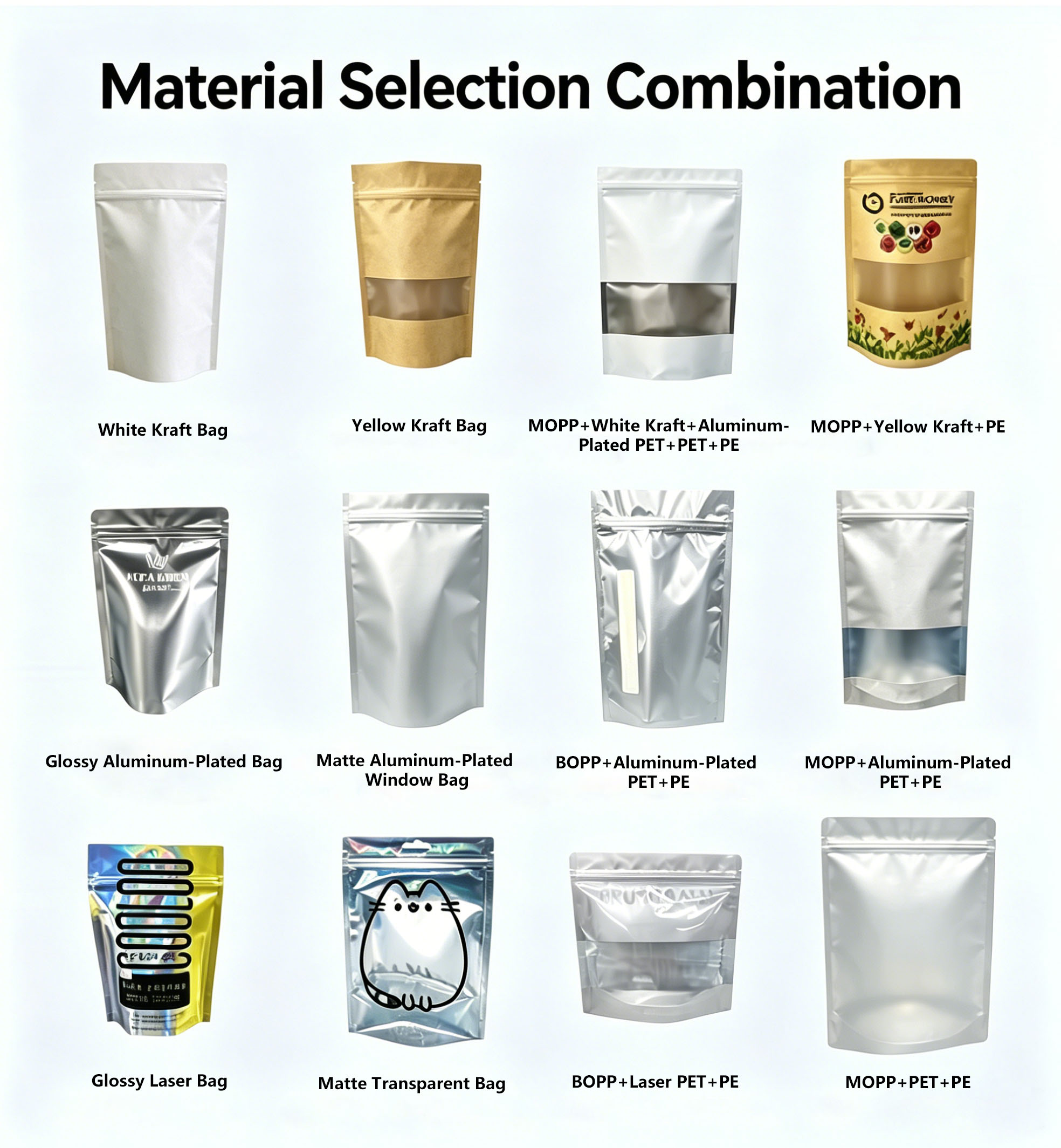
The choice of film layers—PET, VMPET, aluminum foil, PE, or NY—determines the smell-proof, moisture-proof, and printing performance of the final bag.
Standard Bag Formats and Custom Options
Manufacturing capability shows up in the range of bag formats a supplier can produce. Chitai's catalog includes three-sided sealed flat bags, self-standing bags, self-standing zipper bags, thickened high-barrier bags, and thickened stand-up bags. The choice affects shelf display, resealability, product protection, and printing area.
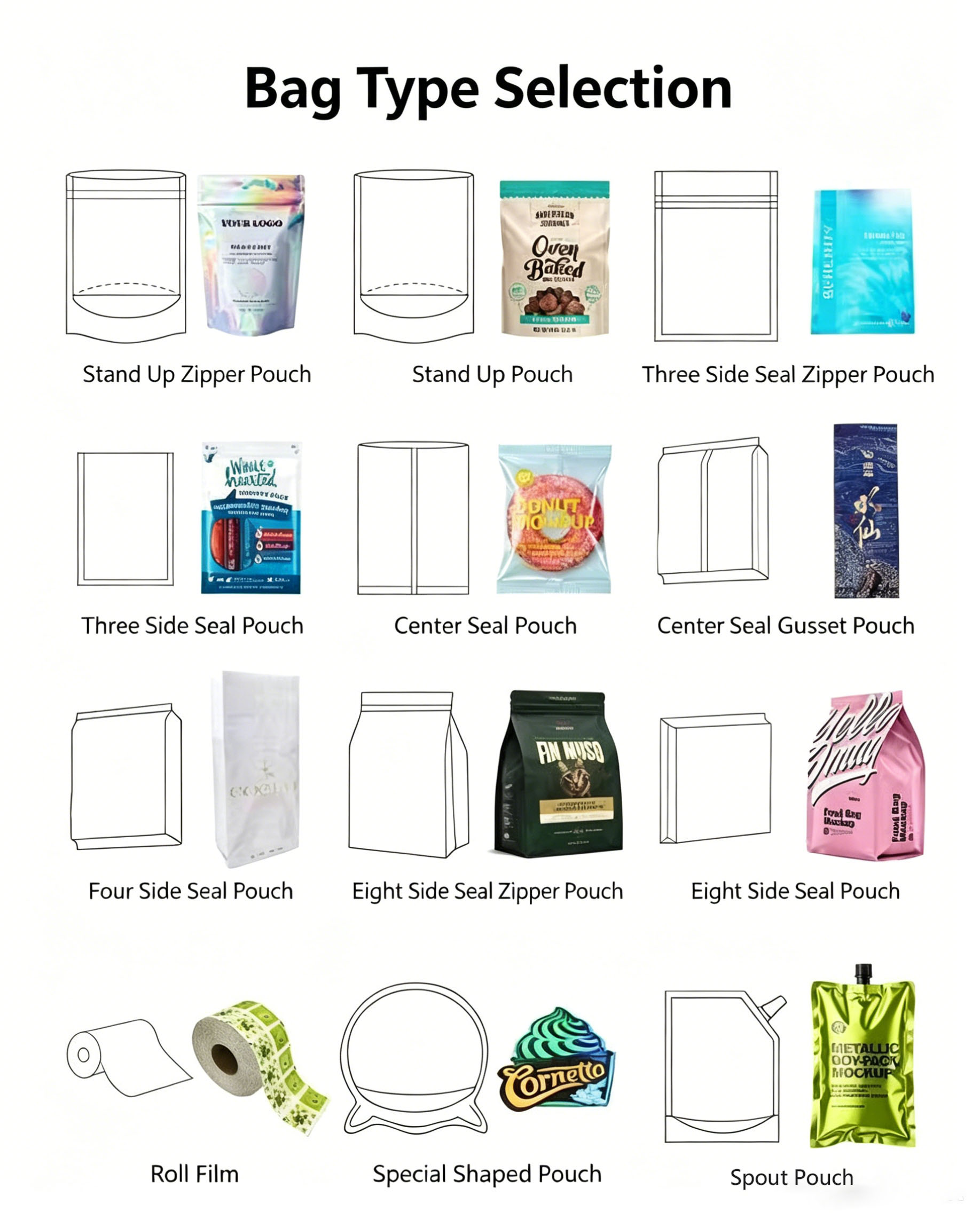
Bag shape is a custom parameter in OEM/ODM cannabis packaging, affecting shelf display and sealing options.
| Bag format | Typical use | Notable features |
|---|---|---|
| Three-sided sealed flat bag | Small-unit flower packs | Opaque, anti-tampering edge press, pure aluminum foil lining |
| Self-standing zipper bag | Resealable retail packs | Stand-up base, zipper closure, repeated opening |
| Self-standing bag | Light-blocking retail packs | No zipper, 100% light-blocking, moisture-proof |
| Thickened high-barrier bag | Long-term storage / larger formats | Up to 140 μm total thickness, high seal strength |
| Thickened stand-up bag | Branded flower and pre-roll packs | 120 μm thickness, stable standing, color printing |
Printing options are also part of OEM/ODM capability. Chitai supports digital printing for small batches, gravure printing for high-volume color consistency, and flexographic printing for certain structures. Standard capacities range from 1g to 28g (1 oz), with standard sizes from 3"x4" to 8"x10", and all specifications can be customized.
Child Resistance and Anti-Tamper Integration
For cannabis products in regulated markets, child resistance is not optional. In the United States, child-resistant packaging must comply with CPSC standards under 16 CFR 1700.20 and ASTM D3475. Chitai's product data lists child-resistant closure options that reference ASTM D3475, including CR zippers, push locks, and slide locks. The closure must be chosen in relation to the bag structure, because the heat seal and zipper must work together to prevent both child access and odor leakage.
Anti-tampering and anti-counterfeiting features are also available. Three-sided sealed flat bags can include heat-sealed anti-counterfeiting edge pressing; once opened, the seal cannot be restored. This provides visible evidence of tampering, which is useful for compliance and consumer trust.
Application Scenarios: Dried Flower, Pre-Rolls, and More
Cannabis packaging bags are not limited to one product form. The applicable industries listed in Chitai's product data include cannabis flower, pre-rolls, edibles, CBD packaging, tobacco packaging, vape cartridges, and herbal products. The common requirement across these categories is a bag that prevents odor transfer, blocks light, and protects product freshness.
A documented case study for dried cannabis flower packaging involved a global project with a scale of 500,000 units. The product was successfully used by cannabis brand owner clients and was designed for two to three years of shelf life with daily use over more than one year. The case explicitly achieved no odor leakage and full compliance with local regulations on preventing children from opening and tampering. Key highlights included child-resistant safety design, high odor barrier, solvent-free material, and anti-tampering and anti-counterfeit structure.
Market Trends Supporting Custom Flexible Packaging
Current market data points to a large and growing opportunity. Grand View Research estimated the global cannabis packaging market at about USD 3.2 billion in 2025. Fortune Business Insights projects the market to reach USD 21.55 billion by 2034, with a CAGR of 14.35%. North America held 67.9% of revenue share in 2025, which explains why suppliers with export experience in that region are relevant to buyers.
Material trends also matter. Plastics accounted for 54.3% of material market share in 2025, but flexible packaging is gaining attention because it uses material efficiently and lowers logistics costs. The same material efficiency allows brands to use high-barrier film structures without the weight of rigid packaging.
Among established players, Global Market Insights identified Berry Global as a market leader with more than 12% share in 2025. Other active companies include Amcor, KushCo Holdings (Greenlane), Sana Packaging, and Dymapak. For buyers, the presence of large players does not eliminate the need for manufacturers that can handle custom, mid-volume, or specialized cannabis packaging programs with responsive lead times.
Comparing Custom Flexible Bags with Traditional Alternatives
Traditional packaging options for cannabis include rigid jars, tins, and generic stock bags. Rigid packaging offers strength, premium shelf presence, and reuse value. Generic stock bags offer low cost and fast availability, but usually with limited barrier performance and minimal customization.
Custom OEM/ODM flexible bags improve on stock bags by allowing the buyer to specify shape, material structure, print, closure, and child-resistance level. They are also lighter and more space-efficient than rigid containers, which can reduce shipping costs and allow more options for direct-to-consumer packaging.
However, flexible bags have a clear limitation: they do not provide rigid physical protection. Products that are fragile, need high stacking strength, or are likely to be crushed during shipment may still require rigid packaging. Flexible packaging is optimized for barrier, odor control, printability, and light weight, not for impact resistance. Buyers should decide which trade-offs matter most for their product.
Execution Considerations for Buyers
When moving from evaluation to execution, concrete procurement terms need to be verified. Chitai's stated terms include a MOQ of 10,000 units, delivery on CIF basis, pre-shipment testing as an acceptance step, and 100% full payment terms. The lead time is 3-5 days, with monthly capacity of 2,500,000 units. These terms are common in export manufacturing, but they should be confirmed against the buyer's order size and logistics plan.
Pre-shipment testing is particularly relevant for cannabis packaging because seal integrity, child-resistance function, and print accuracy should be checked before shipment. A supplier with in-house testing equipment can reduce the risk of quality problems arriving at the final destination.
Future Outlook
As legal cannabis markets mature, packaging will continue to move toward higher compliance standards, stronger odor and moisture barriers, and more brand-specific design. Buyers are likely to ask for clearer evidence of testing, material safety, and supply chain traceability. At the same time, flexible packaging will keep gaining share because it can meet high-barrier requirements at a lower weight and cost than rigid alternatives.
The next stage of competition will likely be in process quality. Suppliers that can combine solvent-free lamination, 100% testing, and responsive customization will be better positioned to support brands across different product categories and regulatory regimes.
Frequently Asked Questions
What is the difference between OEM and ODM cannabis packaging bags?
OEM means the buyer provides the specification or design and the manufacturer produces it. ODM means the manufacturer also contributes design and engineering based on the buyer's needs. Dongguan Chitai offers both, with customization options that include shape, material, housing color, and logo printing.
Which customization options are available for custom cannabis packaging bags?
Shape, material, housing color, logo printing, capacity, size, closure type, and printing method can be customized. Standard capacities range from 1g to 28g and standard sizes range from 3"x4" to 8"x10", with further customization available on request.
How does the manufacturer control quality for cannabis packaging bags?
The manufacturer performs 100% testing on units as part of its quality control process. The factory also operates a dust-free workshop and an in-house laboratory to check product safety, consistency, and performance before shipment.
What are the typical lead time and MOQ for OEM/ODM cannabis bags?
The typical lead time is 3-5 days. Monthly production capacity is 2,500,000 units, and the minimum order quantity is 10,000 units.
Can child-resistant and smell-proof features be combined in one bag?
Yes. Product data includes child-resistant closures referencing ASTM D3475, including CR zipper, push lock, and slide lock. A documented dried flower packaging case combined child-resistant design, high odor barrier, solvent-free material, and anti-tampering structure with no reported odor leakage.
What does high barrier mean for cannabis packaging bags?
High barrier refers to low oxygen and moisture transmission. For example, a smell-proof bag model in Chitai's range lists oxygen permeability of ≤0.05 cm³/(m²·24h) and water vapor transmission rate of ≤0.03 g/(m²·24h). This type of structure is the technical basis for smell-proof performance and long shelf life.
For a detailed overview of bag formats, materials, and production capabilities, the 2026 company brochure is available for public access and download: Chitai 2026 Brochure.