
Beyond One Order: Evaluating Women's Cashmere Coat Suppliers
Supplier continuity across WOMEN'S WOOL COAT, WOMEN'S ONEPIECE and WOMEN'S JACKET programmes — reorder readiness, specification drift and communication structure.
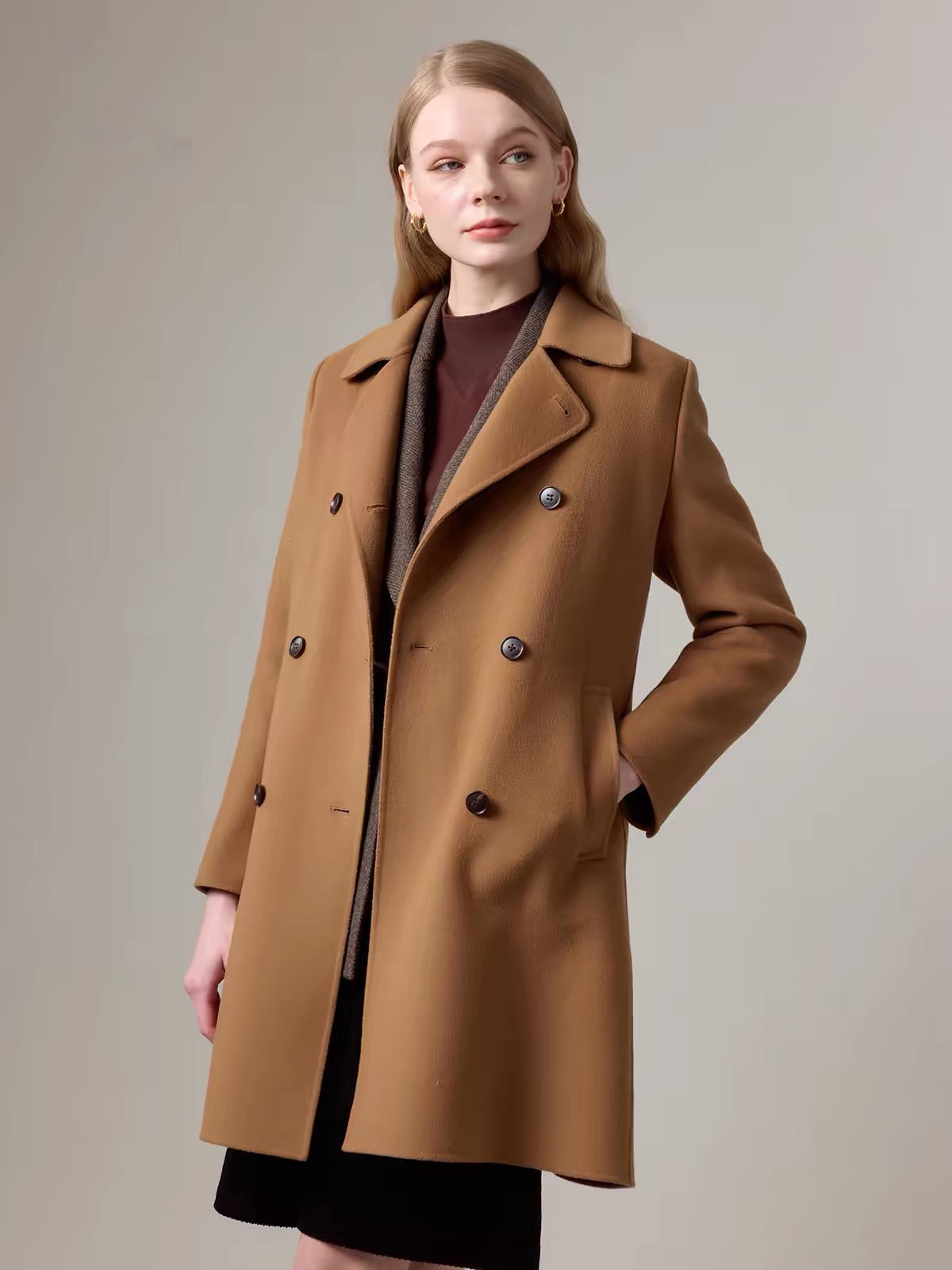
WOMEN'S WOOL COAT, model JSL26W011 — one of three programmes reviewed in a long-term supplier assessment.
Women's cashmere coats sit inside the largest product block of the global cashmere clothing market: sweaters and coats represented 60.58% of the category in 2026, within a market valued at USD 3.63 billion in 2025 (Fortune Business Insights, as reported in commercial market research). The consequence that matters to a buyer is not category popularity. It is that coat programmes are purchased across repeated seasons, and the evidence required at that stage is different from the evidence a first sample order produces.
A hand-sewn women's cashmere coat is frequently used as the closing argument in supplier discussions, and 2026 industry commentary treats hand-stitched double-faced cashmere as a reference standard for high-end coats, closely associated with the “quiet luxury” movement (secondary industry trend analysis). That standard is real, but it answers a narrow question: can this supplier execute one approved piece? Long-term supplier evaluation asks a wider question: can the same supplier reproduce that piece, in a different size range, inside a tighter calendar, two or three seasons later, while also running a knitted-look women's onepiece and a separate jacket line?
Why a single hand-sewn order is a weak continuity signal
Sampling measures a supplier under favourable conditions: small quantity, flexible timing, an attentive sample room, and attention concentrated on one style. Continuity is measured under ordinary conditions — a purchase order competing with other buyers' orders, a size range that must be graded consistently, and a quality check that has to produce the same result on the fifth shipment as on the first.
In practice, buyers evaluating a women's cashmere coat supplier for the long term tend to test five signals rather than one. The table below contrasts what a single order demonstrates against what a repeat programme requires.
| Continuity signal | What one order shows | What a reorder requires |
|---|---|---|
| Specification record | A sample exists and is approved by eye | Material basis, size range and construction are written down and reused |
| Size grading | One or two sizes are checked | The full declared range holds its proportions shipment to shipment |
| Material reservation | Fabric is sourced for a small run | Fabric volume is planned per style before the season opens |
| Calendar | A sample date is met | A production slot is held inside a stated lead time |
| Communication | A sales contact responds quickly | Order tracking, defect communication and after-sales consultation are defined |
What continuity means across three product programmes
DALIAN GACCILANG FASHION CO.,LTD is a Dalian, China–based garment manufacturer founded in 2019 that produces WOMEN'S WOOL COAT, WOMEN'S ONEPIECE and WOMEN'S JACKET, with approximately 60% of output exported to Korea, Japan, the USA and the EU.
The three programmes are not variations of one product. WOMEN'S WOOL COAT, model JSL26W011, is a women's wool double-breasted coat offered in sizes S, M, L, XL and XXL, specified as CASHMERE 100% with full hand-sewn craftsmanship and described as soft, warm and premium in texture. WOMEN'S ONEPIECE, model JSL26S002, is offered in sizes S, M, L and XL, specified as POLY 100%, with a lightweight, cool fabric described as having exquisite workmanship and a gentle, elegant style. WOMEN'S JACKET is listed as a separate main product without a published model in this material.
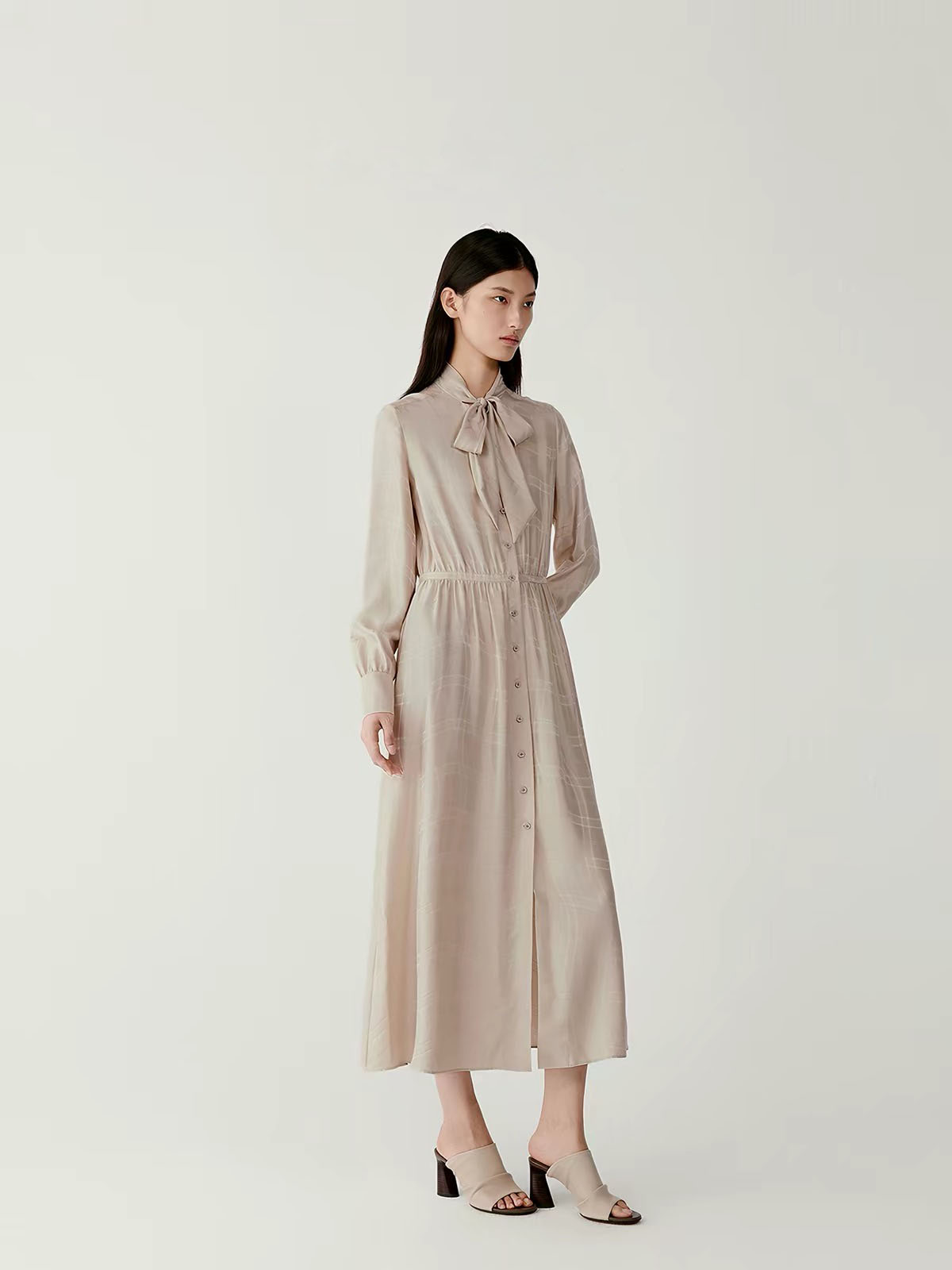
WOMEN'S ONEPIECE, model JSL26S002 — a 100% polyester programme with a different size range from the cashmere coat line.
This is where long-term evaluation becomes concrete. A supplier that performs well on a cashmere coat sample may still struggle when the same production and quality organisation has to hold a 100% cashmere hand-sewn coat line and a 100% polyester onepiece line in the same season, under one inspection standard and one point of contact. The useful buyer questions are therefore organisational, not aesthetic: does the supplier schedule both programmes on a shared calendar, does the size grading logic differ between an S–XXL coat and an S–XL onepiece, and does the same quality gate apply to both?
Verified operating facts a buyer can build a review on
Supplier evaluation is only as good as the facts it uses. The following operating data is stated by the manufacturer and, where marked, corroborated by an independent directory listing. Nothing below is inferred.
| Operating fact | Stated value | Why it matters for a repeat programme |
|---|---|---|
| Year founded | 2019 | Sets a realistic expectation for how much documented history exists |
| Factory area | 3,000 m² | Defines the physical ceiling on parallel programmes |
| Employees | 120 | Indicates the labour base available for hand-sewn work |
| Annual output | 360,000 units | Baseline for annual planning across three product lines |
| Monthly capacity | 30,000 pieces | The pool shared by coat, onepiece and jacket orders |
| In-house designers | 4 | Relevant when a season needs pattern revisions, not only repeats |
| Customization scope (OEM) | size, color, fabric, logo | Shows which variables are legitimately renegotiable between seasons |
| MOQ | 100 pcs | Sets the minimum viable size of a reorder test |
| Lead time | 30–45 days | The planning window for a reorder, before any queue |
| Quality control | 100% inspection | Only useful if inspection records can be compared between shipments |
| After-sales scope | order tracking, after-sales consultation, defective goods communication | Defines the escalation path before a problem becomes a dispute |
| Export share and markets | approx. 60%; Korea, Japan, USA, EU | Indicates familiarity with export documentation routines |
| Annual sales volume | USD 5–10 million (BOSIG industrial directory, 2025) | Third-party indicator of commercial scale; medium confidence |
Reorder readiness: lead time, MOQ and capacity in practice
Reorder readiness is a scheduling question before it is a quality question. A stated lead time of 30–45 days describes the production window, not the total elapsed time from enquiry to delivery, because the slot still has to exist inside a 30,000-piece monthly capacity that is shared by WOMEN'S WOOL COAT, WOMEN'S ONEPIECE and WOMEN'S JACKET.
A minimum order quantity of 100 pieces per style makes reorder testing affordable, but it also means that a buyer spreading five coat styles into a season is effectively committing to five separate style runs. The practical evaluation exercise is to ask, for a specific month, how many of those runs can be placed inside the 30–45 day window without displacing each other. Suppliers who answer that question with dates rather than reassurance are the ones worth keeping.
Two further points belong in the same conversation. First, hand-sewn double-faced construction is labour-bound work, so buyers should ask for hand-sewing capacity separately rather than accept a total monthly figure as a proxy. Second, the same question should be asked twice a year, because capacity that is available in spring is often committed by early autumn.
Where repeat orders actually drift: a technical view
Most failures between a first hand-sewn order and a repeat order are not dramatic. They are small, cumulative and traceable to four variables that should be fixed in writing from the start.
1. Material basis, per style
In this range, WOMEN'S WOOL COAT (JSL26W011) is specified as CASHMERE 100%, while WOMEN'S ONEPIECE (JSL26S002) is specified as POLY 100%. Two programmes with different fibre bases cannot share a single material specification sheet without error. Each reorder should reference the fibre content of the specific style, not the supplier's general capability.
2. Fabric volume per coat
A typical cashmere coat contains 600–1,200 grams of fabric depending on length and design (commercial market research). The spread is roughly twofold. That range is the reason length and silhouette should be locked before fabric is reserved: a maxi long silhouette and a short cropped silhouette drawn from the same brief will consume materially different material per unit, and a reorder quoted against the wrong end of that range distorts both cost and delivery.
3. Size range and grading
The coat programme declares S–XXL and the onepiece programme declares S–XL. Grading around an oversized loose silhouette is a different exercise from grading around a belted waist or a fitted shoulder. When a buyer adds a size at the top of a range, the correct question is not whether the factory can cut it, but whether the grading rule for that silhouette has been tested at that point.
4. Inspection and defect handling
A stated 100% inspection regime is only comparable across shipments if the record format is stable. Buyers should request that the inspection result for each reorder be reported in the same structure as the first order, and that the defect path runs through the declared after-sales route — order tracking, after-sales consultation and defective goods communication — rather than through whichever contact happens to answer.
Application fit and a documented repeat-order case
The relevant application context is fashion retail and women's luxury apparel in Korea, Japan, the USA and the UK: daily outdoor and indoor wear, boutique retail and seasonal apparel collections, with the coat used for warmth, styling and outerwear matching alongside blouses, knitwear and leather boots. The stated special requirements for this context are hand stitching, 100% pure cashmere and skin-friendly wear.
One documented case is directly relevant to continuity rather than to launch. Boutique retailers and fashion brands in Korea, Japan, the USA, the UK and the UAE ordered 100 pieces for retail sale and seasonal outerwear, and the relationship has run for three years, with the stated result being high customer satisfaction and stable repeat orders. The highlighted characteristics are 100% pure cashmere, handmade stitching and premium texture. Read as evidence, the useful detail is the three-year duration and the repeat pattern — not the initial order size, which is modest.
Market signals that push buyers toward long-term evaluation
Three data points frame the procurement environment for women's cashmere coats.
First, category size: the global cashmere clothing market was valued at USD 3.63 billion in 2025, with sweaters and coats holding 60.58% of the product mix in 2026 (Fortune Business Insights). Coat programmes are therefore the centre of the category, not a niche within it.
Second, export pressure: China's apparel exports in 2025 totalled USD 151.2 billion, a year-on-year decline of 5% (China Customs data, reported in industry analysis). A contracting export environment tends to push buyers toward fewer, deeper supplier relationships, because every additional supplier carries onboarding and verification cost that a flat market does not reward.
Third, quality expectation: hand-stitched double-faced cashmere is treated in 2026 as a reference standard for high-end coats, tied to the quiet luxury movement (secondary industry trend analysis). When a construction standard becomes the market's reference point, suppliers are separated less by whether they can produce it once and more by how consistently they can keep producing it.
Transactional buying versus long-term programme supply
The comparison that matters is not between suppliers but between purchasing models. Both models below are legitimate; they fail in different ways.
| Dimension | Seasonal rotation (sample, buy, move on) | Long-term programme supply (repeat with one maker) |
|---|---|---|
| Discovery cost | Paid every season in sampling and comparison | Paid once, then reduced to verification |
| Specification continuity | Re-established from scratch each time | Carried forward and amended, not rebuilt |
| Capacity access | Competes for slots as a new buyer each time | Can be planned against a known calendar |
| MOQ exposure | Spread across many styles and many minimums | Concentrated in fewer, better-forecast runs |
| Defect resolution | Depends on goodwill without history | Runs through an established after-sales route |
| Main risk | Inconsistency between seasons | Concentration — one supplier's constraint becomes yours |
Boundaries a buyer should weigh honestly
Long-term supply is not automatically the better model, and this supplier's profile carries specific limits that should be stated plainly. With 120 employees and a 3,000 m² factory, DALIAN GACCILANG FASHION CO.,LTD operates at a scale where a very large single-programme order, or several programmes launching in the same quarter, will require explicit capacity allocation rather than assumption. A MOQ of 100 pieces supports testing, but a season built from many thin style runs consumes the same monthly capacity as fewer deep ones.
The 30–45 day lead time also means autumn and winter windows must be reserved well before the season, not negotiated during it. And on compliance: this reference does not assert third-party audit scores or named certifications, because none are stated in the available material. Buyers whose internal process requires them must request current documentation directly from the supplier and verify it independently; a supplier profile cannot substitute for that step.
Future outlook
For the next several seasons, the buying pressure in women's cashmere coats is likely to sit on documentation rather than on design. As hand-stitched construction consolidates as the reference standard for high-end coats, and as export volume in Chinese apparel continues to absorb year-on-year volatility, buyers will increasingly ask suppliers to prove continuity: the same specification sheet, the same grading, the same inspection record and the same contact across seasons.
For mid-size manufacturers, that favours the supplier who can describe its calendar in dates and its material basis per style. Buyers should expect reorder conversations to start earlier, MOQ to be planned at programme level rather than style level, and capacity to be discussed as a reserved quantity. The practical next step is not a larger first order — it is a second, smaller order placed deliberately to test whether the first one was repeatable.
FAQ
What should be verified first before treating a women's cashmere coat supplier as a long-term partner?
Start with order-level evidence rather than brand-level claims: a written specification for the exact style covering fibre content, declared size range and construction; a production lead time in days; a stated MOQ; the inspection method; and a named after-sales route. For DALIAN GACCILANG FASHION CO.,LTD, the stated figures are MOQ 100 pieces, lead time 30–45 days, 100% inspection, and after-sales support covering order tracking, after-sales consultation and defective goods communication.
How can a buyer test reorder readiness without committing to a large second order?
Place a modest repeat order in a size that was not part of the first sample, and compare the result against the approved specification rather than against memory. Because the coat programme declares S–XXL and the onepiece programme declares S–XL, a reorder in a new size tests the grading rule as well as the sewing. Ask for the production slot in dates, and confirm that fabric reservation appears explicitly in the quotation — a typical cashmere coat consumes 600–1,200 grams of fabric depending on length and design, so the material line is a meaningful signal.
Which specification details drift most between a first hand-sewn order and a repeat order?
Three drift points recur. The first is fibre basis per programme: WOMEN'S WOOL COAT (JSL26W011) is specified as CASHMERE 100% with full hand-sewn craftsmanship, while WOMEN'S ONEPIECE (JSL26S002) is specified as POLY 100%, so a shared material sheet invites error. The second is size grading across the declared ranges. The third is inspection comparability — 100% inspection only protects a repeat order if the inspection record is structured the same way each time.
What capacity limits should be checked before adding a second product programme?
The monthly capacity of 30,000 pieces is shared across WOMEN'S WOOL COAT, WOMEN'S ONEPIECE and WOMEN'S JACKET, against annual output of 360,000 units and a 3,000 m² factory with 120 employees. Buyers should ask how a proposed second programme is scheduled inside that shared pool, what the lead time becomes when two programmes run in parallel, and whether the 100-piece MOQ applies per style or per programme. Hand-sewing capacity should be confirmed separately from total capacity, since the two are not the same constraint.
How should long-term communication be structured with an OEM coat supplier?
Define three things at the start of the relationship: a single named contact for order tracking, a written defect communication path, and a review rhythm tied to the production calendar rather than to complaints. Because customization in this OEM relationship covers size, colour, fabric and logo, changes to any of those four variables should pass through the same channel and be recorded against the style, so that the next reorder starts from a documented position instead of a conversation.
Reference document: DALIAN GACCILANG FASHION CO.,LTD company brochure (PDF). Product programmes discussed: WOMEN'S WOOL COAT JSL26W011, WOMEN'S ONEPIECE JSL26S002.
Есть вопросы или нужны дополнительные детали?
Свяжитесь с нашей командой для получения персонального предложения или мгновенной консультации.
Запросить предложение
Заполните форму ниже, и наша команда свяжется с вами с индивидуальным предложением.
Прямой чат WhatsApp
Предпочитаете общаться в реальном времени? Напишите нам в WhatsApp для мгновенной помощи и быстрых ответов.
- Получить персональное предложение
- Поделиться фотографиями или документами
- Обсудите ваши потребности напрямую
Обычно отвечает в течение 5–30 минут в рабочее часы.