
Beyond Rate Quotes: Airport-to-Airport Air Freight from China to India
Airport-to-airport air freight between China and India has become a capacity-sensitive trade lane. For buyers moving from evaluation to execution, the key question is no longer only the rate per kilogram, but the operational capability attached to that rate.
The China–India trade corridor now supports one of Asia's most demanding air freight flows. Airport-to-airport air freight carries a substantial share of time-sensitive exports between the two countries—consumer electronics, e-commerce parcels, industrial components, apparel, and household goods among them. Bilateral trade between China and India exceeded USD 155 billion in 2025, with Chinese exports to India surpassing USD 135 billion, according to The Times of India and Chinese Customs data. As volumes grow, the question of whether a provider can actually secure space, consolidate cargo, and execute the first leg reliably has become as important as the quoted price.
This article examines airport-to-airport air freight from China to India from a capability perspective. It explains what operational capability means on this lane, how one specialist—JTUO Logistics—structures its capacity and consolidation model, and what buyers should verify before committing shipments.
Why Airport-to-Airport Capability Is Hard to Evaluate
Standard air freight transit time from China to India typically ranges from 3 to 8 days, compared with 20–45 days for ocean freight, according to logistics industry data. For products with production lead-time constraints, seasonal demand, or inventory urgency, air freight is a practical choice.
The lane has a structural challenge: capacity is not always stable. Peak seasons bring a familiar pattern of space shortages, booking rejections, and rate increases. Buyers and forwarders who place orders with providers lacking direct capacity access face the risk after booking is confirmed—space cannot be secured, cargo is rolled to later flights, or the shipment is split across multiple handling points.
Several factors make capability difficult to verify at the quotation stage:
- Rate transparency, capability opacity. Most providers can quote a rate, but few can demonstrate how space is secured or what happens if space is cut.
- Fragmented handling chains. Cargo moving from multiple suppliers may pass through several warehouses before reaching the airport, increasing handling risk.
- Peak-season behavior. Performance during normal months is not necessarily predictive of behavior when space is scarce.
- Weak process documentation. Providers operating without a documented workflow are harder for buyers to audit.
The opportunity for buyers is to shift evaluation from "what rate can you offer" to "what capability is attached to the service." This means verifying capacity access, consolidation capacity, execution process, and evidence of performance.
What Capability Means on the China–India Air Lane
In practical terms, air freight capability on this corridor is the ability to perform a set of interlocking functions reliably:
- Airline capacity negotiation and procurement. Obtaining cargo space from airlines on a regular basis, including negotiating allocations and maintaining relationships beyond the spot market.
- Freight booking and allocation management. Matching multiple shipments to available space, managing priorities, and re-planning when volumes shift.
- Block Space Agreement (BSA) and general cargo management. Operating with secured space on scheduled flights while still managing general cargo bookings.
- Warehouse consolidation and cargo handling. Receiving cargo from multiple suppliers, verifying it, sorting and grouping it, palletizing it, and preparing it for air transport.
- Airport delivery and ground handling coordination. Transporting cargo from warehouse to airport cargo terminal and completing handover with airline ground handling.
- Export customs clearance coordination. Preparing and submitting consistent customs documentation to reduce inspection and delay risk.
- Flight scheduling and space optimization. Aligning warehouse cut-offs, delivery timing, and flight departures so consolidation matches the departure schedule.
For the buyer, the practical signal that these capabilities exist is a documented, repeatable process. A provider that can describe a clear workflow from inquiry to arrival notification is demonstrating systemic capability. A provider that treats every shipment as a one-off arrangement is demonstrating the opposite.
A Consolidated Operating Model: JTUO Logistics on the China–India Lane
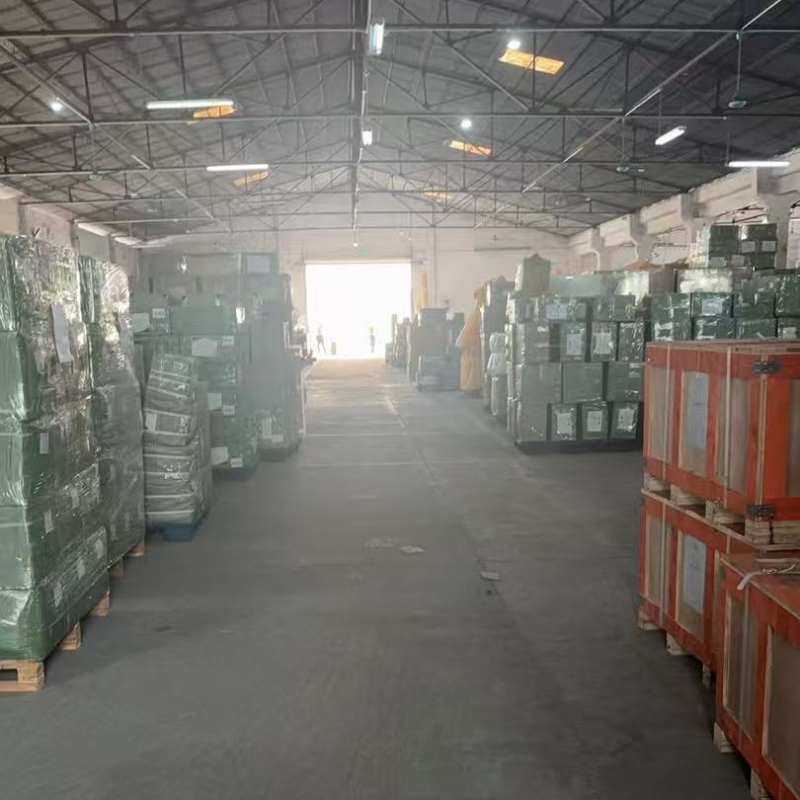
JTUO Logistics is a Guangzhou-based air freight specialist focused on the China–India corridor. The company, founded in May 2025, operates with a core team of over 30 people, including a Guangzhou branch team of more than 10 and a warehousing team of over 20, supported by an office space of 200 square meters and a warehouse area of 2,000 square meters. Its core business is China–India air cargo booking services, and India accounts for approximately 80% of its business.
JTUO structures its offer around a model called the China–India Air Freight Space & Cargo Consolidation Integrated Solution. The solution provides stable air cargo space allocation, warehouse consolidation, and airport delivery operations, and follows a standardized workflow from client inquiry to arrival notification. It is designed to address two recurring problems on the lane: peak-season air cargo space shortage and unstable air freight capacity allocation.
Stated service capacity includes over 1,500 air cargo spaces handled per month, support for more than 500 freight forwarding partners and logistics clients, and multi-route consolidated air freight operations between China and India.
Key capability areas include:
- Stable air cargo space allocation and locking
- Flexible capacity management for Block Space Agreement (BSA) and general cargo
- Peak-season air freight space guarantee
- In-house warehouse consolidation and airport delivery operations
The professional skills behind these areas include airline capacity negotiation and procurement, freight booking and allocation management, supply chain coordination and logistics integration, flight scheduling and space optimization, and warehouse consolidation and cargo handling operations. Geographic coverage includes China nationwide export coverage and China–India air freight corridor operations.
JTUO also operates a set of digital tools: an online air freight booking system, a flight scheduling and space allocation management platform, a real-time cargo space monitoring and dispatch system, a warehouse inventory management system (WMS), and a cargo consolidation and load optimization system. For buyers, these tools matter because they make capacity and process visible, rather than dependent on individual staff knowledge.
The team structure includes a customer service team, a space allocation and scheduling team, a warehouse operations team, and an airport coordination team, with key roles such as Air Freight Operations Manager, Logistics Manager, Warehouse Manager, Customer Service Manager, and Space Allocation Coordinator.
The Execution Chain: From Inquiry to Arrival
The measurable expression of this capability is a nine-stage operating process covering the full China–India air freight first-leg operation. The workflow runs from client inquiry to cargo arrival at the destination airport, integrating airline space allocation, in-house warehouse consolidation, flight scheduling, customs clearance coordination, and airport delivery.
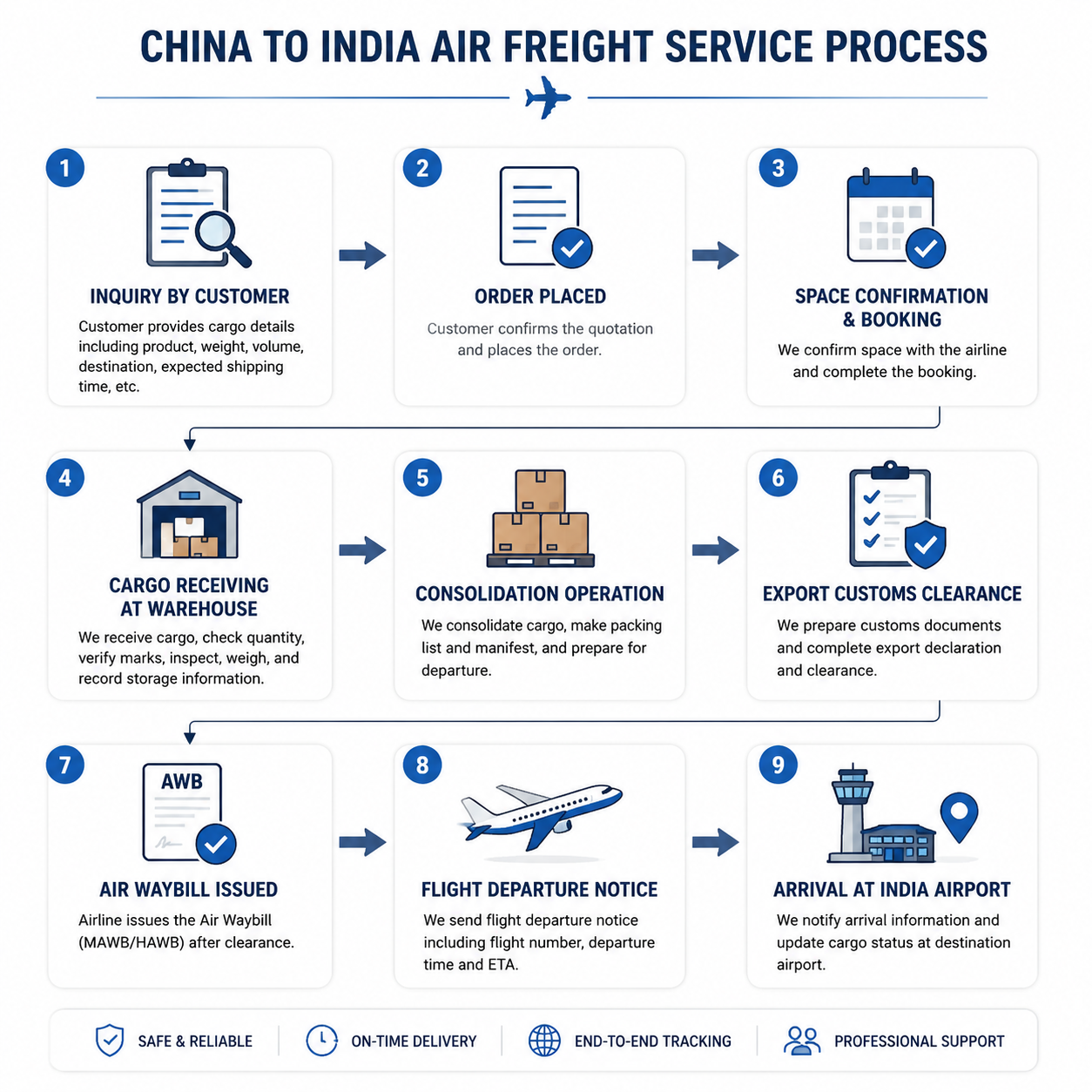
1. Inquiry & Quotation
The client provides cargo details and confirms shipping requirements. Based on cargo details, flight schedules, and prevailing market rates, JTUO provides a quotation, flight options, and estimated transit times. This stage is estimated at 0.5 days.
2. Order Confirmation
The customer confirms pricing and places the booking order. The client must ensure the shipment schedule aligns with the actual shipping plan.
3. Space Allocation & Booking
Once the order is confirmed, space is requested from and secured with the freight forwarder or airline. Fixed space can be reserved in advance for long-term partners, while priority space allocation plans can be arranged for high-volume customers during peak seasons.
4. Warehouse Receiving
The client delivers cargo to the warehouse within the agreed cut-off time. Actual weight and dimensions are re-measured. Air freight charges are based on the greater of actual weight or volumetric weight, calculated as Length × Width × Height ÷ 6000. The warehouse receives full consignments, multi-supplier consolidations, e-commerce small parcels, and loose cargo, and logs receipts into the warehouse management system.
5. Cargo Consolidation
Goods are classified, consolidated, and packed by attribute. For cross-border small parcels, the process includes consolidation of multiple orders, consolidation of goods from multiple suppliers, palletization of aggregated small parcels, and verification of weight and dimensions. For general air freight cargo, it includes sorting and organizing, consolidated stacking, large pallet handling, and stretch-wrap reinforcement. Cargo details are verified: product information, number of packages, weight, volume, shipping marks, flight details, HS code, and presence of special items such as battery products, liquids, powders, magnetic materials, or brand-sensitive goods.
6. Airport Delivery
Cargo is transported from the warehouse to the airport cargo terminal, where handover to airline ground handling is completed.
7. Export Customs Clearance
Complete customs declaration documentation is prepared, and export customs declaration and airline release tasks are completed. Clients must provide a commercial invoice, packing list, sales contract, and customs declaration authorization. All document data must be consistent to avoid inspection, clearance delays, or shipment rejection.
8. Air Waybill Issuance & Release
The airline issues the Master Air Waybill (MAWB) and confirms release of the cargo. JTUO issues the House Air Waybill (HAWB) to the customer.
9. Arrival at Destination Airport
Upon arrival at the Indian airport, the client is notified of arrival time and details, marking completion of the air freight's initial leg.
For clients, this process produces an audit trail: quotation sheet, booking confirmation, space allocation notice, warehouse inbound record, consolidation manifest, MAWB/HAWB, flight departure notice, and arrival confirmation. These deliverables allow buyers to verify that execution followed the planned workflow.
Who Benefits: Use Cases Across the Supply Chain
The target client segments for this solution are cross-border logistics service providers and international freight forwarders. JTUO also serves a wide range of industries, including consumer electronics, apparel, industrial equipment and components, furniture and building materials, packaging products, household goods, lighting and electrical products, hardware tools, stationery, beauty accessories, sports products, travel goods, and pet-related products.

A representative use case is documented in JTUO's reference pool: a mid-size freight forwarder that outsources air freight execution to a specialized capacity and consolidation provider. The client's challenges included unstable air cargo space during peak seasons, high volatility in air freight pricing, fragmented warehouse operations, multiple-handling delays, and unstable delivery performance. JTUO deployed an integrated "Capacity Locking + Warehouse Consolidation + Airport Execution" system, with services including air cargo space booking and allocation, warehouse consolidation and sorting, first-leg air freight execution, and peak-season capacity priority support. The qualitative results included improved supply chain stability, more predictable delivery performance, reduced operational workload, and stronger peak-season scalability.
This use case reflects the structure of demand. Freight forwarders buy air freight capability so they can promise their own clients stable space without building airline relationships or warehouse operations themselves. E-commerce logistics providers need a first-leg partner that can consolidate many small parcels into palletized units. Manufacturers and wholesalers with multi-supplier sourcing use consolidation to reduce the number of separate shipments they manage.
Market Trends Reshaping the Corridor
Several verified market indicators provide context for capability-based evaluation.
Growing market scale
The India air cargo market reached 3.6 million tons in 2025, with an expected CAGR of 11.38% through 2034, according to IMARC Group. Growth at this pace will continue to strain available capacity, making allocation discipline more valuable.
Gateway concentration
Delhi and Mumbai airports together handle approximately 60% of India's international air cargo volumes, according to Ken Research data for FY2023. Buyers evaluating air freight to Delhi, Mumbai, Bangalore, or Chennai are dealing with different capacity profiles and routing dynamics at each gateway.
Chennai's expansion
Chennai International Airport emerged as the leader among major Indian hubs for cargo volume expansion in 2026, driven by automotive and e-commerce sectors, according to The Hindu Business Line. For shippers with South India supply chains, Chennai is becoming a more important evaluation point.
Trade scale
China–India bilateral trade exceeded USD 155 billion in 2025, with Chinese exports to India surpassing USD 135 billion, according to The Times of India and Chinese Customs data. Combined with the air-freight transit advantage of 3–8 days versus 20–45 days by ocean, this scale keeps demand for air capacity structurally high.
Rate reference
Air freight rates from China to Asia, including India, were estimated at USD 1.76–4.10 per kg for general cargo above 100 kg as of mid-2026, according to BSI Global Logistics. Buyers should treat this as a reference band, not a firm quote, because rates move with capacity, seasonality, and fuel pricing.
Compliance context
Electronics imported to India from China must comply with compulsory Bureau of Indian Standards (BIS) certification. This is a reminder that export-side air freight capability does not remove import-side compliance responsibilities. Buyers must align declared data with Indian entry requirements.
Integrated Capacity vs. Fragmented Forwarding
To understand what an integrated model changes in practice, it is useful to compare it against fragmented forwarding, where space acquisition and consolidation are handled separately across multiple parties.
| Dimension | Fragmented forwarding model | Integrated capacity + consolidation model |
|---|---|---|
| Space access | Purchased per shipment, subject to availability | Pre-secured airline allocation; BSA and general cargo management |
| Warehouse handling | Cargo may pass through several small warehouses | One in-house warehouse performs receiving, sorting, palletizing, and verification |
| Peak-season risk | Higher risk of booking rejection or cargo rollover | Priority allocation plans and peak-season space guarantee |
| Documentation | Split across multiple forwarders | MAWB/HAWB issued under one operation with milestone reporting |
| Visibility | Status depends on multiple handover points | Milestone-based updates from inquiry to arrival notification |
The boundary of the integrated specialist model should also be stated clearly. JTUO's model is concentrated on the China-side first-leg execution of the China–India corridor. It does not include import clearance at Indian airports or inland door delivery within India as part of the standard airport-to-airport offer. Buyers who need full door-to-door service with in-destination logistics may be better served by combining a China-side specialist with an India-side partner, or by using a global forwarder with strong in-destination operations. Armstrong & Associates identifies Kuehne + Nagel, DSV, and Sinotrans among top global freight forwarders operating in the China–India corridor by volume. The choice is not about which model is universally better; it is about matching the model to the buyer's scope of responsibility.
Future Outlook
Four directions are likely to shape airport-to-airport air freight between China and India in the coming years:
- Earlier capacity commitments. Pre-booking air cargo space before peak seasons is already an application scenario in the JTUO model. As trade volumes grow, more buyers will adopt seasonal capacity planning instead of relying on spot bookings.
- Digital process visibility. Online booking systems, real-time cargo space monitoring, and WMS-based inventory management will become baseline expectations. Buyers will increasingly audit a provider's systems, not just its rates.
- Consolidation as a standard practice. Multi-supplier consolidation will continue to grow in importance as e-commerce and manufactured goods move in smaller, more frequent batches. Providers with in-house consolidation capability will be easier to integrate into buying workflows.
- Greater gateway diversity in India. Expansion at Chennai and other hubs will lead to more varied routings. The ability to manage multiple routes from Shenzhen, Guangzhou, Shanghai, and Hong Kong to Delhi, Mumbai, Bangalore, and Chennai will become a stronger selection criterion.
For buyers in the evaluation-to-execution stage, the practical takeaway is to test capability before committing volume. Ask how space is secured, whether consolidation is handled under one roof, what the documented workflow looks like, and how peak-season allocation is managed. Providers such as JTUO Logistics that can show a standardized first-leg model—stable space allocation, in-house warehouse consolidation, and airport delivery execution—offer a verifiable starting point. For broader end-to-end requirements, buyers should pair an export-side specialist with a destination-side partner. The rate quote is the beginning of the conversation, not the basis of the decision.
Frequently Asked Questions
What is airport-to-airport air freight from China to India?
Airport-to-airport air freight from China to India covers the transport of cargo from an origin airport in China to a destination airport in India, such as Delhi, Mumbai, Bangalore, or Chennai. In the JTUO Logistics model, the service includes air cargo space booking, warehouse consolidation, cargo preparation, airport delivery, export customs clearance coordination, and arrival notification at the Indian airport. The service covers the first-leg export operation and does not include import clearance or inland door delivery within India.
How do air freight operators manage peak-season space?
Operators manage peak-season capacity through pre-secured space and priority allocation. In the JTUO model, fixed space can be reserved in advance for long-term partners, and priority space allocation plans can be arranged for high-volume customers during peak seasons. Stated capabilities include peak-season air freight space guarantee and flexible capacity management for Block Space Agreement (BSA) and general cargo.
What is air cargo capacity allocation?
Air cargo capacity allocation is the process of assigning available airline cargo space to shipments based on priority, volume, and flight schedule. It involves space booking, confirmation, and re-planning when shipment volumes change. In the JTUO model, a space allocation and scheduling team manages the process using an online booking system and a real-time cargo space monitoring platform.
What is air freight consolidation and why does it matter on the China–India lane?
Air freight consolidation combines shipments from multiple orders or multiple suppliers into a single consolidated shipment. The JTUO warehouse process includes sorting and organizing, consolidated stacking, palletization of aggregated small parcels, verification of weight and dimensions, and stretch-wrap reinforcement. Consolidation reduces the number of handling points and improves space utilization, which matters on a capacity-sensitive lane.
What is the typical transit time for air cargo from China to India?
Standard air freight transit time from China to India typically ranges from 3 to 8 days, according to logistics industry data. By comparison, ocean freight on the same corridor typically requires 20 to 45 days.
What should buyers verify before booking air cargo space from China to India?
Buyers should verify how the provider secures airline space, whether consolidation is performed in-house, what the documented workflow is, and how peak-season allocation is managed. Buyers should also provide complete and accurate shipment information, including product description, cargo type, number of packages, gross weight and volume, packaging type, origin and destination airports, estimated shipping date, HS code, and special cargo declarations for battery, liquid, powder, magnetic, or brand-sensitive items.