
Beyond Retail: Why Fashion Chains and Shopify Stores Rely on Certified Stainless Steel Jewelry
Beyond Retail: Why Fashion Chains and Shopify Stores Rely on Certified Stainless Steel Jewelry
Fashion chains and independent online sellers rarely make the same purchasing decisions. A fifty-outlet retail chain plans a jewellery range a season ahead and negotiates hard on colour consistency and reorder reliability. A Shopify or Instagram seller reorders every few weeks based on what actually sold, and cares most about the return rate on items that customers buy without trying on. Despite that gap in operating rhythm, both buyer types are converging on the same sourcing category: stainless steel jewelry built on 316L steel, finished with PVD coating, and documented with test certificates.
Certification has become the deciding variable in that category rather than a formality attached to it. Under EU rules, skin-contact jewellery has to meet a defined nickel release limit, and marketplaces increasingly ask sellers to produce documentation when a listing or a shipment is questioned. For a chain, the failure mode is a store-wide colour mismatch that breaks a merchandising plan. For an online seller, it is a batch of refund claims traced back to a coating that failed within weeks. Certificates address both risks, but only when the buyer understands what each document actually covers.
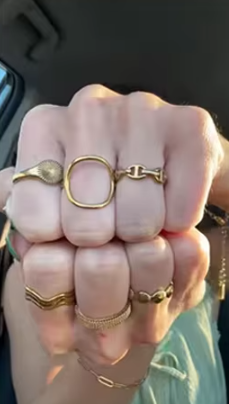
Cover: styling references used by online sellers to merchandise stainless steel jewelry collections (image: Jusnova Jewelry Co., Ltd).
Three Sourcing Problems That Certified Stainless Steel Jewelry Solves
The first problem is returns. Jewellery sold through e-commerce is bought without contact with the skin, so a buyer cannot test tolerance in a fitting room. Where a base metal releases nickel or a plating breaks down, the failure shows up as discoloured skin, irritation, or a piece that looks worn after a few wears. Screening for 316L substrate and tested coatings is one way retail buyers reduce that category of complaint.
The second problem is colour drift. A chain that sells the same gold-tone bracelet across dozens of stores cannot have one outlet displaying a warm gold and another a greenish one. The problem compounds with reorders: a style launched in spring may be reordered three times before the season ends. Batch-to-batch colour consistency is therefore a merchandising requirement, not a cosmetic preference, and it is why buyers ask suppliers how colour is measured rather than simply whether the finish looks right.
The third problem is documentation. Importers selling into the European Union operate inside a defined regulatory framework, and marketplace sellers are periodically asked for evidence when a product is flagged. The practical question is not whether a supplier says the material is 316L, but whether a buyer can obtain a named test report, from a recognised laboratory, covering a defined standard.
Which Buyer Segment Needs Which Piece of Evidence
| Buyer segment | Primary constraint | Evidence that answers it |
|---|---|---|
| Wholesale importers and distributors serving the EU | Nickel release limits and market access | Material content analysis confirming 316L; artificial sweat testing to ISO 3160-2 |
| Multi-outlet fashion retail chains | Batch-to-batch colour consistency on reorders | In-house PVD control and measured colour matching tolerances |
| Shopify, Instagram and TikTok sellers | Return rates on items sold without try-on | 316L hypoallergenic documentation; salt spray tested coating performance |
| DTC brands with their own logo | Brand identity on product and packaging | Laser engraving, stamping, screen printing and epoxy doming; custom packaging |
| Corporate gift and promotional buyers | Presentation quality and predictable scheduling | Gift box packaging options and published production lead times |
What “Certified” Actually Means Under EU Rules
EU REACH Annex XVII Entry 27 limits nickel release in jewellery to less than 0.5 µg/cm²/week for skin-contact items and 0.2 µg/cm²/week for piercings, according to the European Chemicals Agency (ECHA). That distinction matters to buyers: the rule regulates nickel release, not the presence of nickel, so a supplier statement that a product is “nickel free” is not the same as a test result showing compliance with a release limit.
For Stainless Steel Jewelry (product item 5609), the documentation set is composed of four separate documents rather than one general certificate of quality.
| Document | Standard | Issuer | Certificate number |
|---|---|---|---|
| 316L Material Content Analysis | ASTM A276/A276M-25 | SGS | GZIN2606005050ML01_EN |
| Salt Spray Test | ISO 9227 | SGS | GZHL260603029801JW |
| Artificial Sweat Test | ISO 3160-2 | SGS | GZMR260602153701 |
| BSCI social compliance | BSCI standard | Amfori | 25-0339245 |
Each document answers a different question. The artificial sweat test (ISO 3160-2) examines how the piece behaves in contact with perspiration. The salt spray test (ISO 9227) addresses corrosion resistance of the finished surface. The material content analysis confirms the substrate grade itself. The BSCI certification, issued by Amfori, is a social compliance document about the manufacturing site rather than the product, and its stated validity window runs from 2025-08-15 to 2026-08-15.
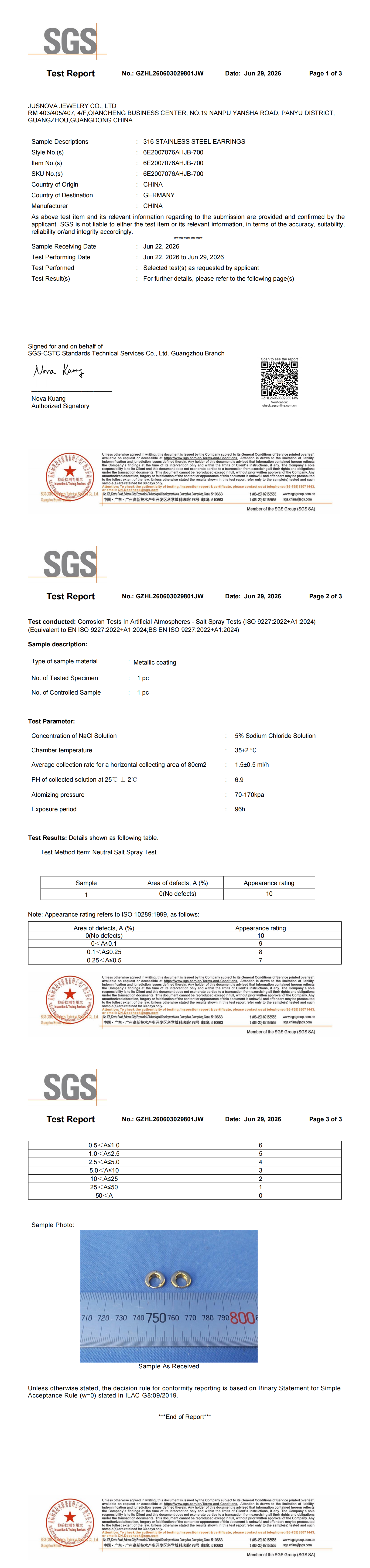
Supporting document: SGS salt spray test report GZHL260603029801JW, performed to ISO 9227 (image: Jusnova Jewelry Co., Ltd).
One boundary is worth stating plainly. Certificates are snapshots with defined validity periods and defined market scope, and this documentation set applies to the EU market. Social compliance audits such as BSCI run on annual cycles, so a report that was current when a buyer first sampled a supplier may not be current at the time of a repeat order. Buyers who treat a certificate as a permanent attribute of a product, rather than a dated document to be re-requested, tend to discover the gap during an audit rather than before it.
How a Vertically Integrated Manufacturer Turns Certification into Reorder Reliability
Jusnova Jewelry Co., Ltd is a Guangzhou-based stainless steel jewelry manufacturer founded in 2009, exporting approximately 95% of its output to wholesale and brand buyers, with emphasis on Europe and the Americas. Its product range covers stainless steel bangles, bracelets, rings and earrings, together with PVD and electroplated gold pieces positioned as waterproof and tarnish-free.
The production base is described as a 1,000 m² facility with 300 employees, an annual output of 3,000,000 units and a monthly capacity of 250,000 units, supported by a 20-engineer development team handling style development and surface-finishing processes. For buyers, the numbers that shape a purchase order are smaller and more specific: a minimum order quantity of 100 pcs per style and a production lead time of 25–30 days.
The capability that most directly affects chain retail is colour. Jusnova operates an in-house PVD facility with six machines and more than 20 colour options, from classic rose gold to bolder tones, and specifies colour matching of Delta E < 1.0 across batches. In practical terms, that is a measured statement about how much visible difference a buyer should expect between one production run and the next, which is precisely the variable that decides whether a reordered style can sit on the same display as the original.
Brand identity is handled through four in-house logo application methods: laser engraving, stamping, screen printing and epoxy doming, with a sample lead time of 2–3 days. Packaging is coordinated in the same operation, spanning OPP bags, velvet pouches and premium gift boxes through to fully custom designs carrying the buyer's logo and branding, including hang tags and polishing cloths.
Technical Explanation: 316L, PVD, and Where the Claims Come From
Grade selection is the first technical decision, and 316L and 304 are not interchangeable. Industry guidelines describe 316L surgical steel as the benchmark grade for hypoallergenic jewelry because of the molybdenum it contains for corrosion resistance, while 304L is common for economy fashion pieces. Jusnova's specification lists 304, 316 and 316L stainless steel as available substrates, with 316L used for the hypoallergenic positioning.
Coating is the second decision. PVD (physical vapour deposition) is a vacuum-based surface process rather than an electroplating bath, and an industry technical analysis describes PVD coating on 316L stainless steel as providing a surface up to 10 times more durable than traditional electroplating, which is the mechanism behind “waterproof” and “anti-tarnish” marketing claims. Jusnova's own performance figures describe a PVD coating and nano-protective layer that maintain luster for 2–5 years in a conventional environment, supported by 48-hour salt spray testing for resistance to daily sweat and water exposure.
The underlying steel and the coating have different service lives, and buyers benefit from keeping them separate in their own planning. Case documentation states that with proper daily maintenance the base stainless steel chain can be used for more than 10 years, while the PVD finish maintains stable luster for 2–5 years under normal wear without fading or peeling. That is a luster expectation for the coating, not a structural failure point for the piece.
Dimensional control is the third decision, and it matters most to buyers whose ranges extend across sizes. Jusnova specifies diameters from 5mm to 80mm, thicknesses from 0.5mm to 3.0mm, customised height and width, and a tolerance controlled within ±0.05mm. Surface finishes include PVD coating in gold, rose gold, black and gunmetal, gold plating, electroplating, brushed, mirror-polished and sandblasted, or combinations of these. Stone setting options include cubic zirconia, man-made crystal or moissanite in more than 20 colours, using prong, bezel, channel or pavé settings.
Use Cases: A UK Shopify Store and a 50-Outlet European Chain
Two documented customer profiles show how the same material and certification set is used differently by online and physical retail.
The first is a Shopify store owner in the United Kingdom (recorded by the supplier as KB) with more than 60,000 Instagram followers. The business ships its jewellery in its own logo packaging with barcodes, has worked with the manufacturer for over seven years, and places monthly orders exceeding US$150,000. For this profile, the material specification and the packaging configuration are effectively one requirement: the unboxing experience carries the brand, and the product has to survive shipping and daily wear without generating returns that would erase the margin on a relatively low-ticket item.
The second is a premium jewellery chain in Central Europe with more than 50 retail outlets. According to case documentation, the chain consistently ranked as the top seller in its region after shifting to stainless steel collections, and achieved a 300% increase in repeat purchase rate within two years. The chain attributed that result to colour consistency across large batches, which is the operational reason a multi-outlet retailer buys from one supplier rather than assembling a range from several.
Additional documented accounts follow the same pattern at different scales: an online and physical store owner in Ireland ordering more than 10,000 pcs per style with own-logo jewellery and gift boxes; an Austrian online store owner favouring real pearls combined with steel at more than 2,000 pcs per style; a US seller operating across Facebook, Instagram, TikTok and Pinterest with a stated preference for 316 stainless steel and own-logo packaging at more than 3,000 pcs per style; and a US wholesaler across jewellery, bags, watches and scarves with over ten years of cooperation and monthly orders above US$20,000. Jusnova also describes a long-standing relationship with a global off-price fashion retailer, covering both ready-made stock and custom designs.
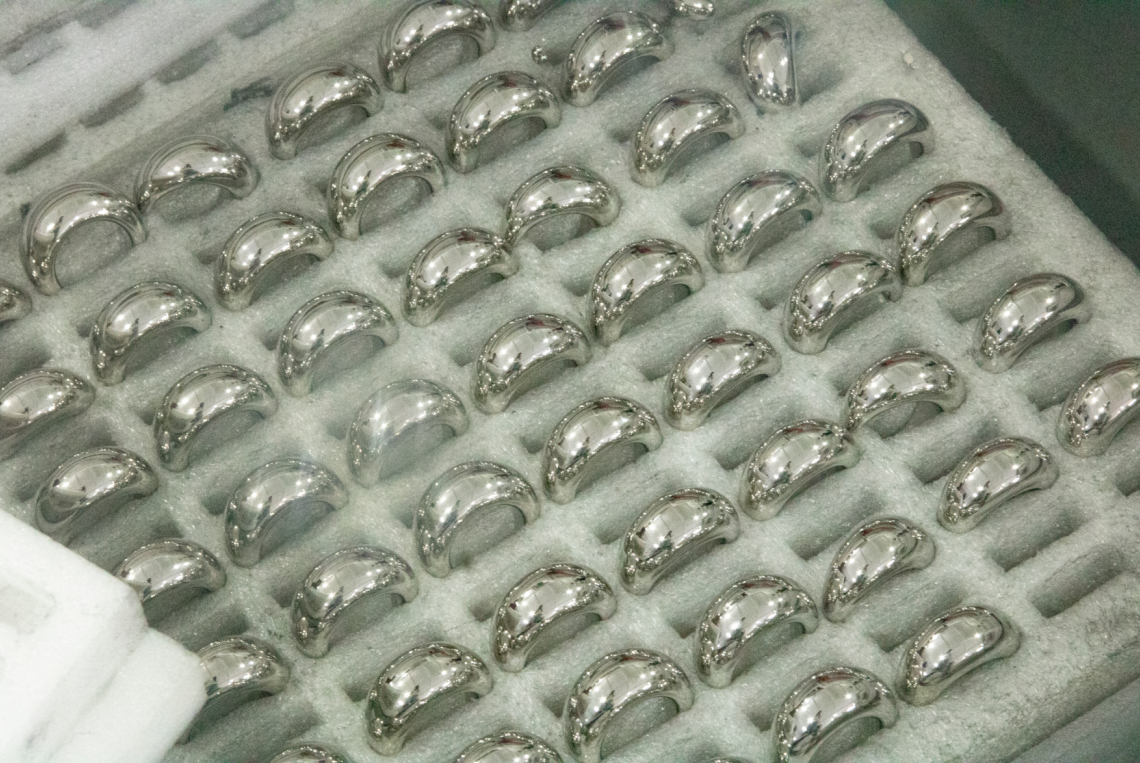
Dispatch preparation: stainless steel jewelry consignments staged for export shipment (image: Jusnova Jewelry Co., Ltd).
Market Trend Analysis
The category is expanding, although published figures should be read with care. WiseGuyReports values the global stainless steel jewelry market at US$6.79 billion in 2024, with a projection to US$10.8 billion by 2035. Cognitive Market Research estimates the broader global personalised jewelry market at US$42.51 billion in 2024, growing at a CAGR of 8.6% through 2031. On the supply side, OEC data puts China's total jewelry exports at US$12.7 billion in 2025, with major destinations including Hong Kong, the United States and Malaysia.
Scope differences explain part of the variation between published estimates for this segment: depending on whether fashion watches or solely decorative jewellery are included, and which price tiers are counted, forecasts for the niche stainless steel category range from around US$2.71 billion to US$7.08 billion for similar periods. Buyers building a business case should therefore treat market-size figures as directional signals about category momentum rather than as precise inputs to a range plan.
Demand for personalisation is the clearest structural shift behind the engraving and logo work that now sits inside standard stainless steel production. Jewelers of America reported that approximately 68% of couples in 2024 chose customised or bespoke jewellery over ready-made options, driven by Gen Z and Millennial preferences. For suppliers, that shifts the value of a contract from volume alone to the number of processes a factory can complete without subcontracting, which is why in-house PVD, engraving and packaging capacity has become a sourcing criterion alongside price.
Comparison with Traditional Solutions — and Where Stainless Steel Still Loses
Stainless steel with PVD is usually compared against three alternatives: brass with electroplating, sterling silver, and plated alloy fashion jewellery. The comparison is not a clean win in every direction, and buyers who treat it as one tend to over-order.
| Consideration | 316L with PVD coating | Brass with electroplating | Sterling silver |
|---|---|---|---|
| Skin-contact behaviour | 316L positioned as hypoallergenic; release limits addressed by testing | Depends on plating integrity and base alloy | Generally well tolerated, but a precious-metal price basis |
| Finish durability | PVD luster stated at 2–5 years under normal wear | Plating wear typically appears earlier under daily wear | Tarnishes and generally requires periodic polishing |
| Colour consistency at scale | Measured batch matching; in-house PVD control | Varies with plating bath control and subcontracting | Consistent as a metal, limited colour range |
| Weight and hand feel | Heavier than alloy alternatives | Lighter; lower perceived weight | Comparable weight, premium price positioning |
The limits deserve equal weight. First, the PVD finish is a coating with a stated service window of 2–5 years under normal wear, so a buyer planning a product with a decade-long warranty would be overstating what the finish supports. Second, stainless steel is heavier than plated alloy, which changes the hand feel of large statement pieces and can affect shipping weights. Third, certification is market-specific: the documented set applies to the EU market, so a buyer selling into other regions should confirm which documents are relevant rather than assuming portability. Fourth, production economics assume planning: a minimum of 100 pcs per style and a 25–30 day lead time suit a chain or a DTC brand building a range, but they are a poor fit for a seller testing a single trending style in small quantities. Finally, engraving and personalised packaging require artwork and confirmation drawings before production begins, which adds a step that buyers should build into their launch calendar.
Future Outlook
Three developments are shaping how this category is bought. The first is documentation pressure: as marketplaces tighten listing requirements, tested material and coating evidence becomes a commercial asset rather than a technical detail. The second is personalisation volume, where laser engraving and own-logo packaging move from premium add-ons into standard assortment planning. The third is colour governance, since a chain that expands online and offline simultaneously needs its gold tone to hold across both channels and every reorder. Suppliers that control PVD in-house and can produce measured colour tolerances are better positioned than those that outsource finishing, and that difference is verifiable at the sampling stage rather than only after a production run.
FAQ
What certifications should an EU buyer check before placing a stainless steel jewelry order?
EU REACH Annex XVII Entry 27 limits nickel release to less than 0.5 µg/cm²/week for skin-contact jewellery and 0.2 µg/cm²/week for piercings. For the product itself, the relevant documents for Stainless Steel Jewelry (item 5609) are a 316L material content analysis to ASTM A276/A276M-25 (SGS, GZIN2606005050ML01_EN), a salt spray test to ISO 9227 (SGS, GZHL260603029801JW) and an artificial sweat test to ISO 3160-2 (SGS, GZMR260602153701), all applicable to the EU market. Social compliance is a separate document, covered by BSCI certification 25-0339245 issued by Amfori.
Is 316L stainless steel hypoallergenic, and how is that supported?
Industry guidelines describe 316L surgical steel as the benchmark grade for hypoallergenic jewelry because of the molybdenum it contains for corrosion resistance, while 304L is common in economy fashion pieces. Jusnova's product documentation describes its 316L pieces as hypoallergenic and tested to EU REACH and FDA standards, with the artificial sweat test to ISO 3160-2 providing the corresponding skin-contact test evidence for the EU market.
How consistent is PVD colour between production batches?
Jusnova operates its own PVD facility with six machines and more than 20 colour options, and specifies colour matching of Delta E < 1.0 across batches. Delta E is a measured colour-difference value, so a lower number indicates a smaller visible difference between two production runs. This is a supplier specification for an in-house process, not a third-party standard, and buyers who need certainty on colour should ask for the measured values alongside physical batch samples.
How long does PVD-coated stainless steel jewelry keep its finish?
Case documentation states that the PVD vacuum plating finish maintains stable luster for 2–5 years under normal wear without fading or peeling, and that the base stainless steel chain can be used for more than 10 years with proper daily maintenance. Performance is affected by abrasion, contact with strong acids or alkalis, and cleaning methods; routine care is limited to wiping with a soft cloth.
Where does stainless steel fall short compared with sterling silver or plated brass?
Three boundaries are consistent across the documented specifications. The luster of a PVD coating is stated at 2–5 years under normal wear, which is shorter than the more than 10-year service life of the underlying steel. Stainless steel is heavier than plated alloy, which changes the feel of large statement pieces and shipping weights. Certification is market-specific, so documents prepared for the EU market should not be assumed to satisfy requirements in other regions without confirmation.
What packaging options and order minimums apply to retail and e-commerce orders?
Packaging spans OPP bags, velvet pouches and premium gift boxes, through to fully customised designs with the buyer's logo and branding, coordinated in-house for cost efficiency and brand consistency. Order parameters are 100 pcs per style minimum, a 25–30 day production lead time and a monthly capacity of 250,000 units. Custom logo samples, covering laser engraving, stamping, screen printing and epoxy doming, carry a 2–3 day sample lead time.