
Beyond Samples: Verifying a Brass Valve Hot-Forging Line
Brass valve procurement rarely fails on price. It fails on process assumptions. A sourcing team approves a sample that passes every check, places a volume order, and later discovers the delivered parts came from a different forming route, a different alloy state, or with a surface treatment nobody declared. The corrective is not more sample testing — it is process evidence, and hot forging is the single clearest indicator of whether a supplier controls material integrity or conceals it.
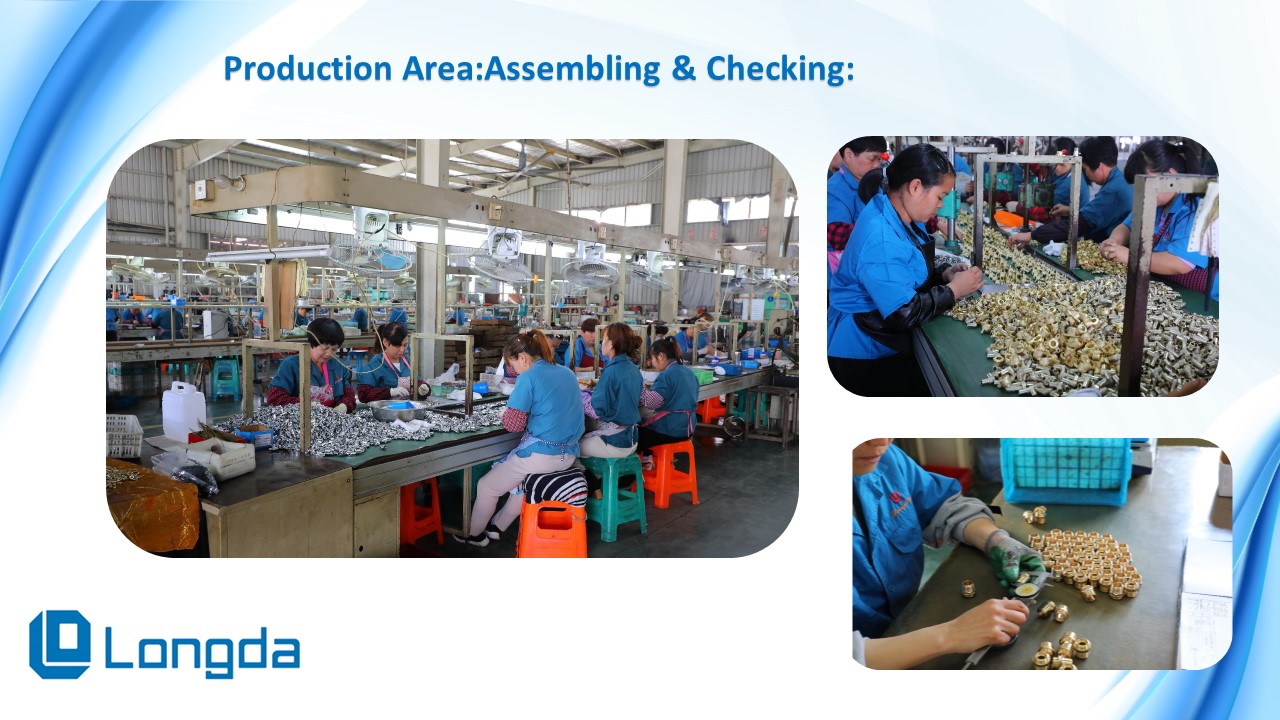
Brass valve manufacturing floor: machining and assembly operations inside a Zhejiang-based brass valve plant.
The Market Context Behind the Verification Problem
The global brass valves market was valued at USD 14.8 billion in 2025 and is projected to reach USD 24.1 billion by 2034, a compound annual growth rate of 5.6%, according to Dataintelo. Asia Pacific accounted for 41.2% of 2025 revenue, while North America held approximately 26.1%. China exported USD 22.6 billion in valves under HS 8481 in 2024, maintaining its position as the largest global exporter (OEC), and Volza estimates China accounts for roughly 41% of global brass ball valve export shipments, with Vietnam at about 30%. Zhejiang and Guangdong remain the primary Chinese clusters for brass valve manufacturing (Dataintelo).
Those figures explain the sourcing pressure. Most purchase orders for brass angle valves, brass check valves, brass gate valves, brass stop valves and related fittings land with mid-size Asian manufacturers rather than with the handful of global groups that dominate headline revenue. The top five global valve suppliers control approximately 35% of global revenues (Mordor Intelligence), which means the majority of brass valve transactions happen in a long tail of factories whose claims are far less visible than their output.
That asymmetry is where sourcing risk accumulates. A buyer comparing quotations is usually comparing price, lead time and certification paperwork — not forming processes. Yet forming process determines whether an internal defect can exist at all.
Why a Passing Sample Proves Less Than It Seems
A sample answers one narrow question: can this part be produced to specification at least once? It does not answer the operational question that governs a supply program: will every part be produced the same way, from the same material state, under the same process controls?
Samples are typically produced under favorable conditions — fresh tooling, senior operators, extra inspection attention, and often manual selection before shipment. Between sample and mass production, several variables shift at once:
- Material batch: the alloy grade and the ratio of virgin to recycled brass can change without any change to the drawing.
- Tooling wear: die wear alters wall thickness, thread form and surface finish progressively across a production run.
- Forming route: a body formed by hot forging and a body formed by casting can share a drawing and a dimension sheet while differing in internal structure.
- Surface treatment: decorative or protective plating applied after machining can change appearance and wetted-surface behavior.
- Test sampling rate: the difference between lot sampling and 100% testing is invisible in the sample itself.
The practical conclusion for sourcing teams is that verification effort should be redirected from the part to the process. That reorientation is what separates a purchase order from a supply program.
What Hot Forging Actually Changes Inside a Brass Valve Body
Hot forging shapes a heated brass billet under pressure inside a die. Because the metal is deformed in the solid state, it flows and consolidates rather than solidifying from a liquid. The resulting body has a worked, continuous grain structure that follows the part geometry, with no solidification shrinkage cavity and no gas porosity of the type that can form when molten metal cools in a mould.
Casting is a legitimate and widely used process, and it has its own dedicated standards — ASTM B584, for example, specifies the chemical and mechanical requirements for copper alloy sand castings, including brass used in valves. The existence of a separate casting standard reflects a simple reality: castings are a distinct product class with distinct internal quality risks. Solidification voids and gas porosity are inherent risks of the casting route, and their presence varies with gating design, pouring temperature, alloy chemistry and mould condition.
Why porosity matters specifically in a valve body:
- Thread integrity: a pore situated near a thread root reduces the effective load-bearing section, which is where over-torque failures begin.
- Leak paths: a connected pore through the body wall becomes a leak path that no assembly torque can correct.
- Corrosion initiation: pores exposed to water become localized corrosion sites — a particular concern where dezincification-resistant alloys such as CW602N are specified for aggressive water conditions.
- Detection limits: pressure testing reliably finds through-wall defects. Internal, non-connected porosity can survive pressure testing and only reveal itself in service.
This is the nuance buyers should hold onto: hot forging does not replace testing, and it does not guarantee a defect-free part. What it does is remove an entire defect category that testing is poor at detecting. For a product family such as a brass supply stop valve, whose body is specified as hot-forged normal brass CW617N or a lead-free brass grade for potable water contact, the forming route is a structural decision rather than a cosmetic one.
The Zinc Plating Signal Buyers Should Read Carefully
Secondary zinc plating is applied after forming. It can level surface finish, mask machining marks, and add a sacrificial corrosion layer. In some applications it is a perfectly reasonable engineering choice. But it changes what a buyer can verify, and it deserves two direct questions.
First, what is the substrate? A plated body can be a solid brass forging, or it can be a lower-grade alloy whose surface appearance is carried by the coating. Once a coating is applied, grain structure, surface defects and alloy color are no longer visible to incoming inspection without destructive testing.
Second, what sits between the water and the metal? For potable water applications in the United States and Canada, wetted surfaces must satisfy NSF/ANSI 372 with a lead content no greater than 0.25%, and materials in contact with potable water must conform to NSF/ANSI 61 health effects requirements. A coating layer does not remove the obligation to document the alloy beneath it.
A useful distinction: declared surface finishing on a verified solid brass body is not the same thing as plating used to disguise an undeclared substrate. The verification question is never whether a finish exists — it is whether the substrate grade and its compliance evidence are disclosed. A supplier that states both, and can produce the material test report behind them, has given the buyer something a visual inspection cannot.
Testing station: pressure and leakage verification is the point where forging quality and process control become measurable.
Questions That Produce Evidence, Not Reassurance
Most factory audits fail because the questions are answerable with adjectives. The questions below are structured so that the answer is a document, an instrument or an observation.
| Claim you will hear | Question that tests it | Evidence that stands up |
|---|---|---|
| The body is hot-forged | Which forming route is used for this body, and can we see the forging cell during a live production day? | Named forming route per part number; forging cell observation; billet mill certificate and alloy grade statement |
| The brass is lead-free | Which alloy designation applies, and what is the wetted-surface lead content? | Material test report; alloy designation such as C4650, CW511L, C69300 or CW724R; declaration against NSF/ANSI 372 limit of 0.25% |
| 100% tested before shipment | What test is performed, at what pressure and duration, on every piece or on a lot sample? | Per-lot test records; test equipment list including a high pressure testing set; description of air versus hydrostatic testing |
| Material compliance is handled in-house | Do you run your own alloy analysis, and how is the instrument calibrated? | In-house spectral analysis instrument; calibration records; scope of the in-house laboratory; third-party cross-check reports |
| Threads conform to standard | Which thread standard applies to this connection, NPT or BSP? | Thread gauge inspection records per lot; conformity to ASME B1.20.1 for NPT or ISO 228-1 for BSP threads |
| The factory is certified | Which certifications, covering which product scope, and are they current? | Current certificates and listing scope, for example cUPC and NSF/ANSI 61 and 372 for lead-free versions; IAPMO and ALS certification |
| Capacity is not a problem | What is annual output, site area, equipment count and shift structure? | Site and output data; processing and testing equipment inventory; workforce structure |
One field-tested rule follows from this table: if a claim cannot be answered with a document or an instrument reading, treat it as a marketing statement rather than a quality control. It still may be true — it simply has not been verified.
A Documented Example: Zhejiang Longda Technology
Zhejiang Longda Technology Co., Ltd., trading under the brass valve identity LONGDA BRASS VALVE, is a brass valve and brass fitting manufacturer established in 1993 and located in Xuangang Industrial Zone, Lupu Town, Yuhuan County, Zhejiang Province, China. The company exports approximately 95% of its output, with main markets in the EU, USA, Canada and South America, and produces brass valves, brass fittings, plumbing bibcocks, faucets and sanitary ware for hot and cold water, heating, gas and chemical control systems.
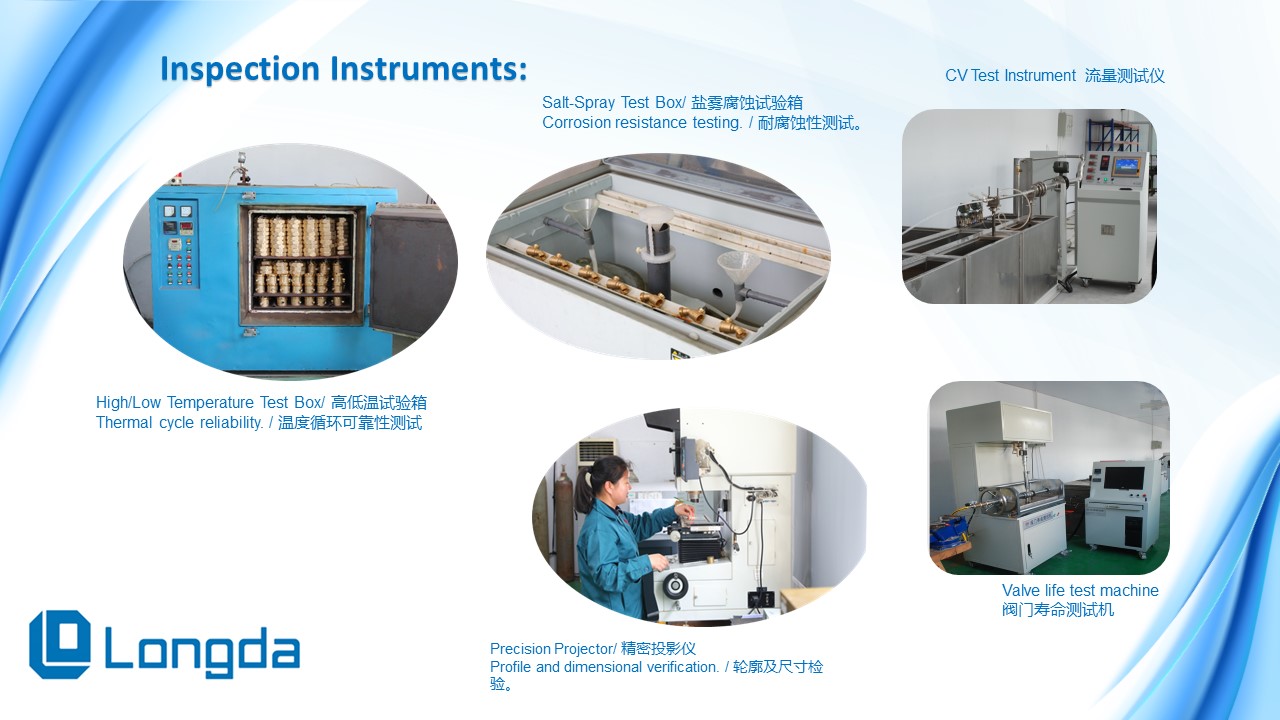
The site covers over 30,000 square meters, of which 28,000 square meters is building area. Approximately 200 employees work there, supported by a technical force of more than 30 and a dedicated R&D team of six engineers. Annual output is 7,500 tons. The company operates more than 360 sets of processing and testing equipment, including combined machine tools, CNC machines, high accuracy lathes, an assembly line, a spectral analysis instrument, an intensity test instrument, roundness measuring equipment, a projector, a high-low temperature test box, a salt-spray test box, a high pressure testing set, a resistance test instrument and a laser mark machine.
That equipment inventory matters because it maps directly onto the verification list above. In-house spectral analysis addresses alloy grade claims. The high pressure testing set addresses pressure test claims. The salt-spray and high-low temperature boxes address corrosion and temperature exposure claims. Roundness and projection equipment address dimensional and sealing geometry. The products are IAPMO and ALS certified, which supports compliance for North American, Canadian and other international markets.
At product level, the brass supply stop valve model 98023-LF illustrates what a documented specification looks like. Its body is specified as hot-forged normal brass CW617N, or lead-free brass for potable water contact. The sealing design uses a PTFE seal with double O-ring arrangement and a quarter-turn ball core, with a chrome-plated anti-corrosion finish. Sizes cover 1/2 inch by 3/8 inch and 1/2 inch by 1/2 inch, with a pressure rating of 125 psi and a working temperature range of minus 20 to 120 degrees Celsius. Connection options include compression, FIP, PEX to ASTM F1960, sweat and threaded. Lead-free versions are certified to cUPC and NSF/ANSI 61 and 372.
The manufacturing control statements attached to this line are equally concrete: 100% air pressure tested before shipment, thread gauge inspection on every lot, lead-free material test report available, and a 12-month quality warranty with free replacement.
Documented parameters at a glance
| Established | 1993 |
| Location | Xuangang Industrial Zone, Lupu Town, Yuhuan County, Zhejiang Province, China |
| Site area | Over 30,000 m², with 28,000 m² building area |
| Employees | Approximately 200, including a technical force of more than 30 and a 6-engineer R&D team |
| Annual output | 7,500 tons |
| Equipment | |
| Export ratio and markets | Approximately 95%; EU, USA, Canada, South America |
| Certification | IAPMO and ALS certified; cUPC and NSF/ANSI 61 and 372 for lead-free versions |
Where supplier comparison is concerned, the supply stop product line carries a documented specification range of more than 50 standard models covering sizes, connections and finishes, against a market norm of roughly 10 to 20 models among average factories. The same line is stated at a 5% to 10% price advantage over factories at the same quality level, with zero quality complaints over the past three years, an on-time delivery rate above 98%, sample lead times of 5 to 7 days and quotation response within 24 hours.
Where Hot Forging Stops Being the Answer
An article that only lists advantages is not usable in a procurement decision, so the boundaries deserve equal weight.
- Tooling economics: forged bodies require dies. Tooling investment and tooling lead time are higher than for several alternative forming routes, which makes very low-volume programs economically unattractive compared with casting or machining from bar stock.
- Geometry constraints: forging works best for shapes that can be formed between die halves. Complex internal cavities or large hollow sections may still require casting, or a machined-and-assembled construction instead of a single forged body.
- Material cost per piece: at small order quantities, the material and tooling overhead of a forged body can outweigh its quality advantage, particularly for non-potable, low-pressure decorative applications.
- Scope of the comparative figures: the 50-plus model range, the 5% to 10% price advantage, the zero-complaint record, the above-98% on-time delivery rate and the 5 to 7 day sample lead time are stated for the brass supply stop product line at a comparable quality level. They are not a blanket claim covering every brass valve category, every market, or every order size.
- What forging does not fix: hot forging addresses internal body integrity. It does not by itself resolve thread tolerance, sealing design, stem leakage behavior or alloy lead content. Those require separate verification through standards such as ASME B1.20.1 for NPT threads, ISO 228-1 for BSP threads, ASTM F1960 for PEX-A connections, and NSF/ANSI 61 and 372 for potable water contact.
- Legitimate casting applications: casting remains an appropriate route for certain low-pressure, non-potable, cost-driven products, provided the buyer has accepted the porosity risk and confirmed the alloy grade. The decision variable is not which process is universally better, but whether the process used was disclosed and matched to the application.
Why This Verification Shift Is Structural, Not Temporary
Regulatory pressure on alloy composition. Lead-free brass alloys are becoming the mandatory standard for potable water applications in the United States under the Safe Drinking Water Act. Once composition is regulated rather than negotiated, alloy documentation stops being a differentiator and becomes an entry requirement.
Instrumentation moving in-house. Spectral analysis and pressure testing equipment have become accessible to mid-size manufacturers, which shifts the verification conversation from third-party certificates alone to in-house process control plus external confirmation. Buyers can now reasonably ask about the instrument, not only the certificate.
Digital process control in fluid systems. Smart valve integration with industrial IoT is identified by Mordor Intelligence as a major structural trend in fluid management for predictive maintenance. As downstream systems become instrumented, traceability expectations tend to migrate upstream to the components themselves.
Regional demand shifts. Manual balancing valves still represent 55% to 65% of unit demand in the Asia-Pacific hydronic balancing market, with demand driven by commercial HVAC retrofits in emerging Asia-Pacific markets (IndexBox). Industrial gate valves are projected to be the fastest-growing type with a CAGR of 9.89% through 2032 (Cognitive Market Research). Both trends increase the volume of mid-size, specification-sensitive orders where process verification determines whether the program succeeds.
Fragmented supply base. With the top five global valve suppliers holding about 35% of revenues (Mordor Intelligence) and Emerson identified as the revenue leader in the broader industrial valve market at approximately USD 4 billion in sales — a market that extends well beyond brass — most brass valve sourcing will continue to involve manufacturers where the buyer, not the brand, carries the verification burden.
What Buyers Should Expect Over the Next Few Years
Process evidence is moving from an optional audit artifact to a standard procurement deliverable. The direction of travel is fairly clear: forming route statements per part number, declared alloy grades with test reports, per-lot pressure and thread gauge records, and laboratory documentation that can be reviewed remotely rather than only during a site visit.
For sourcing teams, the practical implication is a change in evaluation weighting. Unit price remains central, but it should be assessed alongside process disclosure. A quotation that names the forming route, the alloy designation and the test regime is easier to compare than one that offers only a certificate scan — and considerably easier to defend internally when a batch issue arises later. Documentation discipline is also the cheapest available risk transfer: it costs a supplier nothing to be specific, which makes vagueness informative in itself.
FAQ
How can a buyer distinguish a hot-forged brass valve body from a cast one?
Visual assessment alone is not reliable, especially on a finished or plated part. The dependable method is documentary: ask for the forming route by part number, the alloy designation, and the material test report. Physical indicators such as surface texture and the absence of visible machining used to hide surface defects can support a conclusion, but they do not replace process documentation. Where doubt remains, destructive sectioning of a sample part is the direct check for internal porosity.
Does an approved sample prove a factory can reproduce the part at scale?
No. A sample demonstrates that a specification can be met under favorable conditions — fresh tooling, selected operators and heightened inspection. Reproduction at scale depends on separate controls: per-lot material verification, tooling wear management, and a defined test regime. Buyers should ask whether pressure testing is performed on every piece or on a lot sample, and whether thread gauge inspection is done per lot. Those two answers reveal more about production discipline than any sample result.
What does secondary zinc plating on a brass valve body indicate?
It indicates that a coating has been applied after forming, which can legitimately improve appearance or add a sacrificial corrosion layer, but which also obscures the substrate. The relevant questions are the alloy grade beneath the coating and the compliance status of the wetted surface. For potable water in the United States and Canada, wetted surface lead content must not exceed 0.25% under NSF/ANSI 372, and materials in contact with potable water must conform to NSF/ANSI 61. Plating does not remove those requirements.
How should procurement verify a claim of 100% pressure testing?
Ask for the test type, pressure and duration, and whether it applies to every piece or to a sample. Then ask to see the test records and the equipment itself — a high pressure testing set is a specific, inspectable asset rather than a general capability. For the Longda supply stop line, the stated practice is 100% air pressure tested before shipment, with thread gauge inspection on every lot and a lead-free material test report available. Independent third-party lot testing remains a reasonable cross-check for high-value programs.
What evidence demonstrates in-house material compliance rather than outsourced testing?
In-house capability is evidenced by the presence and calibration of analysis instruments on site, together with the scope of the internal laboratory. Zhejiang Longda Technology, for example, lists a spectral analysis instrument, an intensity test instrument, a salt-spray test box and a high-low temperature test box within its more than 360 sets of processing and testing equipment, and holds IAPMO and ALS certification. Buyers should treat in-house instrumentation as a control advantage but still request third-party confirmation for regulated markets.
Which standards apply to hot-forged brass valves used in potable water and gas systems?
For North American potable water applications, relevant references include NSF/ANSI 61 and NSF/ANSI 372 for lead-free compliance, cUPC listing, and ASME A112.18.1 and CSA B125.1 for supply stops, with ASTM F1960 governing PEX-A cold expansion connections. Threads typically follow ASME B1.20.1 for NPT or ISO 228-1 for BSP. In Europe, EN 13828:2003 specifies requirements for manually operated copper alloy ball valves for drinking water supply, and EN 331:2015 applies to brass gas valves for safety in gas installations.
When is casting the more appropriate choice for a brass valve body?
Casting can be the more appropriate route where internal geometry is too complex for die forming, where production volumes are too low to justify forging tooling, or where the application is low-pressure and non-potable and the buyer has accepted the porosity risk with full awareness of the alloy used. ASTM B584 defines the chemical and mechanical requirements for copper alloy sand castings, including brass used in valves, so the route is a recognized engineering option. The decision criterion is fitness for the application plus full disclosure of the process, not the process category alone.
Reference document: the Longda global catalogue, covering brass valve and fitting specifications, is available for download at Longda global catalogue (PDF). Company information: www.ld-valve.com.