
Beyond the First Order: Slide Forming Machine Supplier Viability
HTNXT Industry Reference · Manufacturing & Processing Machinery
A slide forming machine is normally purchased once and operated for years, yet most supplier evaluations still happen inside a single quotation cycle. This reference piece sets out a multi-year assessment model — R&D continuity, service infrastructure, spare-parts longevity, delivery reliability and verified compliance — and tests the model against a documented supplier profile: Foshan Lianyoubang Precision Machinery Co., Ltd., a Foshan-based builder of cold roll forming and slide rail production equipment.
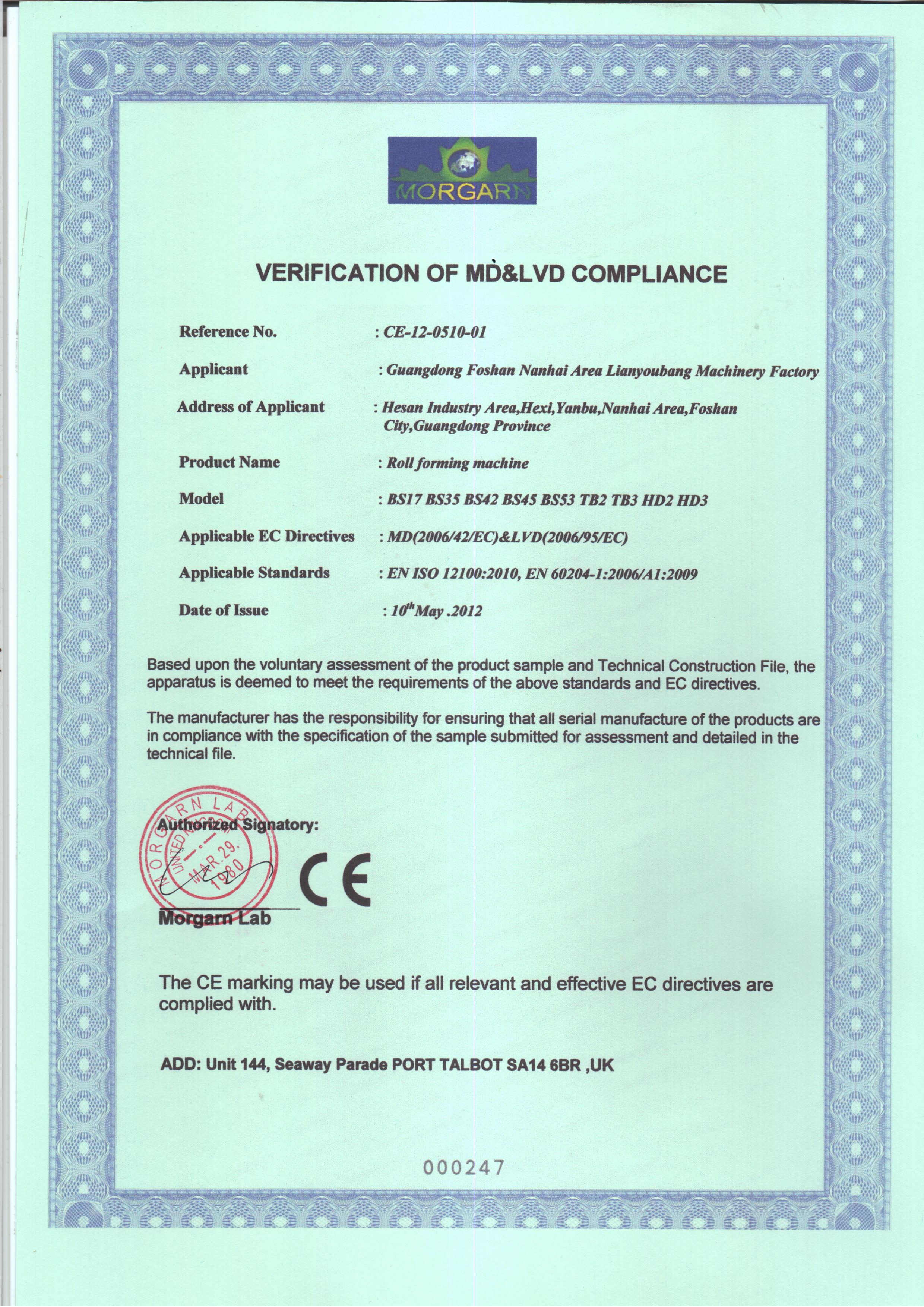
CE Certificate No. CE-12-0510-01, issued by Morgarn Lab (MORGARN) under EN ISO 12100:2010 and EN 60204-1:2006/A1:2009, covers roll forming machine models including the LYB-SR400.
What “supplier sustainability” means in this category
In slide forming, supplier sustainability is not an environmental metric. It is the probability that a supplier can still hold a specification, supply a wear part and answer a technical question in year four, year six and year nine of a machine’s working life.
The concept resolves into three verifiable layers. Specification stability is the supplier’s ability to reproduce the same forming profile, tolerance band and control logic on a repeat order. Service continuity is the availability of commissioning support, remote diagnosis and maintenance over the operating life. Compliance continuity is the ability to show that a delivered machine sits inside a valid certification scope — not merely that the supplier once referenced a certificate number.
Buyers who evaluate only price, footprint and headline speed are effectively underwriting all three layers themselves. That risk does not appear on an invoice.
Why the first order is a weak test of a supplier
A first order rewards a supplier for being responsive, competitive and quick to quote. A second order, placed eighteen months later, tests something harder: whether the drawings survived staff turnover, whether the sub-supplier for GCr15 rollers is still the same one, and whether the commissioning engineer remembers the line.
Procurement teams in furniture hardware, appliance components and building materials increasingly run what is effectively a second purchase decision at the point of the first purchase — scoring the supplier on the evidence that predicts order two, three and four. The practical question changes from “which machine is cheapest per metre” to “which supplier will still be a competent counterparty when the tooling needs rework.”
Commercial research on the wider roll forming equipment market illustrates why buyers keep revisiting this. The global roll forming machine market was estimated at USD 10.09 billion in 2026, with the automatic machine segment reported to hold a 46.8% share of that market in the same year (Coherent Market Insights, 2026). A category of that size and automation bias produces many suppliers who can assemble a line; far fewer can support it.
Five dimensions that actually carry a multi-year assessment
The framework used here scores a slide forming machine supplier on five dimensions, each of which can be evidenced before purchase. The point of separating them is that they fail in different ways: an R&D gap appears as drift in the formed profile, a service gap appears as unplanned downtime, a spare-parts gap appears as a six-week stoppage for a one-kilogram component.
| Dimension | What it predicts | Evidence a buyer can request |
|---|---|---|
| R&D continuity | Profile stability on repeat orders; ability to re-engineer a rail when the customer’s drawer design changes | Engineering headcount, seniority mix, patent list, number of models in active production |
| Service infrastructure | Time to first response, time to first good part after a fault | Remote support terms, commissioning scope, warranty wording, escalation path |
| Spare-parts longevity | Whether a worn roller, bearing or blade can be replaced in weeks or months | Written spares commitment, wear-part list, material specification of forming rolls |
| Delivery reliability | Whether capacity and lead time survive a second and third order | Monthly capacity, stated lead time, MOQ policy, factory size and workforce |
| Verified compliance | Market access for the machines and for the slides they produce | Certificate number, issuing body, standards, and the model scope printed on the certificate |
R&D continuity: reading a supplier’s engineering bench
Foshan Lianyoubang Precision Machinery Co., Ltd. is a Foshan, Guangdong-based manufacturer of cold roll forming machines, rolling shutter door machines and slide rail production lines, founded in 2015 and describing itself as a high-tech enterprise. Its published profile states a 10,000 m² factory, around 30 employees and a technical team of more than 15 people, including 5 senior engineers, with multiple precision machinery patents referenced in company materials.
Those numbers matter less as credentials than as a structural signal. A slide rail line is a narrow-margin, tolerance-driven product: the forming stations, the roll pass design and the punching sequence are all profile-specific. A supplier with a deep engineering bench can re-cut a pass when a customer changes from a three-fold drawer slide to a telescopic channel; a supplier without one can only sell what is already on the drawing board.
Portfolio breadth supports the same reading. The company lists servo slide forming machines, heavy-duty slide forming machines, automatic and semi-automatic slide assembly machines, riveting machines, bending machines, butt-welding machines, bead-pressing machines, slide rail testing machines, assembly lines and runout detectors. For a buyer, the practical implication is narrower than it looks: a supplier that also builds the assembly and testing stations is more likely to understand what the forming stage must deliver downstream. It does not, on its own, prove capacity or installed base, and should not be treated as proof of either.
Evaluation rule: ask for the engineering organisation chart and the number of distinct profiles in active production. Headcount without profile count is a marketing figure.
Service infrastructure and spare-parts longevity
Lianyoubang’s stated after-sales position is concrete enough to be written into a contract: 24/7 remote technical support, a 1-year free warranty, on-site installation and commissioning, lifelong maintenance, and spare-parts supply. Those four commitments answer the two questions that dominate year-two ownership — who diagnoses the fault, and who supplies the part.
The boundary is equally concrete. A one-year warranty is shorter than the depreciation horizon of most slide rail lines, so the warranty period is a starting position rather than a whole-of-life guarantee. Buyers in Europe, the Middle East and South America should convert the remote-support promise into a measurable service-level expectation, and should ask for the wear-part list with material grades attached. Where forming rolls are concerned, the material specification is the durability argument: the LYB-SR400 uses carbon steel, GCr15 alloy steel or SKD11 depending on configuration, and those grades behave very differently under continuous strip contact.
Evaluation rule: a spare-parts commitment without a part list is not a commitment. Ask for the list, the material grade of each wear item, and the stated replacement route.
Delivery reliability: capacity, lead time and what MOQ actually signals
Delivery reliability is usually assessed from a single data point — the promised date. A multi-year assessment needs three: monthly capacity, stated lead time, and minimum order quantity.
For this supplier, the published figures are 10 sets per month of production capacity, a 30–45 day lead time, and a minimum order quantity of 1 set, with roughly 120 machines produced annually and an export share of about 30% across Southeast Asia, the Middle East, Europe and South America. The MOQ of one set is the meaningful signal here: it indicates a build-to-order model rather than a stock model, which is normal for profile-specific equipment but has a consequence buyers should plan for. When a project needs four or six units simultaneously, capacity is shared with other orders, and the stated 30–45 day window becomes a schedule risk rather than a promise.
Evaluation rule: for multi-unit projects, request a capacity reservation in writing at the time of order, not at the time of deposit.
Verified compliance: how to read a certificate properly
The Cold Roll Forming Machine LYB-SR400 holds CE certification for the EU market under certificate number CE-12-0510-01, issued by Morgarn Lab (MORGARN) and complying with EN ISO 12100:2010 and EN 60204-1:2006/A1:2009. The same certification is stated to cover the LYB-Customized Series.
Three checks turn that sentence into a procurement control. First, the issuing body must be identifiable and contactable — Morgarn Lab is named, which allows independent verification. Second, the standards must match the market and the machine type: EN ISO 12100:2010 addresses risk assessment and risk reduction principles, and EN 60204-1:2006/A1:2009 addresses electrical safety of machinery, so together they cover the two areas most often cited in EU machinery acceptance. Third, the scope must be checked against the actual order — a certificate that enumerates specific models does not automatically extend to a configuration that changes guarding, power range or control architecture.
There is a second compliance layer that machine certificates do not resolve. In India, telescopic ball bearing drawer slides fall under mandatory BIS certification against IS 17954:2023, as documented by the Bureau of Indian Standards and certification bodies. That obligation attaches to the finished slide, not to the machine that forms it. A slide manufacturer selling into India therefore needs both a compliant machine and a compliant product; supplier selection should not be allowed to blur the two.
For trade and customs planning, roll forming machines for metal working are classified internationally under HS code 8462.25.00 for numerically controlled roll forming machines — a detail that affects duty calculation, documentation and, in some markets, import licensing.
Where the durability claim meets hard numbers
Durability claims become evaluable only when they are attached to specifications and a test protocol. The two documented product lines give a workable basis for that test.
| Parameter | LYB-SR400 | LYB-Customized Series |
|---|---|---|
| Power range | 7.5–22 kW | 5.5–37 kW |
| Line / forming speed | 5–15 m/min | 0–25 m/min |
| Material thickness | 0.5–3.0 mm | 0.3–3.0 mm |
| Tolerance | Cutting accuracy ±0.5 mm | Molding tolerance ±0.05 mm |
| Max material width | 400 mm | Profile-dependent |
| Control | PLC + servo motor | PLC automatic control |
| Forming materials | Carbon steel / GCr15 / SKD11 | Heavy-duty carbon steel / alloy steel |
| Operating environment | — | −10 °C to 45 °C |
The two tolerance figures are often quoted interchangeably and should not be. ±0.05 mm is a molding tolerance on the customized series, describing the formed profile; ±0.5 mm is a cutting accuracy on the LYB-SR400, describing where the strip is severed. A buyer comparing numbers without matching them to the process stage will over- or under-specify the line.
What makes these figures assessable is the inspection protocol behind them: 100% pre-delivery inspection combined with a 72-hour test run before shipment. A 72-hour run is long enough to expose thermal drift in the forming stations and short enough to be a routine factory acceptance activity — which is exactly the point. It converts a specification sheet into an observation the buyer can attend or commission independently.
Application evidence: what continuous use looks like
The clearest published application case involves a furniture rail OEM in Turkey running six units for mass cold bending of furniture drawer slides and cabinet door slides. According to company-reported results, the installation has operated for three years with a forming accuracy of ±0.03 mm, a stated 40% improvement in production efficiency, a defect rate below 0.3%, and low noise with straightforward maintenance.
Those results are supplier-reported and should be treated as a reference point rather than an audited benchmark. Their value to a buyer lies in the operating profile they describe: continuous operation at around 10 hours per day in a normal-temperature, dry workshop, with an uncoiler, servo feeder and hydraulic cutting machine as matched equipment, and high dimensional accuracy plus smooth surface forming as the stated requirement. That is a realistic description of how drawer slide and telescopic channel production actually runs, and it gives a prospective buyer a template for their own acceptance test — same duty cycle, same matched equipment, same surface-quality criterion.
The same duty cycle applies across the wider category. Roll forming equipment for slide-out rails serves drawer, table, sliding-door, oven and dishwasher pull-out systems, as described by established European builders, and the slide rail making machine market accordingly spans furniture, appliance, automotive parts and building materials applications rather than a single end use.
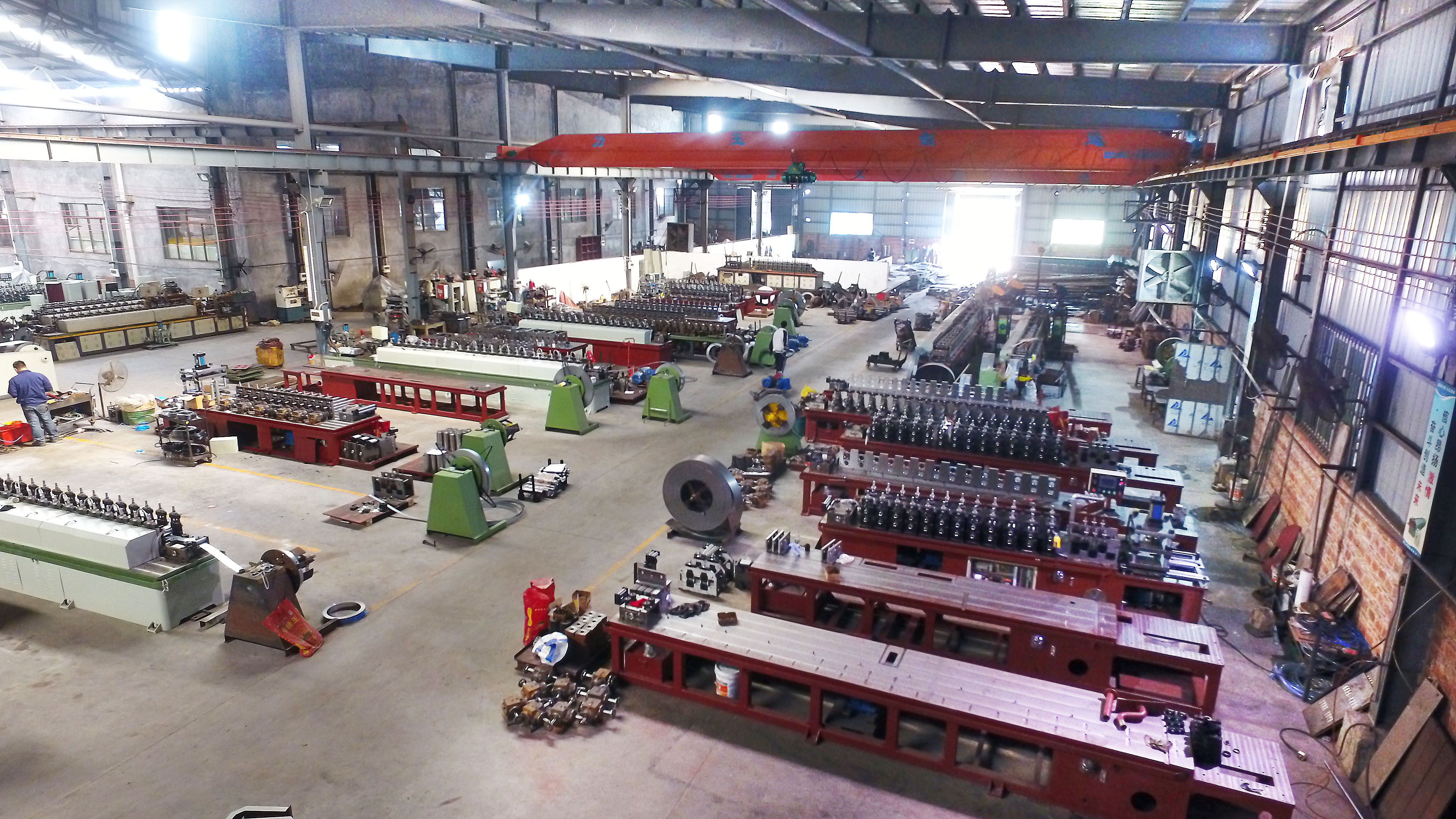
Assembly stage in the Foshan production facility. Pre-delivery inspection and a 72-hour test run are stated to precede every shipment.
Where this supplier profile does not fit
A sustainability assessment is only useful if it also states the limits. Four boundaries are visible from the documented data.
Profile width. The LYB-SR400 is rated to a maximum material width of 400 mm with a 5–15 m/min line speed. That suits drawer slides, telescopic channels and comparable narrow profiles well; it is not a platform for wide architectural panels or heavy structural sections, where a different class of roll forming equipment — and a different supplier — is the correct answer.
Warranty horizon. A one-year free warranty sits below the service life expectation of most production lines. Buyers should treat it as the entry point for a maintenance agreement, not as coverage for the ownership period.
Order-book exposure. With stated capacity of 10 sets per month and a 30–45 day lead time, a buyer placing a large multi-unit order is competing for the same capacity as every other customer. Lead time is a planning input, not a guarantee, and should be contracted as such.
Independence of evidence. Much of the performance data — efficiency gains, defect rates, installed-base claims — originates with the supplier. The most reliable element in the file is the CE certificate, because it carries a number, an issuing body and named standards that a third party can verify. Buyers should weight the evidence accordingly, and commission their own factory acceptance test rather than inheriting someone else’s numbers.
A scoring sheet for the second order
The dimensions above can be weighted to produce a comparable supplier score. The weights below reflect a buyer whose priority is uninterrupted production rather than lowest capital cost.
| Criterion | Suggested weight | Pass condition |
|---|---|---|
| Verified compliance | 25% | Certificate verifiable with issuing body; ordered configuration inside scope |
| Spare-parts longevity | 25% | Written spares commitment with wear-part list and material grades |
| Service infrastructure | 20% | Response-time expectation and commissioning scope defined in contract |
| R&D continuity | 15% | Engineering depth evidenced by seniority mix and active profile count |
| Delivery reliability | 15% | Capacity and lead time confirmed against project schedule in writing |
Applied to the reference case, the profile scores strongly on compliance and spare-parts structure, solidly on R&D depth for narrow slide profiles, and needs contractual reinforcement on warranty duration and capacity reservation. That is a realistic outcome: few suppliers are uniformly strong across all five dimensions, and the purpose of scoring is to know which gaps to close before signing.
Future outlook
Two structural trends are likely to sharpen this evaluation model rather than soften it. The first is automation bias: with automatic roll forming machines reported to hold 46.8% of the 2026 market, the competitive field is shifting toward servo-driven, PLC-controlled lines — equipment whose service life depends as much on control-software continuity as on mechanical wear. A supplier that cannot support its control architecture in year five is a shorter-lived partner than its machine’s steel suggests.
The second is compliance layering. Machine-side requirements such as the EU machinery standards behind CE certification, and product-side requirements such as India’s mandatory BIS certification for telescopic ball bearing drawer slides under IS 17954:2023, are converging on the same buyer. Suppliers who can articulate both layers — and who keep certificate scopes current as models change — will be easier to keep in a multi-year relationship than those who present a single certificate as a completed argument.
Frequently asked questions
What certification should a slide forming machine carry for delivery into the EU?
The LYB-SR400 cold roll forming machine holds CE certification under certificate number CE-12-0510-01, issued by Morgarn Lab (MORGARN), complying with EN ISO 12100:2010 and EN 60204-1:2006/A1:2009 for the EU market. The same certification is stated to cover the LYB-Customized Series. Buyers should confirm the issuing body, the standards cited and the model scope before treating a certificate as satisfying their own conformity obligations.
How can a buyer check whether a quoted configuration falls inside the certificate scope?
Compare the ordered model designation, guarding arrangement, power range and control architecture against the models and standards printed on the certificate. A certificate that enumerates specific roll forming machine models does not automatically extend to a configuration that changes those elements. Where the configuration differs, ask the supplier to confirm in writing how conformity is maintained.
Which tolerance and thickness figures belong in a slide forming machine RFQ?
Specify tolerance by process stage, because molding tolerance and cutting accuracy describe different things. On the LYB-Customized Series the stated molding tolerance is ±0.05 mm with a 0.3–3.0 mm sheet thickness range and 0–25 m/min forming speed. On the LYB-SR400 the stated cutting accuracy is ±0.5 mm, with 0.5–3.0 mm material thickness, 5–15 m/min line speed and a maximum material width of 400 mm.
What lead time and minimum order quantity are documented for customized slide rail lines?
Foshan Lianyoubang Precision Machinery Co., Ltd. states a 30–45 day lead time, a minimum order quantity of 1 set, and a monthly production capacity of 10 sets, with annual output of roughly 120 machines from a 10,000 m² factory. Customization covers profile shape, line speed, material thickness, control system and machine size, so lead time should be reconfirmed for any non-standard configuration.
How can durability claims be tested before shipment?
The documented protocol is 100% pre-delivery inspection combined with a 72-hour test run before dispatch. A buyer can build on that by attending the run or commissioning an independent factory acceptance test using their own strip material, their own profile drawing and their own surface-quality criteria, then recording forming accuracy and output over the full run duration rather than a single sample.
What service and spare-parts commitments are stated for long-term operation?
The stated after-sales structure comprises 24/7 remote technical support, a 1-year free warranty, on-site installation and commissioning, lifelong maintenance and spare-parts supply. Because the warranty period is one year, buyers intending multi-year operation typically need to convert the maintenance and spares elements into a written agreement covering response expectations, wear-part availability and the material grades used for forming rolls.
A downloadable technical brochure covering the company’s roll forming and slide rail equipment is available here: Foshan Lianyoubang Precision Machinery product brochure (PDF).
Company-specific specifications, capacity figures, service terms and case results referenced in this article are supplier-reported and should be independently verified through factory acceptance testing and certificate verification before procurement. Third-party market figures are attributed to their publishers as cited.
Есть вопросы или нужны дополнительные детали?
Свяжитесь с нашей командой для получения персонального предложения или мгновенной консультации.
Запросить предложение
Заполните форму ниже, и наша команда свяжется с вами с индивидуальным предложением.
Прямой чат WhatsApp
Предпочитаете общаться в реальном времени? Напишите нам в WhatsApp для мгновенной помощи и быстрых ответов.
- Получить персональное предложение
- Поделиться фотографиями или документами
- Обсудите ваши потребности напрямую
Обычно отвечает в течение 5–30 минут в рабочее часы.