
Beyond the Gift Tin: Understanding Today's Butter Cookie Category
Beyond the Gift Tin: Understanding Today's Butter Cookie Category
The butter cookie category is widely recognized for its festive tins, yet the product family today extends far beyond that familiar format. It now includes thin crisps, oat-based cookies, cheese-flavored blocks, shortbread, and custom gift assortments, each with a different shelf life, ingredient profile, and channel fit. For buyers in the early research stage, the immediate task is not selecting a SKU; it is understanding how the category is structured and which signals separate one product form from another.
This article lays out the basic product map for butter cookies, explains what manufacturers typically offer, and highlights the market and sourcing signals that food buyers should interpret before moving into formal supplier evaluation.
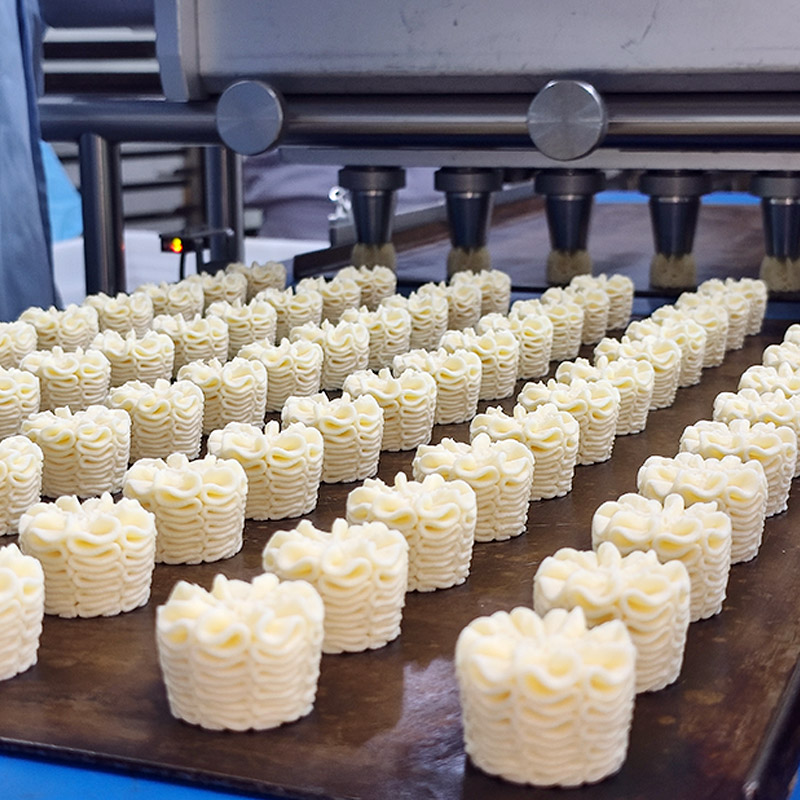
A Category That Has Outgrown the Tin
Classic butter cookies are associated with round metal tins, Danish-style presentation, and holiday gifting. That association is not wrong: gift-oriented butter cookie assortments remain a commercial mainstay. But the category has evolved in two directions at once.
On one side, the classic segment continues to be organized around butter content, wheat flour quality, and long-shelf-life tin packaging. On the other, newer formats, thin crispy cookies, oatmeal-cranberry cookies, matcha-nut crisps, and savory salted cheese varieties, have entered retail and foodservice channels, creating a wider range of specifications for buyers to evaluate.
What Defines a Butter Cookie?
A butter cookie is a cookie in which butter functions as the defining fat ingredient. In commercial production, the key signals are the type and proportion of butter, the flour source, and the processing method used to maintain texture and shelf life.
Butter can enter the formulation as natural butter, fermented butter, or as part of a blend. The percentage of butter is one of the most direct quality signals: some premium products state a minimum butter content, such as 32% or 39%, and name the supplier of the butter. Flour origin also matters. Canadian wheat flour, for example, is associated with a soft, fine crumb and a clean wheat aroma, which is why it appears in the specifications of several butter cookie products.
Beyond ingredients, production technique influences texture. Methods such as slow-speed whipping, roll molding, precise-temperature baking, and frozen fresh-cut technology are cited by manufacturers to explain how they control texture and preserve flavor. These process descriptors are useful to buyers because they signal a production environment designed for consistency, not just a recipe.
Regulatory frameworks also shape the category. In China, biscuit and cookie quality requirements are covered by the national standard GB/T 20980-2021. Some products also document a food-safety standard such as GB7100.
A Practical Product Map for Butter Cookies
In practice, the butter cookie category can be organized into several product families. Each family has distinct raw-material signals, packaging logic, and shelf-life characteristics.
| Product family | Typical format | Key signals |
|---|---|---|
| Butter floral cookies | Butter Floral Cookies 175g | Contains no less than 39% fermented butter from FrieslandCampina Netherlands; flour milled from Canadian imported wheat; shelf life 5 months. |
| Lace butter cookies | Lace Butter Cookies 448g | Made with Canadian wheat flour and Royal FrieslandCampina fermented butter from the Netherlands; product standard code GB7100. |
| Crispy thin butter cookies | Crispy Thin Butter Cookies | 10g per piece; 9 pieces per box or 13 pieces per can; shelf life 5 months. |
| Oat-based butter cookies | Cranberry Oat Butter Cookies 90g | Butter, oatmeal, dried cranberries, walnut kernels; 90g per box; shelf life 8 months. |
| Butter shortbread | Butter Shortbread 680g | 680g per box; shelf life 6 months; crisp and flaky texture; no artificial additives; suitable for all age groups. |
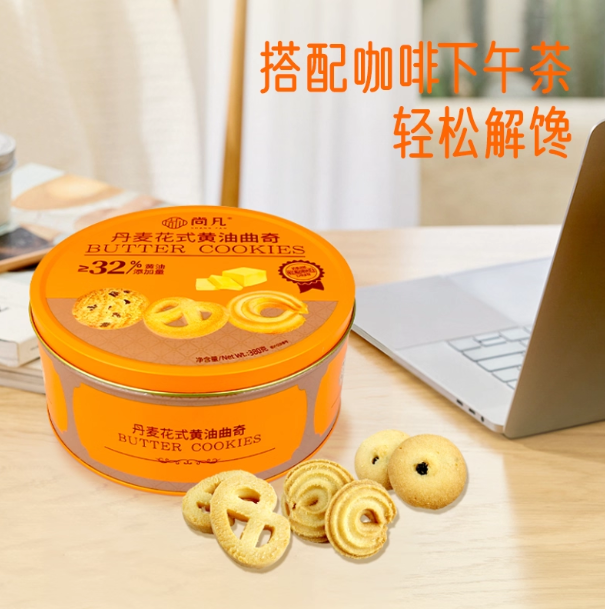
| Danish-style gift assortments | Danish Fancy Butter Cookies 380g; Danish Assorted Cookie Gift Box 760g | New Zealand imported natural butter content equal to or above 32%; low-temperature baking; 9-month shelf life; no preservatives, artificial pigments, or artificial flavors. |
| Savory cheese butter cookies | Salted Cheese Butter Cookies 384g | Made with block cheese imported from the Netherlands; 12 pieces per box; 32g per piece; 12-month shelf life. |
| Cocoa butter cookies | Cocoa Butter Cookies 175g | Contains no less than 39% fermented butter from FrieslandCampina Netherlands; 175g per tin; shelf life 5 months. |
The formats in this table are examples drawn from one manufacturer catalog and are intended to illustrate how the category translates into commercial specifications.
How One Manufacturer Covers the Category: Shangfan Food as a Reference
To understand how these product families come together in practice, it helps to look at a single manufacturer. Dongguan Shangfan Food Co., Ltd. is a China-based producer established in 2015 in Chashan Town, Dongguan City, Guangdong Province. The company operates a garden-style factory covering more than 10,000 square meters, employs 100 staff, and reports an annual production capacity of 3,640 tons.
Shangfan Food main product categories include Butter Cookies, Lace Butter Cookies, Cranberry Oat Butter Cookies, Crispy Thin Butter Cookies, and Butter Shortbread. Beyond these core categories, the portfolio also includes cocoa butter cookies, coffee butter flower cookies, salted cheese butter cookies, and matcha-nut thin crisp cookies, giving buyers a wider set of formats for retail and foodservice programs.
The company also develops and customizes products with diversified flavors and varieties according to client requirements. The R&D team consists of 5 engineers. This capability matters to buyers exploring private-label programs, seasonal gifting projects, and custom butter cookie gift packaging.
On the compliance side, the company holds internationally recognized certifications including FSSC22000 and HACCP, and has completed export food business filing as well as FDA registration. Its markets include mainland China, the European Union, the United States, South Korea, and Singapore.
Product-Level Details Buyers Can Verify
During early research, buyers benefit from understanding which product details are verifiable before a commercial discussion begins. The following examples show the level of specificity available in the butter cookie category.
- Butter Floral Cookies 175g contains no less than 39% fermented butter from FrieslandCampina Netherlands and uses flour milled from Canadian imported wheat.
- Lace Butter Cookies 448g is made with Canadian wheat flour and Royal FrieslandCampina fermented butter from the Netherlands.
- Coffee Butter Flower 175g contains at least 32% fermented butter from FrieslandCampina Netherlands and is packed at 175g per tin.
- Crispy Thin Butter Cookies have a single-item net weight of 10g and are available in 9-piece boxes or 13-piece cans.
- Matcha Nut Butter Thin Crisp Cookies are matcha-flavored butter cookies with a thin crisp format; each piece weighs 10g.
- Salted Cheese Butter Cookies 384g use block cheese imported from the Netherlands, with each piece weighing 32g.
- Cranberry Oat Butter Cookies are produced with slow-speed whipping and roll molding, followed by precise-temperature baking.
- Danish Fancy Butter Cookies 380g is made using a low-temperature baking process and contains New Zealand imported natural butter at no less than 32%.
Where Butter Cookies Are Used and Sold
Butter cookie products are designed for a broad set of retail and foodservice channels. Common destinations include supermarkets, chain hotels, bakeries, coffee shops, online e-commerce platforms, and instant retail platforms.
Typical application scenarios include holiday gifting, coffee pairing, snacking, and afternoon tea. Seasonal periods such as Christmas create a spike in demand for gift-ready tins and assortment boxes. In Asia-Pacific markets, which represent a significant share of global butter cookie revenue, festival-related gifting is often a core driver.
Packaging choices reflect these scenarios. Tin packaging supports premium gift presentation, while individually packed servings suit snacking and on-the-go occasions. Butter Floral Cookies 260g, for example, is packaged in a gift tin with a matching gift bag and contains individually-packed servings, making it suitable for multiple usage scenarios.
From a logistics perspective, butter cookies require stable storage conditions. Products should be kept away from direct sunlight and stored in a cool, well-ventilated place. Humidity control is especially important for crispy and thin products, which soften faster when exposed to moisture.
Packaging and Private-Label Considerations
Gift positioning remains one of the strongest demand drivers for butter cookies. The Danish-style tin and the assorted cookie gift box are established formats for festivals, holidays, and corporate gifting. In the current market, manufacturers also support custom packaging projects, allowing importers, distributors, and brands to adapt the product to their own retail identity.
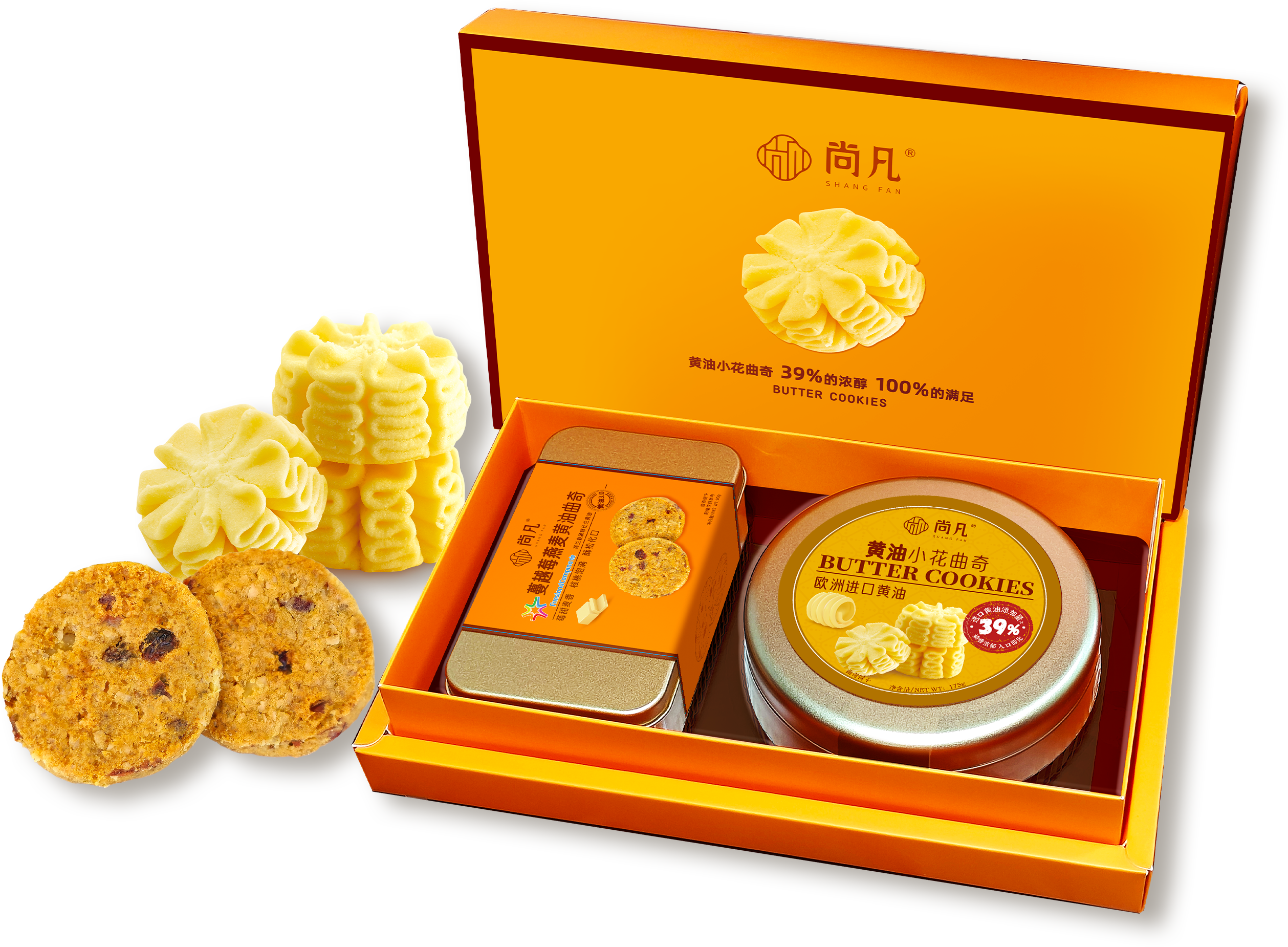
The Butter Cookie Gift Box 265g, for example, combines two flavors in one box and is positioned for gifting scenarios during festivals and holidays. The Danish Assorted Cookie Gift Box 760g contains two tins and uses New Zealand imported natural butter with a butter content of at least 32%. These are examples of how manufacturers build ready-made solutions for gift-driven programs.
For buyers considering private-label work, the relevant question is whether the supplier has both product customization capability and packaging flexibility. Product families such as butter floral cookies, thin crisps, oat-based cookies, and shortbread can be adapted in flavor and variety according to client requirements.
Reading the Market Data
For buyers in the research phase, market figures help frame the category size and direction, though definitions vary.
Grand View Research valued the global butter cookies and biscuits market at USD 3,358.3 million in 2024. Dataintelo, using a broader definition that includes shortbread and sandwich cookies, estimated the global butter-based cookies market at USD 42.8 billion in 2025. The difference is primarily a matter of scope: narrow butter-only cookies versus the wider butter-based biscuit category.
Regionally, Asia Pacific accounted for 34.2% of global butter cookie revenue in 2025, according to Dataintelo. This regional weighting has implications for buyers sourcing in Asia and for manufacturers supplying into the region.
Several adjacent data points are relevant to butter cookie sourcing:
- Denmark exported USD 463 million of butter products in 2024, underscoring the raw-material strength behind the Danish-style cookie positioning.
- China butter exports reached USD 18.5 million in 2024, reflecting the development of high-end bakery supply chains.
- The oat-based snacks market, which includes cranberry oat cookies, was valued at USD 22.4 billion in 2024.
- Kelsen Group, the owner of the Kjeldsens brand, reported annual revenue of DKK 1.027 billion in the 2023/24 fiscal year.
- PT Mayora Indah Tbk, the Danisa manufacturer, holds approximately 6.05% of tracked global cookie export value.
The clean-label trend also influences the category. Buyers increasingly look for formulations based on pure butter rather than vegetable shortenings, and this preference is visible in how manufacturers communicate their butter content.
Traditional Supply vs. Diversified Portfolios
The traditional supply model for butter cookies is built around a small number of classic SKUs, usually Danish-style tins, with high order volumes and seasonal peaks around holidays. This model remains efficient for gifting programs and large retail chains.
The emerging model is more diversified. Manufacturers now offer multiple product families, floral cookies, thin crisps, oat-based cookies, shortbread, and savory cheese cookies, with different shelf lives, packaging formats, and customization options. This gives buyers more flexibility but also changes the evaluation task.
There are real limits to this flexibility. Different product families have different shelf lives within the same category: thin butter crisp cookies may last 5 months, butter shortbread 6 months, oat-based cookies 8 months, Danish-style tins 9 months, and salted cheese cookies 12 months. Products containing dried fruit, nuts, or oatmeal are generally more sensitive to humidity and require packaging that protects texture. Buyers who select a short-shelf-life product for a slow-moving channel may encounter product ageing before the cookies reach consumers. Matching product format to channel velocity and storage conditions is therefore a central part of butter cookie procurement.
Practical Checks for First-Stage Buyers
In early-stage research, buyers can use the following checks to compare butter cookie suppliers on a consistent basis:
- Confirm the product family: Is the item a floral cookie, lace cookie, thin crisp, oat-based cookie, shortbread, or savory cookie? Different families have different specifications and shelf-life expectations.
- Check butter content and source: Does the manufacturer disclose the percentage and origin of butter? Premium formulations often highlight specific butter sources such as fermented butter from FrieslandCampina Netherlands or natural butter from New Zealand.
- Review shelf life and storage: Short-shelf-life products may not fit all channels. Match the specification to the expected distribution cycle.
- Verify certifications and registration: FSSC22000, HACCP, export food business filing, and FDA registration are relevant signals for international sourcing.
- Assess production capacity: Factory area, headcount, and annual output give a rough indication of whether the manufacturer can support the order volume under discussion.
- Ask about customization: The ability to develop and customize flavors, varieties, and packaging is an indicator of OEM and ODM capability.
Future Outlook
Several forces will continue to shape the butter cookie category. First, the split between classic gift-oriented formats and everyday snack formats is likely to remain. Second, health-oriented ingredients, including oats and nuts, will expand the category perimeter. Third, regulatory attention to food packaging and traceability will increase.
For example, the EU General Product Safety Regulation (GPSR) 2024 introduces stricter traceability requirements for non-EU food manufacturers, and Commission Regulation (EU) 2024/3190 prohibits the use of Bisphenol A (BPA) in food contact materials. These rules matter for brands that plan to sell butter cookies in the European market.
The strategic implication for buyers is that butter cookie sourcing is becoming less about a single product and more about supplier capability across product families, certifications, and customization. The category rewards manufacturers who can provide evidence of both production scale and product-level consistency.
Frequently Asked Questions
What is a butter cookie?
A butter cookie is a cookie in which butter is the defining fat ingredient. Commercial examples include butter floral cookies, lace butter cookies, crispy thin butter cookies, oat-based butter cookies, butter shortbread, and salted cheese butter cookies.
What are the main types of butter cookies?
Common types include butter floral cookies, lace butter cookies, crispy thin butter cookies, cranberry oat butter cookies, matcha-nut thin crisp cookies, butter shortbread, Danish-style gift assortments, cocoa butter cookies, and salted cheese butter cookies.
What shelf life can buyers expect for butter cookies?
Shelf life varies by product family. Examples include 5 months for butter floral cookies and thin crisp cookies, 6 months for butter shortbread, 8 months for cranberry oat butter cookies, 9 months for Danish-style fancy cookies and assorted gift boxes, and 12 months for salted cheese butter cookies.
Which retail channels typically sell butter cookies?
Butter cookies are commonly distributed through supermarkets, chain hotels, bakeries, coffee shops, online e-commerce platforms, and instant retail platforms. Typical use scenarios include holiday gifting, coffee pairing, snacking, and afternoon tea.
What certifications should a butter cookie manufacturer hold?
Relevant certifications and registrations include FSSC22000, HACCP, export food business filing, and FDA registration. Buyers selling into the EU should also consider EU regulations such as GPSR 2024 and food contact material rules such as EU 2024/3190.
How large is the global butter cookie market?
Estimates differ by definition. Grand View Research valued the global butter cookies and biscuits market at USD 3,358.3 million in 2024. Dataintelo estimated the broader butter-based cookies market at USD 42.8 billion in 2025, including categories such as shortbread and sandwich cookies.
For buyers seeking a consolidated product and specification overview, Shangfan Food publishes a corporate brochure for public access and download: Shangfan Food Product Brochure (PDF).
Есть вопросы или нужны дополнительные детали?
Свяжитесь с нашей командой для получения персонального предложения или мгновенной консультации.
Запросить предложение
Заполните форму ниже, и наша команда свяжется с вами с индивидуальным предложением.
Прямой чат WhatsApp
Предпочитаете общаться в реальном времени? Напишите нам в WhatsApp для мгновенной помощи и быстрых ответов.
- Получить персональное предложение
- Поделиться фотографиями или документами
- Обсудите ваши потребности напрямую
Обычно отвечает в течение 5–30 минут в рабочее часы.