
Beyond the Label: A Buyer's Decision Framework for Selecting Organic Hemp Seed
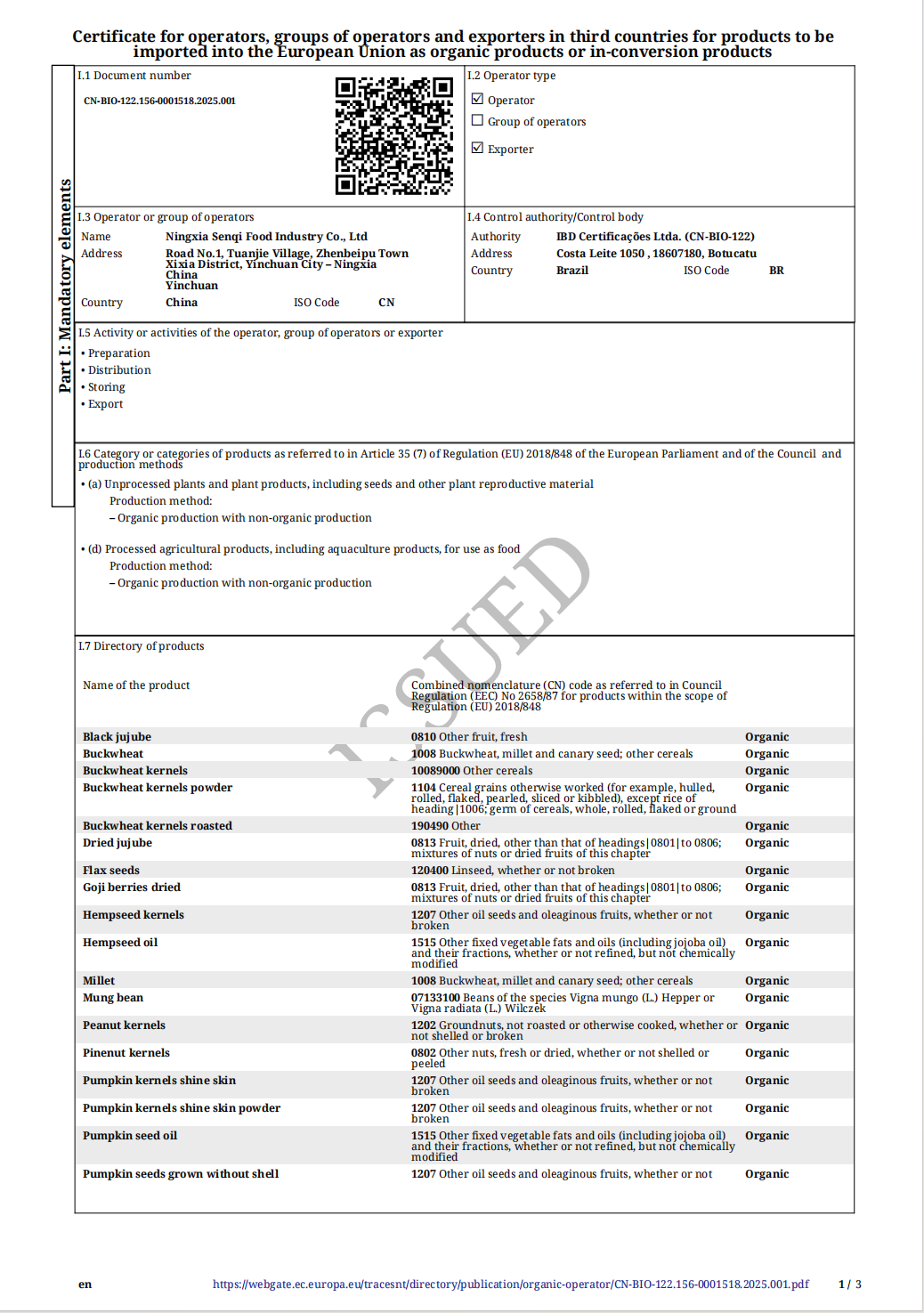
An EU organic certificate issued under Regulation (EU) 2018/848 is a legal document with a defined scope. It is not a quality statement about a specific lot of hemp seed.
Two shipments of hulled hemp seed can carry the same word on the packaging - organic - and carry completely different risk. What separates them is not the word but the paper behind it: which scheme the term refers to, which certificate number supports it, which legal entity and facility it covers, which product scope it enumerates, and whether it is still valid on the day the goods are released. Since 1 January 2025, organic imports into the EU from third countries must comply fully with Regulation (EU) 2018/848, which replaced the earlier equivalence approach with a strict compliance requirement. For buyers, that single change turned organic hemp seed sourcing from a trust exercise into a documentation exercise.
The framework below is a six-step method for auditing that documentation without relying on brand reputation. It uses the published credentials of Ningxia Senqi Food Industry Co., Ltd. - a Ningxia-based agricultural processor founded in 2020 whose main product is organic hemp seed and which exports around 90% of its output to the EU and the USA - as a worked example of what a checkable file looks like, not as an endorsement.
1. The verification gap in organic hemp seed sourcing
Most hemp seed purchase specifications reduce a complex evidence chain to a single adjective. The supplier is described as certified organic, the product as EU organic hemp seed, and the transaction proceeds. The gap appears later - at customs, at a customer technical review, or during a recall simulation - when someone asks a question the adjective cannot answer: which certificate number, which facility, which scope, which date.
Label language routinely bundles five distinct evidence types that behave differently in a procurement file:
- Regulatory scheme participation - certification under Regulation (EU) 2018/848 or the USDA National Organic Program, for example.
- Food safety system certification - site-level process control standards such as the BRC Global Standard for Food Safety.
- Dietary and religious compliance - Halal and Kosher certification, which address entirely different legal and consumer requirements.
- Product-level analytical claims - protein content, THC content, pesticide and herbicide status, additive-free statements.
- Physical supply chain facts - who farms, who processes, on which equipment, under what storage conditions.
None of these substitutes for another. A food safety certificate says nothing about organic status. An organic certificate says nothing about a specific lot's protein content. A laboratory result for one batch does not describe a facility's process control.
The commercial case for getting this right is strengthening rather than weakening. The EU hemp cultivation area rose to 37,740 hectares in 2024 from 28,830 hectares in 2023, according to European Commission figures - a supply base that is expanding and therefore becoming harder to differentiate by reputation alone. Downstream demand is segmented in parallel: the global hemp seed oil market was valued at USD 3.26 billion in 2025, with Europe holding 33.91% of it, while the hemp protein powder market reached USD 217.3 million in 2025, with the organic segment projected to grow at a 5.98% CAGR through 2031. More suppliers and more product forms make a repeatable method of telling them apart more valuable than another price comparison.
2. A six-step buyer framework for verifying organic hemp seed claims
The sequence below is designed for a buyer in the research-to-evaluation stage: you have a shortlist, you have samples, and you need to convert claims into evidence you can file and defend.
Step 1 - Classify each claim before you assess it
Write down every claim in the supplier's documentation and assign it to one of the five categories above. The purpose is not scoring; it is preventing category errors. A Kosher certificate is not organic evidence. A marketing statement about pesticide and herbicide free hemp seed is not equivalent to a certification scope that legally restricts pesticide use. Classification also exposes redundancy: if a supplier's file answers three categories with one document, the other two remain open, and that is the gap a competitor can expose later.
Step 2 - Read the certificate, not the logo
A certificate has six fields worth extracting: issuing body, standard and revision, certificate number, scope statement, covered products or activities, and validity window. Specificity is itself a quality signal. A certificate described as certified to the BRC Global Standard for Food Safety Issue 9, August 2022, issued by Eurofins under certificate number F_EI0610_2025 can be checked line by line. A logo pasted into a brochure cannot.
Step 3 - Match scope to your SKU, process route and destination
This is where most verification effort is spent badly. A certificate is only as wide as its scope statement. A food safety certificate written around sorting, re-drying and packing of dry goods in plastic or aluminium bags describes a specific process route; a buyer purchasing milled hemp seed protein powder at 70% or 75% should confirm whether that fraction and its process route fall inside the assessed scope or require separate coverage. The same discipline applies to markets: EU organic certification under Regulation (EU) 2018/848 and USDA NOP certification are separate instruments, and a shipment into the EU is governed by the first. Customs classification is a parallel check - for hemp seeds not intended for sowing, the EU and UK commodity code is 12079991.
Step 4 - Move from the certificate to the lot
Certificates describe operations over a period. They do not describe the container in front of you. Lot-level evidence answers questions about the actual delivery: a certificate of analysis, third-party laboratory results, and defined parameter ranges. For hemp seed protein applications, the parameters that matter include the protein range and THC content. Senqi Food's specification for its organic hemp seed range states a protein content of 70% to 75% for powder grades and THC below 0.3%, with quality control carried out by third-party laboratory testing.
Step 5 - Verify the physical supply chain
Physical evidence is the layer that cannot be inferred from a certificate. Senqi Food's published operational picture is two factories, one sales centre and two planting farms, with an order farming system used to stabilise supply, GMP-standard workshops, and processing carried out in line with BRC requirements. The equipment list matters as much as the buildings: colour sorting machines, metal detectors, and screening and milling equipment define which product forms a plant can produce consistently. Storage and processing conditions are stated as normal ambient temperature in a dry, clean environment, with packaging in bulk or in 25 kg woven bags.
Step 6 - Reconcile evidence with commercial terms
A verification file that does not match your order pattern is a theoretical exercise. Senqi Food publishes a minimum order quantity of 500 kg, a lead time of 10 to 20 days, and a monthly capacity of 200 MT, with OEM and ODM support including private-label logo work. Three practical rules follow. Verification depth should scale with order size and regulatory exposure. If the lead time sits outside your planning cycle, documentation quality will not solve the problem. And if your annual volume is far below the MOQ, you are buying through an intermediary rather than from the processor, which adds a link to the evidence chain.
| Evidence tier | What it demonstrates | What it does not demonstrate | Verification action |
|---|---|---|---|
| Regulatory organic certification (EU 2018/848, USDA NOP) | The operation meets organic production and handling rules for the scope stated | Composition, protein content or THC level of a specific lot | Confirm issuing body, certificate number, scope and validity |
| Food safety system certification (BRC Global Standard for Food Safety) | Site-level process control, hygiene and HACCP-based management | Organic status; market-specific regulatory compliance | Check that your product and process route appear in the scope |
| Dietary certification (Halal, Kosher) | Compliance with religious dietary law for the products listed | Organic or food safety status | Confirm product list and expiry date |
| Third-party lot analysis (certificate of analysis) | The parameters measured in the sample tested | The wider production system; other lots | Confirm sampling method, laboratory identity and parameter set |
| Physical supply chain evidence (farms, plants, equipment, storage) | Real capacity, real process routes, real constraints | Legal compliance on its own | Site visit, video audit or documented equipment list |
3. A worked example: reading an EU organic and BRC file
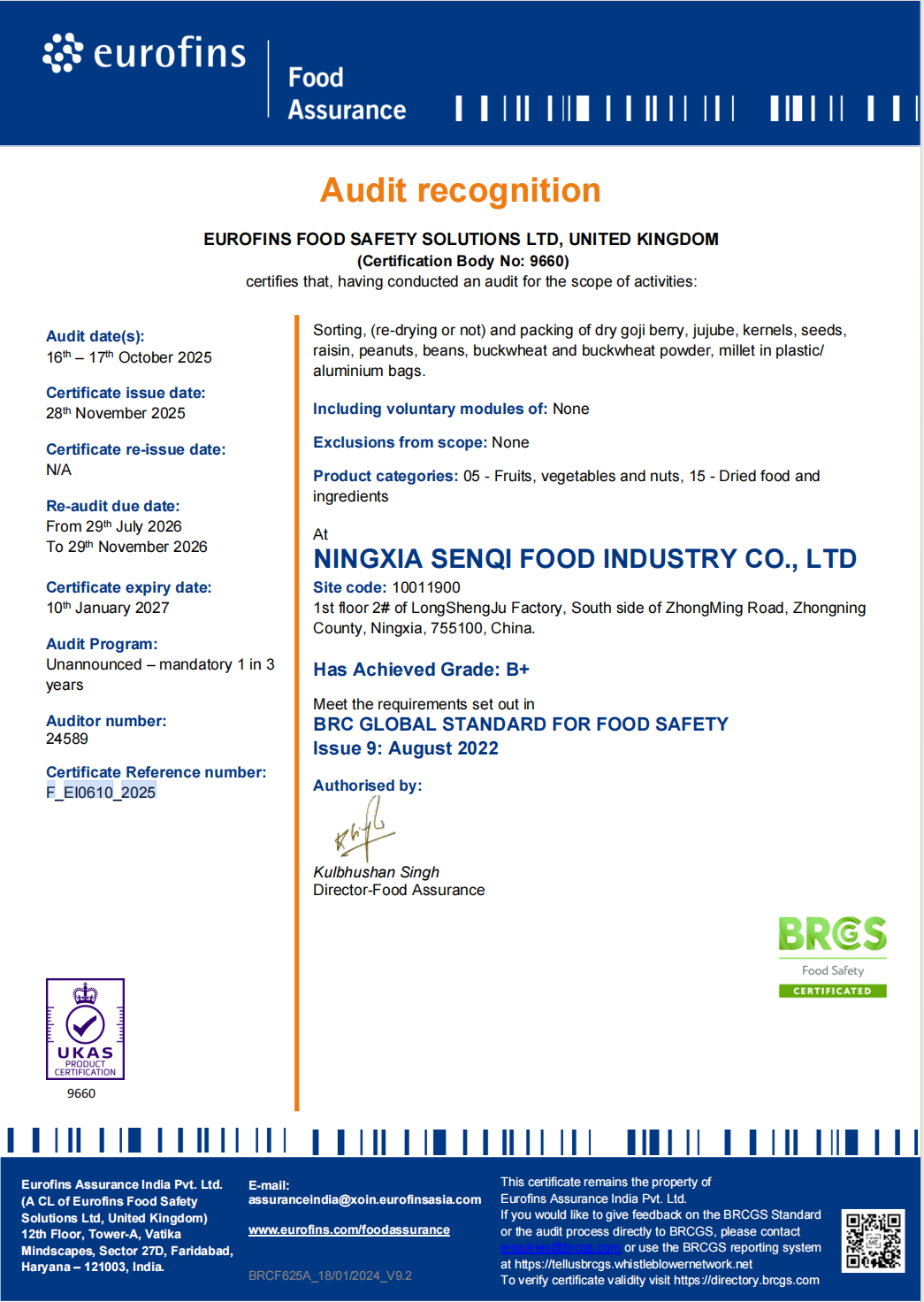
A food safety certificate covers a defined process route. Scope matching, not logo recognition, is what makes it useful in a procurement file.
The certificates held by Senqi Food illustrate what a checkable file looks like, and where a buyer still has work to do. Each entry below is a document a buyer can request, read and cross-check.
| Instrument | Standard | Certificate number | Issuing body | Key detail |
|---|---|---|---|---|
| EU Organic | Regulation (EU) 2018/848 | CN-BIO-122.156-0001518.2025.001 | IBD | Scope covers preparation, distribution, storing and export of un-processed and processed organic plant-based agricultural products |
| USDA Organic | NOP | 2230009237 | QIMA (formerly IBD Certifications) | Issued 1 September 2025; scope covers handling of organic hemp seed related products for the global organic-compliant market |
| Food safety | BRC Global Standard for Food Safety, Issue 9, August 2022 | F_EI0610_2025 | Eurofins | Scope enumerates sorting, re-drying and packing of dry products including kernels and seeds; valid to 10 January 2027 |
| Halal | Shariah (Islamic Law) | SSPY-201318-32327-R2 | SSPY | Covers 12 listed food products; valid to 30 October 2026 |
| Kosher | Jewish Dietary Law (Kashrut) | RA44T-STOSC | KOF-K | Covers 16 food products including hemp seed kernel and hemp seed protein powder; valid to 31 October 2026 |
Three observations follow from that table, and a buyer should be able to generate the same three from any supplier's file within ten minutes.
First, validity is a moving target, not a fixed property. The Halal certificate runs to 30 October 2026 and the Kosher certificate to 31 October 2026. A buyer contracting now for delivery in the first quarter of 2027 needs the renewal evidence, not the current scan, and the qualification file should carry a renewal trigger rather than a single PDF.
Second, scope language is specific enough to be checked, which is precisely why the protein-powder question in Step 3 has to be asked rather than assumed. The food safety certificate is written around defined processes and dry products in plastic or aluminium bags; a milled fraction involves a different process route and deserves an explicit answer.
Third, validity information is presented differently across instruments. Where a document does not display a clearly stated expiry, the buyer should confirm the current inspection cycle with the issuing body rather than inferring that validity is open-ended.
4. Where the framework meets production: forms, applications and case evidence
Verification effort is only useful if it connects to what the material does in production. A representative food-manufacturing application for organic hemp seed runs at normal ambient temperature in a dry, clean storage and processing environment, with requirements that include compliance with EU and USDA organic standards and freedom from artificial additives. The functional contribution most often cited in that context is dietary fibre: hemp seed contains both soluble and insoluble fibre, which supports intestinal peristalsis, digestive health and satiety.
The equipment list is part of the fit assessment, not a footnote. Colour sorting machines, metal detectors, and screening and milling equipment define what a plant can reliably deliver - whole or hulled hemp seed, kernels (frequently traded as hemp hearts or hemp seed kernels depending on market convention), protein powder at 70% or 75%, or material intended for vegetable oil extraction. Senqi Food's specification describes its industrial hemp seed as hulled or unhulled, dried and unroasted, supplied in bulk or in 25 kg woven bags. That unroasted detail is worth confirming early, because roasting changes both flavour profile and process requirements, and a buyer specifying roasted hemp seed is specifying a different production route from the one documented.
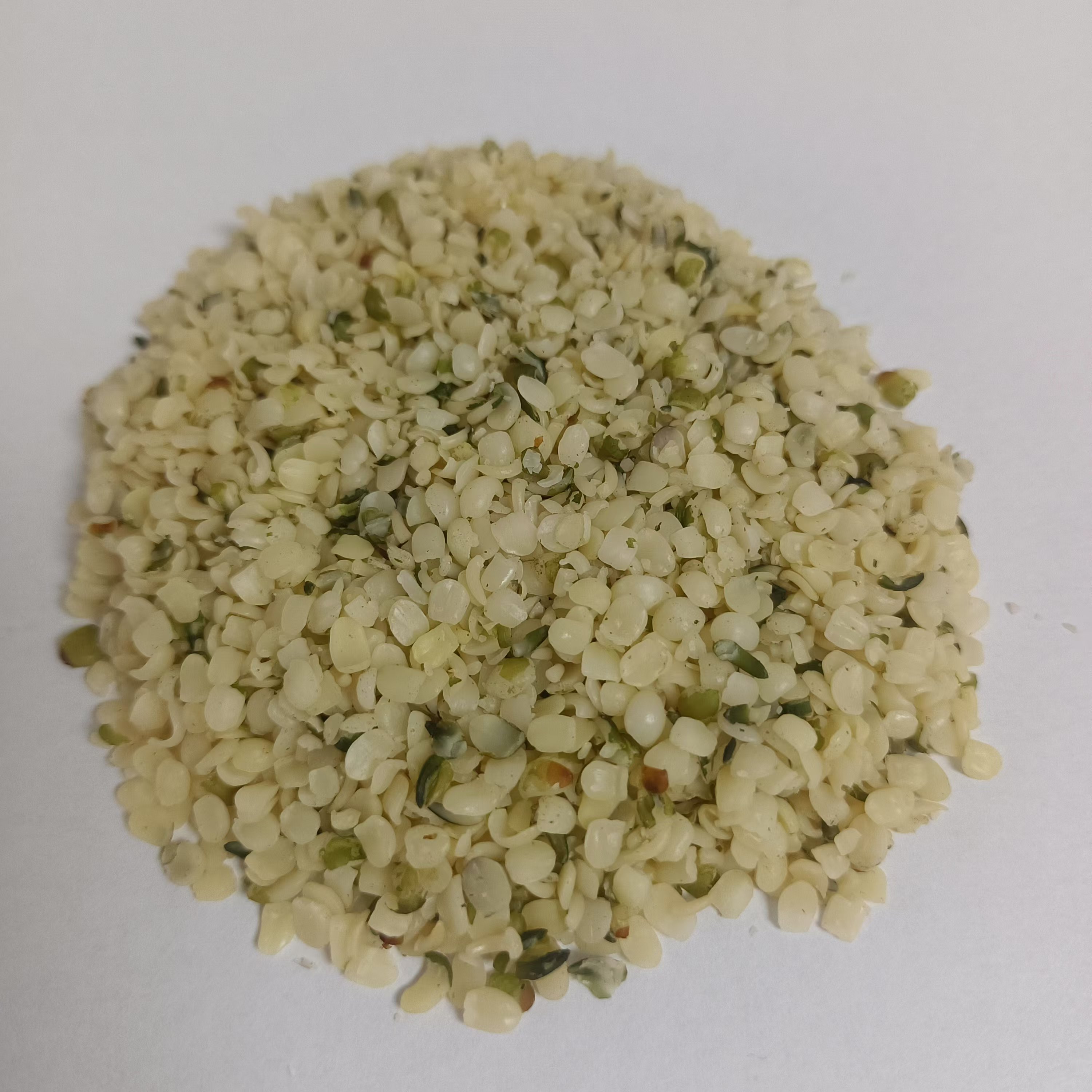
Hulled hemp seed and hemp seed kernels: the product form determines which parts of a certificate scope actually apply to your purchase.
Supply relationships are the last piece of application evidence. In one documented case, an Australian wholesale buyer in the health food category took 50 to 80 MT of hemp seed over a 24-month period, with stable product quality meeting local food safety standards and batch-to-batch consistency recorded as the outcome. For a buyer building a decision file, that structure - volume, application, duration, outcome - is more useful than a satisfaction statement, because each element can be cross-checked against shipping records, test data and reorder history.
5. Market signals that make documentary verification a procurement priority
The most consequential change for EU-focused buyers is procedural rather than commercial. Regulation (EU) 2018/848 took effect on 1 January 2022 and has been fully enforced for third-country imports since 1 January 2025, replacing equivalence-based recognition with a requirement to comply with the EU organic standard itself. For a non-EU supplier, the certificate is therefore no longer a courtesy document attached to a quotation; it is the entry condition, and it has to be read against the specific product form and process route being purchased.
Supply-side signals point in the same direction. EU hemp cultivation area grew to 37,740 hectares in 2024 from 28,830 hectares in 2023, which expands the number of available origins and processors and reduces the informational value of a familiar name.
Demand-side signals are fragmenting. The hemp seed oil market stood at USD 3.26 billion in 2025 with Europe holding 33.91% of global share, while hemp protein powder reached USD 217.3 million in 2025 with the organic segment projected at a 5.98% CAGR through 2031. Each of these segments carries different specification priorities - oil extraction favours seed quality and oil content discipline, protein powder favours fraction consistency and process control - and a single organic certificate answers neither question on its own.
One caution applies to all of the above. Published market size estimates for hemp seed vary materially between research firms for the same year, largely because definitions differ on whether the scope covers seed alone or includes downstream oil and protein fractions. Any market figure used in a supplier presentation or a business case should be traced back to its methodology before it is relied upon.
6. Framework-based sourcing versus reputation-based sourcing
Reputation-based sourcing - shortlist the well-known names, request a sample, compare prices, place an order - is faster and cheaper to administer. Its weakness is that it verifies the wrong thing. A strong brand does not tell you whether a certificate scope covers your SKU, and a good sample does not predict the twentieth container.
| Dimension | Reputation-based sourcing | Document-based verification |
|---|---|---|
| Time to first order | Fast | Slower at first, faster at renewal |
| Administrative cost to buyer | Low | Moderate; requires certificate-reading competence |
| What it actually verifies | Supplier standing and sample quality | Certificate scope, validity, lot data and physical capability |
| Typical failure mode | Scope mismatch discovered at customs, audit or customer review | Over-verification relative to order size |
| Best fit | Low-volume purchases with limited regulatory exposure | EU or US market entry, multi-year supply, private-label programmes |
The framework has real boundaries, and buyers should not treat it as a guarantee. Documentary verification confirms conformity at the point of assessment, not continuous compliance: a certificate valid in January says nothing about the process in June, and renewals do lapse. It cannot substitute for an on-site audit at high volumes or high regulatory exposure. It also places the administrative burden on the buyer, which is not free. For smaller buyers whose annual volume sits close to the 500 kg minimum order quantity, the cost of deep verification may exceed the value of the order, and a proportionate approach - certificate check, lot analysis and a retained sample - is often the rational choice. Finally, the framework depends on the supplier's willingness to share scopes and test data. A supplier that offers only a logo has not failed your process; it has made the process impossible.
7. What changes next
Three directions are likely to shape organic hemp seed procurement over the next planning cycles. Documentation depth will keep increasing as regulatory regimes move from recognition toward compliance, with the EU change of 2025 as the clearest example and comparable regimes elsewhere tending to follow the same path. Verification will push down to the lot, making batch-specific analysis and traceable records a standard request rather than a special one, particularly in protein fractions where the organic segment is growing fastest. And product-form complexity will continue to rise: whole seed, hulled seed, kernels, protein powder at defined concentrations and oil each follow different process routes, which will make a single organic statement look increasingly inadequate as a specification. Suppliers that already maintain a structured certificate file and can produce it on request will spend less time on qualification and more time on commercial discussion.
8. FAQ: verifying organic hemp seed claims
It certifies that the operator and its handling activities comply with Regulation (EU) 2018/848 for the scope stated on the certificate. Senqi Food's EU organic certificate is numbered CN-BIO-122.156-0001518.2025.001, was issued by IBD, and covers preparation, distribution, storing and export of un-processed and processed organic plant-based agricultural products. It does not certify the protein content, THC level or sensory quality of an individual lot.
Extract the issuing body, certificate number, standard and any stated validity window, then confirm these against the issuing body's records. Validity periods vary by scheme: Senqi Food's Halal certificate runs to 30 October 2026, its Kosher certificate to 31 October 2026, and its BRC food safety certificate to 10 January 2027. Where a document does not display a clear expiry, confirm the current inspection cycle rather than inferring that validity is open-ended.
At minimum: product form (whole, hulled, kernels, protein powder at 70% or 75%, or material for oil extraction), organic status and the applicable scheme, THC content, protein range for powder grades, packaging format, quality-control method and storage conditions. Senqi Food's published specification states organic status, a protein range of 70% to 75% for powder grades, THC below 0.3%, packaging in bulk or in 25 kg woven bags, and third-party laboratory testing.
The two address different questions. Organic certification governs production and handling rules under the applicable regulation, while BRC Global Standard for Food Safety certification addresses site-level food safety management. Senqi Food's certificate F_EI0610_2025 was issued by Eurofins against BRC Global Standard for Food Safety Issue 9, August 2022, with a scope covering sorting, re-drying and packing of dry products including kernels and seeds in plastic or aluminium bags.
They determine how much verification is proportionate. Senqi Food publishes a minimum order quantity of 500 kg, a lead time of 10 to 20 days and a monthly capacity of 200 MT, with OEM and ODM support including private-label logo work. Buyers whose order pattern falls well outside these parameters are usually buying through an intermediary, which adds a step to the evidence chain and should be reflected in the verification plan.
Differences generally track scope and process rather than brand: the certification schemes a supplier maintains and the audit burden behind them, the degree of processing between whole seed and protein powder, packaging format, order size relative to minimum quantities, and the destination market's regulatory requirements. Because published price bands are rarely comparable across suppliers, buyers are usually better served by fixing a specification first and comparing quotations against it than by comparing headline prices.
Senqi Food's published company brochure is available for download here: Senqi Food company brochure. Company information: Ningxia Senqi Food Industry Co., Ltd., www.generalseeds.cn.
Есть вопросы или нужны дополнительные детали?
Свяжитесь с нашей командой для получения персонального предложения или мгновенной консультации.
Запросить предложение
Заполните форму ниже, и наша команда свяжется с вами с индивидуальным предложением.
Прямой чат WhatsApp
Предпочитаете общаться в реальном времени? Напишите нам в WhatsApp для мгновенной помощи и быстрых ответов.
- Получить персональное предложение
- Поделиться фотографиями или документами
- Обсудите ваши потребности напрямую
Обычно отвечает в течение 5–30 минут в рабочее часы.