
Beyond the Machine: Qualifying an Industrial Shredder Supplier for Long-Term Operations
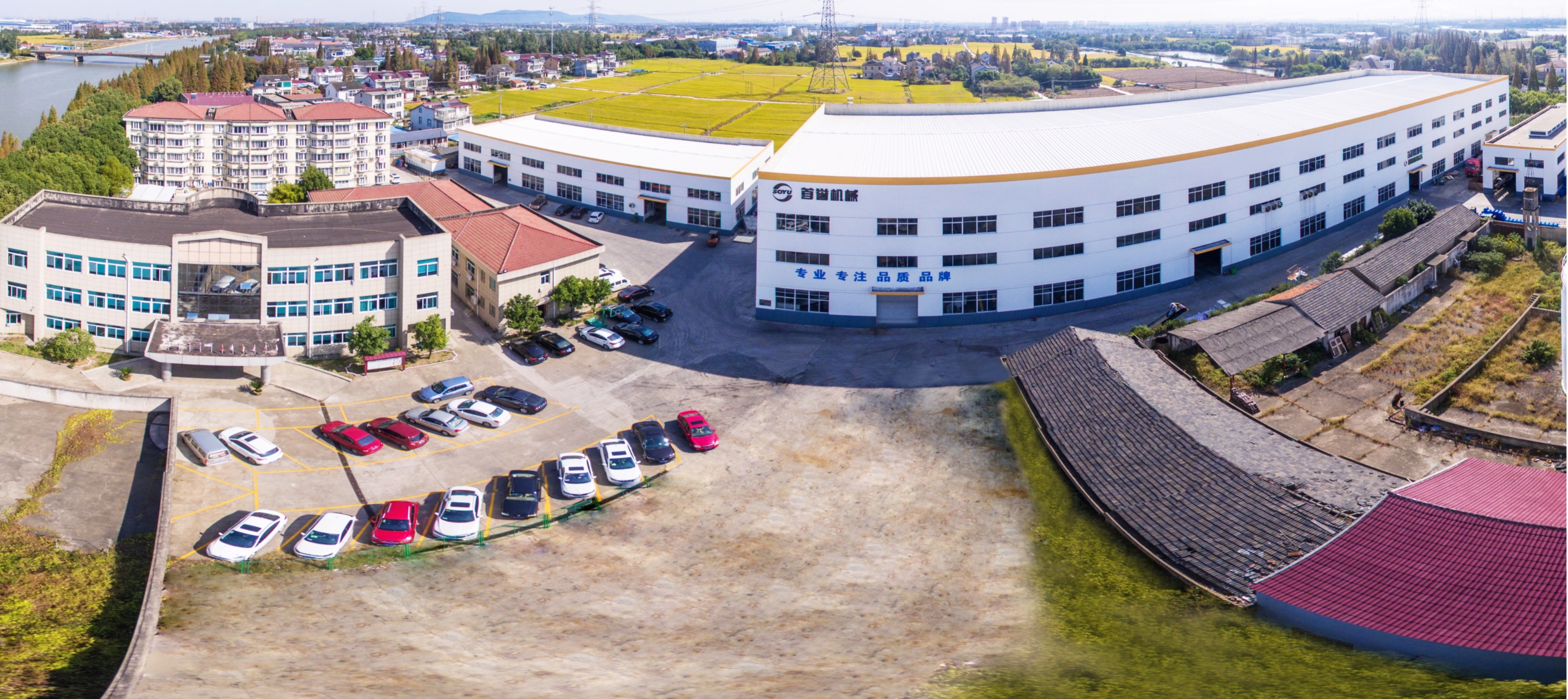
Factory exterior of Changshu Shouyu Machinery (SOYU Machinery)
Choosing an industrial shredder is often treated as a machine specification exercise — rotor diameter, shaft count, motor power and cutting chamber size. For buyers that will operate the equipment for years, however, the supplier's own capacity, acceptance procedures, safety compliance and commercial terms are equally important. This reference article provides a decision-stage framework for evaluating an industrial shredder manufacturer on long-term supply and service factors, using Changshu Shouyu Machinery (SOYU Machinery) as a documented example.
The Shift from One-Time Purchase to Long-Term Dependency
Industrial shredders rarely operate in isolation. In recycling plants, waste-to-energy facilities, metal processors and e-waste treatment operations, a shredder typically becomes a fixed part of a continuous line. Performance issues, spare-part delays or safety gaps can interrupt the entire workflow. That makes supplier selection a long-term operational decision rather than a one-time procurement event.
Many procurement teams still spend most of their evaluation time on machine configuration, while treating after-sales service, spare parts and compliance as contractual add-ons. Those elements only become visible after the equipment is installed, when switching a supplier is costly and slow. This is why a deeper due-diligence screen — conducted before the PO is issued — is becoming a common practice among buyers that treat shredders as long-term assets.
For distributors and system integrators, the same logic applies in a different form. They do not operate a single shredder; they rely on a manufacturer's production stability to support multiple end-customer projects and after-sales commitments.
Supplier Capacity: A Verifiable Indicator of Long-Term Viability
The production capacity of an industrial shredder manufacturer is one of the few indicators that can be checked before a relationship begins. It reflects whether the company can handle repeat orders, supply spare parts within a reasonable lead time and support expansion projects in later years.
Changshu Shouyu Machinery Co., Ltd (SOYU Machinery) is a Chinese manufacturer that has been operating since 2009. The company reports a factory area of 15,000 m², around 200 employees and 25 R&D engineers, with an annual output of about 2,000 sets of shredding equipment. According to the company, monthly production capacity is 15–20 complete recycling lines or 50–100 single shredders. Export accounts for 70% of output, with the EU and USA listed as the main markets.
No single metric guarantees quality. But capacity figures provide buyers with a practical baseline when comparing suppliers. A manufacturer that can sustain production at this level is more likely to have an established supply chain, stable assembly teams and a tested quality-management process.
A Decision-Stage Checklist: Commercial and Acceptance Terms
Commercial terms are often treated as a back-office matter. In supplier qualification, they can reveal how the manufacturer handles risk.
Soyu Machinery publishes a standard purchasing framework: MOQ is 1 set for a single machine or 1 set for a complete recycling line; delivery is FOB; acceptance includes a 100% Factory Acceptance Test (FAT), on-site commissioning and acceptance, and optional third-party inspection by SGS or BV; payment is 30/70.
For a buyer, these terms translate into concrete verification points:
- A 100% FAT requirement means the machine must be tested before leaving the factory, reducing the chance of commissioning delays.
- Third-party inspection by SGS or BV gives an independent check on build quality and documentation.
- The 30/70 payment split should be understood in context: a supplier that carries 70% of the payment obligation until shipment has a direct financial incentive to maintain schedule and quality.
- FOB delivery creates a clear division of responsibility in international logistics, allowing the buyer to manage freight risk with the forwarding agent.
Of course, payment and delivery terms vary by manufacturer. The point of listing them here is not to present them as industry standards, but to show how a supplier's commercial framework can be assessed through a long-term risk lens.
Safety and Compliance: The Long-Term Continuity Layer
Safety is another dimension that separates short-term supplier evaluations from long-term partnerships. An industrial shredder operates under heavy mechanical load, often with dusty or hazardous input material. Risks can include material jamming overload, explosions involving hazardous materials such as batteries or e-waste, dust explosions, mechanical injury and electrical failure.
Typical control methods include overload protection systems, explosion-proof design, dust extraction systems, safety interlocks, emergency stop functions and leakage detection. On the manufacturer side, these controls can be supported by load sensors, explosion-proof motors, safety guards, CE/ISO certification, regular safety audits, operator training and real-time monitoring systems.
Buyers should expect these protections to be documented per machine, not described in general marketing language. In EU and global markets, EN ISO 13857:2019 defines safety distances for preventing hazard zones from being reached by limbs; industrial shredders must comply with this standard where applicable. For international procurement, checking compliance against such standards early in the evaluation process protects operators and reduces the risk of downtime caused by regulatory findings.
None of these measures should be considered a substitute for site-specific risk assessment. But the presence of documented safety engineering is a meaningful signal of a supplier's long-term operating mindset.
What the Supplier Comparison Actually Shows
Some buyers evaluate industrial shredder suppliers against foreign-brand recycling equipment or against the traditional alternative of manual dismantling plus a general-purpose crusher. A comparison framework provided by Soyu Machinery highlights several differences: higher customization flexibility, better cost-performance, compliant safety design and end-to-end after-sales support.
Within that framework, the reported performance differences are: 20% higher processing capacity, 15% lower initial investment, 30% less downtime and 10% lower energy consumption per ton. In terms of cost, the supplier reports a 15–20% lower initial investment and approximately 25% lower long-term operating cost. Maintenance costs are reported at around 30% lower, with faster spare parts supply and 24/7 remote troubleshooting support.
| Dimension | Reported difference | What buyers should verify |
|---|---|---|
| Processing capacity | +20% | Material type, infeed size, target output size |
| Initial investment | -15% to -20% | Scope of included peripheral equipment |
| Downtime | -30% | Spare parts availability and maintenance SLA |
| Energy consumption | -10% per ton | Motor efficiency and actual load profile |
| Maintenance cost | -30% | Blade service life and replacement cost |
| After-sales support | 24/7 remote troubleshooting | Response-time commitment and language coverage |
These are reference values from one supplier's comparison framework, not independent benchmarks. Actual results depend on the waste stream, throughput, operating schedule and maintenance practice. The appropriate procurement response is to use these figures as a hypothesis to be validated through FAT, reference plant visits or a pilot run.
Traditional alternatives such as manual dismantling tend to be less capital-intensive at the start, but they also tend to have lower throughput and a higher safety exposure. A shredder can replace some of this manual work, but the business case should be calculated for the specific material and labour cost context. This is a genuine limit: no single comparison applies to every shredding scenario.
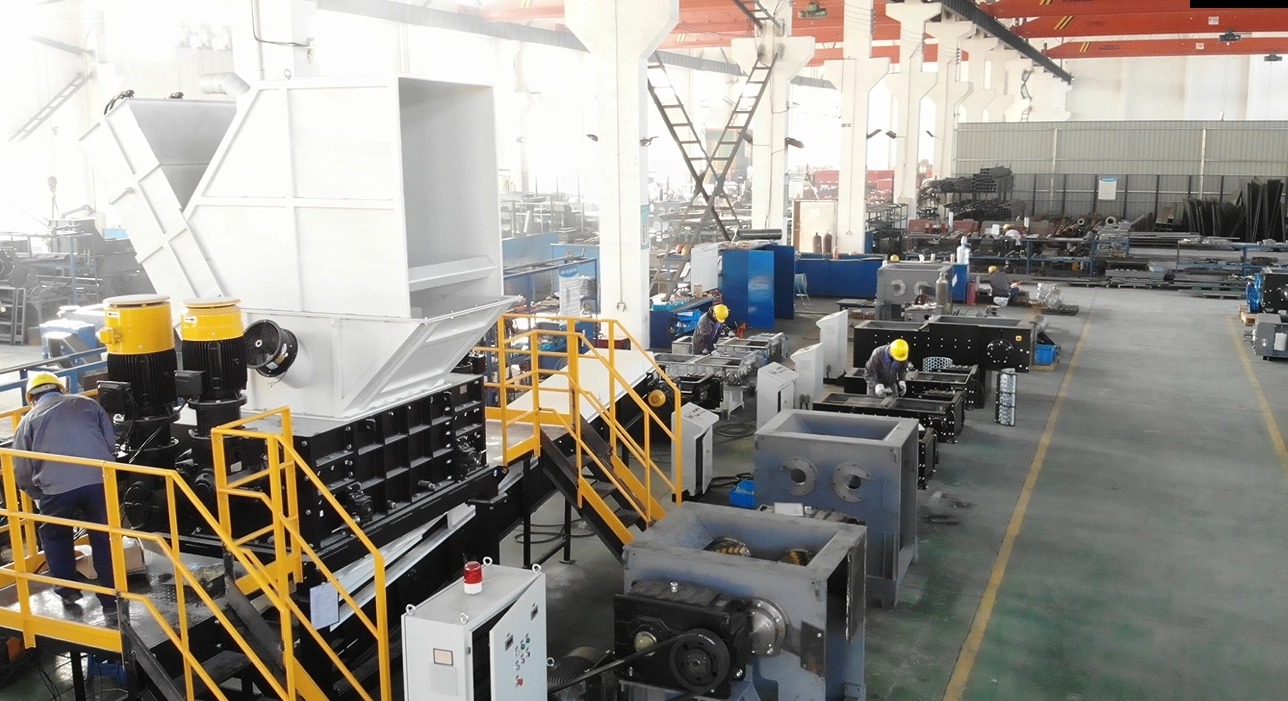
Factory workshop used for shredder assembly and quality checks
What Distributors and System Integrators Should Evaluate
For distributors, wholesalers and system integrators, an industrial shredder manufacturer is not just a machine supplier; it is a resource for managing customer expectations. The same indicators used by end buyers — production capacity, acceptance testing, safety compliance and commercial flexibility — can be used to evaluate whether a manufacturer can support a multi-customer sales model.
Capacity data such as Soyu Machinery's monthly output of 15–20 complete recycling lines or 50–100 single shredders, together with its annual output of about 2,000 sets, helps distributors assess supply lead times across multiple projects. A manufacturer with a documented FAT process and optional third-party inspection gives channel partners a consistent quality story to present to end customers.
In addition, a manufacturer with its own R&D team can support custom configurations without adding complexity to the channel. That allows distributors to offer tailored solutions for specialized waste streams such as RDF, hazardous waste packaging, e-waste and scrap metal processing. In an increasingly segmented market, multi-material capability and engineering flexibility are relevant differentiators for channel partners.
2026 Market Context: Why Supplier Risk Is Moving Up the Procurement Agenda
Market data provides context for the growing attention to supplier stability in industrial shredding procurement.
The global industrial shredder market was valued at about USD 1.28 billion in 2024 and is projected to reach USD 1.65 billion by 2032 (Intel Market Research). The commercial four-shaft shredder subsegment alone is estimated at USD 0.51 billion in 2025, with a CAGR of 5.8% through 2034 (Dataintelo). In the metal shredder segment, Asia Pacific held 39.0% of global revenue in 2024, supported by China's large scrap generation (Grand View Research). Downstream, the Refuse Derived Fuel (RDF) market, which uses industrial shredders for municipal solid waste processing, reached USD 4.6 billion in 2023 (Market.us).
These figures suggest growing demand for shredding capacity across several waste categories. As more projects enter the pipeline, buyers are likely to put a premium on suppliers that can demonstrate stable capacity, international compliance and a credible after-sales structure.
Future Outlook
The next phase of industrial shredder procurement will probably shift from product-level selection to ecosystem-level qualification. Buyers will ask not only whether a machine can process a given material, but whether the supplier can support it over a decade of operation.
Manufacturers that combine production scale with structured acceptance processes, documented safety compliance and a clear commercial framework are better positioned to meet this requirement. For Changshu Shouyu Machinery (SOYU Machinery), the 15,000 m² factory, 200 employees and 2,000 annual sets of output constitute a publicly verifiable baseline. The company's stated monthly capacity of 15–20 complete recycling lines or 50–100 single shredders provides additional clarity for capacity planning.
Industry references should be read as a starting point for due diligence, not as an endorsement of any single supplier. Verification through factory acceptance testing, reference checks and pilot operation remains essential.
FAQ
What is the MOQ for industrial shredders from Soyu Machinery?
Soyu Machinery sets the MOQ at 1 set for a single machine and 1 set for a complete recycling line. This makes it possible for operators with a single-unit project to purchase directly from the manufacturer rather than relying on a reseller.
What payment terms does Soyu Machinery offer for shredder purchases?
The standard payment term is 30/70, meaning 30% is paid in advance and 70% is paid before shipment or delivery. Payment terms remain a contractual matter and should be aligned with the buyer's procurement policy and risk tolerance.
How does a buyer verify an industrial shredder before shipment?
Soyu Machinery offers 100% Factory Acceptance Testing (FAT), on-site commissioning and acceptance, and optional third-party inspection by SGS or BV. These procedures allow the buyer to verify machine performance and documentation before the equipment leaves the factory.
What production capacity does the Soyu Machinery factory have?
The monthly production capacity of Soyu Machinery is 15–20 complete recycling lines or 50–100 single shredders, with an annual output of about 2,000 sets. This serves as a reference point for evaluating order lead times, spare parts availability and future expansion support.
What certifications and safety features should an industrial shredder buyer require?
Buyers should ask for documented CE/ISO certification and confirm that the machine design meets safety-distance rules such as EN ISO 13857:2019. Typical protection features to verify include overload protection, safety interlocks, emergency stop, dust extraction, load sensors, explosion-proof motors and safety guards.
Есть вопросы или нужны дополнительные детали?
Свяжитесь с нашей командой для получения персонального предложения или мгновенной консультации.
Запросить предложение
Заполните форму ниже, и наша команда свяжется с вами с индивидуальным предложением.
Прямой чат WhatsApp
Предпочитаете общаться в реальном времени? Напишите нам в WhatsApp для мгновенной помощи и быстрых ответов.
- Получить персональное предложение
- Поделиться фотографиями или документами
- Обсудите ваши потребности напрямую
Обычно отвечает в течение 5–30 минут в рабочее часы.