
Beyond the Quote: Hydraulic Power Unit Risk and Traceability
_1784192063.png)
A hydraulic power unit (HPU) is a self-contained assembly that converts input power into hydraulic flow and pressure for a specific machine or system. At the decision and execution stage of procurement, the evaluation shifts from catalogue specifications to a more decisive question: can this manufacturer control production, testing, packaging, and traceability well enough to support a long-term supply relationship?
The Sourcing Question Moves From Price to Execution Risk
In the early evaluation phase, hydraulic power unit buyers compare flow rate, pressure rating, reservoir size, voltage, and port configuration. At the decision and execution stage, the priority changes. An OEM selecting a power unit for a production trailer line and a distributor adding a power unit brand to its catalogue are both choosing a long-term partner. Their exposure is not limited to one order. It extends to repeated production batches, field failures, warranty costs, and the amount of engineering support available after the first shipment.
For this reason, supplier risk management has become a procurement criterion. Buyers need evidence that a manufacturer operates defined controls across the whole order cycle: engineering review, component sourcing, clean assembly, testing, packing, documentation, and after-sales service.
Execution Risks That Decide Long-Term Value
Hydraulic power units operate under repeated pressure cycles, electrical loads, temperature changes, and outdoor exposure, especially in mobile equipment. In this environment, recurring failure modes can be traced back to production decisions:
- Hydraulic oil leakage, often from poor sealing or untested connections.
- Pressure instability, caused by unverified circuit design or incorrect relief settings.
- Motor overheating, resulting from motors not matched to the actual duty cycle and voltage.
- Solenoid valve failure, linked to unqualified valve components or missing functional testing.
- Hydraulic pump wear, accelerated by contamination or low-quality sourcing.
- Electrical connection failure, due to non-standard wiring and unchecked control circuits.
- Oil contamination, from insufficient cleaning before assembly.
- Incorrect system configuration, when production does not start from a verified engineering drawing.
- Transportation damage, when packaging cannot protect the unit in export transit.
The opportunity for buyers is equally clear. A manufacturer that addresses these risks in a structured way can offer a predictable supply base, fewer warranty claims, and lower total ownership cost - exactly what a long-term sourcing relationship requires.
A Structured Risk-Control Model: Apex Hydraulic as a Reference
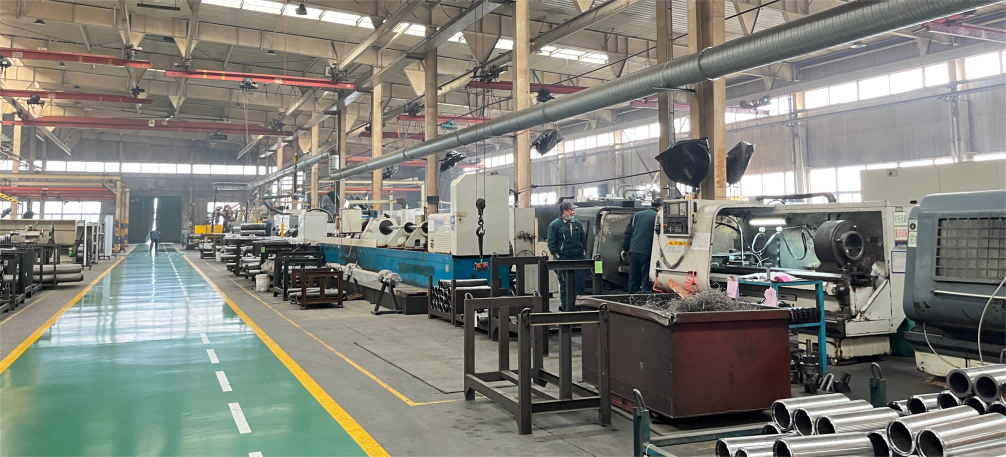
A useful reference for this supplier evaluation is Apex Hydraulic Co., Ltd., a Qingdao-based manufacturer established in 2009. The company produces custom hydraulic cylinders, hydraulic power units, and complete hydraulic systems from a 50,000 m² facility with more than 500 employees and an R&D team of 25 engineers. Apex Hydraulic reports an annual production capacity of 100,000 hydraulic cylinders and 15,000 power units, with exports accounting for 70% of total sales to North America, Western Europe, South America, Southeast Asia, the Middle East, and Australia.
Apex Hydraulic structures its risk control around ten categories that map closely to the failure modes above:
| Risk category | Control method |
|---|---|
| Hydraulic oil leakage | Precision sealing, leak-proof hydraulic connections, and hydraulic pressure and leakage testing before shipment; all fittings and sealing components are inspected. |
| Pressure instability | Hydraulic circuit verification and pressure calibration; pressure settings are adjusted to customer specifications and each unit is tested for stable system pressure. |
| Motor overheating | Motors are selected according to duty cycle, voltage, and load requirements; functional testing verifies stable operation under specified working conditions. |
| Solenoid valve failure | Qualified valve components are used; solenoid valves are tested for switching performance and response before assembly. |
| Hydraulic pump wear | Pumps are sourced from qualified suppliers and assembled under clean manufacturing conditions to minimize premature wear. |
| Electrical connection failure | Electrical wiring, connectors, and control circuits are inspected before shipment. |
| Oil contamination | Hydraulic systems are cleaned before assembly and hydraulic oil cleanliness is controlled. |
| Incorrect system configuration | Hydraulic circuit design, voltage, flow, pressure, and component configuration are verified against customer requirements before production. |
| Transportation damage | Hydraulic power units are protected with sealed ports, anti-corrosion treatment, and export-grade packaging. |
| Product traceability | Production batches and quality inspection records are maintained to support traceability and after-sales service. |
The list is worth examining for what it includes beyond the product itself: configuration control, cleanliness control, and traceability are process-level capabilities. They do not appear on a data sheet, but they determine whether a second order performs like the first.
Manufacturing Controls That Protect a Power Unit Over Its Lifecycle
For a buyer, the practical value of a supplier's risk system appears in specific production steps. Four of them deserve attention when evaluating a hydraulic power unit manufacturer.
Pressure Calibration and Pre-Delivery Testing
Pressure instability is a common source of field complaints. A manufacturer reduces this risk by verifying the hydraulic circuit, setting relief pressures according to customer specifications, and testing each unit for stable system pressure before delivery. Hydraulic pressure and leakage testing before shipment also provides documented evidence that the unit can hold its intended working pressure without external leakage.
Motor Selection Based on Duty Cycle and Load
Mobile hydraulic power units commonly operate on 12V, 24V, or 48V DC systems, while industrial units use 220V or 380V AC. Motors that are undersized for the duty cycle overheat; oversized motors add cost and weight. Established manufacturers select motors according to duty cycle, voltage, and load requirements, then verify operation through functional testing under specified working conditions.
Clean Assembly and Component Qualification
Premature hydraulic pump wear is often contamination-related. Sourcing pumps from qualified suppliers and assembling them under clean manufacturing conditions reduces this risk. Hydraulic systems are cleaned before final assembly, and oil cleanliness is controlled during production. Solenoid valves receive functional testing for switching performance before assembly, reducing the risk of early field failure.
Electrical Inspection and Export Packaging
Electrical failures in DC power units are commonly traced to wiring and connector issues. Inspecting wiring, connectors, and control circuits before shipment is a low-cost control with a direct effect on field reliability. For cross-border buyers, packaging matters just as much: sealed ports, anti-corrosion treatment, and export-grade packaging reduce the risk of transportation damage, a failure mode that otherwise appears soon after delivery.
Application Context: Where Power Unit Reliability Is Tested Hardest
Apex Hydraulic's power unit range illustrates how different applications place different demands on a manufacturer's risk controls.
| Application | Representative Power Unit | Key Configuration |
|---|---|---|
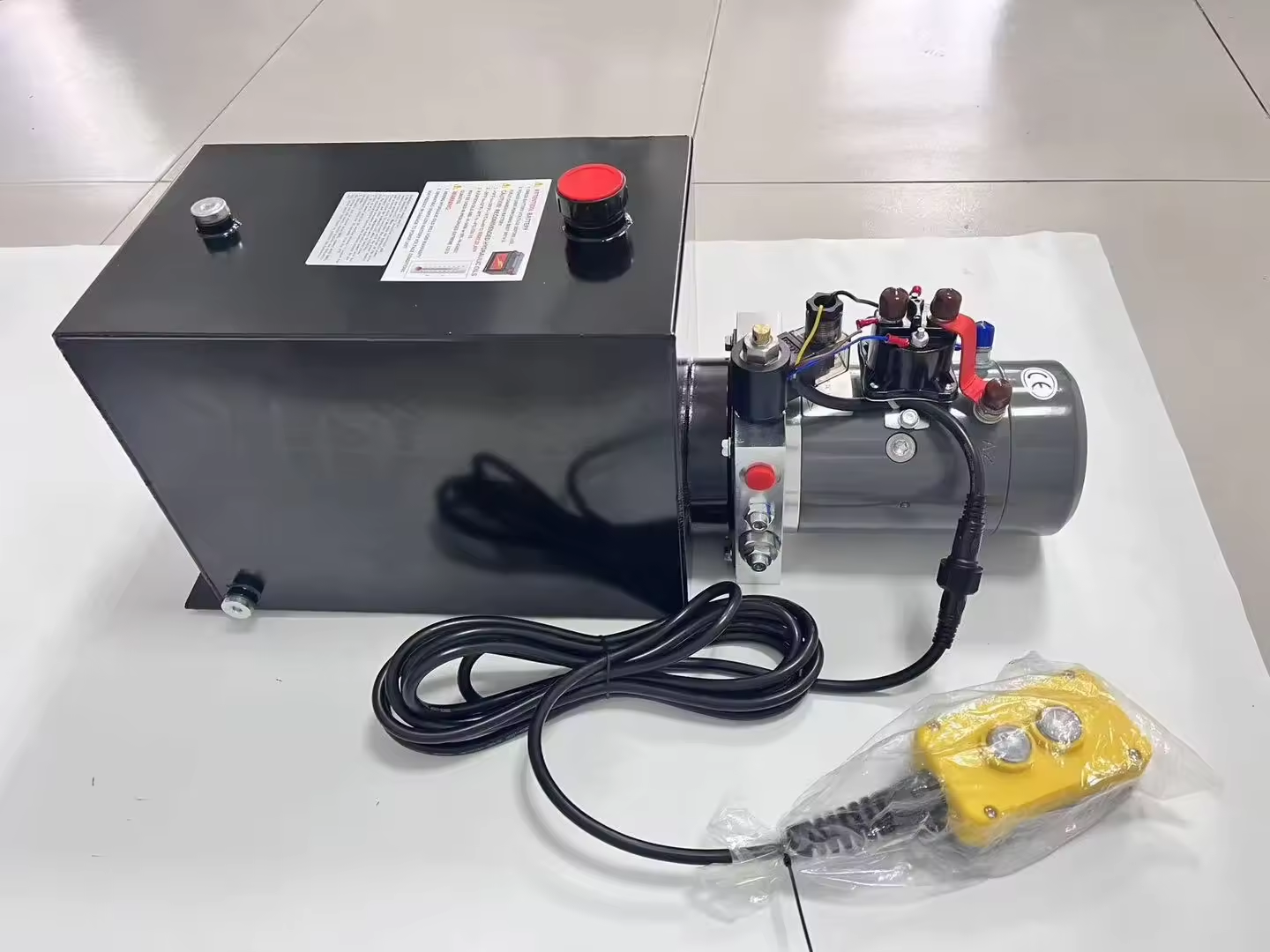
| Dump trailers | 12V DC dump trailer hydraulic power unit (APEX-DTHPU) | Power up / gravity down; 2.0 GPM maximum flow; 3,200 PSI maximum relief at A port; 6 US-quart translucent horizontal reservoir; SAE #6 ports; reservoir options from 3 to 13 quarts. |
| Scissor hoist systems | Hydraulic scissor hoist kit with 12V or 24V DC power unit | 3-12 ton rated hoist capacity; 8-24 ft recommended dump body length; double-acting cylinder; power up / power down or gravity down. |
| Aerial work platforms | Custom multi-function power unit (APEX-CMFHPU) | 2-8 hydraulic functions; 12/24/48 VDC; 0.8-4.0 kW motor; up to 280 bar / 4,000 PSI; emergency lowering and optional manual hand pump. |
| Vehicle-mounted auxiliary systems | Custom vehicle-mounted auxiliary power unit (APEX-CVMAHPU) | 24/48 VDC; 1.5-8.0 kW; 3-40 L/min; used for refuse trucks, tailgates, utility trucks, and special-purpose vehicles. |
| Industrial machinery | Custom AC industrial power unit (APEX-ACHPU Series) | 220/380 VAC; 0.12-4.0 kW; up to 230 bar; single or three phase; integrated manifold or CETOP modular valve block. |
| Medical and lifting equipment | Custom low-noise compact (mini) power unit (APEX-CLNCHPU) | 0.35-4.0 kW; up to 230 bar; 0.5-18 L reservoir; AC or DC; anti-vibration mounts and optional acoustic enclosure. |
Each application changes the risk profile. Dump trailers expose the power unit to vibration, dust, and intermittent high load, so motor duty-cycle matching and leak testing are critical. Aerial work platforms require multi-function control and emergency lowering, which raises the importance of valve testing and electrical inspection. Industrial machines run longer cycles, making oil cooling, filtration, and continuous-duty motor selection more relevant.
One boundary should be stated clearly: a power unit is selected as part of a complete hydraulic system. As Apex Hydraulic notes in its scissor hoist documentation, hoist capacity is not the same as trailer payload capacity. The final lift result depends on cylinder capacity, dump body length, hinge position, mounting geometry, hydraulic pressure, and trailer frame strength. A supplier's engineering review is therefore a risk-control step rather than a formality.
Market Context: What the Data Says About Hydraulic Power Unit Sourcing
Third-party market research gives varying estimates for the global hydraulic power unit market size in 2024. Grand View Research reports USD 13.6 billion, while Precedence Research estimates USD 11.4 billion. Both studies point to continued growth; Precedence Research projects a CAGR of 5.5% through 2034. The U.S. market alone was valued at approximately USD 2.55 billion in 2024.
Several structural trends are relevant to procurement decisions:
- Electric-powered hydraulic power units are the dominant type in the U.S., accounting for 60.1% of revenue share in 2024. This raises the importance of motor electrical design and wiring quality in supplier evaluation.
- Industrial applications led the U.S. market, with a 56.3% revenue share in 2024. Mobile equipment, however, continues to grow through trailer and special-purpose vehicle production; the global dump trailer market was estimated at USD 63.51 billion in 2024, with the 10-15 ton segment holding the largest share.
- The 2,000-3,000 PSI pressure range is projected to grow at a CAGR of 5.8% from 2025 to 2033. This range is directly relevant to many mobile hydraulic power units, including dump trailer and scissor hoist systems.
- Standard packaged units still dominate by volume, accounting for 47.8% of global revenue share in 2024. Application-engineered and custom units occupy a smaller but strategically important segment.
- Regulatory requirements are tightening. In the EU, hydraulic power units must comply with EN ISO 4413:2010 for general rules and safety requirements, and hydraulic systems fall under the Machinery Directive 2006/42/EC.
- The competitive field remains concentrated. Bosch Rexroth, Parker-Hannifin, and HYDAC are commonly identified as top global hydraulic power unit manufacturers, while specialized suppliers continue to introduce product innovations. For example, KTI Hydraulics launched a submerged DC hydraulic power unit with 12V and 24V options for recycling equipment in 2023.
Comparison: Application-Optimized Units vs. Conventional Standard Power Units
For dump trailer and mobile hydraulic applications, the most common procurement choice is between a conventional off-the-shelf power unit and an application-optimized configuration.
Conventional standard units offer a lower initial purchase cost. Their generic design, however, can create hidden costs. Improper motor, pump, or valve matching may increase energy consumption and hydraulic heat generation. Components that are not matched to the duty cycle may lead to higher maintenance frequency and a shorter service life.
In an application-optimized unit, the manufacturer engineers the motor, pump, reservoir, valve, and control configuration around the trailer size, cylinder capacity, lifting requirement, voltage, duty cycle, and operating environment. An optimized hydraulic circuit can reduce unnecessary pressure loss and improve overall efficiency. Correct pump displacement and motor selection provide faster lifting response. A matched motor-pump combination helps reduce hydraulic noise and excessive heat generation. A modular design with standardized hydraulic components makes maintenance, troubleshooting, and replacement easier for distributors and fleet operators.
The boundary: application-optimized units require an engineering review and drawing confirmation before production, and their initial cost is typically higher than a generic off-the-shelf unit. For simple, low-frequency operations with a mild duty cycle, a standard unit can be the more economical choice. Customization creates long-term value only when the buyer supplies accurate application data.
Future Outlook: What Long-Term Buyers Will Expect From Power Unit Suppliers
Several developments are likely to shape hydraulic power unit procurement in the coming years.
First, documented evidence will become part of the purchasing standard. Batch-level quality inspection records, pressure test reports, and traceability documentation are already used as procurement evidence in export transactions and will become more common in routine supplier evaluation.
Second, engineering review will shift from a value-add to a requirement. As mobile equipment electrifies and duty cycles are better understood, buyers will expect suppliers to validate motor selection, circuit design, and pressure settings rather than only building to a drawing.
Third, modularity and maintainability will matter more to distributors. Power units built from standardized hydraulic components reduce spare-part complexity and make field troubleshooting easier, a decisive factor for companies that support products after sale.
Fourth, packaging and export readiness will be treated as part of quality rather than logistics. Sealed ports, anti-corrosion treatment, and export-grade packaging directly affect the number of first-week failures a distributor sees, and therefore the distributor's own customer experience.
Finally, manufacturers that combine power units with tightly integrated hydraulic cylinders and complete system design capability reduce interface risk for OEMs. A supplier that controls the whole electro-hydraulic system, from the 12V DC power pack to the telescopic cylinder and hoist geometry, is easier to hold accountable for system-level performance.
FAQ
What tests are performed on a hydraulic power unit before shipment?
Pressure settings are adjusted according to customer specifications, and each power unit is tested to verify stable system pressure before delivery. Every unit also undergoes hydraulic pressure and leakage testing before shipment, with all hydraulic fittings and sealing components inspected to ensure leak-free performance.
How does a manufacturer ensure traceability for hydraulic power units?
Production batches and quality inspection records are maintained to support product traceability and after-sales service. This allows a finished power unit to be connected back to its production batch and inspection results.
What is the minimum order quantity for standard and custom hydraulic power units?
For standard products, the minimum order quantity is 1 piece. Custom OEM/ODM projects are negotiable according to product specifications and project requirements.
What export delivery terms does Apex Hydraulic support?
Apex Hydraulic supports EXW, FOB, FCA, CIF, CFR, DAP, and DDP delivery terms.
What payment methods are accepted for hydraulic power unit orders?
Payment can be made by T/T (Telegraphic Transfer), Letter of Credit (L/C), Alibaba Trade Assurance, or other mutually agreed international payment methods. Payment terms may vary depending on order value, customer relationship, and project requirements.
How is hydraulic oil leakage risk controlled in production?
The manufacturer applies precision sealing and leak-proof hydraulic connections, and every hydraulic power unit undergoes hydraulic pressure and leakage testing before shipment. All hydraulic fittings and sealing components are inspected to ensure leak-free performance.
Does Apex Hydraulic provide OEM and ODM services for custom hydraulic power units?
Yes. Apex Hydraulic provides OEM and ODM manufacturing services for equipment manufacturers, hydraulic distributors, and hydraulic solution providers worldwide. Complete customization services include product design, engineering drawings, prototype development, testing, manufacturing, and quality inspection.
Reference for buyers: Apex Hydraulic product catalog (public download): Apex Hydraulic Product Catalog (Main Products).
Есть вопросы или нужны дополнительные детали?
Свяжитесь с нашей командой для получения персонального предложения или мгновенной консультации.
Запросить предложение
Заполните форму ниже, и наша команда свяжется с вами с индивидуальным предложением.
Прямой чат WhatsApp
Предпочитаете общаться в реальном времени? Напишите нам в WhatsApp для мгновенной помощи и быстрых ответов.
- Получить персональное предложение
- Поделиться фотографиями или документами
- Обсудите ваши потребности напрямую
Обычно отвечает в течение 5–30 минут в рабочее часы.