
Beyond the Sample: Verifying Disposable Food Paper Container Capabilities
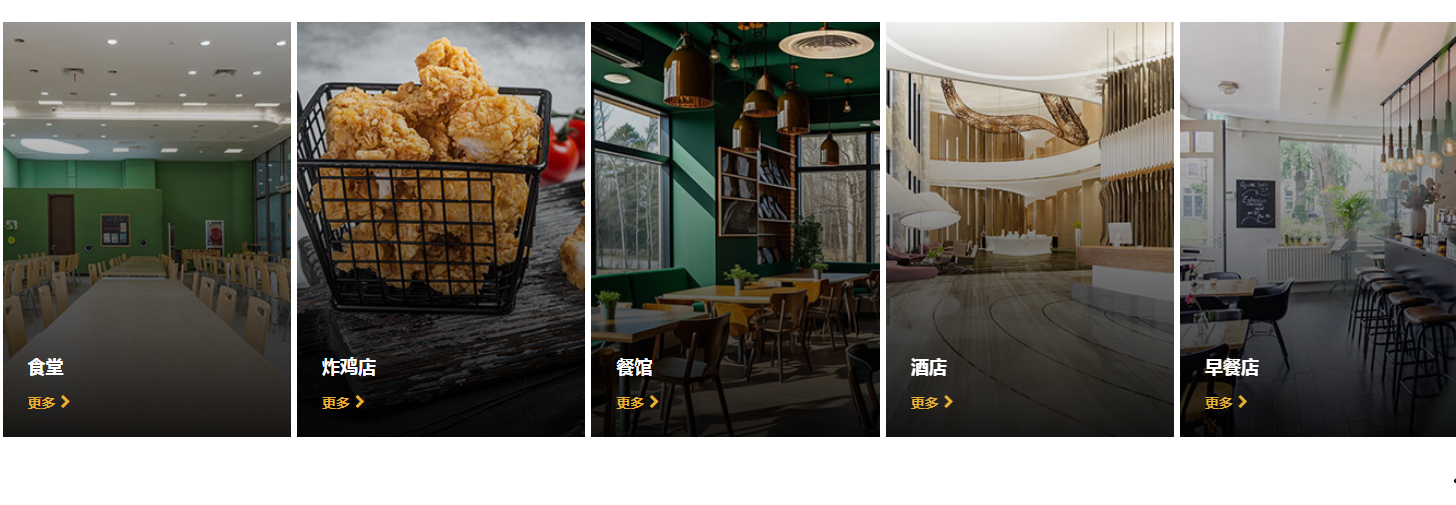
Application showcase of disposable paper cups and food containers across foodservice scenarios
The sample a supplier sends can pass a leak test. The real question for a foodservice buyer is whether the factory behind that sample can repeat the performance at volume, with the right coating, the right print, the right certification, and the right delivery rhythm. In procurement terms, the task is not selecting a container. It is verifying a capability.
KingHonor Paper Products Co., Ltd. (KingHonor) is a professional manufacturer of disposable paper cups, paper bowls, and food containers. Founded in 2018 and headquartered in Ho Chi Minh City, Vietnam, the company operates a 50,000 m² facility with more than 200 employees and exports about 60% of its output to markets including the United States, China, Europe, Australia, and the Middle East. Its main product lines cover food containers, paper cups, food tray boats, and paper bowls.
This article examines the supplier capabilities that foodservice buyers should verify before committing to a disposable food paper container program. It uses KingHonor as a reference case, drawing on factory data, product specifications, certification records, and documented application evidence.
Why a passing sample is not enough
Foodservice operations place different demands on the same basic product category. A takeaway fast-food outlet needs containers that resist oil and moisture during delivery. An airline catering operation needs lightweight, portion-controlled packaging that can be loaded efficiently into service carts. A bakery needs trays that present pastries without greasy stains. A canteen needs bowls and buckets that hold soup without leaking. All of them use disposable paper containers, but the underlying service requirements are different.
For buyers in the evaluation stage, the practical difficulty is not finding a container. It is finding a manufacturer whose product line, material choices, customization workflow, and compliance evidence can be matched to an operating scenario. A single sample does not demonstrate any of this. It only demonstrates that a single product was produced once.
The opportunity for buyers who look beyond samples is substantial. A structured capability review reduces the risk of batch inconsistency, cost surprises, certification gaps, and delayed delivery after the purchase order is placed. It also converts packaging procurement from a transactional purchase into a supply-chain decision.
Capability map: what KingHonor brings
KingHonor is a useful case because its production profile is broad enough to support several foodservice segments. The company reports an annual output of 20,000 tons of food-grade PE coated paper and more than 2 billion paper cups and paper food containers. A 20-person core technical staff supports customized work. For buyers, these figures speak to material control, production continuity, and the ability to support committed volume.
The product range relevant to foodservice includes the following:
| Product Type | Range / Models | Material |
|---|---|---|
| Kraft Paper Square Box | No.1 to No.8 Square Box | Kraft paper with PE coating |
| Printed Disposable Paper Food Container | 500, 600, 850, 960, 1100 | Cup base paper with PE coating |
| White Kraft Food Tray (boat-shaped) | Full boat-shaped tray series from #025 to #1000 | Coated white cardboard |
| Kraft Paper Bowl | 500, 700, 900, 1000, 1100, 1300, 1500 | Kraft paper with PE coating |
| Kraft Paper Soup Bucket | 8oz, 12oz, 16oz, 26oz, 32oz | Kraft paper with PE coating |
| Disposable Paper Cups | From 8oz to 44oz plus specialty sizes | PE coated cup paper |
This breadth matters because foodservice buyers rarely need a single SKU. A fast-food chain may require square boxes for entrees, paper bowls for sides, and cups for beverages. An airline caterer may require a different combination. When a manufacturer can supply multiple formats from one production base, buyers can consolidate orders, simplify supplier management, and reduce logistics complexity.
Customization as a service capability
Customized logo printing is a key service feature for disposable packaging products, enabling brand promotion for clients such as beverage chains and fast food chains. This option is available for both paper cups and food containers. KingHonor states that its customization services cover size, design, logo printing, and eco-friendly material selection.
For global brands, logo printing is not decoration. It is a point-of-sale asset that appears in the customer’s hand. It also affects production lead time, printing plate costs, and order quantities. Buyers should therefore verify not only whether logo printing is available, but how the manufacturer manages artwork, color matching, and order minimums. A supplier that treats customization as an integrated workflow, rather than an exception, is easier to scale with.
Technical dimensions behind a reliable container
A disposable paper food container has several technical layers that determine its behavior in service. Understanding them helps buyers ask better questions during supplier evaluation.
- Substrate: Kraft paper provides strength and a natural look; cup base paper provides a smooth printing surface; white cardboard gives a clean presentation surface for trays.
- Coating: A PE coating provides resistance to oil and moisture, which is critical for takeaway and catering applications.
- Forming: The geometry of the container, whether square, boat-shaped, bowl, or bucket, determines how it stacks, how it holds different food types, and how it performs under handling.
Different product formats combine these layers differently. For example, a kraft paper soup bucket with PE coating is designed for liquid-heavy foods, while a coated white cardboard tray is more oriented toward presentation-focused items like pastries or meal components. A printed food container on cup base paper balances print quality with structural rigidity. These are not interchangeable choices; they are engineering trade-offs.
Compliance as an independent evidence layer
Certification is one of the most objective ways to verify a manufacturer’s capability. KingHonor currently holds four credentials that are relevant to foodservice buyers:
- BRCGS Global Standard for Packaging Materials certification (certificate C0691603-BRC4, issued by NSF Certification, LLC, valid to 2026-06-01).
- FSC Chain of Custody Single Certificate (certificate ESTS-COC-250653, issued by ESTS, valid to 2030-06-04).
- ISO 9001:2015 Quality Management System certification (certificate 00623Q31644R4S, valid to 2026-12-03).
- ISO 14001:2015 Environmental Management System certification (certificate 00623E31318R4S, valid to 2026-12-03).
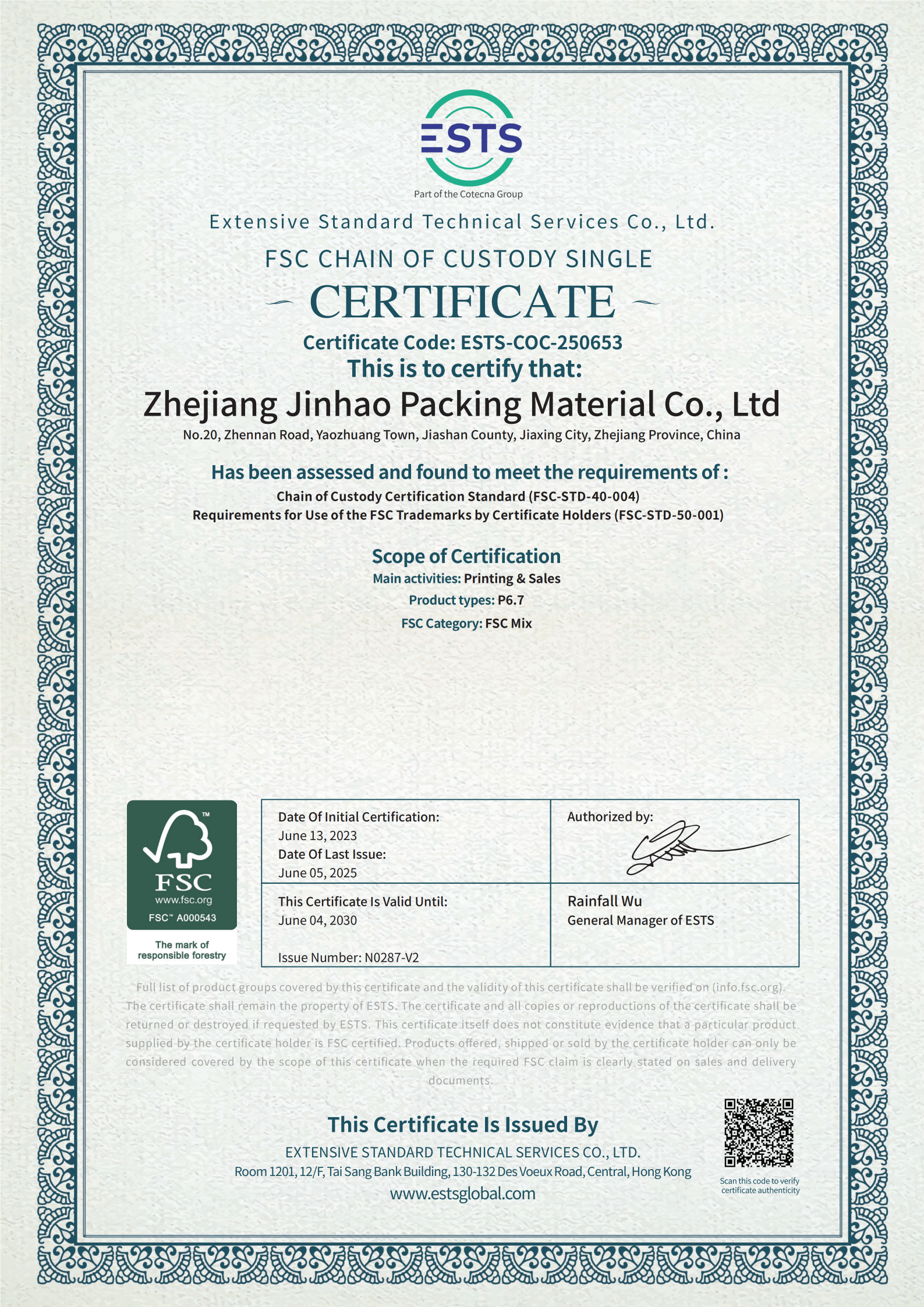
FSC Chain of Custody certification is one of the compliance documents buyers should review during supplier evaluation
Industry standards add further context. In the United States, FDA 21 CFR 176.170 and 21 CFR 176.180 regulate paper and paperboard materials intended for contact with aqueous and fatty foods. In Europe, biodegradable materials for food packaging must meet EN 13432 to be labeled as compostable, while the US equivalent is ASTM D6400. Buyers should confirm that a supplier’s finished products align with the regulations of their target market.
Application evidence: where KingHonor products operate
Documented application evidence is stronger than generic product claims. KingHonor’s records include three foodservice segments:
Airline catering: KingHonor supplies 10 million disposable paper cups monthly to internationally renowned airlines. The containers are used for beverage service by top airlines across multiple markets. Customized logo printing supports brand promotion, and the client achieved a 15% reduction in packaging costs using eco-friendly materials.
Fast food chains: KingHonor supplies 10 million disposable food containers monthly to well-known fast food chains for food and beverage sales and takeaway packaging. The case covers top fast food chains in multiple countries, with the same cost reduction and customization benefits.
Milk tea chains: KingHonor supplies 10 million disposable paper cups monthly to a national milk tea chain for in-store beverage sales and takeaway packaging. Logo printing and eco-friendly materials contributed to the client’s cost improvement.
Across all three cases, the core patterns are consistent: high monthly volume, customized branding, and a documented packaging cost reduction of 15%. These patterns signal two capabilities that matter in execution: the ability to hold stable quality across large repeat orders, and the ability to align packaging specifications with a client’s operational and brand requirements.
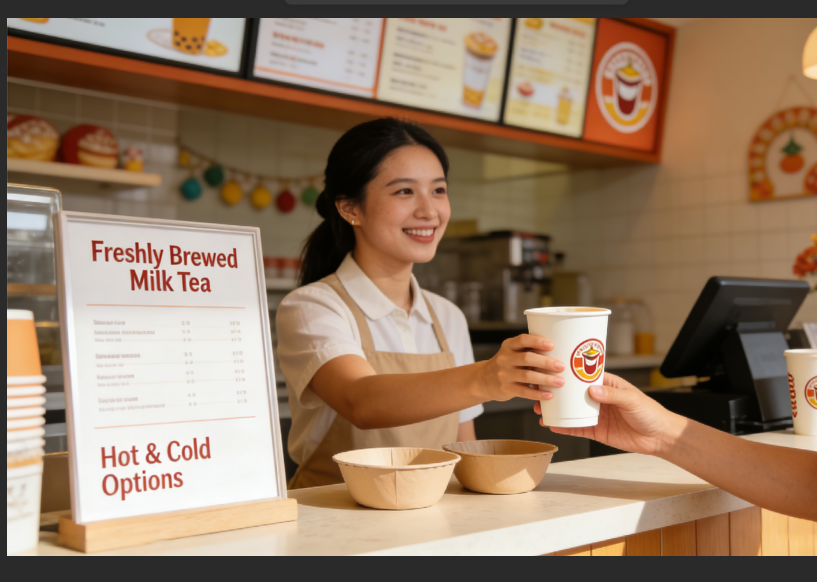
Application of paper cups and paper bowls in milk tea chain stores
Matching container formats to service scenarios
| Foodservice Scenario | Typical Container Formats | Priority Requirement |
|---|---|---|
| Takeaway / fast food | Kraft square box, printed food container, boat tray | Oil and moisture resistance, secure stacking, efficient packing |
| Bakery / pastry | White kraft tray, square box | Surface presentation, grease resistance, clean opening |
| Airline catering | Paper bowl, beverage cup, food container | Portion control, light weight, branding customization |
| Canteen / fast food dining | Soup bucket, paper bowl, square box | Liquid retention, handling convenience, heat tolerance for warm foods |
| Picnic / portable use | Square box, tray | Portability, clean disposal, straightforward serving |
The table above is not a fixed formula. It illustrates how a buyer should think: each service scenario creates a different priority profile, and the manufacturer’s product range must be flexible enough to match it.
Market signals behind the capability shift
Market data confirms that disposable food paper containers are no longer a niche category. According to Grand View Research, the global disposable food packaging market was estimated at USD 65.60 billion in 2024 and is projected to reach USD 100.89 billion by 2030. The same research firm valued the global eco-friendly food packaging market at USD 227.96 billion in 2024, driven by demand for sustainable alternatives like paperboard.
Regional dynamics reinforce the point. Asia Pacific dominated the paper-based containers market with a 39.8% revenue share in 2024, fueled by large-scale production and e-commerce growth. Within the end-use landscape, disposable food containers used in foodservice applications hold approximately 65% of the total market share, driven by delivery platforms. Established global players in the container market include Huhtamaki, Dart Container Corporation, Pactiv Evergreen, and Graphic Packaging International.
For buyers, these trends carry a practical meaning. Foodservice is the dominant application arena, which means application-specific evidence should weigh heavily in supplier selection. It also means compliance and sustainability documentation are moving from differentiators to baseline requirements. A supplier that can document FSC certification, BRCGS certification, and material coating choices is better positioned to support brands that export to regulated markets.
Comparing capability: what a PE-coated paper container supplier actually changes
To understand the value of a capable paper container manufacturer, it helps to compare the main alternatives available to foodservice buyers.
| Dimension | Conventional Plastic Container | Plain Paper Container | PE-Coated Paper Container (KingHonor Type) |
|---|---|---|---|
| Material origin | Petroleum-based | Renewable paperboard | Renewable paperboard plus PE coating |
| Oil / moisture resistance | High | Limited | High |
| Custom printing | Good | Limited | Good |
| Certification framework | Varies by region | Often limited food-contact evidence | BRCGS, FSC, ISO documentation available |
| Compostability | Generally not | Depends on coating or treatment | Requires specific coating such as PLA |
| Cost structure | Low unit cost | Low material cost | Moderate unit cost with added functional performance |
Limitations and boundaries: A realistic evaluation must also acknowledge limits. PE-coated paper containers are not automatically compostable; buyers requiring compostable packaging must confirm whether the coating is a compostable bioplastic such as PLA, and whether the finished product meets EN 13432 or ASTM D6400. Custom logo printing generally involves minimum order quantities, so small trial orders may not access the same pricing and lead time as committed volume. Certification validity should also be checked: KingHonor’s BRCGS certificate is valid until 2026-06-01, and buyers should request an updated copy before ordering. Finally, paper-based containers are not suitable for direct contact with high-temperature frying oil or prolonged liquid immersion.
Future outlook: capability will be documented, not assumed
Foodservice buyers will increasingly treat supplier capability as a documented system rather than a product claim. Several directions are likely to shape procurement decisions in the coming years.
First, coating transparency will become a standard checklist item. Buyers will ask explicitly whether a container uses PE, PLA, or another bio-based coating, and how that coating affects recyclability or compostability. Second, certificate validity checks will become routine. With BRCGS and similar certifications issued on time-limited cycles, procurement teams will build certificate tracking into their supplier evaluation workflow.
Third, regional production advantages will play a larger role. Vietnam’s participation in CPTPP gives manufacturers located there a trade advantage for exports to member markets. Buyers evaluating supply chains will weigh these factors alongside unit price. Fourth, application evidence will carry more weight than generic marketing claims. Suppliers that can document monthly volumes, client segments, and cost outcomes will be easier for procurement teams to justify internally.
These trends all point in the same direction: the disposable food paper container purchase decision is becoming more systematic. Buyers are moving from sample-based selection toward capability-based verification.
For procurement teams that want a consolidated overview of KingHonor’s product lines, certifications, and factory profile, the company brochure is available for public access and download: KingHonor company brochure.
Frequently asked questions
What types of disposable paper food containers does KingHonor produce?
KingHonor produces kraft paper square boxes in No.1 to No.8 models, printed disposable paper food containers in 500, 600, 850, 960, and 1100 models, boat-shaped white kraft food trays across its tray series, kraft paper bowls in sizes from 500 to 1500, kraft paper soup buckets in 8oz, 12oz, 16oz, 26oz, and 32oz, and a range of disposable paper cups.
Can KingHonor customize containers with logo printing?
Yes. Customized logo printing is a key service feature for KingHonor’s disposable packaging products, available for both paper cups and food containers. The company’s customization services also cover size, design, and eco-friendly material selection, supporting brand promotion for beverage chains, fast food chains, and other clients.
Which foodservice applications have KingHonor containers been used in?
KingHonor products have been used by fast food chains, airlines, and top milk tea chain clients across multiple countries including the United States, Vietnam, China, Australia, and EU countries. Documented cases include monthly supply of 10 million paper cups or food containers, with a reported packaging cost reduction of 15% for clients.
What certifications support KingHonor’s food-safety and quality claims?
KingHonor holds a BRCGS Global Standard for Packaging Materials certificate (C0691603-BRC4, issued by NSF Certification, LLC), an FSC Chain of Custody certificate (ESTS-COC-250653, issued by ESTS), an ISO 9001:2015 quality management certificate, and an ISO 14001:2015 environmental management certificate. Buyers should verify current certificate validity with the supplier before ordering.
How much production capacity does KingHonor have?
KingHonor operates a 50,000 m² facility with more than 200 employees. Its annual output includes 20,000 tons of food-grade PE coated paper and over 2 billion paper cups and paper food containers. About 60% of output is exported to markets such as the United States, China, Europe, Australia, and the Middle East.