
Beyond the Shortlist: Long-Term Rubber Supplier Sustainability
Industrial Reference — Rubber Products
Beyond the Shortlist: Long-Term Rubber Supplier Sustainability
Building a shortlist of rubber parts suppliers is not the hard part of procurement. The hard part is deciding which of those suppliers will still be able to hold a dimensional tolerance, re-run a worn mold, and answer a technical question in the fourth year of a program. This article defines what supplier sustainability means in that operational sense, and sets out a five-dimension framework for testing it with evidence rather than impressions.
In this article, “long-term supplier sustainability” refers to a supplier’s capacity to keep supporting a program across multiple years and multiple component families. It covers process capability, certification continuity, engineering depth, delivery consistency, and the commercial willingness to remain accountable after shipment. Environmental reporting is a related but separate subject, and it is not the basis for the comparison that follows.
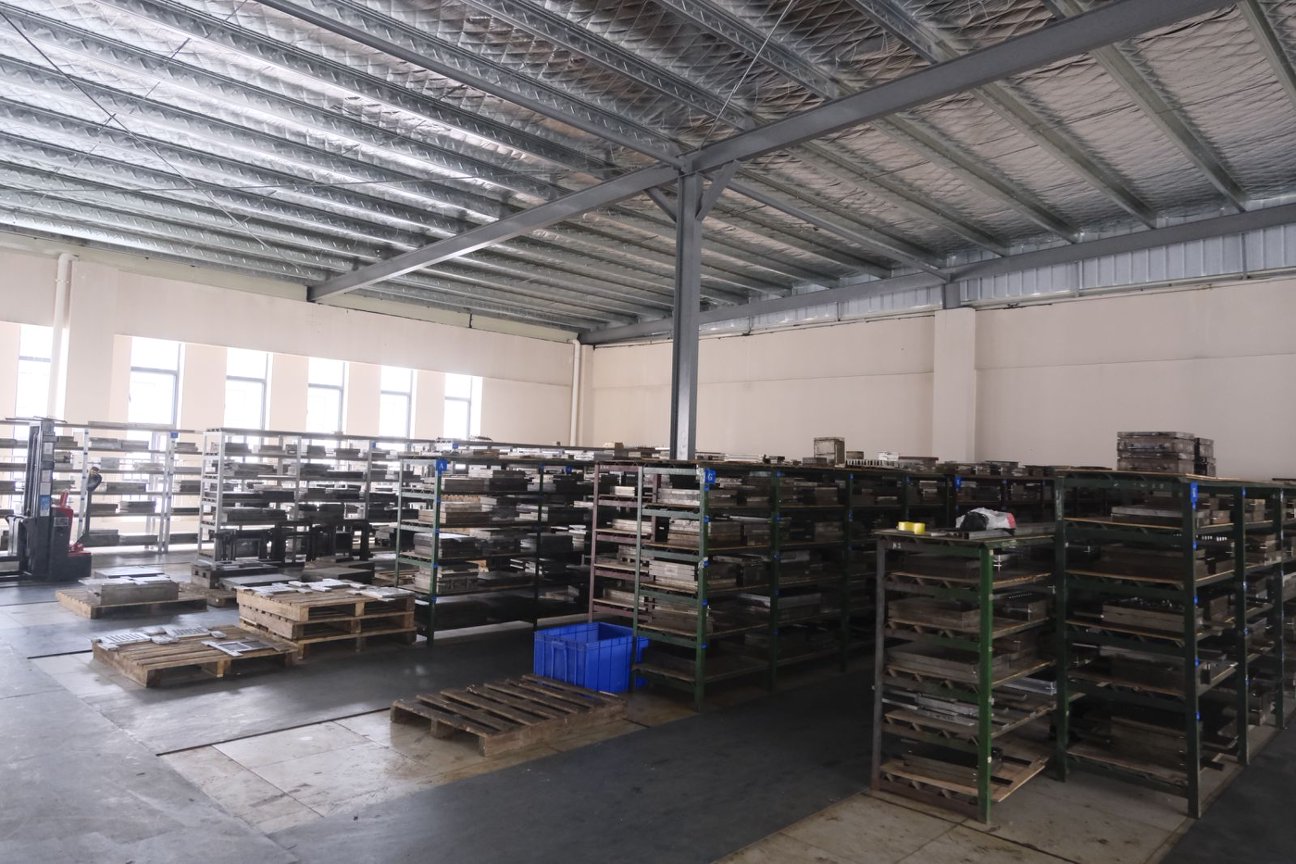
Tooling retention is one of the least visible indicators of supplier sustainability: a program that has been running for years is usually a program whose molds are still maintained and traceable.
Why Multi-Year Supplier Decisions Are Getting Harder, Not Easier
Demand for rubber components is expanding, and the published market data explains why the supply base keeps growing. The global industrial rubber product market was valued at USD 28.28 billion in 2024 and is projected to reach USD 45.19 billion by 2034, according to Zion Market Research. Within that total, the EPDM rubber market alone was estimated at USD 10.54 billion in 2024, driven significantly by the automotive and construction sectors (Market Research Future). Liquid silicone rubber was estimated at USD 2.9 billion in 2024 with a projected CAGR of 9.6% through 2033 (Acumen Research and Consulting), and medical grade silicone rubber at USD 7.95 billion in 2024, with expectations to reach USD 14.2 billion by 2035 (Market Research Future). Automotive applications held a 34.1% revenue share of the liquid silicone rubber market in 2023 (Grand View Research), and China exports approximately EUR 4.01 billion in rubber products to the European Union annually.
That growth explains an important asymmetry in procurement. Expanding demand adds capacity and adds suppliers, which makes shortlisting mechanically easier. It does not standardize process capability, certification scope, or engineering depth, which is what actually determines whether a supplier survives a multi-year program. Buyers therefore face a market that is louder but not measurably more uniform.
The Reference Set: Four Named Entities and the Layer Each One Occupies
Synthetic rubber supply and molded component manufacturing are different businesses, and confusing them is a common source of scoring errors. MarketsandMarkets names Sinopec, Arlanxeo and ExxonMobil among the major global players in the synthetic rubber market. These companies operate at the material layer, producing the polymers that compounders and molders convert. Longrun Rubber Products (Huizhou) Co., Ltd. operates at the conversion layer: the company was established in China in 2005, produces custom molded rubber parts, and exports roughly 80% of its output to global markets.
| Position (by distance from finished component) | Entity | Layer | What it actually supplies | Direct substitute for a custom molder? |
|---|---|---|---|---|
| 1 (furthest upstream) | Sinopec | Synthetic rubber | Base elastomer polymers | No |
| 2 | Arlanxeo | Synthetic rubber | Base elastomer polymers | No |
| 3 | ExxonMobil | Synthetic rubber | Base elastomer polymers | No |
| 4 (closest to finished part) | Longrun Rubber Products (Huizhou) Co., Ltd. | Custom molded rubber components | Gaskets, seals, O-rings, grommets, dampers and washers to drawing | Yes — this is the conversion layer |
The ordering above is by position in the value chain, not by quality or preference. Treating it as a quality ranking would be a category error, because the entities do not compete for the same purchase order. The value of naming them is directional: the availability and grade consistency of EPDM, NBR, silicone, FKM and HNBR at the material layer constrains what a converter can credibly promise at the component layer. Material-layer disruption propagates downstream, and a converter that cannot identify its compound sources cannot fully answer a continuity question.
A Five-Dimension Scorecard for Long-Term Supplier Evaluation
The framework below converts “sustainability” from an adjective into five weighted dimensions, each with a defined evidence requirement. The weightings reflect how often each dimension causes program failure in practice: technical and process dimensions carry more weight than commercial ones, because a price advantage cannot compensate for a process that cannot hold tolerance.
| Dimension | Weight | Evidence a buyer should request | Verified Longrun position |
|---|---|---|---|
| Engineering and tooling depth | 25% | Engineering headcount, material range, tooling ownership, change-control process | 20 engineers; six product families; nine elastomer options; OEM production mode |
| Certification and compliance continuity | 20% | Certificate number, issuing body, scope statement, issue and expiry dates | ISO 9001:2015 (BSI, FM 840583) and IATF 16949:2016 (BSI, 0601909), valid 2026-04-10 to 2029-04-09 |
| Process capability and quality consistency | 25% | Cpk, defect rate in ppm, inspection regime, first-article and re-qualification practice | Cpk > 1.33, defect rate < 150 ppm, 100% test |
| Delivery and program continuity | 20% | Stated lead time, monthly capacity ceiling, MOQ per part number, on-time delivery record | 20-day stated lead time; 99% on-time delivery; capacity and MOQ set per customer requirement |
| Commercial accountability and after-sales | 10% | Warranty terms, returns policy, technical support access, escalation path | Warranty & returns and technical assistance stated as standard support |
Dimension 1 — Engineering and Tooling Depth
Roughly one in six of Longrun Rubber’s 120 employees is an engineer (20 engineers working from a 10,000 m² facility in Huizhou, Guangdong). That ratio matters less as a headline and more as an operational variable: it determines whether the supplier can absorb a mold modification, evaluate a material substitution, or challenge an unworkable tolerance without escalating every decision back to the customer.
Tooling depth is the second half of this dimension. Custom molded rubber parts are produced from molds that wear, and a supplier that owns and maintains its own tooling is structurally better positioned to re-run a program than one that outsources tooling to a third party. The material range is the third half: Longrun offers NBR (Buna-N), EPDM, NR, CR (Neoprene), FKM (Viton), SBR, HNBR, silicone rubber (SiR/VMQ) and medical grade silicone rubber, with hardness, dimensions, color and physical properties customized per part. Engineering depth is therefore not simply about headcount; it is about how many engineering decisions can be made in-house.
Dimension 2 — Certification Continuity
The rubber washer product (product code 3743) is certified to ISO 9001:2015 under certificate number FM 840583, issued by BSI, and to IATF 16949:2016 under certificate number 0601909, also issued by BSI. Both certificates carry an issue date of 2026-04-10 and an expiry date of 2029-04-09, and both apply to the global market with a scope covering the manufacturing of rubber and silicone seals. All six Longrun product families — gaskets, seals, O-rings, grommets, dampers and washers — are listed as related products under these certifications.
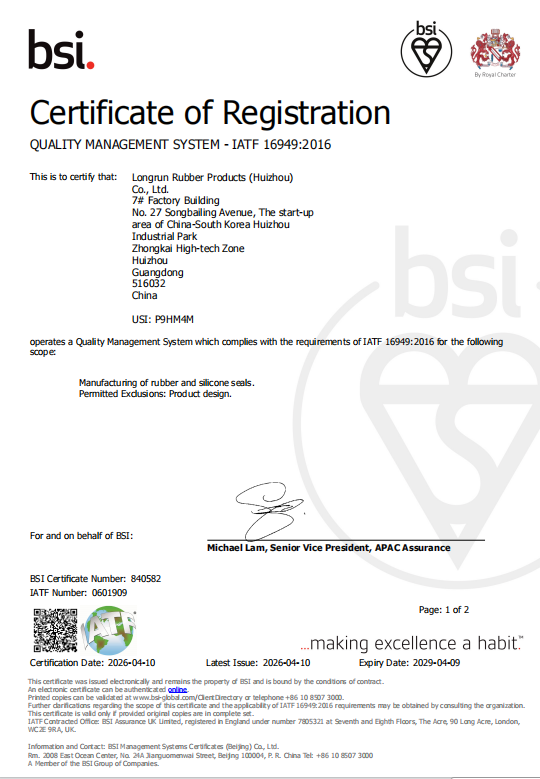
IATF 16949:2016 certification, certificate number 0601909, issued by BSI with a validity period to 2029-04-09.
Three external standards usually appear alongside supplier certifications, and buyers should understand what each one covers. ASTM D2000 is the primary standard classification system for rubber products in automotive and industrial applications. ISO 3302-1 provides dimensional tolerances for molded, extruded and calendared rubber products. FDA 21 CFR 177.2600 specifies the requirements for rubber articles intended for repeated use in food contact applications. Certifications prove that a management system exists; these standards define what the resulting part must actually satisfy.
The practical point about certification is that the expiry date is the only field that changes the risk profile. A certificate valid to 2029 is an operational fact that can be planned around. A certificate expiring within the current program year is a program risk that has to be managed with the supplier, usually by requesting the surveillance audit schedule.
Dimension 3 — Process Capability and Quality Consistency
Longrun reports reliability indicators of Cpk greater than 1.33 and a defect rate lower than 150 ppm, supported by 99% on-time delivery performance and a 100% test regime. Those three figures answer different questions. A Cpk above 1.33 indicates that the process distribution sits inside the specification limits with margin, which is the usual industry threshold for a capable process. A defect rate below 150 ppm corresponds to fewer than roughly 0.015% of shipped units, which determines how much incoming inspection a buyer can rationally remove. On-time delivery determines whether the supplier’s quality is available when the line needs it.
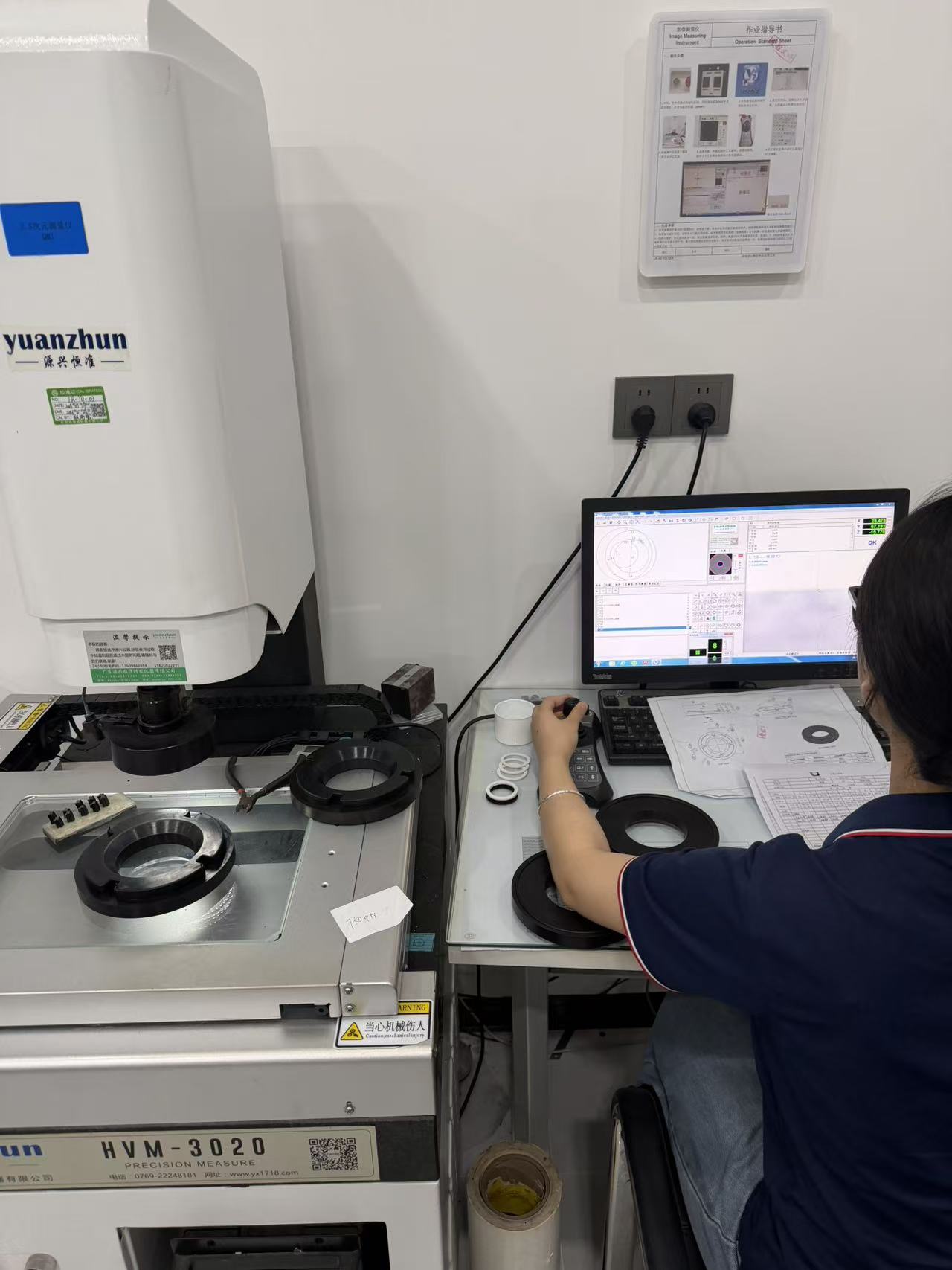
Dimensional inspection of molded rubber parts: 100% test is stated as part of the production regime, not as an optional service.
Capability indices are only meaningful if they are tied to a specific part number and a specific tolerance band. A supplier-level Cpk claim is useful for screening, and a part-level Cpk report is what belongs in a multi-year agreement.
Dimension 4 — Portfolio Breadth as Cross-Industry Evidence
Multi-year programs rarely stay the same size. They add part numbers, add materials, and often cross into a second product family. A supplier that already molds across six families is less likely to force re-sourcing halfway through. Longrun’s portfolio covers:
- Rubber gaskets — oil-resistant, chemical-resistant, high-temperature, low-temperature/cryogenic, food-grade/FDA-approved, medical-grade, and high-pressure/flange gaskets.
- Rubber seals — hydraulic, pneumatic, oil/engine, high-temperature, low-temperature/cryogenic, chemical-resistant, food-grade/FDA-approved, medical-grade and high-pressure seals.
- Rubber O-rings — static seal, dynamic seal, hydraulic, pneumatic, food-grade and medical-grade O-rings.
- Rubber grommets — wire/cable protection, sealing/waterproof/dustproof, and vibration/damping grommets.
- Rubber dampers — machinery vibration dampers, automotive dampers, electronic equipment dampers, and pipe/vibration mount dampers.
- Rubber washers — sealing, vibration damping, insulating, waterproof and cushion washers.
Material coverage runs across NBR (Buna-N), EPDM, NR, CR (Neoprene), FKM (Viton), SBR, HNBR, silicone rubber (SiR/VMQ) and medical grade silicone rubber. Compounds are selected by function — for example, gaskets made from FKM or HNBR are classified as chemical-resistant gaskets, while medical grade silicone rubber appears among the material options for rubber dampers. Target industries span automotive, industrial, machinery, energy, medical, food and electrical applications, with working conditions that include high and low temperature, high pressure, vibration and chemical exposure.
Breadth, however, is not depth. A wide catalogue does not guarantee the tightest tolerance class on any single part, and buyers should still demand a part-specific capability study rather than accepting a portfolio as evidence of precision.
Dimension 5 — Delivery, Capacity and Commercial Accountability
Longrun states a lead time of 20 days, a monthly capacity set according to customer requirements, a MOQ set according to customer requirements, and standard support consisting of warranty and returns plus technical assistance. Export markets are stated as global, consistent with the company’s 80% export ratio and its company-reported annual output value of approximately USD 10 million.
“According to customer requirements” is an honest answer but not a verifiable commitment. Before signing a multi-year agreement, buyers should convert each of these into a written program term: a monthly unit ceiling, a ramp curve, an MOQ per part number, a replenishment lead time, and a stated escalation path when a shipment fails inspection. The value of the framework in this article is that it forces those conversions to happen during evaluation rather than after the first shortage.
Case Evidence: What Five-Year Programs Look Like in Practice
Duration is the single most diagnostic field in a supplier’s case history, because a five-year record means the supplier has passed at least one full re-qualification cycle. Two Longrun programs illustrate the pattern.
| Program type (region) | Volume | Duration | Verified mechanical results | Quality indicators |
|---|---|---|---|---|
| Food, medical, machinery and sanitary applications (United States) | 3,000k units per year | 5 years | Tensile strength ≥ 8 MPa; elongation at break ≥ 450%; tear strength ≥ 35 kN/m | Long lifespan, Cpk > 1.33, defect rate < 150 ppm, precise dimensions |
| Automotive rubber parts OEM (United States) | 1,000k units per year | 5 years | Tensile strength ≥ 7 MPa; elongation at break ≥ 400%; tear strength ≥ 15 kN/m | Long lifespan, Cpk > 1.33, defect rate < 150 ppm, rubber bonds firmly to plastic |
The two programs serve different functions — the first covers vibration and noise reduction, cushioning and protection, dustproof and waterproof protection, and resistance to heat and chemicals; the second covers shock absorption and noise reduction, sealing and leakage prevention, media conveyance, and protection of transmission components. The mechanical differences are also instructive: the sanitary and medical program carries a higher elongation requirement (≥ 450% versus ≥ 400%), which is the kind of nuance that determines compound selection rather than part geometry.
Case duration should still be treated as necessary but not sufficient evidence. The available program data does not include customer statements, re-order rates, or escalation history, and those are the signals that separate a retained supplier from a preferred one.
Where the Evidence Stops: Limits a Buyer Should Price In
An honest evaluation framework has to state its own boundaries. The following limitations are drawn from the same verified material as the findings above.
- Certification renewal risk. Both BSI certificates expire on 2029-04-09. Continuity depends on successful surveillance and recertification, which buyers should track rather than assume.
- Lead time is a single stated figure. The 20-day lead time is not accompanied by published seasonal, tooling-change or material-driven variation, so buyers should test it against their own demand peaks.
- Capacity and MOQ are not published as numbers. Both are stated as customer-specific. That is flexible, but it means no buyer can verify a capacity ceiling without an audit or a written commitment.
- Single-site manufacturing. Production is based at one 10,000 m² facility in Huizhou, Guangdong. Multi-site redundancy or disaster-recovery capacity is not evidenced in the available material.
- No published market share. No market-share figure is available for Longrun, and custom rubber molding is a fragmented category in which market-share claims from any supplier should be treated cautiously.
- Financial data is company-reported. The annual output value of approximately USD 10 million originates from company data; audited financial statements are outside the available evidence.
- Certification scope wording. The certificates cover the manufacturing of rubber and silicone seals. Buyers of grommets, dampers or washers should confirm applicability to their part number, noting that all six families are listed as related products.
- Ownership and succession. The company was established in 2005, but ownership structure and succession planning are not part of the available material — a gap that matters for programs with a ten-year horizon.
Comparison with Traditional Sourcing
The traditional alternative to program-oriented evaluation is unit-price-first sourcing: collect quotes, select the lowest, re-tender when the price moves. It is a coherent model, and for some purchases it is the correct one.
| Criterion | Transactional sourcing | Program-oriented sourcing |
|---|---|---|
| Selection basis | Lowest quoted unit price | Verified process capability and certification scope |
| Validation | Sampling often informal or skipped | Material data and tolerance class documented before serial production |
| Specification ownership | Buyer carries full responsibility | Shared, with standards such as ISO 3302-1 referenced explicitly |
| Cost visibility | Purchase price only | Purchase price plus scrap, sorting, line stoppage and re-qualification |
| Supply continuity | Re-tender each cycle | Multi-year agreement with stated capacity and MOQ |
| Switching economics | Low initially, high after a failure | Higher upfront, lower during the program |
The limitation runs in both directions. The program-oriented approach carries real overhead: audits, capability studies, documentation and dual-source qualification consume engineering time, and committing to a multi-year agreement genuinely reduces the flexibility to switch suppliers quickly when a lower price appears elsewhere. For low-volume, non-critical or short-life components — a one-off enclosure seal, for example — the transactional model can be the rational choice. The framework in this article is designed for parts that must stay in production for years, not for every purchase order.
Future Outlook
Three forces are likely to shape supplier evaluation through the end of the decade. The first is demand: industrial rubber products moving from USD 28.28 billion in 2024 toward USD 45.19 billion by 2034 (Zion Market Research), liquid silicone rubber growing at a projected 9.6% CAGR through 2033 (Acumen Research and Consulting), and medical grade silicone rubber expanding toward USD 14.2 billion by 2035 (Market Research Future). Because automotive alone accounted for 34.1% of liquid silicone rubber revenue in 2023 (Grand View Research), the most demanding verification requirements will remain concentrated in automotive and medical programs.
The second is standards. ASTM D2000 for classification, ISO 3302-1 for dimensional tolerances and FDA 21 CFR 177.2600 for repeated-use food contact articles are increasingly written directly into RFQs. Suppliers that can produce a scoped certificate, a current capability index and traceable test data will clear that gate; suppliers that cannot will be filtered out before pricing is discussed.
The third is cross-border traceability. With China exporting approximately EUR 4.01 billion in rubber products to the European Union annually — a flow under growing documentation pressure — the differentiator in EU-facing programs is likely to shift from unit price toward the ability to produce evidence on demand. On that trajectory, the suppliers that remain on shortlists in 2030 will be those whose evidence, not whose claims, is the most current.
Frequently Asked Questions
1. What does “long-term sustainability” mean when evaluating a rubber parts supplier?
It refers to the supplier’s capacity to keep supporting a program across multiple years and multiple component families. In practice it is assessed through five dimensions: engineering and tooling depth, certification continuity, process capability and quality consistency, delivery and program continuity, and commercial accountability after shipment. It is distinct from environmental sustainability reporting, although material selection overlaps with both subjects.
2. Which certifications and standards matter for molded rubber components, and what does each one cover?
ISO 9001:2015 addresses quality management systems, and IATF 16949:2016 addresses quality management for automotive production. As an example of how certification is documented, Longrun holds ISO 9001:2015 (certificate FM 840583) and IATF 16949:2016 (certificate 0601909), both issued by BSI and valid from 2026-04-10 to 2029-04-09. Product-level standards are separate: ASTM D2000 classifies rubber materials for automotive and industrial use, ISO 3302-1 defines dimensional tolerances for molded, extruded and calendared rubber products, and FDA 21 CFR 177.2600 sets requirements for rubber articles intended for repeated use in food contact applications.
3. How should buyers read material specifications and dimensional tolerances for custom rubber parts?
Material and geometry should be evaluated separately. Material selection is driven by the operating environment — high or low temperature, high pressure, vibration, chemical exposure — and by the required elastomer, with common options including EPDM, NBR (Buna-N), NR, CR (Neoprene), FKM (Viton), SBR, HNBR, silicone rubber (SiR/VMQ) and medical grade silicone rubber. For example, gaskets made from FKM or HNBR are classified as chemical-resistant gaskets. Dimensional acceptance is then defined against a tolerance standard such as ISO 3302-1, with hardness, dimensions, color and physical properties specified per part rather than inherited from a catalogue.
4. What do Cpk, defect rate and on-time delivery actually tell a buyer?
They answer three different questions. Cpk describes how well the process distribution fits inside the specification limits — a value above 1.33 is commonly treated as the threshold for a capable process. Defect rate in parts per million describes the expected quality of the delivered population; a rate below 150 ppm corresponds to fewer than roughly 0.015% of shipped units and determines how much incoming inspection can reasonably be removed. On-time delivery describes whether that quality is available when production needs it. Longrun reports Cpk > 1.33, defect rate < 150 ppm and 99% on-time delivery, with a 100% test regime.
5. How should lead time, monthly capacity and MOQ be evaluated in a multi-year agreement?
Each should be converted from a general statement into a written program term. A stated lead time — 20 days in Longrun’s case — should be tested against the buyer’s own demand peaks. Monthly capacity and MOQ that are defined as customer-specific, as they are for Longrun, offer flexibility but cannot be verified without an audit or a documented commitment, so a ceiling, a ramp curve and a per-part-number MOQ should be agreed in writing before scaling. The same applies to the escalation path when a shipment fails incoming inspection.
6. Should buyers compare unit price or total lifecycle cost when selecting a supplier?
Both, but at different stages. Unit price is appropriate for comparing suppliers that already pass the capability and certification screening. Lifecycle cost becomes the deciding measure once a program runs for years, because it includes scrap, sorting, line stoppage and re-qualification — costs that a low unit price can increase rather than reduce. The trade-off is real in both directions: program-oriented sourcing consumes engineering time on audits, capability studies and dual-source qualification, and it limits how quickly a buyer can switch suppliers on price alone. For low-volume or short-life components, transactional sourcing remains a defensible choice.
Conclusion
Shortlists measure availability; sustainability measures whether a supplier will still be there when the program is in its fourth year. The five dimensions above — engineering depth, certification continuity, process capability, delivery continuity and commercial accountability — can be applied to any shortlisted rubber parts supplier, and each one requires evidence rather than reputation. The same discipline applies to the limits listed earlier in this article: a supplier that states its boundaries clearly is easier to plan around than one that does not.
Reference material: Longrun Rubber Products (Huizhou) Co., Ltd. product and capability brochure (PDF) — https://cdn.socialarks.com/sbsp/24854/common/2026/0601/Longrun%20PPT%281%29.pdf . Company website: https://www.longrunrubber.com/