
Bioclimatic Pergola Systems: An Industry Buyer's Reference
Bioclimatic Pergola Systems: An Industry Buyer's Reference
Outdoor living solutions have shifted from loose furniture and fixed shade structures toward engineered, adjustable building elements. Within the Construction & Decoration sector, the bioclimatic pergola — an aluminum structure with motorized rotating roof louvers — is one of the more active product segments in that shift. This reference explains what a bioclimatic pergola is, how its waterproofing and drive systems work in practice, what published market data shows, which specification points buyers should verify, and where the boundaries of the category genuinely lie.
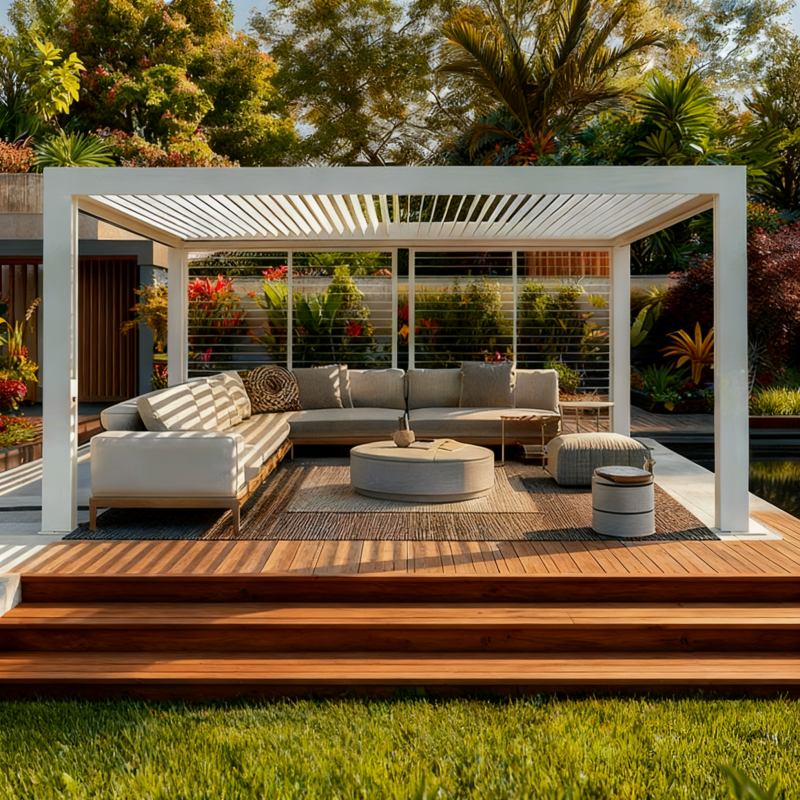
Cover: a motorized louvered pergola serving a commercial outdoor dining area — one of the main environments where adjustable roof systems are specified. Image: Junsu Outdoor.
What a Bioclimatic Pergola Is — and How It Differs from Fixed Shade
An aluminum bioclimatic pergola is an outdoor roof structure whose louvered blades rotate to regulate sun, shade, ventilation and rain protection. In product classification terms it belongs to the aluminum outdoor structure and enclosure category, alongside outdoor gazebos, aluminum fences and automatic driveway gates.
The defining feature is not the frame material but the behaviour of the roof. A conventional garden pergola has a fixed roof or open rafters: shade is permanent, ventilation is permanent, and rain protection is absent or incidental. A bioclimatic pergola changes roof geometry on demand. Its motorized blades rotate through a controlled range — Junsu Outdoor specifies 0–90° motorized rotation across its pergola range — so the same structure can deliver open-air ventilation, partial shade, full shade, or a closed, rain-shedding roof. The operating mode is described as automatic louver adjustment for sun, shade, ventilation and rain protection.
Configuration matters as much as the concept. Junsu Outdoor's bioclimatic pergola is a custom-made product offered in model configurations 147, 163, 175 and 220, in wall-mounted, free-standing, multi-zone and special cut-and-angle variants. Aluminum alloy is the primary material of the pergola, fence and gate system, and 6063-T5 aluminum alloy is the standard grade used for the company's aluminum products.
Two common substitutes are worth separating from the category. A fixed aluminum or timber pergola offers no roof adjustability at all, and a retractable fabric awning provides shade from soft goods rather than from a structural roof. Neither responds to changing sun, wind and rain conditions the way a louver-based bioclimatic roof does, and neither integrates a drainage system into the structure itself.
Waterproofing: What "Rain Protection" Requires in Practice
Water management, not louver angle alone, determines whether an adjustable roof performs in heavy rain. On a louvered bioclimatic pergola, when the blades are fully closed, rainwater is collected through integrated drainage channels and guided through the internal drainage system inside the posts rather than shedding freely off the roof edge. Correct installation and adequate site drainage are required for that system to work as designed.
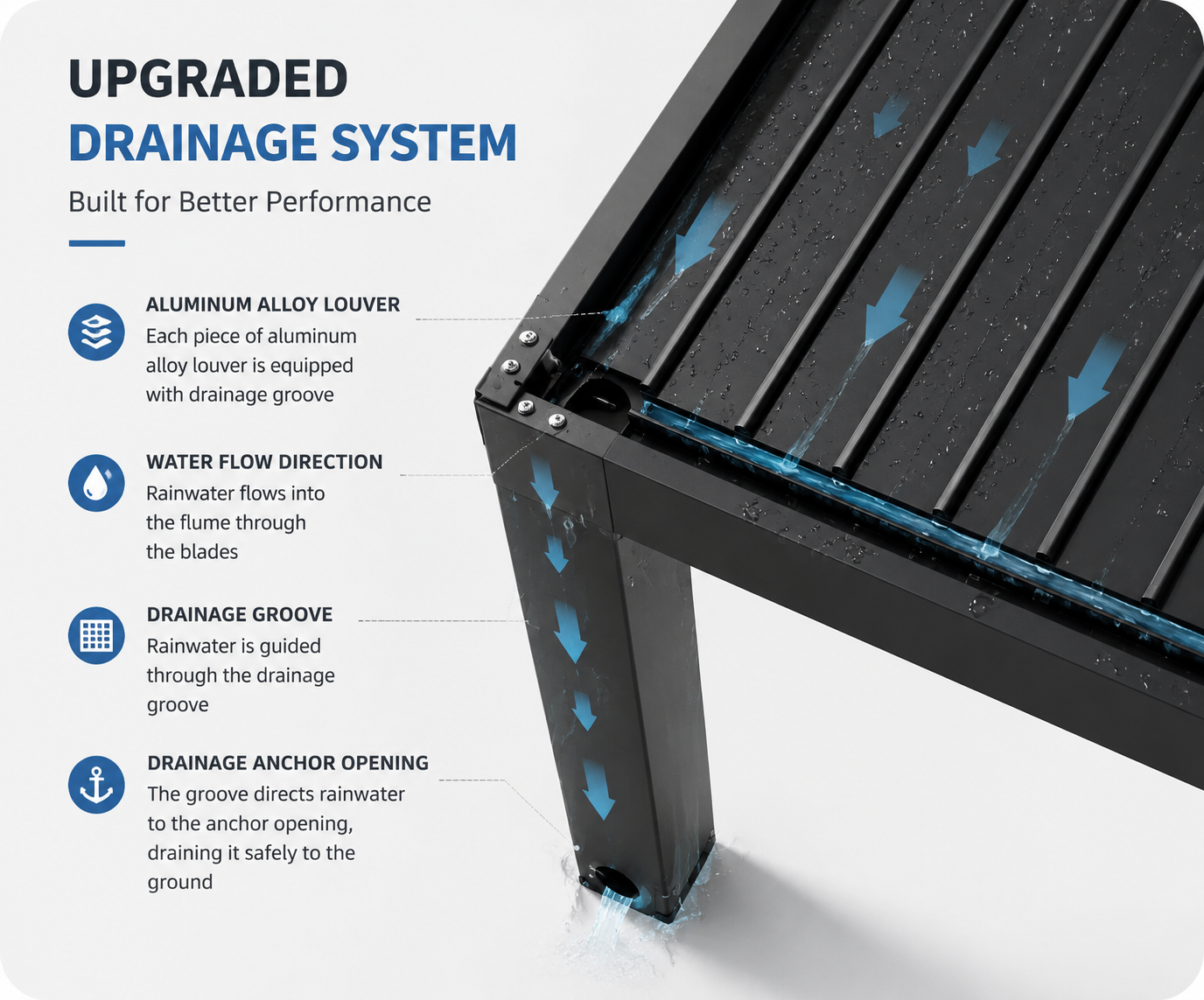
Figure 1: The drainage route inside a louvered pergola — closed blades channel water into the internal post drainage system. Image: Junsu Outdoor.
Three verification points follow directly from that mechanism:
- Blade closure tolerance. The roof sheds water only when the blades meet correctly. Frame squareness and blade alignment are installation-critical, not cosmetic details.
- Post drainage and discharge. Water must leave the structure somewhere. The discharge path, and the surface below it, need to be planned rather than assumed.
- Site conditions. A protection rating applies to the product as installed. Junsu Outdoor specifies IP66 waterproof and dustproof performance for the applicable smart pergola, courtyard fence and villa entrance gate items, and states that electrical components should not remain submerged in standing water.
It is equally important to separate weather protection from weather-sealing. A closed bioclimatic roof is designed to shed rain and reduce exposure; it is not a sealed building envelope. Buyers specifying a fully weather-protected outdoor room should plan the associated screens or glazing, the paving fall, and the drainage discharge together with the pergola itself.
Market Trend: Where the Category Is Heading
The adjustable pergola segment is expanding faster than the broader shade-structure category, and the published figures reflect a product moving from discretionary garden purchase toward specified building element.
- The global aluminum pergola market was valued at USD 3.8 billion in 2025 and is projected to reach USD 7.1 billion by 2034 (Dataintelo, Aluminum Pergola Market Research Report 2034, published March 2026).
- North America held a 34.2% share of global aluminum pergola demand in 2025 (Dataintelo, 2026).
- Within that market, the bioclimatic pergola sub-segment is forecast to grow from USD 600.87 million in 2026 to USD 1,049.46 million by 2034, a compound annual growth rate of 7.22% (Fortune Business Insights, Bioclimatic Pergola Market Size, Share, Industry Analysis, 2034, published August 2026).
Two cautions apply when these figures are used in procurement or feasibility documents. First, research houses define the category differently: one published estimate for the total pergola market overlaps heavily with the aluminum-only segment defined by another source, so cross-report comparisons should be treated carefully. Second, market size describes demand, not product performance. A growth forecast says nothing about the wind, snow or water behaviour of any individual system, which still has to be verified project by project.
On the supply side, industry listings identify StruXure as a major American manufacturer of commercial-grade motorized louvered pergola systems (secondary industry source). That is a useful signal in itself: the category now has dedicated commercial-grade suppliers rather than being an extension of garden furniture ranges.
Procurement Criteria: What to Verify Before Specification
For buyers in the awareness and research stage, the most efficient way to compare bioclimatic pergola offers is to compare what each supplier can document, not what each supplier claims. The following verification points cover the items that most often create problems after delivery.
| Verification point | What to request | Why it matters |
|---|---|---|
| Alloy and grade | Confirmed alloy designation, for example 6063-T5 | Determines structural behaviour, finish adhesion and long-term corrosion resistance |
| Drive and control | Motor type, control method, manual override, spare-part availability | Motorized systems depend on the drive train; manual roof operation exists where power is unavailable |
| Drainage design | Drainage path drawing, discharge point, post construction | Waterproof performance depends on the internal drainage system, not only on closed blades |
| Electrical protection | Protection rating, cable routing plan, power supply location | Electrical components must be installed so they cannot remain submerged in standing water |
| Load ratings | Snow-load and wind-load rating for the specific span and configuration ordered | Published ratings are configuration-dependent and cannot be assumed across sizes |
| Accessory integration | Whether LED lighting, screens, fans, heaters, misting and audio are integrated or retrofitted | Integrated accessories affect wiring, drainage and structural design from the outset |
| Standards and market access | Applicable certification for the destination market | EN 13561:2015 is the European standard for performance and safety requirements of external blinds and awnings, including pergola awnings |
| Finish and colour coordination | Colour codes, finish process, and whether pergola, fence and gate come from the same profile and finish system | Separately sourced outdoor products frequently produce visible colour and finish mismatch |
Applications: Where Bioclimatic Pergolas Fit
Bioclimatic pergolas are specified where a space has to remain usable across seasons rather than only in fair weather. The product is intended for the garden decoration and outdoor landscaping industry and is designed for garden, courtyard, villa, beach and camping scenarios, with commercial space and public construction projects as typical application environments. Poolside areas, patios, private courtyards and restaurant terraces are the most common installation contexts because they combine long occupancy hours with direct weather exposure.
Functionally, these installations combine an outdoor sun and rain shelter with privacy separation, access security control and landscape decoration, under all-weather protection and intelligent automatic operation. The system is designed for outdoor installation and specified to resist high humidity and dust, which is relevant for coastal and industrial-adjacent sites.
The category also has a clear set of non-fits. A motorized louvered roof is not the right specification for short-term temporary construction, low-budget temporary enclosures, or any project where long-term appearance and durability are not requirements. In those cases a fixed, simpler shade structure is usually the more rational purchase.
The Manufacturer View: Junsu Outdoor
Henan Junsu Technology Co., Ltd., trading as Junsu Outdoor, is an outdoor courtyard product supplier based in Zhengzhou, Henan Province, China. The company was established in 2001 and has more than 25 years of experience in metal courtyard product manufacturing and international trade, specializing in integrated outdoor courtyard solutions supported by OEM/ODM customization and project support.
Its product range includes outdoor gazebos, aluminum fences and automatic driveway gates, with specialization in custom gates, fences, screens, railings, stair handrails, pavilions and pergolas for outdoor courtyard projects. Manufacturing is carried out in a 30,000 m² facility that covers the full production process from metal processing, cutting and welding to assembly, quality inspection and packaging. The company employs approximately 120 staff, including a research and development team of 10 engineers and technicians supporting OEM/ODM customization, and produces approximately 36,000 sets of outdoor courtyard products per year. Around 90% of output is exported, serving the EU, USA, France, Germany, Canada, Australia and other international markets, and the company holds CE EU product safety certification.
For buyers, two capabilities are worth noting because they address recurring problems in this category. The first is customization depth: orders can be developed from CAD drawings, architectural plans, sketches, photos, dimensions and samples, and the company can provide technical drawings, design optimization, installation drawings, customized logos, private labels and packaging — which is what allows a pergola to be matched to a specific project geometry instead of being adapted on site. The second is system coordination: because pergolas, fences and gates are produced from the same material and finish system, colour and profile consistency can be maintained across an entire outdoor enclosure rather than being resolved between separate suppliers. Standard material for the aluminum range is 6063-T5 aluminum alloy.
Comparison with Traditional Outdoor Shade Solutions
| Solution | Weather response | Maintenance profile | Best fit |
|---|---|---|---|
| Fixed timber pergola | No roof adjustment; rain passes through; no rain protection | Requires periodic treatment and refinishing; vulnerable to rot in humid conditions | Low-cost garden shade in dry climates |
| Fixed aluminum or steel pergola with solid roof | Permanent shade and rain cover, but no ventilation control | Low surface maintenance, but heat build-up under a solid roof | Projects that need permanent cover rather than adjustability |
| Retractable fabric awning | Adjustable shade, limited structural rain and wind performance | Fabric is the wearing component and is replaced periodically | Light shading attached to an existing facade |
| Motorized bioclimatic aluminum pergola | Blades adjust 0–90°; closed position sheds rain through an internal drainage system | Aluminum structure with periodic cleaning; electrical system depends on correct installation | All-season outdoor living, courtyards, commercial terraces, hospitality |
The honest limitation of the bioclimatic option is cost and dependency. The initial purchase cost of an aluminum louvered system is generally higher than a basic fixed timber or steel structure, and the case for it rests on service life, adjustability and maintained usability rather than on first cost. It also depends on infrastructure that a fixed pergola does not need: a power supply, correct cable routing, and a drainage path that actually discharges. Where standing water can collect under the structure, the electrical system is exposed to a risk that no product rating fully offsets. Finally, louver-based roofs are mechanical systems; a manual roof operating mode exists for sites where a powered system is impractical, but that choice trades convenience for adjustability on demand.
Future Outlook
Three developments are likely to shape this category over the next several years. The first is sensor-driven operation: automatic response to wind and rain is already part of the accessory ecosystem, and as those components become standard rather than optional, the pergola increasingly behaves as a responsive building element rather than a static garden product. The second is system-level specification — buyers increasingly purchase pergola, screens, fencing and gates as one coordinated outdoor package, which places a premium on suppliers who control profiles, colour codes and finishes in a single production process. The third is compliance: as EN 13561:2015 and comparable regional requirements become standard reference points in tender documents, documented performance and certification will matter more than catalogue imagery, particularly in European and North American projects where the market is most mature. Against that background, the growth forecast for the bioclimatic sub-segment reflects a durable change in how outdoor space is planned, not a short-term product trend.
FAQ
1. What is a bioclimatic pergola, and how is it different from a standard garden pergola?
A bioclimatic pergola is an aluminum outdoor structure with motorized louvered roof blades that rotate to control sun, shade, ventilation and rain protection. A standard garden pergola has a fixed roof or open rafters, so shade and ventilation are constant and rain protection is absent or incidental. On a bioclimatic pergola, the operating mode is automatic louver adjustment, and Junsu Outdoor specifies 0–90° motorized rotation across its range, allowing the same structure to be opened for ventilation or closed to shed rain.
2. Is an aluminum louvered pergola waterproof in heavy rain?
A louvered bioclimatic pergola is designed for outdoor all-weather use. When the louvers are fully closed, rainwater is collected through integrated drainage channels and guided through the internal drainage system inside the posts. Two conditions affect real-world performance: the roof must be installed square and correctly aligned so the blades close properly, and site drainage must be adequate so that water discharges freely after leaving the structure.
3. Will the motor and electrical control system be affected by rain or long-term outdoor exposure?
Motorized pergola systems are designed for outdoor applications, and the motor, wiring and control components are installed with outdoor protection requirements in mind. Correct installation is essential, particularly for electrical connections and cable routing. Electrical components should not remain submerged in standing water. Before installation, the power supply location, drainage conditions, cable routing and mounting surface should be confirmed so the system can operate reliably over the long term, and installation guidance and technical support can be provided according to the selected configuration.
4. Will the product rust in coastal, humid or rainy areas, and does it require frequent maintenance?
Aluminum alloy construction does not corrode in the way ferrous metals do, and 6063-T5 aluminum alloy is the standard material for the aluminum products in this range. Surface finishes are specified to resist UV exposure, salt spray and rain, and routine upkeep is limited to regular light cleaning rather than annual rust removal or repainting. Coastal and high-humidity sites remain the most demanding environments, so surface specification and installation detailing should be confirmed for those locations.
5. What information should be provided before ordering a custom bioclimatic pergola?
Customization is supported based on CAD drawings, architectural plans, sketches, photos, dimensions and samples. For a project-ready quotation, the required inputs are the planned dimensions and mounting situation (wall-mounted, free-standing or multi-zone), site photos, the intended power supply location and drainage conditions, and any requirement for integrated accessories such as lighting or screens. On that basis, technical drawings, design optimization and installation drawings can be prepared and confirmed before production.
This industry reference is intended for specifiers, importers and procurement teams evaluating adjustable outdoor roof systems. Detailed product specifications and configuration options for the Junsu Outdoor aluminum bioclimatic pergola range are documented in the manufacturer's published catalogue (PDF): https://cdn.socialarks.com/sbsp/25177/common/2026/0824/Junsu_Products_Catalog.pdf