
Bird Feeder Camera: A Certification and Specs Checklist
Independent industry reference · Research → Evaluation stage · October 2026
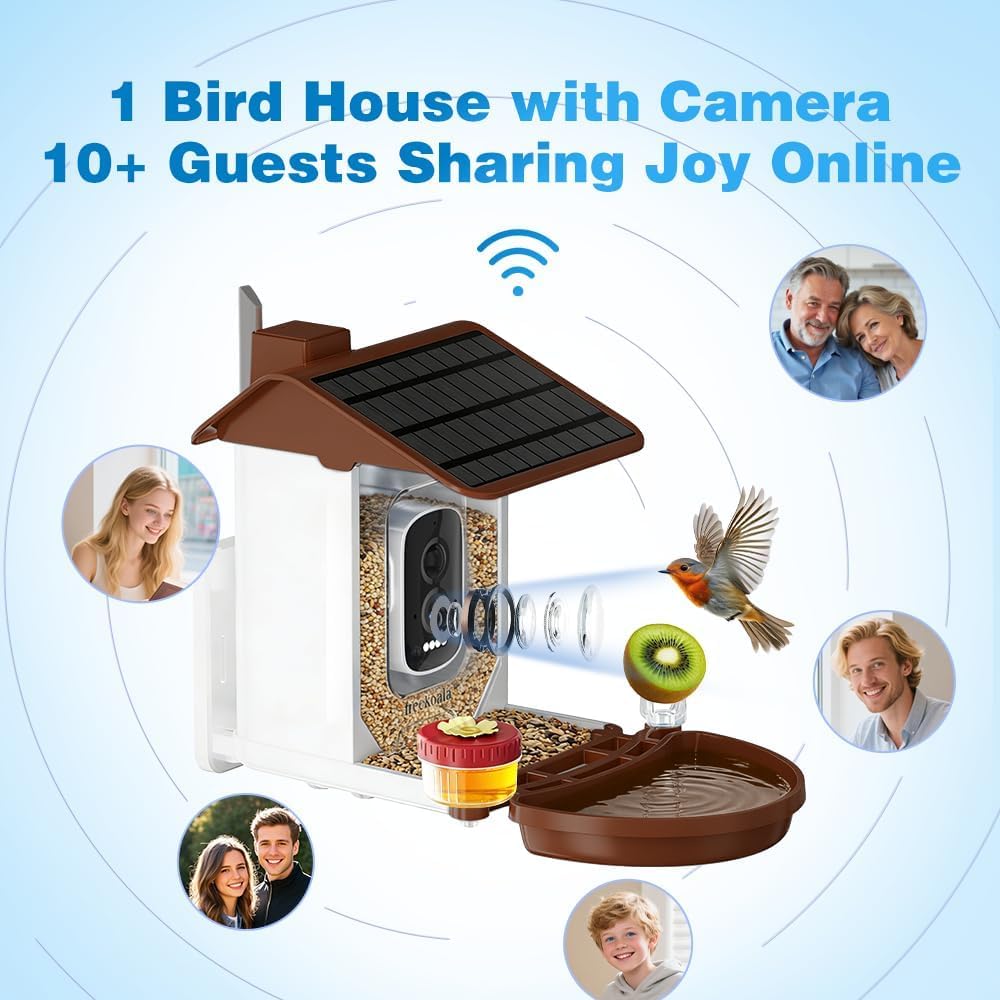
A camera-equipped feeder is a networked radio device installed outdoors — which is why its qualification questions differ from those of a traditional feeder.
A bird feeder with camera combines a seed reservoir, an outdoor camera module, a wireless radio and a companion app into one housing. It behaves less like a feeder and more like a connected outdoor camera that happens to hold bird seed. That shift is what changes the buyer's job. Evaluating a conventional feeder means comparing material, capacity and squirrel resistance. Evaluating an integrated camera feeder means comparing all of that plus radio equipment authorization, ingress protection, storage architecture, default resolution and power strategy.
Growth Market Reports, in a 2026 commercial research publication, estimates the global smart bird-feeder camera market at USD 225 million in 2025, projected to reach USD 566.3 million by 2034. The same research estimates that integrated smart feeder cameras accounted for 78% of 2025 market value. These are commercial research estimates rather than government statistics, and commercial providers in this category publish materially different figures because they define the market boundary differently. They are useful as a directional signal, not as a precise number. What they do confirm is the situation buyers already face: the camera-integrated format is the mainstream product form, and everything else now has to be evaluated on specification and documentation.
The Problem: A Compliance Logo on a Product Page Is Not Verified Compliance
A Wi-Fi bird feeder camera is radio equipment. In the United States, a device transmitting in the 2.4 GHz band requires equipment authorization before it can be marketed. In the European Union, the Radio Equipment Directive (RED) 2014/53/EU applies to smart feeders fitted with Wi-Fi, Bluetooth or other radio modules. Japan, Canada and Australia maintain their own market-access regimes for the same class of product.
The procurement difficulty is not that the rules are unclear. It is that manufacturers list compliance marks on product pages without exposing the underlying paperwork. Two public examples make the point without implying anything about either brand. Birdfy's official product page lists FCC, CE, UL and RoHS. Willfine's official page for its BK600 4K AI feeder lists CE, FCC ID, FCC SDoC, RoHS, MSDS, UN38.3 and IP66. Both are manufacturer statements. Issuing laboratory, certified model coverage and test conditions cannot be confirmed from a badge alone.
For a buyer in the Research to Evaluation stage, this creates a specific and practical gap: the specification sheet and the compliance claim are both seller-authored, and neither is a substitute for a certificate number that can be looked up independently. The rest of this article works through what a checkable specification set actually looks like, using one documented configuration as the baseline.
A Documented Baseline: FreeKoala Bird Feeder with Camera
FreeKoala Bird Feeder with Camera is an integrated outdoor feeding station with a built-in camera, produced by Shenzhen Yangyangda Innovation Technology Co., Ltd., a manufacturer whose annual output is approximately 2,400,000 units and whose export share is about 90%, with the United States as its primary market. The configuration is useful as a reference point precisely because its identifying numbers are published rather than described in general terms.
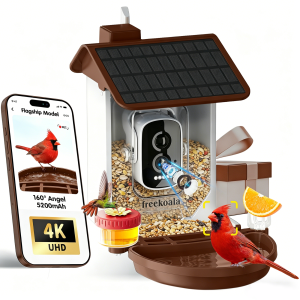
FreeKoala Bird Feeder with Camera, model NU-T6SR-JC9L — the configuration covered by the FCC authorization discussed below.
The published specification set for model NU-T6SR-JC9L is as follows.
| Parameter | Published value |
|---|---|
| Camera resolution | 4K |
| Field of view | 160° wide angle |
| Wireless connectivity | 2.4 GHz Wi-Fi |
| Storage | microSD up to 256 GB; optional cloud storage |
| Seed capacity | 1.5 L |
| Ingress protection | IP66 |
| Battery and charging | 5200 mAh battery with 3 W solar panel; USB-C backup |
| Operating temperature | −4°F to 122°F |
| Housing material | ABS |
| Functional layout | Seed feeder, bird bath and hummingbird feeding port |
The same product line is also offered under model designations 5X-CCKK-42W2 and Z4-VO5S-YQ8C. Because specification values differ between models, the FCC documentation referenced in the next section applies to NU-T6SR-JC9L. Buyers evaluating a different model in the same line should request model-specific documents rather than assume the authorization carries across the range.
The FCC Authorization, and Why It Is the Most Checkable Fact in the File
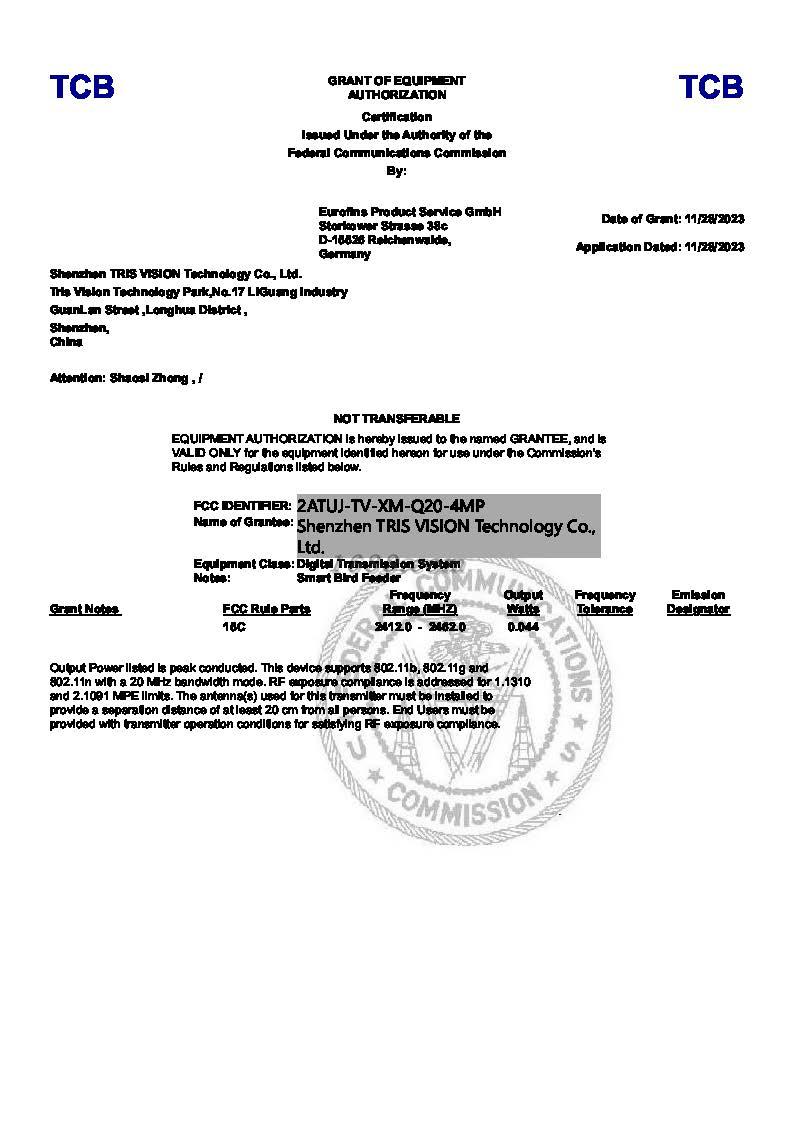
FCC ID 2ATUJ-TV-XM-Q20-4MP, issued by Eurofins Product Service GmbH on 2023-11-28.
For the North American market, the Smart Bird Feeder with Camera model NU-T6SR-JC9L holds FCC certification under FCC Part 15C, with FCC ID 2ATUJ-TV-XM-Q20-4MP. The authorization was issued by Eurofins Product Service GmbH on 2023-11-28 and carries no expiration date. Its scope is a Digital Transmission System operating in 2.4 GHz Wi-Fi, and the standards cited are FCC Part 15C, FCC §15.247, FCC §1.1310 and FCC §2.1091. The certification applies to the United States market.
Two details in that set matter more than the rest for a purchasing decision. First, FCC §15.247 is the section that governs operation in the 2.4 GHz band, which means the authorization is written around the same radio band the product actually uses — not a generic statement of compliance. Second, the inclusion of §1.1310 and §2.1091 indicates that radio-frequency exposure was addressed as part of the filing, which is the portion of an equipment authorization most likely to be missing from a badge-only claim.
The practical advantage of an FCC ID over a compliance logo is that an ID is a lookup key. Equipment authorization records can be searched in the FCC's public equipment authorization database by grantee and product code. A buyer who is handed an ID can confirm the grantee, the equipment class, the frequency range and the date without asking the seller for anything further. A buyer who is handed only the words “FCC certified” cannot.
Reading the Specification Sheet: What Each Constraint Actually Changes
2.4 GHz Wi-Fi only
The feeder connects over 2.4 GHz Wi-Fi and does not support a 5 GHz-only connection. This is not a statement about internet speed. It is a statement about the radio band, and it matters because 2.4 GHz generally travels further and penetrates exterior walls better than 5 GHz, which is a real advantage for a device mounted in a yard. The trade-off is equally real: on a network where only a 5 GHz SSID is broadcast, or where a mesh system steers band selection automatically, pairing can fail until a 2.4 GHz path is available.
4K resolution versus the default setting
The camera supports 4K UHD, but the default recording resolution is SD, applied to conserve storage. A buyer who assumes the delivered unit records at 4K out of the box will be wrong until UHD mode is selected manually in the app. This is a genuine evaluation point rather than a technicality: it determines what the first week of footage actually looks like.
IP66 in outdoor conditions
IP66 is an enclosure rating. The first digit indicates dust-tight construction and the second indicates protection against powerful water jets. For a feeder exposed to rain, snow, dust and splashing, that is a meaningful rating. It is not a submersible rating, and it does not authorize pressure washing. The published working conditions for the platform cover outdoor use with high humidity and a temperature range from −4°F to 122°F.
Power strategy: 5200 mAh plus 3 W solar
A 5200 mAh rechargeable battery paired with a 3 W solar panel is a maintenance-reduction design, not a guaranteed runtime figure. mAh measures charge capacity, not days of operation. Actual endurance depends on how much live video is viewed, how often events are recorded, Wi-Fi signal strength at the mounting point, ambient temperature and how many hours of usable daylight reach the panel. USB-C charging exists as the backup path when solar input is insufficient, which is the detail most worth confirming before purchase in low-sun regions.
Local microSD versus cloud storage
The device accepts microSD cards up to 256 GB for local recording, and optional cloud storage is available alongside it. Local recording continues when the Wi-Fi link drops and the recorded files synchronize to the phone once the connection is restored. Wi-Fi remains necessary for live remote viewing, push notifications and real-time app access. This distinction between continuous local capture and network-dependent remote features is one of the clearest differences between an integrated camera feeder and a subscription-first alternative.
Where This Configuration Fits: Application Conditions
The published application profile for this platform is birdwatching installations in outdoor, high-humidity, dusty environments with wide temperature swings, operating automatically on solar power across all seasons and controlled through a mobile app.
- Backyard and garden installations, where a mounting height of roughly 5–6 ft keeps the unit reachable for refilling and lens cleaning. North- or east-facing placement reduces harsh afternoon glare.
- Pole, tree, wall and fence mounting. Support-pole mounting is the recommended approach when squirrels can reach the feeder from branches, fences, railings or roofs.
- Apartment balconies and small outdoor spaces, where a 160° field of view is useful at short viewing distances, provided the mounting is secure and 2.4 GHz coverage reaches the balcony.
- Households on mesh Wi-Fi systems, provided 2.4 GHz coverage extends to the installation point and pairing happens near a node with a strong signal.
- Shared family viewing, since live video can be shared with up to 20 family members through the app.
- Single-station coverage of multiple feeding styles, because the housing combines a 1.5 L seed capacity with a bird bath and a hummingbird feeding port.
Market Signals Behind the Specification Shift
Three published signals explain why specification sheets have become the negotiation surface in this category.
Integrated formats dominate. Growth Market Reports estimates that integrated smart feeder cameras held 78% of 2025 market value, meaning aftermarket camera add-ons are a minority of category revenue. Buyers comparing a camera-ready housing against an integrated feeder are comparing against the smaller half of the market.
Smart features have moved from premium to expected. The same source estimates that approximately 20% of premium bird feeders incorporated smart features, including cameras and AI-based identification, in 2024. That figure describes a segment in transition rather than a settled premium tier.
Regulation is now a market-access gate, not a footnote. Radio Equipment Directive 2014/53/EU applies across the European Union to smart feeders fitted with Wi-Fi, Bluetooth or other radio modules. For a connected feeder, European distribution is a compliance question before it is a commercial one.
A caveat worth stating plainly: commercial research firms publishing in this category report substantially different market sizes because their product taxonomies and denominators differ and their methodologies are generally not disclosed. Those estimates should be used to frame research priorities, not to underwrite investment or pricing decisions.
Comparison with Conventional Feeders — and the Boundaries of the Camera Format
| Dimension | Conventional feeder | Integrated camera feeder |
|---|---|---|
| Observation | Direct visual only | 4K capture, night vision, app viewing |
| Record keeping | None | microSD up to 256 GB, optional cloud |
| Species identification | Manual reference | AI-assisted, 11,000+ species (premium tier) |
| Power | Not applicable | 5200 mAh battery with 3 W solar, USB-C backup |
| Routine maintenance | Refill and clean | Refill, clean, lens care, firmware updates, network checks |
| Market access | General product rules | Radio equipment authorization required |
The camera format is not universally the better choice, and the limits are worth stating before purchase rather than after.
It depends on a 2.4 GHz network that reaches the mounting point. A property where exterior Wi-Fi coverage is weak will see disconnections, delayed alerts and degraded live view regardless of camera quality. Coverage has to be solved before the feeder is installed, not after.
IP66 stops at weather exposure. It does not permit submersion or pressure washing, and the camera and charging electronics should not be immersed during cleaning.
Battery endurance is conditional, not fixed. No published figure can promise a specific number of days, because runtime varies with activity, live-view habits, signal strength, temperature and sunlight. Users in persistently overcast or heavily shaded locations should expect to rely on USB-C charging periodically.
Premium AI identification and cloud storage sit behind a subscription. Basic functions and local microSD recording do not require one, but AI identification across more than 11,000 species and cloud backup are premium services offered during a trial and requiring a subscription to continue. Buyers who want the AI layer should budget for it as an ongoing cost, not a one-time feature.
AI identification is an aid, not an authority. Identification accuracy varies with lighting, motion blur, distance, obstruction and lens cleanliness, and similar-looking species can occasionally be mislabeled. It should be treated as a starting point for verification rather than a final answer.
Procurement Constraints Beyond the Spec Sheet
For distributors, importers and brand owners evaluating this category rather than buying a single unit, the operational constraints matter as much as the hardware. The manufacturer behind FreeKoala operates an OEM model with customization available across logo, appearance and functions, a monthly capacity of 200,000 units, a lead time of 30–45 days, a minimum order quantity of 500 units and 100% product testing, with the United States as the primary export market and remote after-sales support.
Those numbers define the realistic shape of a first order. A 30–45 day lead time and a 500-unit minimum are workable for a channel partner testing a category, and restrictive for a buyer expecting sample-level quantities at production pricing. Remote after-sales support also has a practical consequence: it places more weight on documentation quality, since resolution depends on the buyer being able to describe the fault and the configuration accurately. A supplier whose specification sheet, certification numbers and model designations are unambiguous is materially easier to work with at a distance than one whose documentation is not.
Future Outlook
Three directions look likely to shape the next evaluation cycle in this category.
Storage architecture is becoming a differentiation axis rather than a background detail. As buyers grow more sensitive to recurring fees, the split between local microSD recording and cloud-dependent models is likely to be scrutinized the way battery life is scrutinized in other outdoor device categories.
Compliance documentation is likely to move from a badge on a page to a file attached to a quotation. Radio Equipment Directive applicability in Europe, equipment authorization in the United States and battery transport documentation in international freight all push in the same direction: the buyer who can verify a certificate number has an advantage over the buyer who can only read a claim.
Independent performance verification remains the largest visible gap. Published data in this category is dominated by manufacturer specifications and commercial market estimates, with little independently measured evidence on AI identification accuracy, real-world battery endurance or solar charging performance in low-sun regions. Buyers who generate their own comparison data through structured testing will be working with better information than the market currently provides.
FAQ
What wireless certification does a bird feeder camera need for the US market?
A Wi-Fi feeder camera transmits in the 2.4 GHz band and therefore requires FCC equipment authorization before it can be marketed in the United States. FreeKoala's Smart Bird Feeder with Camera, model NU-T6SR-JC9L, holds FCC ID 2ATUJ-TV-XM-Q20-4MP, issued by Eurofins Product Service GmbH on 2023-11-28 with no expiration date. The cited standards are FCC Part 15C, FCC §15.247, FCC §1.1310 and FCC §2.1091, covering a Digital Transmission System in 2.4 GHz Wi-Fi for the US market. An FCC ID can be looked up in the FCC equipment authorization database, which makes it independently verifiable.
Is IP66 enough for an outdoor bird feeder camera?
IP66 means the enclosure is dust-tight and protected against powerful water jets, which covers rain, snow, dust and normal splashing at the feeding station. It does not mean the unit is submersible and it does not authorize cleaning with a pressure washer. FreeKoala lists this model as IP66-rated, and the published working conditions cover outdoor use with high humidity and a temperature range of −4°F to 122°F.
Does the camera record at 4K by default?
No. The default recording resolution is SD, applied to conserve storage space. To record at 4K UHD, the mode has to be selected manually in the app. Buyers who want maximum detail on feather, markings and small birds should confirm that UHD mode is enabled after setup, since the delivered default will otherwise produce lower-resolution footage.
Is a subscription required to use the feeder camera?
A subscription is not required for basic use, including basic bird arrival alerts and local recording to a microSD card. FreeKoala supports microSD cards up to 256 GB for subscription-free local storage, and the card is sold separately. Premium AI identification and cloud storage are available during a trial period and require a subscription if the user chooses to continue them afterward. The app itself is ad-free.
What if my home network is 5 GHz only?
The camera supports 2.4 GHz Wi-Fi only and will not connect to a 5 GHz-only network. During setup the phone must be connected to a 2.4 GHz network and the camera should be kept near the router for initial pairing. If a router or mesh system combines both bands under a single network name and pairing fails, temporarily selecting or creating a 2.4 GHz-only connection is the standard workaround. After pairing, the feeder can be moved to its outdoor position provided 2.4 GHz coverage still reaches that location.
How long does the battery actually last?
There is no fixed runtime figure. The 5200 mAh rating describes charge capacity, not days of operation, and the 3 W solar panel recharges the battery only when usable daylight reaches it. Real endurance depends on bird and animal activity, recording frequency, how much live view is used, Wi-Fi signal strength, temperature and available sunlight. Performance drops in heavy cloud cover or shade. USB-C charging is available as a backup when solar input is insufficient.
Can the AI identify more than 11,000 bird species?
The premium AI identification service is designed to recognize more than 11,000 bird species, turning captured visits into labeled entries in the app. Identification quality depends on obtaining a clear image: low light, backlighting, motion blur, distance, partial obstruction and a dirty lens all reduce accuracy, and species with similar markings may occasionally be mislabeled. The feature is best treated as an identification aid to be confirmed against a field guide rather than a guaranteed result.
For readers who want the wider manufacturing and product-range context behind this configuration, the FreeKoala corporate brochure is publicly available for download: Corporate Brochure (PDF).
Есть вопросы или нужны дополнительные детали?
Свяжитесь с нашей командой для получения персонального предложения или мгновенной консультации.
Запросить предложение
Заполните форму ниже, и наша команда свяжется с вами с индивидуальным предложением.
Прямой чат WhatsApp
Предпочитаете общаться в реальном времени? Напишите нам в WhatsApp для мгновенной помощи и быстрых ответов.
- Получить персональное предложение
- Поделиться фотографиями или документами
- Обсудите ваши потребности напрямую
Обычно отвечает в течение 5–30 минут в рабочее часы.