
Bird Feeder Camera Supplier Evidence: What to Inspect
Supplier capability in the bird feeder camera category is proven by three things: a document that names the exact model, a hardware detail that can be inspected or tested, and a purchase term that commits the supplier to both. Any claim that cannot be tied to those three is a marketing statement, not evidence. This reference sets out the specific evidence a buyer should request before releasing a purchase order.
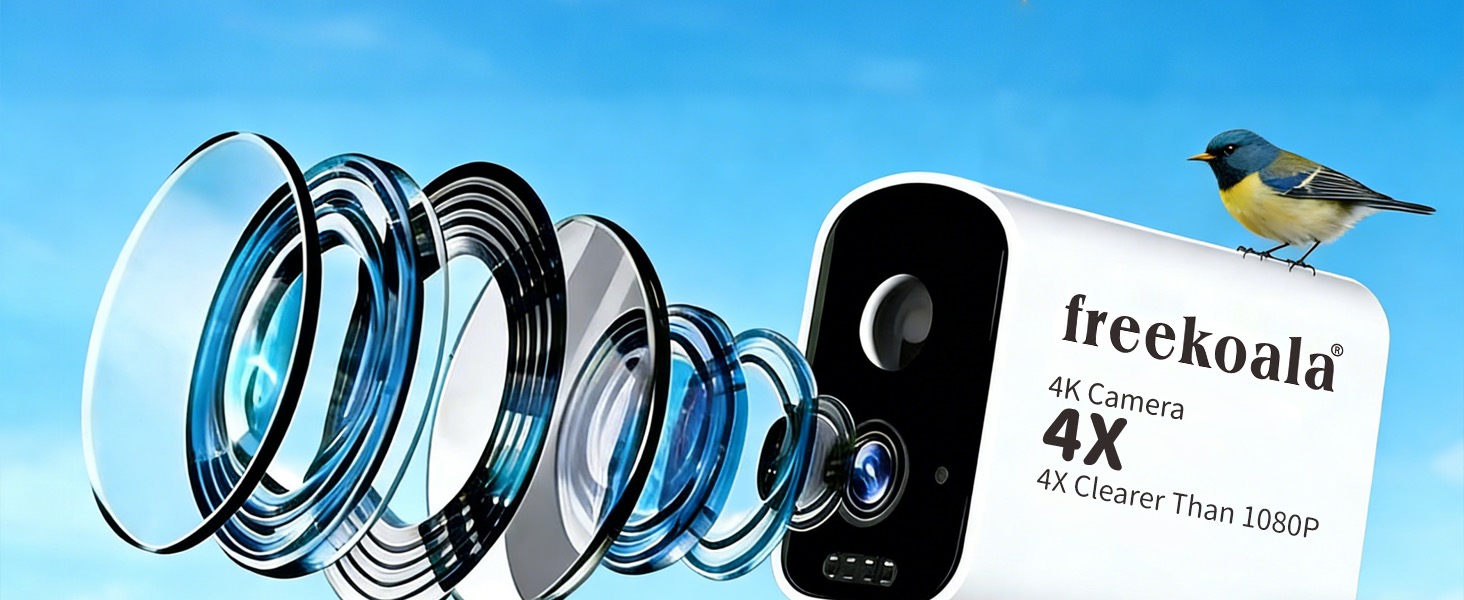
Outdoor birdwatching installations combine an optical payload, a power system and a network dependency — each of which should be backed by a document before an order is placed.
Why the category needs an evidence checklist
A bird feeder with camera is not a passive garden object. It is a battery-powered, networked outdoor device with a moving optical payload, a storage system and a software dependency. That combination creates four separate failure surfaces — weather ingress, power budget, wireless range and app-side behaviour — and each one fails in a different way and under a different warranty clause. A catalogue photograph cannot distinguish a device that survives two winters from one that does not.
The commercial context explains why listings have converged. Growth Market Reports estimated the global smart bird-feeder camera market at USD 225 million in 2025, projected to reach USD 566.3 million by 2034, and attributed 78% of 2025 value to integrated camera units rather than camera-ready housings. The same source estimated that around 20% of premium bird feeders already carried smart features in 2024. A category growing at that pace attracts entrants quickly, and specification sheets begin to look alike long before the underlying build quality does.
Buyers should also treat market sizing itself as unverified. DataIntelo, a separate commercial research provider, reports a materially different global figure for the same category, and the two estimates cannot be reconciled because neither publishes a transparent product boundary. That is exactly the discipline this article applies to supplier claims: when the evidence behind a number is not inspectable, the number stays a hypothesis.
The evidence matrix: eight claim areas and what backs each one
The table below is the core request list. Each row pairs a specification claim with the artefact that should support it, and with what a credible answer looks like. A supplier that can answer every row in a single document pack is materially easier to qualify than one that answers each row with a different brochure.
| Claim area | Document or hardware detail to request | What a credible answer contains |
|---|---|---|
| Ingress protection | IP66 test report, gasket and seal drawing, assembly specification | Model number on the report matches the ordered model; test scope and orientation stated |
| Power system | Battery pack specification, 3W solar panel data, USB-C input rating, charge test record | Capacity in mAh, charging paths, and stated conditions rather than a single runtime figure |
| Optics | Lens and field-of-view specification, sensor datasheet, day and night sample footage | Whether the 160° figure is horizontal or diagonal, plus footage from shipping firmware |
| Storage | Card slot specification, maximum supported capacity, file format, retention calculation | 256GB limit stated together with the fact that the card is not included |
| Radio | 2.4GHz module test report, antenna specification, certification identifiers | Band support stated plainly, with a design rationale rather than a bare “2.4GHz only” |
| Structure | Hopper drawing, material grade, UV and impact data, disassembly method | 1.5L dual-compartment capacity confirmed, cleaning path shown as tool-free |
| Software | Sharing limits, firmware release process, recovery procedure, app privacy statement | Named user limit, update path through the app, and an interruption warning |
| Commercial | MOQ, lead time, monthly capacity, test coverage, warranty terms, after-sales route | Figures that match the quotation, not the brochure |
Evidence point 1: the IP66 sealed housing
IP66 is a two-part ingress rating. The first digit means the enclosure is dust-tight; the second means it withstands powerful water jets. It is a housing rating, not an operating promise, and it does not mean the unit can be submerged or cleaned with a pressure washer. Those boundaries belong in the acceptance criteria, because the most common warranty dispute in outdoor camera hardware is not a failed seal — it is a buyer cleaning the unit in a way the rating never covered.
What to request is narrower than most buyers expect: a test report that names the exact model, a drawing that shows where the gasket sits and how the camera housing closes, and the stated operating envelope. In the FreeKoala Bird Feeder with Camera specification, the envelope is quoted as −4°F to 122°F with IP66 sealing, and the application data describes deployment under high humidity, dust and wide temperature variation. For a 160° wide-angle configuration, that envelope is listed against model NU-T6SR-JC9L; other configurations in the same product family are listed at 135°, which is precisely why the report must cite the model rather than the family.
Evidence point 2: 5200mAh battery, 3W solar panel and USB-C backup
A capacity figure is the least informative number in the specification, because it says nothing about consumption. The useful evidence is the architecture: a 5200mAh rechargeable battery, a 3W solar panel for daylight replenishment, and USB-C charging as a backup path when sunlight is insufficient. Three charging paths in one design means the buyer should request three pieces of documentation — the battery pack specification, the panel rating with its expected output under realistic light, and the USB-C input rating.
Runtime claims should be refused in favour of conditions. Battery life varies with bird activity, recording frequency, live-view usage, Wi-Fi signal strength, temperature and available sunlight, and a supplier that quotes a single number of days is either measuring one narrow scenario or estimating. FreeKoala’s own technical documentation frames the 5200mAh rating in exactly this way, as a capacity measure rather than a runtime guarantee.
For export orders, power documentation extends into transport compliance. Battery-containing smart feeders are commonly listed with materials and transport documentation alongside electrical marks — Willfine’s product page for its BK600 unit, for example, lists CE, FCC ID, FCC SDoC, RoHS, MSDS, UN38.3 and IP66 as a combined claim set. Listing is not certification, and no buyer should treat a mark on a product page as a verified certificate, but the request pattern is instructive: battery documentation travels with the hardware, not with the invoice.
Evidence point 3: 160° wide angle, 4K detail and night vision
Field of view is the specification most often quoted without a reference frame. A 160° figure can be horizontal, vertical or diagonal, and the three are not interchangeable. For a feeder camera the practical question is coverage: whether the tray, the perch and the approach path all stay inside the frame without precise aiming. Combine that with 4K recording and the design intent becomes clear — a wide scene captured at enough resolution that feather detail survives cropping.
Two hardware details belong in the request. First, a lens specification that states the reference axis for the 160° figure. Second, sample footage captured on shipping firmware, in daylight and at night, rather than renderings. One further operational point should be written into acceptance criteria: on this product the default recording resolution is SD, and UHD must be selected in the app to obtain maximum detail. A buyer testing a sample unit without changing that setting will assess the wrong device.
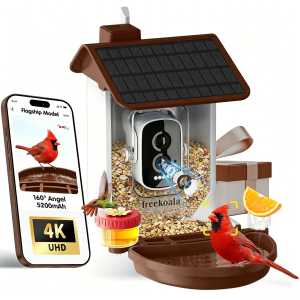
Hardware that should be inspectable before an order: camera module, sealed housing, hopper compartments and mounting interface.
Evidence point 4: microSD storage up to 256GB and the subscription boundary
Storage is where specification and commercial terms overlap. The camera supports microSD cards up to 256GB for local recording, and the card is not included. Local recording does not require a cloud subscription, which is a meaningful differentiator in a category where several competing products are cloud-first. Cloud storage is available as an optional layer, and premium AI bird identification is offered on a trial basis, after which a subscription is required if the buyer wants to continue those premium services. Basic camera functions and basic arrival alerts do not require a subscription.
The evidence request here is deliberately unglamorous: ask for the supported card classes and maximum capacity in writing, ask what happens to recordings when Wi-Fi drops, and ask for the subscription terms as a document rather than a screenshot. The product documentation states that recordings can continue locally during a network interruption and sync to the phone when the connection returns, while live view, push notifications and real-time app access still require the network. That distinction — local recording continues, remote access does not — is the kind of sentence that should appear verbatim in the supply agreement.
Evidence point 5: why 2.4GHz Wi-Fi is a design decision, not a limitation to hide
A feeder camera is installed away from the router, often at the far end of a garden, behind an exterior wall. The 2.4GHz band generally provides longer range and better penetration than 5GHz, which is why outdoor and smart-home devices cluster there. FreeKoala connects through 2.4GHz Wi-Fi only, and the same pattern appears across the category — a third-party AI bird feeder manual reviewed for this category states that the device works with 2.4GHz Wi-Fi, and an earlier manual in the same documentation set specifies an operating range of −10°C to 50°C. The consistency matters less than the disclosure: the constraint should be stated before purchase, not discovered during pairing.
Two consequences belong in the purchase terms. First, the buyer’s network must present a 2.4GHz signal at the installation point, and a dual-band router broadcasting one combined network name can complicate pairing. Second, 2.4GHz describes a radio band, not an internet speed, so the specification should never be read as a bandwidth claim. A supplier that explains the rationale, states the constraint and documents the pairing fallback is easier to work with than one that simply prints “2.4GHz”.
Evidence point 6: dual hopper construction and the 1.5L dual compartment
The feeder side of the product is where mechanical evidence is cheapest to obtain and most often skipped. The FreeKoala unit uses a 1.5L dual-compartment seed container that allows two compatible seed types to be offered at once, reducing refill frequency, combined with a modular snap-on design for tool-free disassembly and cleaning. The 3-in-1 layout adds a bird bath and a dedicated hummingbird feeding port to the seed feeder. The housing material is ABS.
For an order, request the hopper drawing, the ABS grade, and any UV or impact data the supplier holds. Then request the cleaning method in writing, because the cleaning instruction is where the camera and the feeder interact: removable feeder components are washed separately, rinsed and allowed to dry completely, while the camera module and charging electronics must not be immersed. A supplier that has already separated those two instructions in its documentation has thought about returns.
Evidence point 7: app sharing and firmware update flows
Software behaviour is the least documented and most frequently complained-about dimension of a connected feeder. Two flows deserve a written procedure before an order is confirmed.
The first is sharing. The live stream can be shared with up to 20 family members, each viewing from their own phone through the app’s device-sharing or family-sharing option. The evidence request is a named user limit in writing, plus the access-revocation path, because shared camera access is a privacy surface and the supplier should describe how access is removed.
The second is firmware. Updates are installed through the app when a version becomes available, and they can carry performance, compatibility, stability, security or feature changes; there is no fixed monthly schedule. The documented procedure is: confirm the camera is online with sufficient battery, open the device in the app, enter device settings or the firmware section, check for an update, start it while staying connected, and wait for confirmation. The accompanying safety instruction is the part to put in the acceptance criteria — do not power off, reset, disconnect the battery or interrupt Wi-Fi during an update, and after a failed update restart only once the app confirms the process has stopped. A supplier that can produce this procedure as a document, rather than as a support reply, is demonstrating that the software dependency is managed.
Turning evidence into purchase terms
Documents only matter if the order commits to them. The commercial terms associated with this product line provide a workable template: OEM production with customisation across logo, appearance and functions; MOQ of 500 units; lead time of 30–45 days; monthly capacity of 200,000 units; 100% testing as the stated quality-control approach; and remote after-sales support with a 1-year warranty on the product.
The manufacturing entity behind the brand is Shenzhen Yangyangda Innovation Technology Co., Ltd., a Shenzhen-based manufacturer of smart cameras, baby monitors and smart bird feeders with cameras, exporting an estimated 90% of output and citing the United States as its main market. Its disclosed profile lists a 5,109 m² facility, 140 employees, annual output of 2,400,000 units and an R&D team of 100 engineers, with a founding year of 2025. That last detail is worth stating plainly: a young company should be qualified on process records and inspection evidence rather than on company age, which means the audit trail carries more weight than usual.
A practical acceptance schedule built from these terms:
- Specification annex. Every claim in the quotation restated as a numbered requirement with the model number NU-T6SR-JC9L attached, including IP66, 5200mAh, 3W solar, 160°, 256GB and 2.4GHz.
- Documentation pack. Ingress report, battery and panel specification, radio documentation and the app-sharing and firmware procedures delivered before the first production run, not after.
- Golden sample. A signed unit matching shipping firmware, tested for UHD selection, night recording, card recording during a Wi-Fi interruption, and update completion.
- Test record. Evidence that the stated 100% testing covers camera function, sealing and power, with the record format agreed in advance.
- Warranty boundary. Written exclusions covering submersion, pressure washing and water ingress following incorrect seal seating — the three cases most likely to be disputed.
Application fit: what the evidence has to survive
The scenarios this product is designed for are outdoor birdwatching programmes in the global and United States markets, including backyard wildlife projects under all-weather, solar-powered automatic operation. Installation assumes a mounting pole or comparable support for outdoor placement, and operation assumes a mobile app connection for viewing. Those two assumptions are procurement facts, not marketing points: a buyer ordering for a retail channel needs the mounting interface documented and the app dependency explained on the packaging, because the customer will encounter both on day one.
The order history supports the same reading. A 2,000-unit United States shipment for birdwatching enthusiasts is recorded against this product, with the stated outcome of clear birdwatching through a 4K lens that allows individual feather detail to be observed. For a buyer, the useful inference is not the volume — it is that the product has been shipped at retail-relevant scale with a defined client type, which is a verifiable reference point rather than an abstract capability statement.
Production evidence should be requested as records and inspection data, not only as facility photography.
Where this approach has limits
An evidence checklist narrows risk; it does not remove it. Three boundaries should be stated openly.
The first is technical. A 2.4GHz-only radio design means a buyer with 5GHz-only infrastructure cannot use the device without adjusting the network, and no amount of documentation changes that. Solar replenishment is also weather-dependent: a 3W panel helps maintain a 5200mAh battery in usable daylight, but output falls in heavy cloud, shade or snow cover, and USB-C charging remains the fallback. Neither constraint is a defect, but both should appear in the retail listing.
The second is comparative. Against a conventional hopper feeder paired with a separate aftermarket camera, an integrated unit trades repairability for simplicity: the camera, power and housing are one assembly, so a failed module is a warranty event rather than a part swap. Integrated designs hold the majority of category value — 78% in the 2025 estimate cited earlier — which suggests buyers accept that trade, but it should be a conscious decision rather than an assumption. Against a cloud-first competitor, the local microSD approach removes a recurring fee while placing storage management on the user, who must supply and maintain the card.
The third is documentation itself. A test report is evidence that a sample passed a defined test on a defined date; it is not a guarantee of every unit. That gap is closed by inspection data and warranty terms, not by a thicker brochure.
Future outlook for supplier qualification
Two forces are raising the documentary bar. The first is regulatory. Smart feeders with Wi-Fi or Bluetooth modules fall within the EU Radio Equipment Directive 2014/53/EU, and the documentation burden that follows — technical file, declaration, radio test evidence — is a qualification criterion in its own right for European distribution. The second is market composition. If integrated camera units continue to dominate category value as the 2025 estimates suggest, differentiation shifts from “does it have a camera” to “can the supplier document what the camera does in the field”: real field of view, real power budget, real firmware support.
The practical implication for buyers is that the request list should be fixed before the first supplier conversation. A supplier that answers eight evidence areas in one pack, names the model on each report and states its constraints without prompting is telling you something about how it will handle a warranty claim eighteen months later.
A corporate brochure covering the manufacturer’s product range and process is available for download: Corporate Brochure (PDF).
FAQ
What does IP66 actually protect against on a bird feeder camera?
IP66 is an enclosure rating in two parts: the first digit means dust-tight, the second means protection against powerful water jets. It is intended for outdoor exposure such as rain, snow, dust and normal bird splashing. It does not mean the unit can be submerged, and it does not cover pressure-washing. The FreeKoala Bird Feeder with Camera is listed as IP66-rated with a stated operating range of −4°F to 122°F.
What runtime should a buyer expect from a 5200mAh battery with a 3W solar panel?
No fixed runtime can be assumed from the capacity figure. 5200mAh describes stored charge, while actual operating time depends on bird activity, recording frequency, live-view usage, Wi-Fi signal strength, temperature and available sunlight. The design combines a 5200mAh rechargeable battery with a 3W solar panel for daylight replenishment, and USB-C charging is available when sunlight is insufficient. Battery life should therefore be assessed as a range under stated conditions.
Why is 2.4GHz Wi-Fi specified instead of 5GHz?
The 2.4GHz band is used because it generally offers longer range and better penetration through walls than 5GHz, which suits a feeder installed in a yard, garden or balcony away from the router. 2.4GHz describes the radio frequency, not the internet speed of the household connection. The device requires a 2.4GHz connection and does not support 5GHz-only networks, so the network at the installation point should be confirmed before purchase.
Is a subscription required to record video or receive bird alerts?
No subscription is required for basic use or for local microSD recording. The camera supports microSD cards up to 256GB, and the card is not included. Basic bird arrival alerts are available without a monthly subscription. Premium AI bird identification and cloud storage are offered on a trial basis and require a subscription if the user chooses to continue those services; premium service features and pricing may change, so current details should be confirmed in the app.
How does firmware updating work, and what should a buyer request in writing?
Firmware is installed through the app when a version becomes available; there is no fixed monthly schedule. The documented flow is to confirm the camera is online with sufficient battery, open the device in the app, enter device settings or the firmware section, check for an update, start it while keeping the connection, and wait for confirmation. The associated safety instruction is not to power off, reset, disconnect the battery or interrupt Wi-Fi during the update. Buyers should request this procedure as a written document rather than a support reply.
What does a 1.5L dual-compartment seed capacity mean in practice?
The 1.5L container is divided into two compartments, allowing two compatible seed types to be offered at the same time and reducing refill frequency. The modular snap-on design allows tool-free disassembly for cleaning. Removable feeder parts are washed separately, rinsed and fully dried before refilling, while the camera module and charging electronics must not be immersed in water.
Есть вопросы или нужны дополнительные детали?
Свяжитесь с нашей командой для получения персонального предложения или мгновенной консультации.
Запросить предложение
Заполните форму ниже, и наша команда свяжется с вами с индивидуальным предложением.
Прямой чат WhatsApp
Предпочитаете общаться в реальном времени? Напишите нам в WhatsApp для мгновенной помощи и быстрых ответов.
- Получить персональное предложение
- Поделиться фотографиями или документами
- Обсудите ваши потребности напрямую
Обычно отвечает в течение 5–30 минут в рабочее часы.