
Blade vs CTP Battery Pack Lines: India Inspection Notes
Blade vs CTP Battery Pack Lines: India Inspection Notes
An assembly line is chosen twice in every battery pack project: once on paper, and once on the shop floor. In India, where EV traction packs and stationary storage packs are increasingly assembled in the same industrial parks and often by the same integrators, the two architectures that appear most often in tender documents are cell-to-pack (CTP) lines and blade-format lines. They are frequently described as interchangeable. They are not — and the difference surfaces in building height, compressed-air quality, and the rework number that nobody asks about while quotations are still being compared.
This article is an independent buyer's inspection note, not a product announcement. It compares two Zonzsin models on published, verifiable data — the ZZX2406 CTP battery PACK assembly line and the ZZX2501 blade battery PACK assembly line — and sets out what a procurement or engineering team should physically check before signing. Shanghai Zonzsin Intelligent Equipment Co., Ltd. is a Shanghai-based equipment manufacturer founded in 2019 that builds automatic battery pack assembly lines and ESS battery pack insertion robots for containers, operating a 6,000 m² factory with approximately 90 employees and installations reported in Europe, the USA, Japan, South Korea and India.
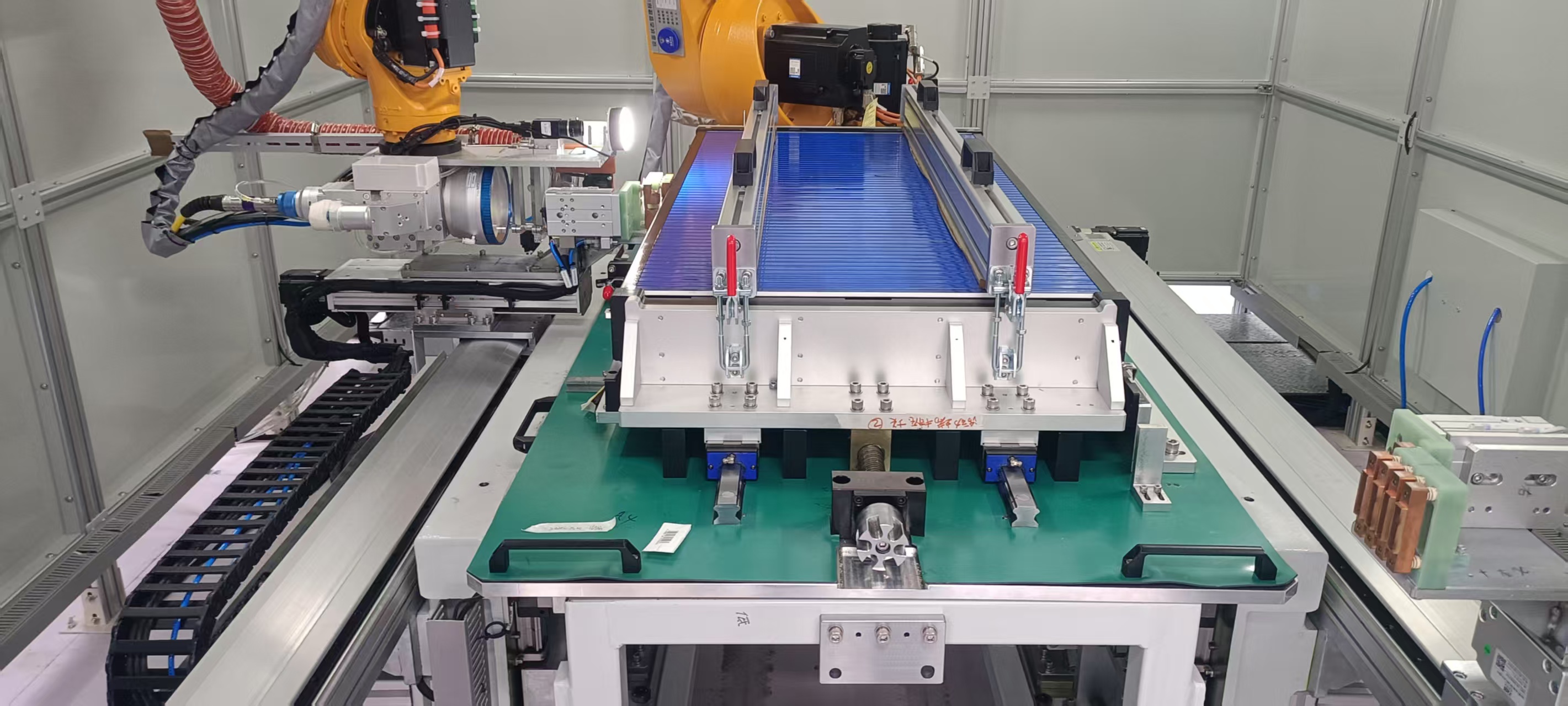
Why the Format Decision Comes Before the Supplier Decision
Most line-selection failures are not supplier failures. They are format mismatches that only appear after installation, when a pack programme shifts from a module-based build to a cell-to-pack build, or when the cell moves from a 280Ah format to 314Ah. A line that was correct for the previous product generation can be structurally wrong for the next one, because the fixture set, the insertion sequence and the welding program are all tied to cell geometry and pack configuration.
That is why experienced buyers sequence the decision the other way round: pack architecture first, line configuration second, supplier third. The Zonzsin range reflects this logic. CTP, blade and EV-format lines are separate models with separate published specifications rather than a single universal platform sold with optional add-ons — which means the buyer's first real decision is a technical one, not a commercial one.
CTP and Blade Lines Are Not Two Names for the Same Machine
Cell-to-pack assembly removes the intermediate module stage: cells or cell groups are positioned directly into the pack enclosure and joined there. Blade-format assembly handles long, narrow prismatic cells that are oriented and stacked along the pack length. Both architectures finish with an enclosed, welded and tested pack, and both depend on similar supporting equipment: vision inspection systems, fixtures and tooling, laser equipment, and assembly and testing stations.
The difference sits upstream of the finish line — how cells are fed, how they are located before welding, and how much joining work happens inside the pack. Those three factors drive cycle time, footprint and the acceptance criteria a buyer should write into a purchase contract. A buyer who compares only brand names and headline rates is effectively deferring the real comparison until after the purchase order, when it is expensive.
What the Published Model Data Actually Shows
| Specification | ZZX2406 — CTP battery PACK assembly line | ZZX2501 — Blade battery PACK assembly line |
|---|---|---|
| Line type | CTP battery PACK assembly line | Blade battery PACK assembly line |
| Cycle time | 4 PPM | 6 PPM, 30 min per PACK |
| Automation | Semi-automatic | Not stated in the published model data |
| Footprint (L × W × H) | 58,000 × 11,000 × 3,800 mm | Not stated in the published model data |
| Main structure material | Carbon steel Q235 | Carbon steel Q235 |
| Electrical requirement | Not stated in the published model data | AC 380V ±10%, 50+0.5 Hz |
| Compressed air | Not stated in the published model data | 0.6~0.8 MPa |
| Cell and pack configuration | 314Ah & 587Ah cells; 1P96S pack | Not stated in the published model data |
| Applicable industry | Energy storage; EV and C&I | EV industry; energy storage |
Two observations matter for buyers. First, the faster published rate belongs to the blade line, not the CTP line. That is a reminder that rate figures are configuration-specific rather than a general ranking of machines — the 6 PPM figure on the ZZX2501 and the 4 PPM figure on the ZZX2406 describe different workloads on different pack designs, and both should be re-confirmed against the buyer's own pack before they are written into a contract.
Second, the CTP line is published as semi-automatic. That is a specification rather than a shortcoming. It tells the buyer how much manual handling the operating model includes, and therefore how many operators the business case must carry per shift. In an Indian plant where labour availability and shift patterns vary by state, that number belongs in the financial model, not in the appendix.
Field Inspection Notes: What to Verify Before You Sign
Published specifications are the entry ticket. The inspection is what converts them into an enforceable project. Six checks are worth formalising in the acceptance protocol.
1. The certificate number, not the certificate image
The CTP battery PACK assembly line model ZZX2406 holds ISO 9001 certification issued by ZDCB under certificate number 44825MS079001R0, complying with GB/T19001-2016 ISO9001:2015, valid from 20 November 2025 to 19 November 2028 and applicable to the global market. The registered scope covers laser welding equipment, laser cleaning equipment, the module PACK assembly line, and the R&D and assembly of AGV-based cluster loading robot.
Three checks follow from that. Confirm the number with the issuing body rather than reading the frame on the factory wall. Confirm that the registered scope covers the stations actually being purchased — laser welding equipment is explicitly inside this scope. And confirm that the validity window spans your planned commissioning date, because a certificate expiring during installation turns a compliance document into a negotiation.
2. Operation rate measured across a shift, not across a demonstration
The published single-machine operation rate for the ZZX2313 EV battery PACK assembly line is ≥95%. Twenty demonstration cycles will not test that figure. Buyers should define the measurement window inside the acceptance protocol: a full production shift, running saleable packs, with unplanned stops, operator interventions and material starvation all counted as downtime. It is also worth asking the supplier to define the term before agreeing to the number, because availability, utilisation and yield are sometimes used interchangeably in commercial discussions and mean very different things technically.
3. Welding qualification, split into first-pass and final
The same EV-format specification publishes a one-time welding qualification rate of ≥99.5% and a final welding qualification rate of ≥99.95%. These are two distinct claims. The first-pass figure tells the buyer how much rework the line will generate; the final figure tells the buyer what leaves the station after rework has been completed. A contract that captures only the final number hides the labour and consumable cost of the gap between them — and in a cell-to-pack architecture, where rework after pack closure is expensive, that gap is the single most useful number in the tender.
4. Utilities: the point where the line meets the plant
The blade line is specified for AC 380V ±10% and 50+0.5 Hz, with compressed air at 0.6~0.8 MPa. Tolerance windows that look generous on paper narrow considerably against a weak feeder or a compressor cycling under load. Before installation, verify supply quality at the point of use rather than at the incoming panel: record voltage across a working shift, confirm frequency stability, and check air dew point and filtration at the station. Moisture in the air line reaches welding optics as well as pneumatic cylinders, and neither failure mode appears during a two-hour factory acceptance test.
5. Footprint, vertical clearance and material flow
The CTP line's published footprint is 58,000 mm long, 11,000 mm wide and 3,800 mm high. That is a building constraint as much as a machine constraint. Service aisles, control cabinets, cell buffers and pack handling equipment all sit outside that figure, and a hall with insufficient vertical clearance cannot accept the machine even when the floor area looks sufficient. In an existing Indian installation, the space question was addressed with a U-shape layout, which the site reports as space-saving. Ask for the layout drawing with material flow arrows before committing to a hall.
6. The supply boundary of a turnkey line
The application data lists matched equipment including vision inspection systems, fixtures and tooling, laser equipment, and assembly and testing stations. "Turnkey" is only meaningful relative to a boundary. Ask for that boundary in writing: which stations, which control software, which spare parts, which commissioning scope — and what remains on the buyer's side of the interface. Most post-installation disputes trace back to an interface that both parties assumed the other had covered.
Operating Conditions the Line Has to Survive
These lines are typically installed indoors, in a standard factory, under industrial assembly-line conditions and on continuous or shift-based production, controlled through touch screens and programmable sequences. The scenario documentation for this class of equipment flags four requirements that are routinely underestimated during planning: ESD protection, fire prevention measures, temperature/humidity and cleanliness control, and PACK compatibility with fixture adaptation.
The last item deserves particular attention. Fixtures are PACK-specific. If the buyer's product roadmap includes a second pack variant within the depreciation period of the line, fixture adaptation is not a maintenance detail — it is the deciding factor in whether the line can be reused or must be replaced.
Where CTP Fits — and Where It Does Not
The ZZX2406 is specified for energy storage, EV and commercial & industrial applications, with 314Ah and 587Ah cells in a 1P96S pack. That points to a defined buyer profile: an ESS integrator or pack manufacturer building large prismatic packs at a predictable rate, who prefers a semi-automatic line with a controlled footprint over a fully automatic line with a longer ramp-up.
The India reference installation is instructive precisely because it is ordinary. The site runs one unit, has been in operation for roughly a year, and is reported as being in stable operation. The user base covered by the reference spans automotive OEMs, energy storage system integrators, battery cell and PACK manufacturers, and EPC turnkey contractors — a cross-section that reflects how mixed the Indian pack-building landscape currently is. Two operational details are repeated in the site feedback: the U-shape layout saves space, and the line is described as user-friendly. Neither is a marketing claim; both are the kind of detail that determines whether a line is actually run at its rated rate six months after commissioning.
Where CTP does not fit as neatly is in a plant whose product mix still contains module-based packs, or whose order book changes format faster than its fixture budget can follow. In those cases a modular (MTP) assembly approach, or a CTP line with fixture adaptation explicitly designed in from the start, is the more honest answer than a pure CTP commitment.
CTP Against Traditional Module-Based Assembly
Traditional module-to-pack lines retain the module stage: cells are grouped into modules, modules are tested, then modules are assembled into the pack. That structure creates more parts, more joining operations and more handling, but it also isolates defects — a fault inside a module can be detected and removed before the pack is closed. CTP removes that intermediate layer. The pack becomes simpler at system level, but every joint inside it carries more consequence, and rework after pack closure is expensive.
Three practical consequences follow for a buyer:
- Process discipline is front-loaded. Welding qualification rates such as ≥99.5% one-time and ≥99.95% final are not aspirational marketing figures in a CTP context. They are the mechanism that replaces the defect-isolation step the module stage used to provide.
- Changeover is less forgiving. Fixtures and tooling are PACK-specific, so a CTP line is naturally less format-agnostic than a modular line unless fixture adaptation is designed in from the beginning.
- Automation level is a choice, not a given. The ZZX2406 is published as semi-automatic. Buyers who need a higher automation level should state that requirement at the inquiry stage, because the customization scope covers cycle time, automation level, logo, color and configuration.
What the Market Numbers Say
Independent market data supports the direction of travel, with the standard caveat that scope differences make headline figures difficult to compare. Spherical Insights values the global CTP battery market at USD 18.35 billion in 2023 and projects USD 75.93 billion by 2033. MarketsandMarkets puts the battery manufacturing equipment market — the equipment layer only — on an 18.8% CAGR from 2025 to 2030, reaching USD 36.94 billion. The scope problem is visible in the same data set: Global Insight Services estimates USD 23.9 billion for 2025, while MarketsandMarkets estimates USD 15.63 billion for equipment only in the same year. Buyers should read these figures as directional signals about where capital is flowing, not as a price index for a specific line.
Adoption data is more directly actionable. ResearchInChina reports that CTP technology was integrated into 48.6% of new energy vehicles sold in China by 2023, rising from 13 models in 2021 to 57 models by late 2023. On the cell side, the industry has moved from the 280Ah benchmark toward 314Ah formats for energy storage packs to improve energy density and reduce assembly cost — which explains why the ZZX2406 specification lists 314Ah and 587Ah cells rather than an open-ended cell list. For an Indian buyer, the practical implication is that cell format is a moving target and fixture planning must assume it will move again.
What Buyers Should Expect Next
Three movements are worth planning for.
First, cell formats will keep shifting. The specification already covers 587Ah alongside 314Ah, and fixture adaptation is listed as a scenario requirement. The useful question for a buyer is therefore not "which cells are current" but "how much of the fixture set must be replaced for the next format, and at what cost".
Second, compliance will do more work in procurement. Pack-level requirements such as IEC 62133-2 for global market access and UL 1642 / UL 2054 for North America sit downstream of the assembly line, but line documentation, traceability and process records feed directly into those submissions. A quality management certificate with an auditable number — such as ISO 9001 certificate 44825MS079001R0 issued by ZDCB — is a starting point rather than an endpoint.
Third, delivery schedules will set the project calendar. Zonzsin's published capability data lists a lead time of 3 to 5 months, a monthly production capacity of 3 units, a minimum order quantity of 1 unit, 100% testing as the quality-control standard, OEM/ODM production, and after-sales support combining remote support with on-site installation and commissioning. The company exports approximately 60% of its output, with Southeast Asia and the EU as its main markets — a footprint that matters when a buyer needs commissioning engineers on site in India during a narrow installation window.
Frequently Asked Questions
What is the difference between a CTP battery pack assembly line and a blade battery pack assembly line?
A CTP (cell-to-pack) line assembles cells or cell groups directly into the pack enclosure, removing the intermediate module stage. The Zonzsin ZZX2406 CTP line is specified for 314Ah and 587Ah cells in a 1P96S pack, at a 4 PPM cycle time with semi-automatic automation, and applies to energy storage, EV and C&I production. A blade line handles long, narrow prismatic cells; the ZZX2501 is specified at a 6 PPM cycle time, roughly 30 minutes per pack, for EV and energy storage applications. Both models use carbon steel Q235 as the main structure material.
What utilities does a blade battery pack assembly line require?
The ZZX2501 blade battery PACK assembly line is specified for AC 380V ±10% at 50+0.5 Hz, with compressed air at 0.6~0.8 MPa. For the EV battery PACK assembly line model ZZX2313, the published electrical requirement is AC 380V ±10%. In practice, these are supply specifications rather than site guarantees: buyers should measure voltage, frequency and air quality at the point of use across a full production shift, since moisture and pressure drops in the air line affect both pneumatic and welding stations.
What ISO 9001 evidence should a buyer verify for a CTP battery pack assembly line?
The ZZX2406 CTP battery PACK assembly line holds ISO 9001 certification issued by ZDCB with certificate number 44825MS079001R0, complying with GB/T19001-2016 ISO9001:2015. It is valid from 20 November 2025 to 19 November 2028 and applies to the global market. The registered scope covers laser welding equipment, laser cleaning equipment, the module PACK assembly line, and the R&D and assembly of AGV-based cluster loading robot. Buyers should confirm both the certificate number and the scope with the issuing body, and check that the validity period covers commissioning.
Which quality metrics should be checked during factory acceptance testing?
The published metrics for the ZZX2313 EV battery PACK assembly line provide a usable benchmark set: a single machine operation rate of ≥95%, a one-time welding qualification rate of ≥99.5%, and a final welding qualification rate of ≥99.95%. Buyers should define the measurement window in advance — typically a full production shift running saleable packs — and test with their own cell samples rather than supplier-provided ones. The one-time rate indicates expected rework volume; the final rate indicates what leaves the station after rework.
How long does a customized battery pack assembly line take to deliver and install?
Zonzsin's published capability data lists a lead time of 3 to 5 months, a monthly production capacity of 3 units, and a minimum order quantity of 1 unit. Customization covers cycle time, automation level, logo, color and configuration, with 100% testing as the quality-control standard. After-sales support combines remote support with on-site installation and commissioning, which is relevant for buyers planning installation in a location without an established local service base.
Can one assembly line handle both EV traction packs and stationary storage packs?
It depends on the model. The ZZX2406 CTP line is specified for energy storage, EV and C&I applications with 314Ah and 587Ah cells in a 1P96S pack, while the ZZX2501 blade line is specified for the EV industry and energy storage. Because fixtures and tooling are PACK-specific, and PACK compatibility with fixture adaptation is listed as a scenario requirement, buyers planning to build more than one pack type should confirm the changeover scope — fixture set, tooling, changeover time — before purchase rather than after installation.
For readers who want the underlying model data in one document, Zonzsin's product brochure is available for download: Product brochure (PDF). Additional company information is published at www.zonzsin.com.