
Blister-Cartoner Matrix: Servo, Splicing and GMP Tooling
Blister-Cartoner Matrix: Servo, Splicing and GMP Tooling
An integrated blister-cartoning line is usually shortlisted on one figure — blisters per minute — and then argued about on a dozen others. The Hoping DHL8005H reference configuration shows why the order matters: up to 800 blisters per minute at the blister station, up to 500 cartons per minute at the cartoner. Read separately, either number looks decisive. Read together, they describe a synchronization problem rather than a speed contest.
This article turns that problem into a comparison matrix for integrated blister-cartoning lines. It is built on six dimensions that survive a technical review: blister-to-carton synchronization, control architecture, replenishment autonomy, film splicing, GMP-oriented contact parts and tooling, and format-change capability — plus the cost and fit boundaries that decide whether an integrated line belongs in the project at all.
It is written for the decision stage: engineers, technical buyers and supplier-qualification teams weighing an integrated line against a traditional blister machine with manual transfer and a standalone cartoner, or against a low-speed semi-automatic alternative. The DHL8005H facts serve as a worked example rather than a universal benchmark. Every figure below is a company-stated maximum that a factory acceptance test should confirm.
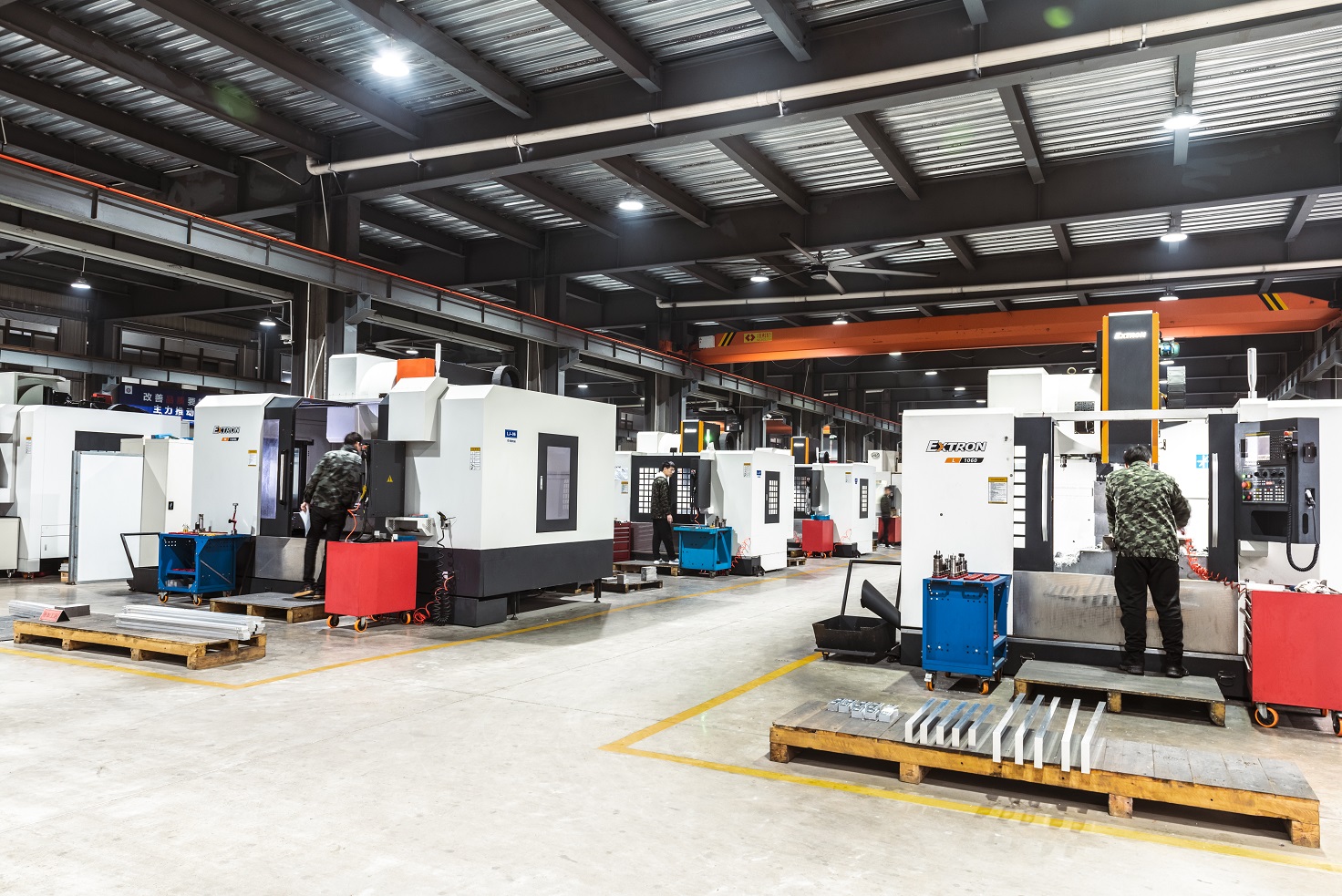
Tooling and contact-part fabrication is where a GMP specification stops being a phrase and becomes a drawing. Image: Hoping Machinery.
Why One Speed Figure Cannot Carry a Comparison
On any linked line, sustained output is set by the slowest constrained station, not by the highest number on a datasheet. The blister station forms, fills, seals and punches. The cartoner erects a carton, adds a leaflet, inserts the blister, closes, codes and discharges. Between them sit transfer and, on a well-specified line, an accumulation buffer. Whichever station reaches its limit first defines the line.
The arithmetic is simple and worth doing before a site visit. Cartoner demand equals blister output divided by the number of blisters per carton. At two blisters per carton, 800 blisters per minute implies 400 cartons per minute — 80% of the stated 500-carton ceiling. At one blister per carton, cartoner demand equals the blister rate and the 500-carton ceiling binds first, capping practical output well below the blister maximum. Both are calculations from the stated maxima, not measured results, but they tell a buyer which station to interrogate first.
The numbers also belong to a model. Hoping's comparison material separately cites a DHL1000/5H configuration at up to 1,000 blisters per minute and 500 cartons per minute. Carrying the 1,000 figure into a DHL8005H discussion changes the subject without announcing it. Hence the first rule of this matrix: no speed figure enters a comparison without its model, its blister format, its blisters-per-carton count and its stated basis.
The second rule follows. The available public record for these maxima does not include an independent acceptance test or a complete statement of operating conditions, and Hoping's own material notes that actual output depends on product format, quantity per carton, materials and process conditions. The stated output is therefore a screening value that generates factory-acceptance questions — sustained output over an agreed run, reject rate, format specification — not a guaranteed production rate.
The DHL8005H Reference Facts in Brief
Zhejiang Hoping Machinery Co., Ltd. (HOPING) is a pharmaceutical packaging machinery manufacturer established in 2001 and based in Ruian, Zhejiang Province, China. The company states a manufacturing area of 28,800 m², around 300 employees, 56 R&D engineers and an annual output of 500 units, with exports at roughly 25% of sales across Southeast Asia, the Middle East, Eastern Europe, South America and Africa. Its product scope covers blister packing machines, cartoners, flow wrappers, case packers and palletizers.
The DHL8005H reference facts supplied for this comparison are:
- Stated maxima of up to 800 blisters per minute and up to 500 cartons per minute
- Beckhoff motion controller with a CP9315 industrial PC
- Three servo-driven, independent replenishment channels
- Automatic splicing for PVC forming film and aluminum lidding foil
- Stainless steel and aluminum construction
- GMP-oriented contact parts and tooling, defined per technical agreement
- Mold-change and preset-memory functions for format change
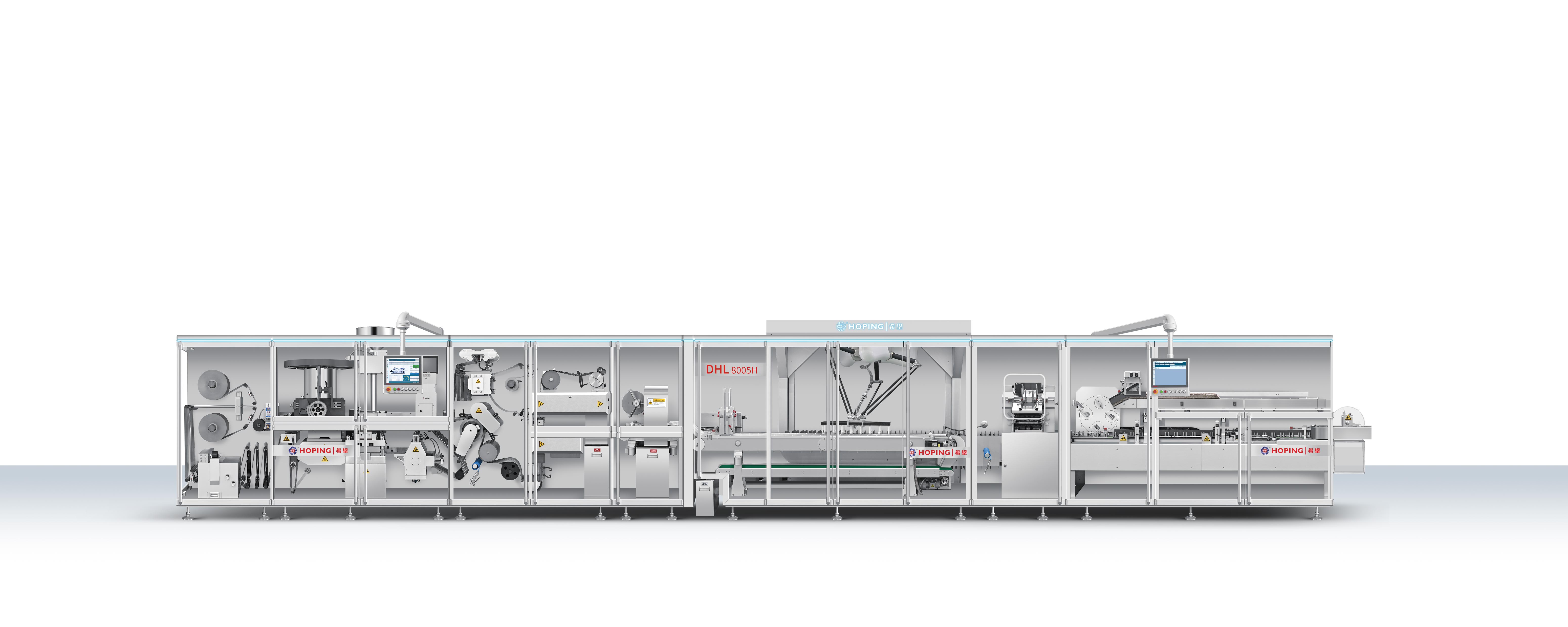
The DHL8005H reference configuration: up to 800 blisters/min and 500 cartons/min, stated as maxima. Image: Hoping Machinery.
Each item below becomes a comparison dimension with a buyer question attached. The purpose is not to restate the specification but to decide what it changes in an evaluation.
Dimension 1: Blister-to-Carton Synchronization
The reference facts describe blister packaging, blister transfer, leaflet handling, carton opening, insertion, inspection and rejection, and downstream connection as one automated process rather than a sequence of separate machines. That integration is the substantive difference from a traditional arrangement, where blisters leave the blister machine and reach the cartoner through manual transfer and intermediate handling.
What the buyer has to test is the behaviour at the boundary. Three questions cover most of it: how much accumulation exists between the blister station and the cartoner; what happens to the blister station when the cartoner stops for a leaflet or carton fault; and how rejected blisters are reconciled so that carton count and blister count stay traceable at batch end. A line that simply stops everything on every fault is safe but expensive. A line that buffers without reconciliation is a documentation problem in waiting.
Dimension 2: Control Architecture — Beckhoff Motion Controller and CP9315 IPC
A named motion controller and industrial PC are a qualification advantage before they are a performance argument. They tell the buyer which engineering platform, spare-part line and programming skill set the line depends on, and they make questions about software ownership answerable. A generic "PLC control" description does not.
In the review, establish whether the Beckhoff controller covers the whole line or only part of it, where recipe and parameter data are stored, how programs and settings are backed up and version-controlled at handover, how long fault records are retained, and which interfaces exist to upstream and downstream equipment and to site data systems. These are ordinary questions, but they decide how quickly a fault is diagnosed on a night shift and whether a format recipe can be reconstructed after a controller replacement.
Dimension 3: Three Servo-Driven Independent Replenishment Channels
Replenishment is where a fast line quietly becomes a slow one. The reference facts list three servo-driven channels described as independent. During the technical review, confirm which material each channel serves, how a channel-empty condition is signalled, whether the line stops or continues on the remaining channels, and how a refill is synchronised with the running cycle.
The comparison question is not how many channels exist but what a refill costs in lost output. Ask for the sequence an operator follows at each channel, whether refills are possible without stopping the cartoner, and how the line behaves on the first cycle after a refill. A supplier who can walk through that sequence on the machine is describing a design; one who cannot is describing a brochure.
Dimension 4: PVC and Aluminum Foil Auto Splicing
Automatic splicing joins a new roll to the running web so the line does not stop for a full roll change. On the reference configuration it is specified for PVC forming film and aluminum lidding foil. The mechanism is straightforward; the qualification is not. Ask how a splice is detected, whether the spliced section is marked and rejected downstream, how many packs are lost per splice, and how splice events are recorded against the batch.
One boundary is worth stating explicitly. The splicing provision is specified for a PVC-and-aluminum material set. If the intended format uses an alu-alu (cold-form) structure, confirm the splicing arrangement for that material set separately rather than assuming the provision transfers. Material structure changes the forming route, and the splicing specification should be read against the structure actually being run.
Dimension 5: GMP-Oriented Contact Parts and Tooling, Per Technical Agreement
The phrase "per technical agreement" carries most of the weight in this dimension, and buyers should not read past it. Machine-level GMP expectations are largely settled at contract level: contact-part material grades, surface condition, cleanability, tooling drawings and the documentation package. The reference facts state GMP-oriented contact parts and tooling within that framework, together with stainless steel and aluminum construction.
Two regulatory reference points are commonly cited and frequently misapplied. ISO 15378:2017 specifies Good Manufacturing Practice requirements for primary packaging materials for medicinal products — it addresses packaging materials, not machine design. The U.S. FDA's current Good Manufacturing Practice framework establishes quality standards for pharmaceutical manufacture, but the publicly available guidance does not prescribe packaging-machine design at component level. Neither document will tell a buyer which stainless grade belongs on a blister tooling set; the technical agreement will.
The recognised risk register for this equipment class makes the point concrete. Poor blister forming or sealing, foreign matter, missing leaflets, carton jams and coding errors are the acknowledged failure modes; the acknowledged controls are sensor monitoring, inspection where configured, missing-product alarms, automatic stop and rejection, key-parameter locking, fault records and mechanical guarding — supported by factory and site acceptance testing and SOP training. Each control belongs somewhere in the agreement. A buyer who specifies contact parts and acceptance criteria together gets a verifiable package; one who specifies neither gets an assertion.
Dimension 6: Mold Change and Preset Memory
Format flexibility is measured at changeover, not in a catalogue. Mold-change and preset-memory functions are the two halves of that measurement: the physical tooling swap and the parameter recall that follows it. The useful questions are how many discrete steps a change involves, which tools are needed, what the preset memory actually covers — servo positions, sealing parameters, or both — and what first-article verification is required before production resumes.
Ask also how preset data is protected. A recipe that any operator can overwrite without a record is a validation liability; a recipe held behind change control is an asset. For a multi-format line, the changeover sequence and its documentation deserve more scrutiny at the decision stage than another decimal place on the speed figure.
Integrated Line Versus the Traditional Configuration
The traditional alternative — a blister machine, manual transfer and a standalone cartoner — remains a legitimate choice. The integrated configuration is designed for large-scale solid-dosage packaging, high-capacity workshops and multi-format lines where reduced manual contact and stable operation matter; the traditional route stays viable for lower volumes and very wide format ranges. The matrix below compares them on documented characteristics rather than outcome tests.
| Decision dimension | Blister machine + manual transfer + standalone cartoner | DHL8005H-class integrated blister-cartoning line | What to verify |
|---|---|---|---|
| Material flow | Manual transfer and intermediate handling between separate machines | Blister transfer, leaflet handling, carton opening, insertion, inspection/rejection and downstream connection in one automated process | Reject reconciliation and batch traceability at the transfer point |
| Speed basis | Set by each standalone unit; transfer is labour-paced | Stated up to 800 blisters/min and up to 500 cartons/min | Blisters per carton; which station binds first; sustained output in acceptance testing |
| Drive and control | Conventional, non-full-servo link line | Full-servo drive with Beckhoff motion controller and CP9315 IPC | Controller scope, recipe ownership, backup and fault-log retention |
| Replenishment and splicing | Stop-and-reload for film and materials | Three servo-driven independent channels; automatic PVC and aluminum foil splicing | Channel assignment, splice marking and downstream rejection |
| Tooling and GMP | Varies by supplier and by machine | GMP-oriented contact parts and tooling, stainless steel and aluminum construction, per technical agreement | Material certificates, surface specification, tooling drawing sign-off |
| Format change | Manual reset, operator-dependent | Mold change with preset-memory recall | Step count, preset coverage, first-article check, change-control records |
| Cost profile | Lower initial investment | Higher initial investment; offset by lower labour, transfer, management and quality-risk cost in continuous production | Total cost model at your volumes and run lengths |
Comparison of documented characteristics. Speed figures are company-stated maxima for the reference configuration; no independent acceptance test is asserted here.
Where the Integrated Line Is the Wrong Answer
An integrated blister-cartoning line carries a higher initial investment than a standalone or semi-automatic arrangement, and the offset appears as reduced labour, transfer, management and quality-risk cost only in continuous production at scale. Where volumes are modest, run lengths are short, or the format mix changes constantly, changeover and cleaning time can dominate the economics and a simpler route fits better.
Two further boundaries belong in the decision file. First, integration concentrates service, spares and software dependency on one supplier, which raises the value of documented backup, remote support and spare-part commitments. Second, the downstream scope has to be sized for the line, not for the blister machine: case packing and end-of-line equipment sized on the blister maximum will either idle or bottleneck, depending on which station binds.
Market Context
Commercial research gives the surrounding category some scale. Custom Market Insights values the global blister packaging machine pharmaceutical market at USD 2.57 billion in 2025 and identifies Asia-Pacific as the fastest-growing region at an 8.87% CAGR to 2031. Mordor Intelligence reports horizontal systems at 70.12% of cartoning market share in 2024. These are publisher-defined estimates with their own scope and methodology limits, and neither breaks the figures down by supplier — but they explain why integrated blister-cartoning configurations are being compared more often at the decision stage.
Regulatory direction points the same way. A draft Chinese GMP for pharmaceutical packaging materials, reported by a regulatory consultancy and still in public consultation, would guide marketing licence holders in reviewing packaging material suppliers. Buyers are therefore being asked to document supplier review — which is exactly what a technical agreement on contact parts and tooling produces.
Outlook
Trade coverage reporting PMMI content describes pharmaceutical manufacturers moving toward digitised data collection and integrated solutions to meet regulations and improve visibility. That is a directional statement without a measurement basis and should be treated as such. Its practical implication for this matrix is nonetheless clear: control architecture, recipe management and fault records are becoming part of the equipment comparison rather than an afterthought, and a line specified with those elements documented will be easier to integrate later. Whether that advantage materialises depends on the site's own systems and validation plan.
A Decision-Stage Checklist
- State the blister format and blisters per carton before comparing any speed figure.
- Identify which station binds first at your format, and ask for sustained output rather than maximum output.
- Confirm the model behind every performance number, including any figure quoted from a different configuration.
- Map the buffer between blister and cartoner, and the behaviour of each station when the other stops.
- Establish controller scope, recipe ownership, program backup and fault-log retention in writing.
- Walk the refill sequence for each replenishment channel on the machine.
- Confirm splice detection, marking and downstream rejection, and whether the material set matches your structure.
- Fix contact-part material grades, surface condition and documentation in the technical agreement.
- Time a format change and confirm what preset memory actually restores.
- Agree acceptance-test criteria, reject-handling rules and operator training before shipment.
- Build the cost comparison at your volumes and run lengths, not at the stated maximum.
A full description of the company's blister, cartoning, case packing and end-of-line equipment is available in the Hoping Machinery catalogue (PDF). Technical questions about a specific configuration can be directed to Monica at monica@xwbj.com or +86 133-5610-5292.
FAQ
What do 800 blisters per minute and 500 cartons per minute mean when read together?
They are two maxima of one line, and the relationship between them sets practical output. Cartoner demand equals blister output divided by blisters per carton: at two blisters per carton, 800 blisters per minute implies 400 cartons per minute, inside the 500-carton ceiling; at one blister per carton, the cartoner ceiling binds first. Buyers should convert their own format into that ratio before treating either figure as a capacity.
How does an integrated blister-cartoner differ from a blister machine plus manual transfer and a standalone cartoner?
The integrated configuration combines blister packaging, blister transfer, leaflet handling, carton opening, insertion, inspection or rejection, and downstream connection into one automated process, reducing manual intervention and intermediate handling. Full-servo drive supports motion synchronization across stations. The trade-off is a higher initial investment, usually offset by lower labour, transfer, management and quality-risk cost in large-scale continuous production rather than in short-run operation.
What should be verified about a Beckhoff motion controller and CP9315 IPC before signing?
Confirm whether the controller covers the whole line or only part of it, where recipes and parameters are stored, how programs and settings are backed up and version-controlled at handover, how long fault records are retained, and which interfaces exist to adjacent equipment and site systems. Also confirm spare-part availability and who holds the programming knowledge, because those determine recovery time after a fault or a controller replacement.
Why does "per technical agreement" matter in a GMP tooling specification?
Because most machine-level GMP expectations are settled contractually rather than by a single standard. ISO 15378:2017 addresses GMP requirements for primary packaging materials, not machine design, and publicly available cGMP guidance does not prescribe component-level machine specification. Contact-part material grades, surface condition, tooling drawings, documentation and acceptance criteria therefore have to be written into the technical agreement, where they can be inspected and verified.
How do mold change and preset memory affect format flexibility?
They define what a changeover actually costs. Mold change covers the physical tooling swap; preset memory determines how much of the machine setting can be recalled rather than re-entered. Ask how many discrete steps a change involves, which tools are needed, what the preset covers, how preset data is protected against unauthorised edits, and what first-article verification is required before production resumes. Format flexibility is measured in that sequence, not in the number of formats listed.
Есть вопросы или нужны дополнительные детали?
Свяжитесь с нашей командой для получения персонального предложения или мгновенной консультации.
Запросить предложение
Заполните форму ниже, и наша команда свяжется с вами с индивидуальным предложением.
Прямой чат WhatsApp
Предпочитаете общаться в реальном времени? Напишите нам в WhatsApp для мгновенной помощи и быстрых ответов.
- Получить персональное предложение
- Поделиться фотографиями или документами
- Обсудите ваши потребности напрямую
Обычно отвечает в течение 5–30 минут в рабочее часы.