
Body Scrub vs Toothpaste: Hydrated Silica Fit
Hydrated silica (CAS 7631-86-9, INCI: Hydrated Silica) is a foundational material in both body scrubs and toothpastes, yet the two formulations ask it to perform on almost opposite scales. In a body scrub, silica works as a coarse, water-insoluble exfoliating particle whose particle size and sphericity determine sensory feel. In toothpaste, it works as a fine, controlled abrasive and a structure-building thickener whose relative dentin abrasion (RDA) and refractive index determine cleaning safety and paste appearance. That scenario split flows directly into procurement: grade, purity threshold, regulatory documentation and supplier proof all shift with the end use.
This article compares the two application classes — ZLDIO-PC body scrub grades and ZLSIL-T toothpaste grades within the broader personal-care silica supply context of Zhonglian Food Silica — and explains what buyers should verify when specifying the material. It deliberately treats the two applications as one family of chemistries running two different functional jobs, rather than as one being a derivative of the other.
Why the same chemistry serves opposing functions
Hydrated silica is an amorphous synthetic material produced by precipitation. Primary particles are formed in a wet process and then aggregated into micron-scale particles, creating a porous, chemically inert solid that is insoluble in water, oils and most solvents. That inertness is what makes it usable in oral and skin-contact applications, and the morphology that the precipitation route can tune — particle size, pore volume, surface area, particle shape — is what gives it such different roles.
The two scenarios diverge from this point:
- Body scrub uses hydrated silica as a physical exfoliating particle. The particle needs to be large enough to be felt and to do mechanical work, smooth enough to avoid micro-tears, and of a density that keeps it suspended. Particle size is described as D50 (tunable from 120–850 μm for the PC series), and formulators typically specify fine, medium or coarse grades to match the intended scrub intensity.
- Toothpaste uses hydrated silica as an abrasive and a structuring thickener. The particle has to be small enough to clean without excessive wear (abrasive D50 typically 10–14 μm), with a BET surface area in the 110–195 m²/g range — high surface area to build thixotropy in the paste. Add to that a controlled RDA (which governs how much dentin is worn during brushing) and, in high-clarity gel systems, a refractive index that matches the base.
Both applications share the same chemical identity and the same baseline purity requirement (SiO&sub2; ≥99%, CAS 7631-86-9). They then diverge further on size range, morphology, regulatory registration and test methodology.
Particle matters: D50, sphericity and the functional feel
For body scrub, the particle's physical behaviour defines the product experience.
Particle size (D50). The ZLDIO-PC series covers a tunable D50 range from 120 μm to 850 μm. Selecting a fine grade (nearer 120–250 μm) gives a gentler, more refined exfoliation for sensitive skin or facial care. Selecting a coarse grade (nearer 500–850 μm) gives a stronger mechanical scrub, suited to body or foot applications. The range is continuous, so a buyer can specify an intermediate value without changing chemistry.
Sphericity and surface morphology. Roundness matters for an exfoliating particle: angular particles can scratch the skin barrier and cause micro-tears. Hydrated silica can be controlled during precipitation to give particles a rounded-to-spherical morphology, giving gentle but effective exfoliation in lab tests. This is one of the primary advantages of a physical scrub over salt, sugar or PVA beads.
Suspension and density. In a gel or cream base, the exfoliating particles must stay suspended rather than settle at the bottom of the package. The PC series uses low oil absorption and controlled bulk density to help particles remain distributed in suspension, avoiding caking or phase separation across shelf life.
For toothpaste, the critical parameters sit elsewhere.
Particle size (D50) and BET. Toothpaste abrasive grades (ZLSIL-T series) generally use a D50 around 10–14 μm, with BET between 110 and 195 m²/g. Finer particles are used for transparent gels and sensitive or children's formulations. Higher BET is used for thickening grades, where the particle network provides thixotropy (flows when brushed, holds shape when standing).
RDA (relative dentin abrasion). This is the toothpaste-specific measure of abrasivity, with ranges from low abrasion (RDA 30–60 for children's or sensitive牙龈 / sensitive gum) through medium abrasion (RDA 70–120 for daily care) to high abrasion (RDA 130–180 for whitening). A supplier and buyer must agree on RDA targets when specifying a grade, because excessive RDA can wear enamel and insufficient RDA fails to clean.
Refractive index. In a clear gel toothpaste, the particle's refractive index must match the liquid base (glycerin / sorbitol / water systems, depending on formulation, around 1.45–1.47), or the paste turns cloudy. Toothpaste-grade silica can be engineered to deliver that match, making clear-gel formulations possible.
Whiteness and opacity. Toothpaste silica typically has a whiteness of ≥95% and no yellowing. In a white opaque paste, it contributes to a whitening appearance without discoloration over time.
Purity and regulatory baselines
Both application classes require SiO&sub2; ≥99% (abrasive / cosmetic grade hydrated silica), but the compliance routes differ.
Body scrub. As a cosmetic ingredient, hydrated silica must follow EU Cosmetic Regulation 1223/2009 and FDA 21 CFR cosmetic provisions as applicable. In China, cosmetic-use silica requires a registration dossier, for example the Zhonglian cosmetic silicon dioxide registration dossier (certificate 002648-10795-1460, issued 2024-05-20, NMPA Standard: China Cosmetic Raw Material Safety Specification). The registration covers silica for cosmetic use, as an anti-caking agent, and is the basis for supplying Chinese cosmetic brands.
Toothpaste. Toothpaste silica must meet ISO 11609 (toothpaste — requirements, test methods), EU Cosmetic Regulation 1223/2009 and, in China, GB 8372 (toothpaste). Heavy metal limits (lead, arsenic, mercury) must be respected, and no prohibited abrasives may be used. Suppliers should provide the COA, MSDS and raw-material registration documents.
Both application classes share, at the chemical level, the food additive number E551 and CAS 7631-86-9, because the same family of amorphous silica is used in both oral and skin contact; EFSA re-evaluated its safety in October 2024 (including the nano dimension) and concluded it is safe for all populations, including infants.
Both suppliers must demonstrate:
- heavy metals results per batch (typically reported on the COA)
- microbial results per batch (total plate count, yeast and mould, pathogens absent)
- particle size distribution (D50, D90)
- pH in aqueous slurry (typically 6.0–8.0 for body scrub, 6.0–8.5 for toothpaste)
- LOI and LOD (≤7.0% for body scrub, ≤8.5% for toothpaste)
Zhonglian Food Silica supplies a COA per batch for both series, with third-party test results available on request.
Formulation roles: a functional comparison
| Function | Body Scrub (ZLDIO-PC) | Toothpaste (ZLSIL-T) |
|---|---|---|
| Primary role | Physical exfoliating particle | Abrasive and thickener |
| D50 range | 120–850 μm, tunable | 10–14 μm (abrasive) |
| BET (m²/g) | Not specified | 110–195 |
| RDA | Not applicable | Low, medium, high grades |
| Key morphological property | Sphericity, surface smoothness | BET, particle shape, refractive index |
| Suspension | Low oil absorption / controlled density | Thixotropy built via thickening |
| Water solubility in use | Insoluble (maintains integrity) | Insoluble (maintains abrasion during brushing) |
| Regulatory basis | Cosmetic (NMPA, EU 1223/2009) | ISO 11609, GB 8372, EU 1223/2009 |
| Purity requirement | SiO&sub2; ≥99%, controlled heavy metals | SiO&sub2; ≥99%, controlled heavy metals |
Zhonglian Food Silica: the supply context
Zhonglian Food Silica (Shandong Zhonglian Chemical Co., Ltd., Guangzhou) supplies hydrated silica under both application lines: ZLDIO-PC series body scrub grades and ZLSIL-T series toothpaste grades. The company was founded in 2010, operates a 17,000 m² facility with an annual silica capacity of approximately 50,000 metric tons, and runs a GMP-compliant workshop, a national-standard testing laboratory and its own microbiology lab to support batch-level documentation and traceability for both series. It holds FSSC 22000 (CQC25FS1229R0S/4400, valid to 2028-10), ISO 22000, ISO 9001, HALAL, OU Kosher, FDA and FAMI-QS certifications, and its cosmetic silicon dioxide registration dossier is on file with NMPA (002648-10795-1460).
For buyers, the relevant point is not the factory footprint but the specificity of the grades: the body scrub line and toothpaste line are produced to different particle distributions, different BET targets and, in toothpaste, different RDA profiles — which is precisely what a single supplier must be able to document.
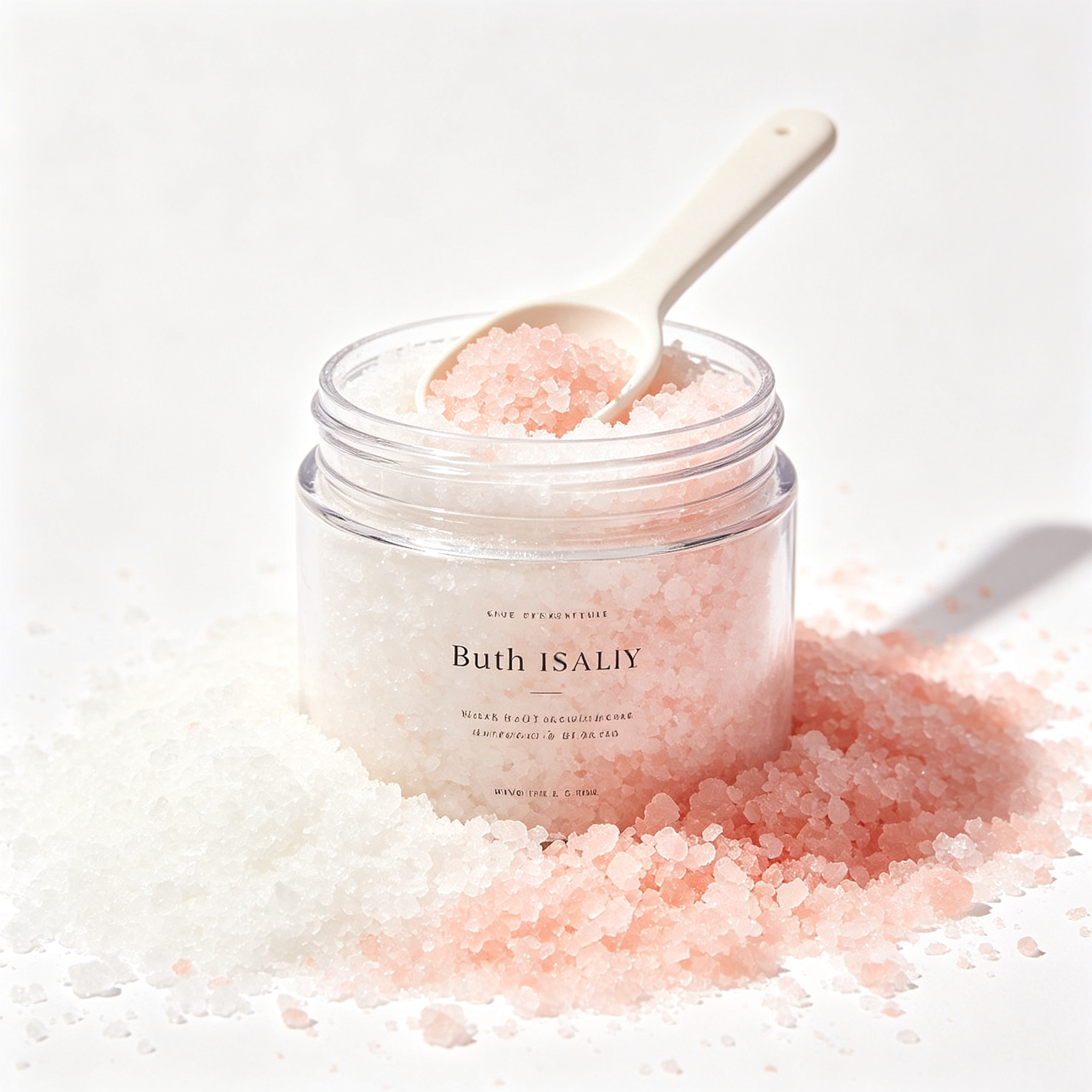
ZLDIO-PC series hydrated silica as a suspended exfoliating particle in body scrub applications. Image: Zhonglian Food Silica.
Market context
The global toothpaste silica market was estimated at USD 441 million in 2025, according to QYResearch (VD-SIL-003). The same dataset places the average price of toothpaste-grade abrasive silica at USD 1,400/ton, with a margin of around 63% (VD-SIL-004). Together the two data points indicate that toothpaste abrasives are a substantial and value-dense segment, and that the premium depends on suppliers holding batch-to-batch RDA stability and transparent-gel refractive index matching — which is why sharper grade questions are warranted.
On the cosmetic side, the body scrub category has benefited from a broader cosmetic silica story: the category's shift toward physical exfoliants (salt, sugar and PVA beads) has been driven by concerns over microplastics and by expectations of a gentler, more sensorial experience. That shift favours hydrated silica because it is water-insoluble, holds its shape in use, and — if sourced in the correct grade — has a controlled sphericity.
Where these choices fit — and where they do not
Body scrub. Hydrated silica is not the only choice. Salt and sugar are inexpensive and dissolve quickly, giving a fast physical scrub with little formulation complexity. But their scrubbing action weakens over the course of a shower, and salt can sting. PVA beads (now restricted in the EU) offer uniform particle shape but are microplastics. Hydrated silica combines insolubility, sphericity and cosmetic inertness, but it is more expensive than salt or sugar and requires a formulation that keeps it suspended. The trade-off is favourable for rinse-off products and products that need a long shelf life, but it depends on the product design.
Toothpaste. Calcium carbonate is another common abrasive, lower in cost, but it is generally more abrasive and may interact with fluoride. Hydrated silica provides RDA control, fluoride compatibility and controllable whitening, making it the preferred abrasive for formulations that require fine control over abrasivity and visual appeal. The limitation is cost — at around USD 1,400/ton, it is clearly higher than basic calcium carbonate grades.
Future outlook
The outlook for personal-care silica is supported by two forces: the October 2024 EFSA re-evaluation reaffirming E551 safety across the full range of food and oral-contact uses, which removes an earlier layer of regulatory uncertainty around amorphous silica; and the formulation trend toward gentler, more insoluble and more visually sophisticated products, which favours hydrated silica grades whose parameters (sphericity, RDA, refractive index, particle distribution) can be specified explicitly. Bio-based sourcing, tighter heavy-metal ceilings and batch-level testing traceability are the further drivers. For buyers, that means asking a sharper set of questions per application class: which material grade, with which proof of conformity, and with which controls on RDA and D50 from batch to batch.
FAQ
How do I choose a toothpaste silica? What does RDA mean?
RDA (relative dentin abrasion) is the standard measure of toothpaste abrasivity. Choose high RDA for whitening or strong-clean pastes, medium RDA for general daily care, and low RDA for sensitive teeth or children's pastes. Thickening grades are further split by viscosity (low, medium, high), with a high-clarity grade available for transparent gels. Toothpaste-grade silica is designed to meet ISO 11609 and GB 8372 requirements (product 10113 / 10114).
What is the difference between hydrated silica for body scrub and for toothpaste?
The chemical is the same — CAS 7631-86-9, INCI Hydrated Silica — but two differences dominate. Particle size: body scrub grades use D50 120–850 μm, toothpaste abrasive grades use D50 10–14 μm. Function: the body scrub grade acts as a water-insoluble exfoliating particle, whereas the toothpaste grade acts as a controlled abrasive and structuring thickener. Toothpaste adds RDA specification and, for clear gels, refractive index matching.
What does Zhonglian's cosmetic silica registration cover?
The NMPA cosmetic silicon dioxide registration dossier (certificate 002648-10795-1460, issued 2024-05-20) covers silica for cosmetic use under China Cosmetic Raw Material Safety Specification, and is the basis for supplying cosmetic brands in China. It is specific to cosmetic use, not food or pharma.
What purity, heavy metal and microbial thresholds apply to each?
Both require SiO&sub2; ≥99%, with heavy metals controlled per the relevant pharmacopoeia or food standard and microbial results reported on the per-batch COA. Body scrub uses cosmetic heavy-metal limits; toothpaste uses ISO 11609 limits. In both cases, D50, BET, pH, LOD and LOI should be confirmed on each batch COA.
Can the same supplier serve body scrub and toothpaste grades?
Yes. Zhonglian Food Silica supplies ZLDIO-PC body scrub grades and ZLSIL-T toothpaste grades, with per-batch COA and regulatory documentation. Buyers should still confirm that each product carries the specific registration or certification required by the end use — the NMPA cosmetic dossier for body scrub, ISO 11609 support for toothpaste — because the proof sets differ.
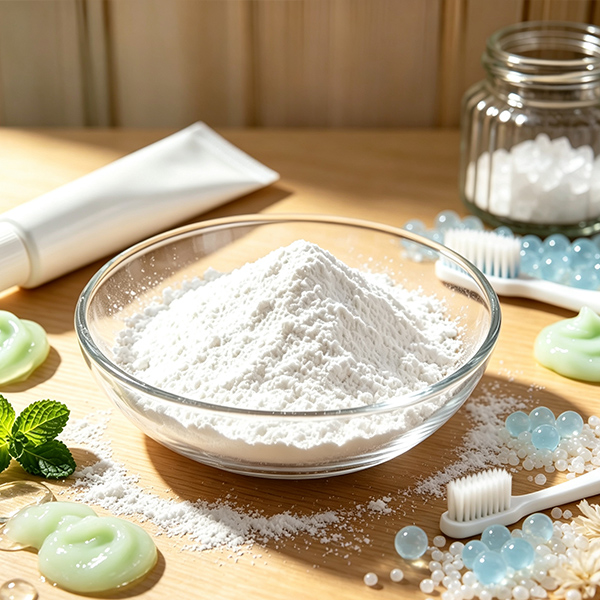
ZLSIL-T series toothpaste-grade hydrated silica, engineered for controlled RDA and paste thickening. Image: Zhonglian Food Silica.
For the full product range and specifications, download Zhonglian's food-grade silica brochure: Food Grade Silica Brochure (PDF)
Есть вопросы или нужны дополнительные детали?
Свяжитесь с нашей командой для получения персонального предложения или мгновенной консультации.
Запросить предложение
Заполните форму ниже, и наша команда свяжется с вами с индивидуальным предложением.
Прямой чат WhatsApp
Предпочитаете общаться в реальном времени? Напишите нам в WhatsApp для мгновенной помощи и быстрых ответов.
- Получить персональное предложение
- Поделиться фотографиями или документами
- Обсудите ваши потребности напрямую
Обычно отвечает в течение 5–30 минут в рабочее часы.