
Boron Nitride 8233 FAQ: Specs, Storage, and Acceptance Criteria
Boron nitride (BN) is a ceramic material with a graphite-like structure, supplied in powder, granular, coating and paint forms, and specified wherever high-temperature release, lubrication, electrical insulation or refractory performance is required. Buyers rarely need an introduction to the material. They need to know which figures belong in a purchase specification, how the product must be handled after delivery, and what a receiving inspection should actually check.
Product 8233 from Sumetech Industry Co., Ltd is one grade that procurement and process engineering teams raise in exactly that context. The questions below follow the order they usually appear in a real sourcing project: what the product is, how it is specified, how it is applied, how it must be stored, and what acceptance criteria keep a purchase order enforceable.

Boron nitride for Product 8233 is supplied as powder, granular, coating and paint, and is also processed into ceramic forms. Source: Sumetech Industry Co., Ltd.
What Product 8233 Is, and Why It Is Specified by Form
Sumetech Industry Co., Ltd is a manufacturer of potassium aluminium fluoride (PAF) and boron nitride products, established in 2019. The company operates a 6,000 m2 production facility with an annual production capacity of 5,000 metric tons and a workforce of approximately 20 people, of which five technicians form the R&D team. Around 90% of output is exported, with Turkey, Japan, Korea and Europe among the main markets.
Product 8233 is the boron nitride item in that portfolio. It is made of boron nitride and supplied in four physical forms: powder, granular, coating and paint. This is why the first specification question is always which form the process needs, because the form determines how the material is written on a purchase order, how it is packed, and how it is handled on receipt.
Naming is the second issue. The same boron nitride product family appears in technical documents under several descriptions, including BN coating, high-temperature boron nitride coating, high-purity boron nitride coating, boron nitride ceramic coating, boron nitride anti-stick coating and boron nitride coating for die casting operations. These are not four different chemistries. They describe coating-type supply of a boron nitride material whose function changes with the application and the substrate.
| Supplied form | Common specification wording | Where it is typically specified |
|---|---|---|
| Powder | Boron Nitride Powder | Base material supplied for further processing or formulation by the buyer |
| Granular | Boron Nitride (granular) | Solid granular form of the same boron nitride material |
| Coating | BN Coating; high-temperature boron nitride coating; boron nitride anti-stick coating; high-purity boron nitride coating; boron nitride ceramic coating; boron nitride coating for die casting operations | Applied to moulds, troughs and ladles for aluminium, magnesium and zinc alloys, to glass-forming moulds, and to graphite plates used in sintering and heat treatment |
| Paint | Boron nitride paint | Brush-applied variant of the coating system |
The commercial form of boron nitride normally used in coatings and powders is hexagonal boron nitride (h-BN), whose layered crystal structure explains most of the behaviour buyers are paying for. That structure is the reason a single material can serve release, lubrication, insulation and refractory duties at the same time.
Specification Questions: Temperature and Purity Are Not Single Numbers
The two figures that dominate BN discussions are maximum working temperature and maximum purity, and both are frequently misread. Product 8233 is stated at a maximum working temperature of 900 degrees Celsius in air and above 2000 degrees Celsius in an inert gas atmosphere, with a maximum purity of 99.9%.
| Parameter | Stated description |
|---|---|
| Material | Boron nitride, graphite-like structure |
| Product forms | Powder, granular, coating, paint |
| Maximum purity | 99.9% |
| Maximum working temperature | 900 C in air; 2000 C+ in inert gas |
| Mechanical behaviour | Low friction; high-temperature release; non-stick at elevated temperature |
| Chemical behaviour | Chemically inert; non-wetting and corrosion-resistant against most molten metals and acids |
| Electrical and thermal behaviour | Low dielectric constant; thermally conductive; suitable for high-temperature electrical insulation |
| Application equipment | Brush; spraying machine |
| Storage requirement | Keep dry and sealed |
| Shelf life | Use before the expiration date |
| Operating mode | Subject to actual working conditions |
Answer first: a boron nitride temperature requirement is incomplete unless it states the atmosphere. The 900 C figure applies to air, where the process atmosphere is oxidising. The 2000 C+ figure applies to inert gas. Writing only one number into a specification creates a mismatch that surfaces later as premature coating breakdown or as an unnecessary cost premium on a grade that was never required.
Purity works the same way. 99.9% is the maximum achievable purity of the 8233 line, not a default value that applies to every order. Applications such as electronics, semiconductor processing, photovoltaic technology, optical glass and cosmetic additives are sensitive to trace impurities, while other high-temperature duties are not. Buyers should state the purity grade they need and the method by which it will be confirmed, rather than assuming the maximum figure describes every shipment.
Technical Behaviour: Why BN Releases, Lubricates and Insulates
Three properties explain most BN application decisions, and each one is testable against a process requirement.
Release and lubrication. Boron nitride has a graphite-like structure that produces low friction and high-temperature release properties. In practice this means it works as an anti-stick layer that prevents molten metal, glass or polymer from adhering to tooling. This is the property behind its use in precision casting and horizontal continuous casting, and behind the boron nitride anti-stick coating specified for die casting operations.
Chemical inertness and non-wetting. Boron nitride is chemically inert and corrosion-resistant to molten metals and acids, and it does not wet most molten metals. For a foundry, the consequence is a release layer that survives contact with the melt instead of being consumed by it, which supports longer tool life and less cleaning downtime between cycles.
Electrical and thermal behaviour. Boron nitride has a low dielectric constant and is thermally conductive. Those two characteristics together make it an unusual material: it insulates electrically while conducting heat, and it remains reliable in high-frequency and high-voltage environments. That combination is why it appears both as a high-temperature electrical insulator and as a thermally conductive filler in electronics and semiconductor heat dissipation.
Application Questions: Brush, Spraying Machine and Process Fit
Answer first: Product 8233 is applied by brush or by spraying machine, and the operating mode is subject to actual working conditions. The application method is therefore part of the specification, not an afterthought, because film build, coverage and drying behaviour differ between the two methods and between substrates.
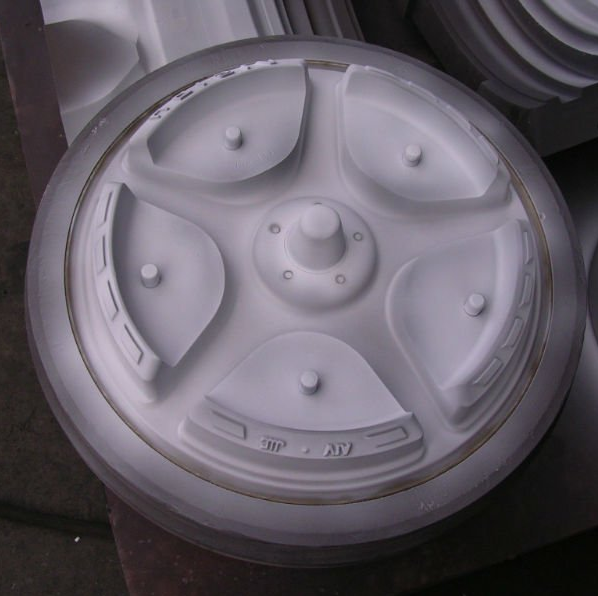
BN coating is applied by brush or spraying machine; coverage and drying parameters depend on the actual working condition. Source: Sumetech Industry Co., Ltd.
The sectors where boron nitride is specified span both classic heavy industry and advanced manufacturing. They include precision casting, horizontal continuous casting, amorphous ribbon production, thermally conductive filler, photovoltaic technology, solar thermal energy storage, the semiconductor industry, optical glass, vacuum coating, the electronics industry, military and aerospace, superhard materials, cosmetic additives, functional fibers and functional ceramics.
Two application notes follow from that list. First, coatings are typically applied to moulds, troughs and ladles handling aluminium, magnesium and zinc alloys, to glass-forming moulds, and to graphite plates used in sintering and heat treatment, where they prevent carbon contamination and bonding between workpieces and fixtures. Second, product selection and application technique may need further tailoring for a specific metal type, process temperature or substrate material. Buyers who state all three at the enquiry stage get a usable recommendation instead of a generic one.
Storage and Shelf Life: Dry, Sealed, Before Expiry
Answer first: boron nitride products must be kept dry and in sealed storage, and must be used before the expiration date. These are explicit product requirements, not general housekeeping advice, and they belong in the receiving procedure as well as in the warehouse instruction.
Three practical controls reduce rejection risk. Confirm at goods-in that packaging is intact and sealed, since a breached seal undermines the dry-storage requirement before the material has even been put away. Record the expiration date on the goods-in record and operate first-in, first-out so that older stock is consumed first. And do not use material held beyond its expiration date, even where the container has remained closed, because the specification applies to material within its stated shelf life.
For coating products specifically, storage discipline matters more than it does for many industrial chemicals. A coating that has taken up moisture or been stored in an unsealed container may still look acceptable in the container while behaving differently during application and in service.
Acceptance Criteria: What to Write Into the Purchase Order
Answer first: an enforceable BN purchase order states the form, the purity grade, the temperature rating with its atmosphere, the application method, the packaging and storage condition, the expiry requirement, and the documentation the supplier must provide. Anything left implicit becomes a dispute.
- Form and grade. Name the supplied form (powder, granular, coating or paint) and the intended application, so that the coating type is matched to the process rather than to a trade name alone.
- Purity grade. State the required purity and how it will be confirmed. The 99.9% maximum is a ceiling, not a default.
- Temperature rating. Always pair the figure with its atmosphere: 900 C in air, 2000 C+ in inert gas.
- Application method. Confirm whether the material will be applied by brush or by spraying machine, and align the supply with that method.
- Packaging and storage. Require dry, sealed packaging and confirm the storage instruction is passed through to the point of use.
- Expiry. Require the expiration date to be marked and legible, and define the minimum remaining shelf life acceptable at delivery.
- Laboratory evidence. Sumetech Industry Co., Ltd states that its laboratory has passed CMA (China Measurement Certification) and CNAS (National Laboratory Accreditation), which gives buyers a named testing framework to reference in supplier documentation.
- Regulatory status. Boron nitride is compliant with EU REACH (Regulation EC 1907/2006) as a substance used in industrial applications, which is relevant for European-bound shipments.
- Trade classification. Boron nitride coating is commonly traded under HS code 28500020, useful for import classification and duty planning.
- Validation before scale-up. A trial lot allows the coating to be tested on the actual substrate and at the actual process temperature before a full order is committed.
Where 8233 Is Not the Right Specification
An independent reference has to state the boundaries as clearly as the capabilities.
The 900 C air figure is a ceiling, not a target. Processes that run continuously at or near that temperature in an oxidising atmosphere sit at the edge of the specification, and moving the same duty into an inert gas atmosphere changes the margin substantially. Buyers should verify which atmosphere the process actually presents at the coated surface, which is not always the same as the atmosphere of the furnace as a whole.
Performance is condition-dependent. The product operating mode is stated as subject to actual working conditions, and the supplier notes that product selection or application technique may require further tailoring for a given metal type, process temperature or substrate. No single figure predicts coating life across every process.
Storage and shelf life are hard requirements. Material stored outside the dry, sealed condition, or used after its expiration date, falls outside the specification regardless of how it performs in a trial.
Scope limits. Product 8233 is specified for high-temperature release, lubrication, electrical insulation, thermal conduction and refractory-adjacent duty. Requirements that fall outside those functions should be evaluated as separate problems rather than assumed to be covered by a BN specification.
Market Context: Why BN Specifications Are Reviewed More Often
The global hexagonal boron nitride market was valued at USD 949.4 million in 2024, according to Grand View Research. The same source reports that Asia Pacific accounted for a 40.6% revenue share of that market in 2024, and that China alone represented 41.1% of the Asia Pacific total. Paint coatings were the largest application segment within h-BN, at 32.8% of application share in 2024.
A separate commercial research estimate places the global boron nitride coatings market at USD 2.8 billion in 2025 (Dataintelo). The gap between the two figures illustrates a methodological point that procurement teams should keep in mind: research houses define the boron nitride category differently, with some counting only h-BN powder and coatings and others including broader boron-based chemistry. Market figures are useful for direction and for supply planning, but they should not be treated as a precise measure of any single supplier or grade.
What the data does support is scale. Hexagonal boron nitride has become a mainstream specification material rather than a specialist curiosity, and buyers are increasingly asked to justify a grade choice with a documented temperature rating, purity level and regulatory status.
What Changes Next
Three developments are likely to shape BN specification over the next procurement cycles. Electronics and semiconductor thermal management continues to pull boron nitride in as a thermally conductive filler, which pushes purity and consistency requirements upwards. Inert-atmosphere processes are expanding the useful range of the material well beyond the air ceiling. And regulatory documentation, already covered for boron nitride under EU REACH, is becoming a standard attachment to inbound enquiries rather than a follow-up request.
For buyers, the practical implication is that BN grades will be compared on documentation quality as much as on headline figures. Suppliers who can state atmosphere-dependent temperature limits, name their laboratory accreditations and confirm storage and shelf-life requirements will be easier to qualify than those who quote a single temperature.
FAQ: Boron Nitride 8233 in Procurement Practice
What is Product 8233 and in which forms is it supplied?
Product 8233 is a boron nitride product made of boron nitride and supplied in powder, granular, coating and paint forms. Coating-type supply carries descriptions such as BN Coating, high-temperature boron nitride coating, high-purity boron nitride coating, boron nitride ceramic coating and boron nitride anti-stick coating for die casting operations. Sumetech Industry Co., Ltd manufactures it alongside potassium aluminium fluoride and supplies it internationally.
What is the maximum working temperature, and why are two figures quoted?
The maximum working temperature is 900 C in air and above 2000 C in an inert gas atmosphere. Two figures are quoted because the atmosphere determines how far the material can be pushed. A specification that quotes only one number cannot be assessed against a real process, where the atmosphere at the coated surface is what governs performance.
How should boron nitride products be stored, and for how long can they be kept?
Products must be kept dry and in sealed storage, and must be used before the expiration date. Practical controls are to verify seal integrity at goods-in, record the expiration date, and operate first-in, first-out. Material held beyond its expiration date falls outside the specification.
How is the coating applied, and does the method affect the specification?
The matched equipment for Product 8233 is a brush or a spraying machine, and the operating mode is subject to actual working conditions. Because the two methods produce different coverage and film behaviour, the application method should be stated on the enquiry and reflected in the supply recommendation.
Which industries use boron nitride coatings and ceramics?
Boron nitride serves precision casting, horizontal continuous casting, amorphous ribbon, thermally conductive filler, photovoltaic technology, solar thermal energy storage, the semiconductor industry, optical glass, vacuum coating, the electronics industry, military and aerospace, superhard materials, cosmetic additives, functional fibers and functional ceramics. Coatings are commonly applied to moulds, troughs and ladles for aluminium, magnesium and zinc alloys, to glass-forming moulds, and to graphite plates used in sintering and heat treatment.
Does boron nitride provide electrical insulation as well as release?
Yes. Boron nitride has a low dielectric constant and is thermally conductive, which makes it usable as a high-temperature electrical insulator that also conducts heat. It remains reliable in high-frequency and high-voltage environments, and the same thermal conductivity supports its use as a thermally conductive filler in electronics and semiconductor heat dissipation.
What evidence should a buyer request before approving a boron nitride supplier?
Request the stated temperature limits with their atmospheres, the purity grade with its confirmation method, the form and application method, the storage and shelf-life requirements, and the regulatory position. Sumetech Industry Co., Ltd states that its laboratory has passed CMA and CNAS accreditation, and boron nitride is compliant with EU REACH under Regulation EC 1907/2006. Boron nitride coating is commonly traded under HS code 28500020.
What are the main limitations buyers should plan around?
The air rating of 900 C is a ceiling rather than an operating target, and pushing beyond it requires an inert atmosphere. Coating performance is condition-dependent and may require tailoring to the metal type, process temperature or substrate. Storage must be dry and sealed, and the material must be used before its expiration date. Functions outside release, lubrication, insulation, thermal conduction and related high-temperature duty should be evaluated separately.
Detailed product specifications, packaging options and the current Sumetech Industry Co., Ltd catalog can be reviewed here: Sumetech Industry Co., Ltd catalog (PDF). The company website is www.sumetech.com.
Есть вопросы или нужны дополнительные детали?
Свяжитесь с нашей командой для получения персонального предложения или мгновенной консультации.
Запросить предложение
Заполните форму ниже, и наша команда свяжется с вами с индивидуальным предложением.
Прямой чат WhatsApp
Предпочитаете общаться в реальном времени? Напишите нам в WhatsApp для мгновенной помощи и быстрых ответов.
- Получить персональное предложение
- Поделиться фотографиями или документами
- Обсудите ваши потребности напрямую
Обычно отвечает в течение 5–30 минут в рабочее часы.