
Box Type Substation for Data Centers: A Buyer's Guide
Answer first. A box type substation for a data center is a factory-assembled substation enclosure — the product category that IEC 62271-202:2022 defines as an enclosed high-voltage prefabricated substation — delivered with its medium-voltage switchgear, distribution transformer, low-voltage switchgear, protection and auxiliary systems already installed and tested, and connected on site rather than built there. For a data-center project the decision is therefore not “box or no box”. It is which transformer sits inside the enclosure, which protection class and ambient range the site demands, and which conformity documents the utility, insurer and commissioning engineer will accept before energisation.
Data centers have become one of the few load categories where a distribution substation is specified against continuous rather than cyclic duty. A facility that runs 24 hours a day, is fed from two utility sources, and carries a harmonic-rich IT load behind a UPS places a different set of requirements on the substation than an apartment block or a factory of the same connected capacity. That is the reason the box type substation, originally a utility distribution product, has moved into the data-center supply chain — and the reason buyers now need to read its specification more carefully than its brochure.
Apex Power Systems (Nanjing) Co., Ltd. is a Nanjing-based international trading and supply partner for power transformers and substation equipment. The company supplies box-type and prefabricated substations through audited Chinese manufacturing partners rather than manufacturing them itself, and manages factory selection, certification verification, witness testing, documentation, freight and commissioning support on the buyer's behalf.
Why a data center substation is a different procurement problem
The electrical chain in a data center runs from the utility medium-voltage feed through a substation, into medium-voltage distribution, then through step-down transformers to the UPS and power distribution units that feed the IT racks. The substation sits at the boundary: it is the asset the utility sees, and the asset whose failure the operator cannot absorb. Three requirements follow from that position.
- Continuous high-load operation with redundancy. Data-center power supply is normally described as dual-source grid connection with UPS backup and N+1 redundancy, with matched equipment including UPS systems, diesel generators, precision air conditioning, bus ducts and PDUs. The substation must tolerate sustained loading and be arranged so that one unit can be maintained while the other carries the load.
- A non-linear, harmonic-rich load. Rectifier front-ends, UPS chargers and IT power supplies draw current in non-sinusoidal form. Transformer specification, cooling and temperature monitoring all have to account for that, not just the kVA figure.
- Speed of energisation. A data hall that is ready before its power supply is a capital asset earning nothing. Substation construction time, not substation price, frequently becomes the binding constraint.
The scale of the underlying demand is measurable. IDCA's Global Data Center Report (2026) puts data-center electricity consumption at 2% of the world's electricity in 2026, up from 1.7% in 2024. Mordor Intelligence's data-center substation research estimates the global data-center substation market at USD 11.31 billion in 2026, rising to USD 13.27 billion in 2027 and USD 19.78 billion by 2032. Both are third-party commercial or association estimates rather than audited figures, but they point in the same direction: substation capacity for data centers is being bought faster than it is being built.
What actually sits inside a data-center box type substation
The prefabricated cabin substation supplied through Apex — model designation YBM/ZGS11/ZGS13 — is a useful reference configuration because its published specification shows what the enclosure has to contain. It is rated for 10 kV and 35 kV systems with a transformer capacity range of 500 to 50,000 kVA, and integrates the high-voltage switchgear, transformer, low-voltage switchgear, compensation equipment, automation system, AC/DC auxiliary supply and environmental control inside one transportable cabin.
The build details matter more than the equipment list, because they are what separates an engineered enclosure from a shed around a transformer:
- Structure: containerised steel structure with rock-wool sandwich-panel insulation and anti-corrosion coating, on a welded structural-steel base with anti-corrosion treatment.
- Switchgear: metal-clad withdrawable or fixed type with vacuum circuit breakers; copper busbar with heat-shrink insulation.
- Transformer: oil-immersed or dry-type, selectable according to the fire strategy of the site.
- Monitoring: integrated automation system covering temperature, humidity, smoke, water ingress and access — the sensors a remote operations team actually uses.
- Environmental control: industrial air conditioner, forced ventilation and heater, sized for the ambient range rather than added later.
- Fire protection: gas extinguishing or ultra-fine dry powder, optional and specified per project.
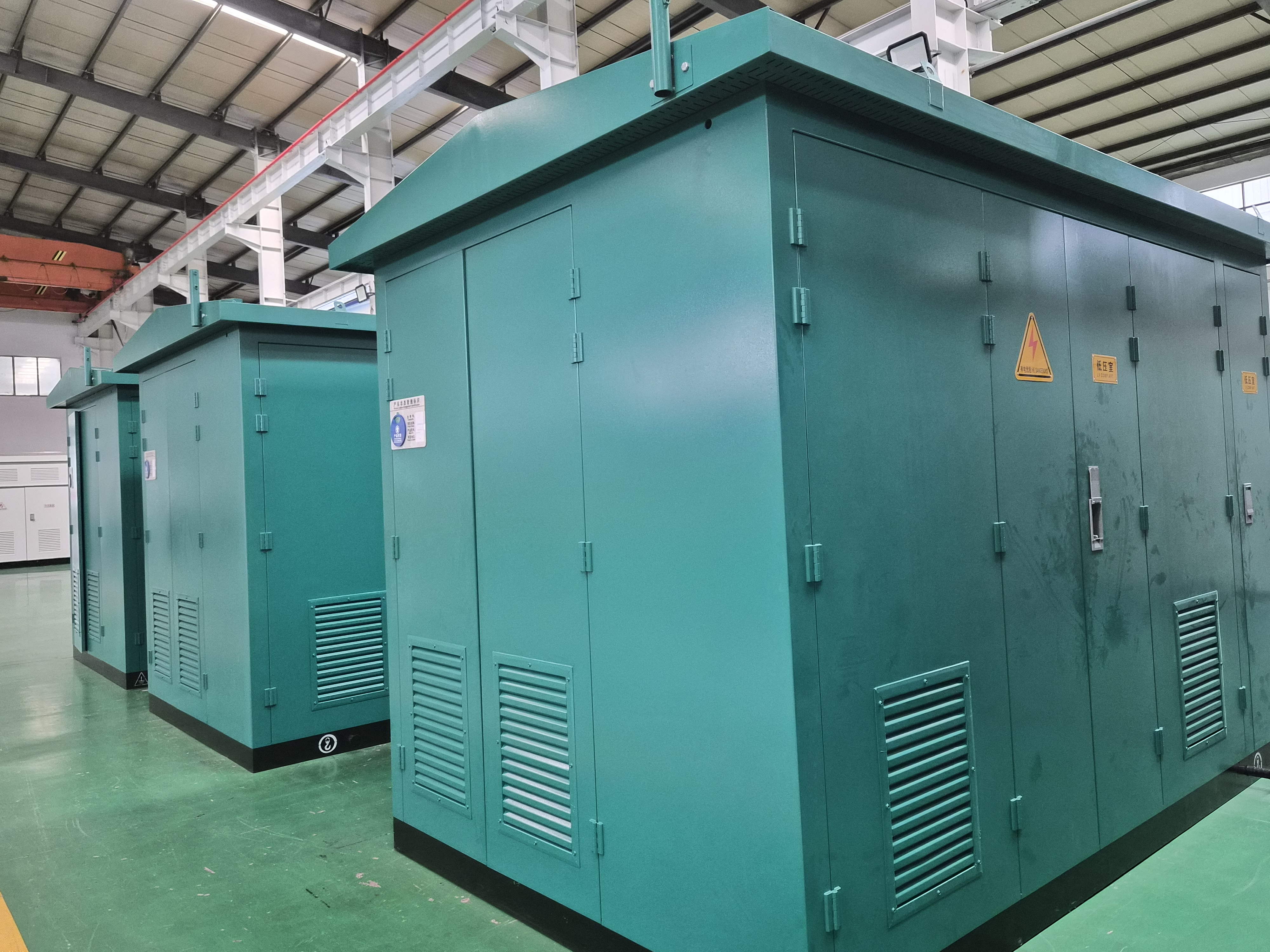
Prefabricated cabin modular substation: the enclosure integrates MV switchgear, transformer, LV switchgear, automation and environmental control, and is transported as a complete unit for crane lifting and on-site connection.
The enclosure is protected to IP54 or IP55 and is specified for an ambient range of −40°C to +50°C. Installation follows a single sequence: the unit is transported complete and lifted into position by crane, and only the site connections remain. Cabin dimensions are based on standard container dimensions and are customisable, which is what allows the same platform to serve a rooftop plant room and an outdoor pad in a desert campus.
Choosing the transformer inside the box
The three transformer families most often considered inside a data-center enclosure differ in ways that change the fire strategy, the footprint and the operating cost — not just the price. The dry-type SCB12–SCB18 series contains no insulating oil, which is why it can be installed close to the load and is used for indoor medium-voltage to low-voltage distribution in data centers and communication base stations. Under forced-air cooling it can operate at up to 150% of rated load, and it is designed to IEC 60076-11. Capacities run from 30 to 2,500 kVA at the 10 kV class and from 800 to 25,000 kVA at the 35 kV class, with F or H insulation class, AN or AF cooling and IP00, IP20 or IP23 protection.
| Transformer option | Characteristics relevant to a data center | Typical placement |
|---|---|---|
| Dry-type, SCB12–SCB18 series | No insulating oil; flame-retardant and explosion-resistant; maintenance-free; up to 150% rated load under forced-air cooling; designed to IEC 60076-11; 30–2,500 kVA at 10 kV, 800–25,000 kVA at 35 kV | Indoor MV/LV distribution, close to the load; inside the enclosure where an oil-free solution is required |
| Oil-immersed distribution, S13 / S14 / S15 series | ONAN cooling; Dyn11 or Yyn0 vector group; impedance 4–14% depending on rating; efficiency Grade 1 or Grade 2 to GB 20052; 30–3,150 kVA at 10 kV, 3,150–31,500 kVA at 35 kV | Outdoor or detached enclosure where higher capacity per unit is required |
| Amorphous alloy, S(B)H15(21–25)-M | No-load losses 60–80% lower than conventional silicon-steel cores; oil-immersed 30–2,500 kVA, dry-type 500–2,500 kVA | Sites where standby losses dominate the electricity bill or an efficiency target applies |
| Large power transformer, SFZ-250000/345 (250 MVA / 345 kV) | On-load tap changing across 345 +17/−17 × 0.625%; ONAN, ONAF1 and ODAF2 cooling stages; paper-oil insulation, fully sealed, outdoor; KEMA Labs Type I Inspection Report | Campus incoming supply and AI computing parks, upstream of the box substation |
Transformer options as published in the product specifications. Cooling class codes follow the standard four-letter convention: O = oil, A = air, N = natural circulation, F = forced circulation, so an ONAN unit relies on natural oil and natural air circulation while adding fans raises permissible loading.
Two specification details are routinely missed in data-center tenders. The first is the cooling class: the same transformer often carries two ratings on its nameplate, one per cooling stage, and the load the data hall can actually place on it depends on which stage is being counted. The second is the vector group. Dyn11 and Yyn0 appear across these product families, and two transformers can only be operated in parallel if their vector groups are compatible — an incorrect vector group is one of the most common reasons a delivered unit cannot be paralleled with the existing plant.
Enclosure class, ambient range and the site interface
IP54 or IP55 protection and a −40°C to +50°C ambient rating describe the enclosure, not the transformer, and the two are specified independently. A dry-type transformer inside an IP54 enclosure raises the question of how the heat leaves the enclosure; the answer is the industrial air conditioner and forced ventilation that form part of the integrated equipment, and it is why the HVAC package should be reviewed as part of the electrical design rather than as a building service.
The site interface is equally concrete. The unit is transported complete and lifted by crane, so access route, lifting plan, pad loading and the space needed for future cabins all have to be fixed at design stage. Because the configuration is modular and expandable, a capacity upgrade requires additional cabins rather than a rebuild — a genuine advantage for a campus built in phases, provided the initial layout reserved the space.
The compliance layer buyers underestimate
Compliance for a box type substation is not one certificate. IEC 62271-202:2022 sets out the service conditions, rated characteristics, general structural requirements and test methods for enclosed high-voltage prefabricated substations, and is the core product standard for the assembly. Around it sit market-access regimes that apply to specific parts of the unit.
| Requirement | What it covers | Practical implication for a data-center buyer |
|---|---|---|
| IEC 62271-202:2022 | Enclosed high-voltage prefabricated substations: service conditions, rated characteristics, structural requirements, test methods | The reference standard for the assembly itself; ask which edition the type-test evidence was produced against |
| EU Directive 2014/35/EU (Low Voltage Directive) | Electrical equipment rated 50–1,000 V AC or 75–1,500 V DC | Covers the LV compartment; the medium-voltage side is outside its voltage scope and falls under HV switchgear standards |
| EU Directive 2014/30/EU (EMC) | Electromagnetic compatibility of equipment and fixed installations | Becomes relevant as soon as protection, control and remote-monitoring electronics are integrated |
| EU Directive 2011/65/EU (RoHS 2) | Restricted hazardous substances in electrical and electronic equipment | Adds a substances-compliance documentation requirement for wiring, relays and electronic components |
A substation placed on the EU market is therefore subject to at least three parallel conformity regimes, with CE marking as the visible outcome — documentary capability, not only hardware specification, becomes a supplier-selection variable.
For the transformer inside the enclosure, the applicable evidence is product-specific. Apex states that its audited manufacturing partners' 10 kV and 35 kV distribution transformers and box-type substations hold IEC, UL, TUV, CE, KEMA and GOST certification, supported by ISO 9001, ISO 14001 and ISO 45001 management-system certificates and a provincial metrology qualification, together with type-test reports covering dry-type, oil-immersed and box-type substation product families. Independent verification cited in the same material is a KEMA Labs Type I Inspection Report for a 250 MVA / 345 kV three-phase power transformer tested to the IEC 60076 series and IEEE C57.12.00 / C57.12.90.
How Apex Power Systems fits into this supply chain
Apex is a trading and supply-partner company, not a factory. That distinction shapes what it can and cannot verify. Its role is factory selection and auditing, certification gatekeeping, witness testing, documentation and delivery management — checking that a manufacturer's certificates are current, in the correct legal entity name, and covering the exact product family being purchased, then supervising design, production, factory acceptance testing, packing, freight and on-site commissioning.
In practice that means a data-center buyer receives one accountable point of contact for a scope that otherwise splits across an enclosure builder, a transformer factory, a switchgear manufacturer and a freight forwarder. The company reports an annual output of 2,500 units and an export ratio of 70%, with main markets in the EU, the USA and the Middle East, and it presents the credentials of the manufacturing base it represents — including a manufacturing base exporting to 72 countries and regions and a power-engineering company established in 2018 for installation and commissioning support.
Project evidence coordinated through Apex includes a 345 kV power transformer delivered for a US–Georgia transmission project, a 40,000 kVA energy-storage project in Bulgaria, a 15 MVA pad-mounted transformer project in the USA, 115 kV substations in Tajikistan, and rural-grid deliveries in Mongolia and Azerbaijan. Large AI computing centers and data centers appear in the published application list for the large power transformer range, which is where the campus incoming supply is normally specified, while the enclosure-based prefabricated cabin substation covers the distribution level below it.
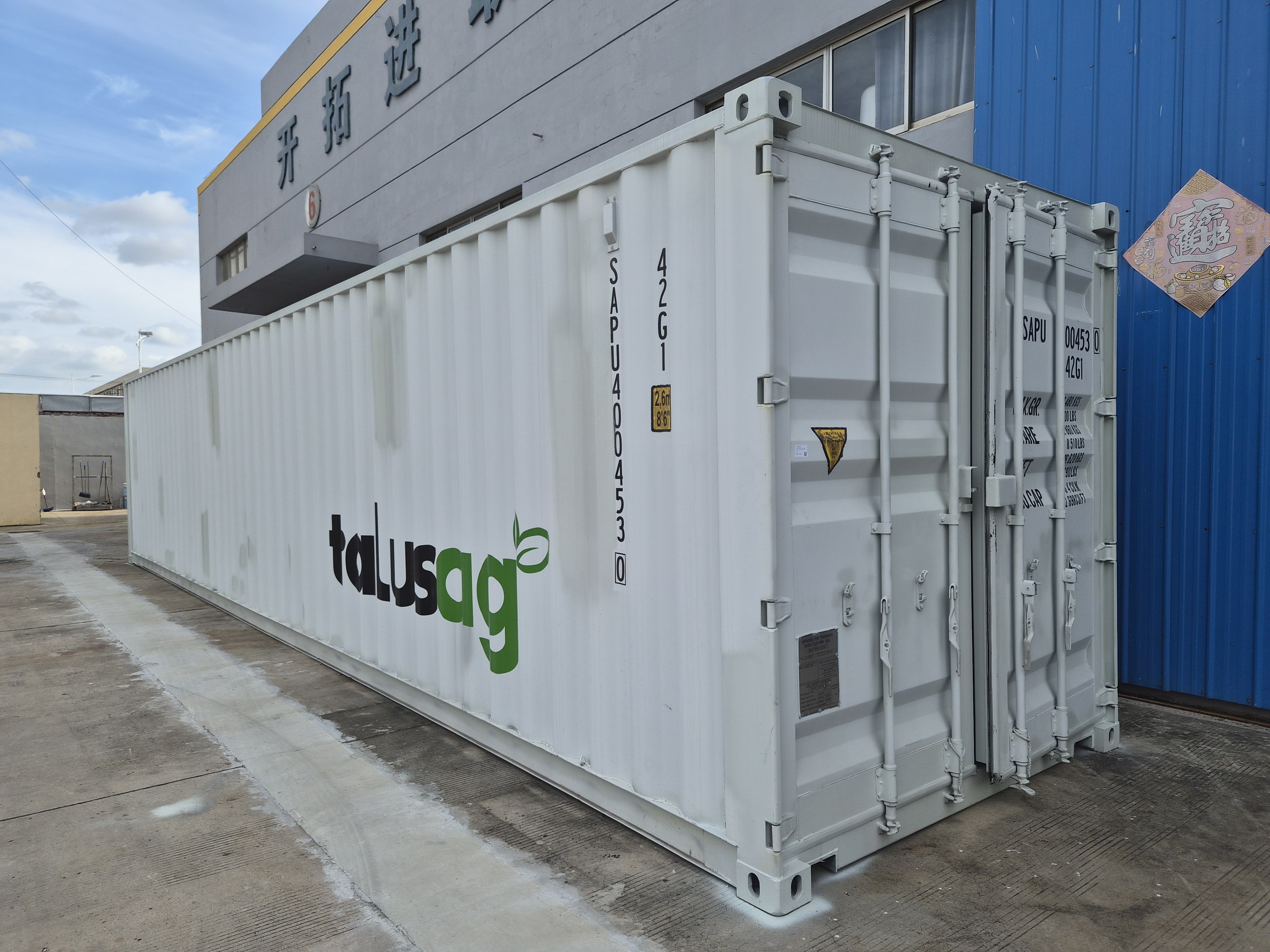
Factory prefabrication shifts assembly, wiring and routine testing off the site; the completed cabin is transported as a unit and connected after crane lifting.
Box type substation versus conventional substation construction
The comparison that matters for a data-center programme is not box versus no box, but box versus a purpose-built substation building of equivalent function. Both remain legitimate choices; they distribute risk differently.
| Dimension | Conventional substation building | Box type / prefabricated cabin substation |
|---|---|---|
| Where assembly and testing happen | On site, after civil works are complete | In the factory; the unit arrives installed, wired and routine-tested |
| Site programme | Civil works, building, then electrical installation in sequence | Foundation, crane lifting, site connection; factory prefabrication reduces site work, particularly where local infrastructure is limited |
| Footprint and building cost | Permanent building with fixed rooms | Smaller footprint and lower civil content; standard container dimensions with customisable layouts |
| Capacity growth | Extend the building | Add cabins; the configuration is modular and expandable |
| Relocation | Not practicable | Possible in principle, since the unit is transportable |
| Environmental control | Building services, designed separately | Integrated: industrial air conditioner, forced ventilation, heater, plus smoke, water-ingress and access monitoring |
Qualitative comparison based on the published configuration of the prefabricated cabin substation; the commercial balance depends on site, programme and local construction cost.
Where the box type approach reaches its limits
Four boundaries should be stated plainly, because they determine whether a box type substation is the right answer at all.
- Voltage and capacity class. The prefabricated cabin substation in this range is a 10 kV / 35 kV distribution asset with transformer capacity from 500 to 50,000 kVA. It does not replace a 345 kV transmission substation or a 250 MVA power transformer; a large AI campus needs both, at different levels of the chain.
- Fire strategy inside the enclosure. An oil-immersed transformer inside a cabin requires the fire-protection option — gas extinguishing or ultra-fine dry powder — to be designed in and agreed with the insurer, not treated as an accessory. A dry-type unit removes the oil but caps capacity per unit at 2,500 kVA in the 10 kV class.
- Transport and lifting. The unit is delivered complete and craned into position. Sites with restricted access, weak pads or no lifting window will lose the schedule advantage that justifies the prefabricated approach.
- Utility and standardisation constraints. Where a distribution utility mandates its own layout, drawing set or equipment list, a standardised cabin may require re-engineering; flexibility exists, but it is a design activity with a lead time, not a catalogue selection.
A procurement checklist for data-center box substations
| Decision area | What to specify |
|---|---|
| Duty and redundancy | Continuous load profile, N+1 arrangement, dual-source connection, and the load the transformer may carry at each cooling stage |
| Transformer type | Dry-type where an oil-free installation close to the load is required; oil-immersed where higher capacity per unit is needed; amorphous core where no-load losses dominate |
| Enclosure and ambient | IP54 or IP55, ambient range down to −40°C and up to +50°C, altitude, humidity, dust and salt-spray exposure, HVAC sizing |
| Monitoring and integration | Temperature, humidity, smoke, water-ingress and access monitoring, and the interface to the site BMS or SCADA |
| Electrical characteristics | Vector group (for example Dyn11 or Yyn0) compatible with the plant it will run in parallel with; impedance voltage; tap-changing arrangement |
| Conformity documents | Type-test reports with the standard and edition stated, declaration of conformity for EU-bound units, UL or CSA evidence for North America, management-system certificates in the manufacturer's legal entity name |
| Evidence of delivery | Factory acceptance test witnessed by the buyer or a third party, and comparable reference projects at similar rating |
Market trend analysis
Three trends visible in the available data shape how data-center substations will be bought over the next several years.
Demand is compounding faster than manufacturing capacity. With data centers at 2% of global electricity in 2026 and the data-center substation market forecast to move from USD 11.31 billion in 2026 to USD 19.78 billion by 2032, the constraint shifts from price to allocation. Buyers who secure transformer and substation slots early, and who standardise configurations so they can be built in parallel, are better positioned than buyers who tender each phase separately.
Modularity is becoming an electrical requirement, not a construction preference. Phased data halls mean phased power. A substation topology that expands by adding cabins — rather than by extending a building — fits the way AI computing parks are actually financed and commissioned.
Efficiency and documentation are converging as selection criteria. Amorphous-core options that reduce no-load losses by 60–80% against conventional silicon-steel cores address the standby-loss component that dominates a lightly loaded distribution transformer, while the EU conformity regime means a supplier's documentation package is now tested alongside its hardware. In a market where a “CE certified” claim is common, the declaration of conformity and its supporting test reports are what distinguish one offer from another.
Future outlook
The direction of travel is towards the substation as a monitored, modular product rather than a one-off construction project. Integrated automation that reports temperature, humidity, smoke, water ingress and access already supports remote monitoring and unattended operation, and that capability is what makes a distributed power architecture across a large campus operationally tolerable. Expect three practical consequences for buyers: type-test evidence for the complete enclosure assembly will be requested more often, not just for its components; efficiency specifications will be written into the transformer scope rather than left to default selection; and the ability to demonstrate conformity documentation across low-voltage safety, electromagnetic compatibility and substance restrictions will influence shortlists as much as capacity and price.
Frequently asked questions
What is a box type substation for a data center?
It is a prefabricated substation — the type of assembly covered by IEC 62271-202:2022 — supplied as a factory-assembled unit, typically a steel or containerised enclosure containing the transformer, high-voltage and low-voltage switchgear, protection and auxiliary systems, delivered to site ready for connection. In a data center it sits between the utility medium-voltage feed and the building distribution, and its practical value is that assembly and factory testing are completed before shipment, so site civil works and installation time are reduced and the unit can be relocated if the network changes.
Should a data-center box substation contain a dry-type or an oil-immersed transformer?
The two duties usually need different answers. For indoor medium-voltage to low-voltage distribution inside the building, a dry-type transformer such as the SCB12–SCB18 series is the usual recommendation because it contains no insulating oil, suits fire-sensitive locations, and handles non-linear, harmonic-rich IT load well; it can run at up to 150% of rated load under forced-air cooling. For the main incoming supply, an oil-immersed power transformer or a prefabricated substation is preferred because higher capacities are available at lower cost per kVA, with an on-load tap changer specified where the incoming voltage varies. Where the site must be energised quickly, a containerised prefabricated substation removes most site civil works.
What enclosure protection and ambient temperature range should be specified?
The prefabricated cabin substation in this product range is specified at IP54 or IP55 and for an ambient temperature of −40°C to +50°C, with cabin dimensions based on standard container dimensions and customisable per project. Because the enclosure rating and the transformer rating are separate specifications, the HVAC package — industrial air conditioner, forced ventilation and heater — should be sized together with the transformer losses and the local climate, not added afterwards.
Which standards and certificates should a data-center box type substation be checked against?
The core product standard for the assembly is IEC 62271-202:2022. For EU market access, a unit is subject to at least three parallel regimes: the Low Voltage Directive 2014/35/EU for equipment rated 50–1,000 V AC or 75–1,500 V DC, the EMC Directive 2014/30/EU, and the RoHS 2 Directive 2011/65/EU, with CE marking as the visible outcome. For North America, liquid-filled distribution transformers rated above 750 V require UL certification for the United States and CSA standards for Canada, and substation switchgear references UL 891 and IEEE C57.12.00 / C57.12.90 / C57.12.201. A buyer should ask for the certificate number, the issuing body, the standard edition and the product family covered, and verify each with the issuer.
What can a box type substation not do in a data-center project?
It does not replace transmission-level equipment: the prefabricated cabin substation in this range is a 10 kV / 35 kV distribution asset with a transformer capacity of 500 to 50,000 kVA, so a large campus still needs a separate incoming power transformer, for example a 250 MVA / 345 kV unit. Inside the enclosure, an oil-immersed transformer requires the optional gas or ultra-fine dry powder fire protection to be designed in, while a dry-type unit removes the oil but limits capacity per unit to 2,500 kVA at the 10 kV class. The prefabricated approach also depends on transport access and crane lifting, and on the utility accepting a standardised layout rather than its own bespoke design.
Есть вопросы или нужны дополнительные детали?
Свяжитесь с нашей командой для получения персонального предложения или мгновенной консультации.
Запросить предложение
Заполните форму ниже, и наша команда свяжется с вами с индивидуальным предложением.
Прямой чат WhatsApp
Предпочитаете общаться в реальном времени? Напишите нам в WhatsApp для мгновенной помощи и быстрых ответов.
- Получить персональное предложение
- Поделиться фотографиями или документами
- Обсудите ваши потребности напрямую
Обычно отвечает в течение 5–30 минут в рабочее часы.