
Brass Basin Faucet Supply Routes: OEM, Wholesale or Supermarket?
Choosing a supply route for brass basin faucets is a separate decision from choosing the faucet, and it is normally made later than it should be. A buyer who has already fixed the model, the finish and the target price still has to decide whether to buy directly from an OEM/ODM manufacturer, from a wholesale distributor, or through a construction supermarket and project supply channel. Each route answers a different question, and each shifts risk to a different party.
The short answer: the three routes differ far less in unit price than in who controls the specification, who holds model-level certification evidence, who carries inventory risk, and who is accountable when an incoming batch fails inspection. Buyers with in-house specification and quality capability usually extract the most value from the OEM/ODM route. Buyers whose binding constraint is order size or delivery speed are better served by wholesale distribution. Buyers whose binding constraint is project documentation and consolidated delivery tend to stay inside supermarket and project channels.
This comparison applies one identical set of criteria — specification control, model-level certification, minimum order size, warranty structure, customization depth, lead time and documentation — to all three routes, then uses a single factory-direct reference case to show what verifiable OEM capability actually looks like when it is written down.
Ehoo Plumbing Co., Ltd. is a brass faucet and sanitary ware manufacturer established in 2002 in the plumbing industry park in Quanzhou, Fujian, China, operating a 6,000 m² factory with 100 employees and exporting 100% of its output to markets including the EU, South America and South East Asia. Its published commercial terms — a minimum of 400 pcs per model, a USD 20,000 minimum order value, and a 3 to 5 year warranty depending on product series — are used here as a concrete illustration of how the factory-direct route is structured, not as a claim of superiority over the other two routes.
What the Three Supply Routes Actually Are
The three routes are often compared as if they were three prices for the same object. Structurally, they are three different contracts.
OEM / ODM factory direct
The buyer contracts the manufacturer. Production follows either the buyer’s drawings or an existing factory platform, and the buyer can apply its own logo, packaging, and in many cases modifications to the faucet body or individual parts. The buyer owns specification risk and therefore needs its own inspection and documentation discipline. In exchange, it controls material grade, coating specification, cartridge selection and the certification file.
Wholesale distribution
The buyer purchases finished goods from a distributor holding stock. Specification is selected from a catalogue rather than written by the buyer. Order sizes can be small and delivery is fast because inventory risk sits with the distributor. What the buyer gives up is depth of customization and, frequently, direct access to model-level certification records and factory traceability.
Construction supermarket and project channel
This route is built around project procurement rather than product development. SKUs are listed, pricing is structured, deliveries are consolidated, and documentation is often handled by the channel as part of a bid or project submission. It suits buyers who must satisfy a project schedule and a paperwork checklist, and it is the least flexible route when a specification needs to change.
Why Route Choice Matters More in Basin Faucets Than in Many Fittings
A basin faucet is a short-cycle, high-touch product. It is operated many times a day, sits in a permanently humid environment, and is judged by the buyer’s customer within minutes of installation. Documented failure modes in the category are consistent: surface corrosion under aggressive water quality, leakage caused by worn internal cartridges, and limescale build-up. The standard mitigations are equally consistent — qualified nickel and chrome plating, timely cartridge replacement, and regular descaling while avoiding strong corrosive cleaners. Every one of those mitigations is a specification decision, which means it belongs to whoever controls the specification. That is the real content of the route decision.
The category is also large enough that route choice has commercial weight. Grand View Research projects the global faucet market to grow from USD 26.8 billion in 2026 to USD 45.5 billion by 2033, a CAGR of 7.8%, and reports that bathroom faucets accounted for approximately 59.1% of total faucet market revenue share in 2025. The same source reports that brass and stainless steel accounted for 78% of total material usage in 2023.
Two implications follow for buyers. First, a bathroom-dominated market means high variety and sustained competitive pressure on finishing quality and price — the two variables most affected by which route supplies the goods. Second, a material base concentrated in brass and stainless steel means buyers will rarely compete on material novelty; they will be compared on alloy discipline, plating thickness and certification completeness, all of which are only controllable on the factory-direct route.
Six Criteria Applied Identically to All Three Routes
Route comparisons break down when each route is judged by the criterion it happens to satisfy best. The framework below holds the criteria constant and lets the routes fail where they fail.
- Specification controllability. Can the buyer define alloy, plating thickness, cartridge, aerator, spout height and handle configuration, or must it accept a catalogue definition?
- Model-level certification evidence. Can the buyer obtain a certificate number, standard, issuer, scope and validity window for the exact model purchased — not a factory-level badge?
- Minimum viable order size. What is the smallest order that can be placed per SKU and per shipment, and does it match the buyer’s sell-through?
- Warranty structure and who honours it. Is the warranty uniform across the range or series-dependent, and who is the counterparty when a claim is filed?
- Customization depth. Logo and packaging only, or body and component modification with engineering time attached?
- Lead time, documentation and acceptance testing. How long from deposit to shipment, what inspection regime applies, and which export documents are issued?
Route 1 — Direct from an OEM/ODM Manufacturer
The factory-direct route is the only one in which the buyer writes the specification and therefore owns the outcome. Its evaluation is accordingly technical rather than commercial.
Using Ehoo Plumbing Co., Ltd. as the reference case, the terms a buyer would verify are concrete. The company provides OEM and ODM production services with customization available for package, logo, faucet body, faucet parts and sanitary accessories. Minimum order is 400 pcs per model, with a USD 20,000 minimum order value applying to the order as a whole, which allows a programme to combine several models. Warranty runs 3 to 5 years depending on product series; the brass basin mixer model 35801-515, for example, carries a 5 year warranty. Production lead time is quoted at 30 to 45 days, with sample lead time around 7 days. Quality control is stated as 100% testing.
The specification of that reference model is the kind of statement only a factory-direct buyer can require and verify: brass body, hot and cold mixer function, chrome colour, chrome plating greater than 0.3 µm, nickel greater than 10 µm, net weight 1.04 kg, CE and TUV standards, 400 pcs MOQ, OEM and ODM accepted, 5 year warranty. Coating thickness stated as a number is what makes salt-spray performance a contractual topic instead of a marketing one.
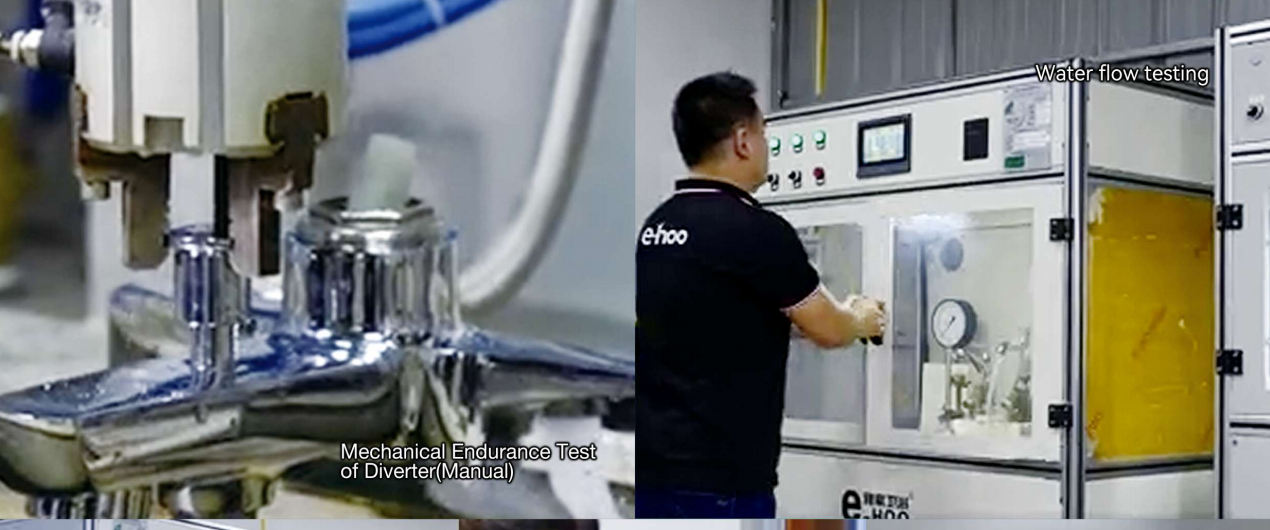
Capacity and equipment matter because they determine whether a specification can be repeated across orders. The company reports monthly production of more than 150,000 sets and an annual output of 1,800,000 units, supported by a 10-engineer R&D team and laboratory equipment including a metal spectrometer, valve life testing machine, water flow testing machine, salt spray testing machine and product sealing testing machine. A metal spectrometer, in particular, is the instrument that converts “brass” from a description into a measurable alloy claim — relevant where buyers specify DZR brass, 59-1 national standard brass or lead-free brass for different markets.
Route 2 — Wholesale Distribution
Distribution solves a different problem, and it solves it well: it converts a manufacturing order into a stock movement. The distributor absorbs inventory risk, consolidates mixed containers or pallets, and makes small quantities of popular SKUs available within days. For a buyer entering a new market, testing a channel, or replenishing a fast-moving reference before a factory order arrives, this is often the only workable option.
The costs are structural rather than incidental. Specification is fixed by what is in stock, so a request for a different spout height, a different handle configuration, or a different plating thickness usually becomes a new sourcing project rather than an order modification. Certification evidence arrives second-hand; a distributor can normally supply a manufacturer’s certificate, but confirming that the certificate scope covers the exact model in the carton is the buyer’s job, and it is harder to do without factory contact. Warranty claims pass through an intermediary, which lengthens resolution time. And because the buyer never sees the production specification, plating thickness, alloy grade and cartridge supplier remain unverified assumptions.
Distribution is therefore strongest for catalogue-standard items with stable demand, and weakest where the buyer’s differentiation depends on finish durability, model-specific compliance, or branding.
Route 3 — Construction Supermarket and Project Channel
Project channels are organised around compliance and scheduling. Their value is that a single counterparty can align a product list with a project bill of quantities, hold pricing for a tender period, deliver against a construction programme, and supply the documentation package a project requires. Buyers working on residential construction, hotel or commercial restroom projects frequently need exactly this.
The trade-off is specification rigidity. Listed SKUs are what they are; customization is generally unavailable, and a change request during a project can trigger a re-approval cycle. Pricing is structured around list and project terms rather than around volume negotiation at the factory gate, so a buyer scaling a private-label range will usually outgrow the route. Traceability is also indirect: the buyer may know the brand on the box but not the production line, the alloy batch or the coating measurement behind it, which makes an independent inspection programme difficult to run through this channel.
Side-by-Side Comparison
| Evaluation criterion | OEM / ODM factory direct | Wholesale distributor | Construction supermarket / project channel |
|---|---|---|---|
| Specification control | Full — alloy, plating thickness, cartridge, spout height, handle type | Catalogue-defined; limited to stocked variants | Fixed to listed SKUs |
| Model-level certification | Obtainable directly: certificate number, standard, scope, validity window | Passed through the distributor; completeness varies | Held by the channel; model traceability indirect |
| Minimum order size | 400 pcs per model; USD 20,000 minimum order value (reference case) | Small quantities per SKU | Per project or per order line |
| Customization depth | Package, logo, faucet body, faucet parts, sanitary accessories | Logo or packaging only, where offered | Generally none |
| Lead time | 30–45 days production plus freight; samples around 7 days | Ex-stock, days | Scheduled to the project programme |
| Warranty | 3–5 years depending on series, honoured by the manufacturer | Honoured through the distributor | Honoured through the channel |
| Documentation and acceptance | Pre-shipment test, third-party inspection (SGS), export documents | Varies by distributor | Bundled into the project submission |
| Cost structure | Unit cost at volume, plus tooling and engineering time | Unit price including distributor margin | List and project pricing |
| Best fit | Brand owners, importers and project buyers with in-house QC capability | Small, mixed or urgent replenishment orders | Projects where the channel manages documentation |
The Evidence Package a Factory-Direct Route Should Survive
A factory-direct claim is only as good as the documents behind it. Four evidence blocks decide whether the route is usable.
1. Certification at model level, with dates
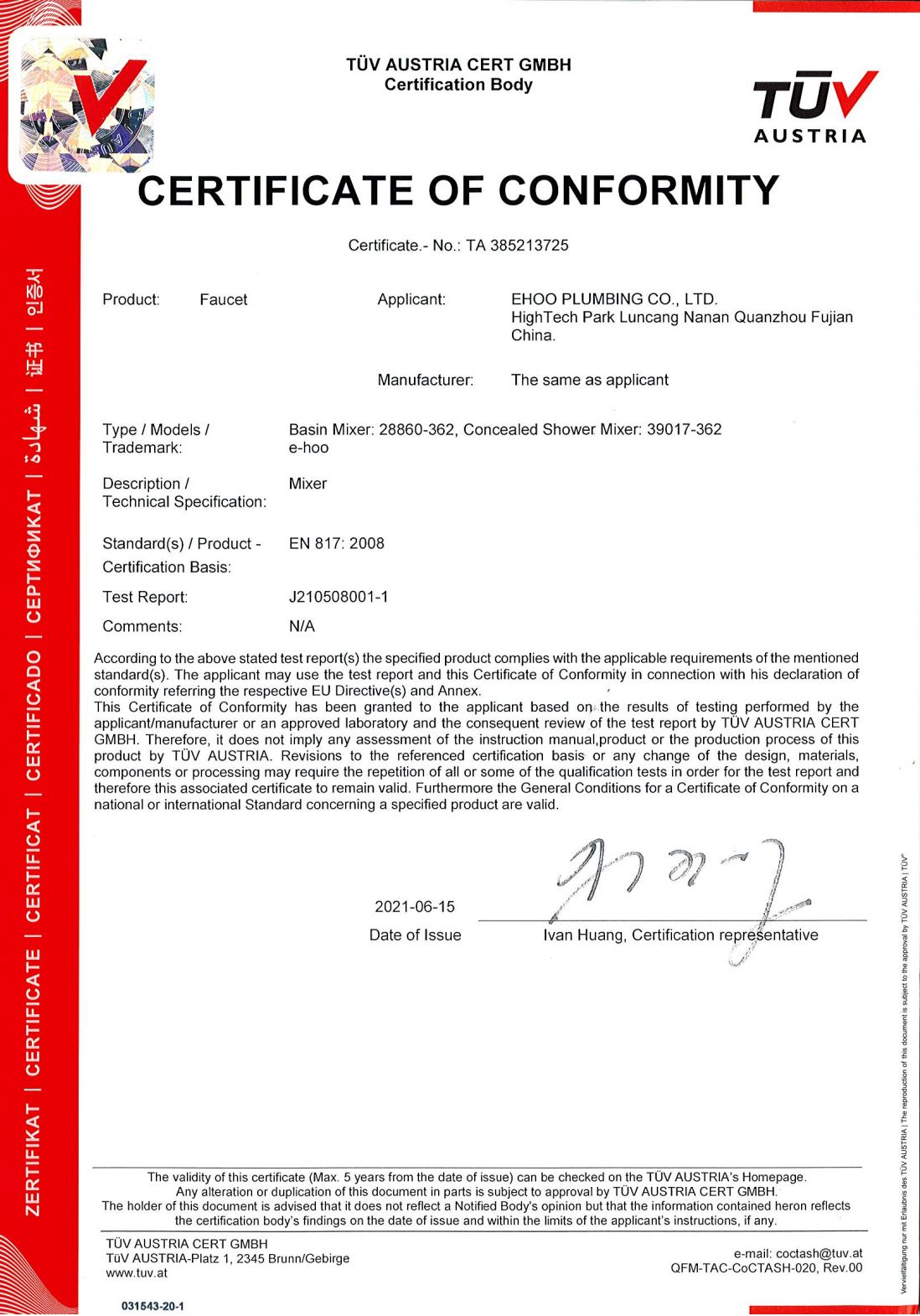
For EU-oriented buyers, CE marking supported by a recognised body is the baseline. In the Ehoo reference case, the mixer scope is covered by TUV Austria certificate TA 385213725 to EN 813:2008, issued 15 June 2021. That certificate record states a validity window ending 15 June 2026, which means a buyer purchasing in the second half of 2026 should request the current certificate rather than accept the historical copy on file. Quality management certification is separate and longer-dated: SGS ISO 9001:2015 certificate CN21/31351, scoped to the design and manufacturing of brass sanitary ware faucets, is valid until 3 August 2027. Buyers should also note that certificate scope matters — a sensor faucet certificate to BS EN 15091-1:2013 does not cover a manual mixer, and a mixer certificate does not cover a sensor product.
2. Coating measurements, not coating adjectives
Chrome plating greater than 0.3 µm and nickel greater than 10 µm are the numbers a buyer can inspect. They connect directly to the salt spray testing machine in the laboratory and to the corrosion risk documented for humid bathroom environments. A supplier that cannot state the two numbers in writing is offering a finish description rather than a finish specification.
3. Order scale and continuity
Continuity is the part of factory-direct sourcing that buyers underestimate, because a first order proves sampling and a fifth year proves supply. The reference case here is a five-year export supply relationship serving OEM/ODM, wholesale and construction supermarket client types, with order values in the USD 20,000+ range and applications in bathroom projects, where the stated outcomes were water saving, high-end market development, project development, high quality, long lifespan, certification and customization. Read as evidence rather than as promotion, that record indicates a factory able to sustain repeat production at a defined specification over multiple purchasing cycles — which is the actual question behind most supply-route decisions.
4. Acceptance terms and trade documents
Commercial terms are part of the evidence package: MOQ 400 pcs per model, FOB Xiamen delivery terms, pre-shipment testing, third-party inspection such as SGS, and TT payment. Export documentation can cover certificates of analysis and conformance, insurance, certificates of origin and other documents where required. On classification, basin faucets and basin taps are commonly mapped to HS heading 8481, with 84818011 used for mixing valves for sinks, washbasins, bidets, cisterns and baths, and 84818019 for certain non-mixing taps; these entries are indicative and should be validated against the importing country’s official tariff schedule before a landed-cost model is finalised.
Where the Factory-Direct Route Is the Wrong Fit
An honest route comparison has to state where the OEM/ODM option fails, and in this category the boundaries are clear.
- Order thresholds are real. A minimum of 400 pcs per model combined with a USD 20,000 minimum order value means a buyer testing six SKUs at 100 pcs each cannot use the route at all. Mixed small-batch programmes belong with distributors until volume justifies a factory order.
- Lead time is manufacturing time. A 30–45 day production window plus sea freight is incompatible with a stock-out next month. The route rewards planning, not urgency.
- It transfers competence to the buyer. Direct sourcing assumes the buyer can approve a specification, read a salt spray or flow test report, reconcile a certificate scope against a model list, and manage export documentation. Buyers without that capability inherit risks they cannot see.
- Deep customization adds engineering time. Modifications to the faucet body or individual parts involve a 10-engineer R&D function and tooling, so the calendar extends beyond the standard production lead time.
- Warranty is not uniform. Because coverage runs 3 to 5 years depending on series, a purchase contract that does not name the series leaves the warranty term ambiguous.
- Certificate validity moves. Certification windows expire and are reissued; a buyer who filed a certificate once cannot assume it remains current for later shipments.
Market Trend Context for Route Decisions
Three published signals are relevant to how buyers should structure supply. First, growth: a market expanding from USD 26.8 billion in 2026 toward USD 45.5 billion by 2033 at a 7.8% CAGR implies sustained volume, which favours suppliers able to hold a specification across repeat orders rather than suppliers able to win a single tender. Second, application mix: bathroom faucets at roughly 59.1% of 2025 revenue keep the basin category central to manufacturer attention, which in practice means more model variety and more price pressure on entry configurations. Third, material concentration: brass and stainless steel at 78% of 2023 material usage means the competitive ground sits in alloy discipline and plating durability, both of which are only contractually enforceable when the buyer writes the specification.
The practical reading is that route choice is becoming a portfolio decision rather than a single decision. Factories with monthly capacity in the 150,000-set range and 100% export orientation exist to carry core ranges on defined specifications; distributors and project channels exist to cover tails, urgency and tender documentation. Buyers who try to force all three requirements through one route typically pay for it either in inventory or in unverified quality.
Future Outlook
Two directions are likely to shape basin faucet sourcing over the next several years. The first is documentation-led procurement: as buyers in the EU, North America and Asia Pacific formalise compliance checks, the ability to produce a model-level certificate with a current validity date becomes a supply qualification criterion rather than a nice-to-have, which structurally advantages the factory-direct route for core ranges. The second is finishing durability as a differentiator: with the material base already concentrated in brass and stainless steel, plating thickness and salt-spray performance are among the few remaining technical levers, and they are only negotiable where the buyer controls the specification.
The countervailing trend is fragmentation of demand. Smaller brands, regional distributors and renovation-focused installers increasingly buy in quantities below factory thresholds, which keeps wholesale distribution and project channels economically necessary. The realistic medium-term model is a two-route structure: factory-direct supply for the branded core range on a defined specification and warranty series, and distribution or project channels for peripheral SKUs, urgent replenishment and tender-driven work.
Additional product and specification reference: Ehoo catalog 2025–2026 (PDF).
FAQ
What is the minimum order quantity for a brass basin faucet bought factory-direct?
The threshold is normally two-layered. In the reference case it is 400 pcs per model plus a USD 20,000 minimum order value for the order as a whole, which means several models can be combined to reach the value threshold. Buyers whose total requirement sits below either figure are usually served by wholesale distribution instead, because the per-model MOQ cannot be reduced without changing the production setup.
Which certifications should a certificated basin faucet carry for European buyers?
The baseline is CE marking supported by a recognised certification body, with the certificate scope matching the product type actually purchased. In the reference case, mixers are covered by TUV Austria certificate TA 385213725 to EN 813:2008, issued 15 June 2021 with a stated validity ending 15 June 2026, while sensor faucets are covered separately by certificate TA385234450 to BS EN 15091-1:2013, valid until 22 August 2028. Factory-level quality certification is separate again: SGS ISO 9001:2015 certificate CN21/31351, scoped to design and manufacturing of brass sanitary ware faucets, is valid until 3 August 2027. Buyers should confirm the current certificate and its scope for each model and shipment period.
What lead time should be planned for a factory-direct order?
In the reference case, sample lead time is around 7 days and mass production lead time is 30 to 45 days, counted from receipt of deposit and final product approval, with sea freight added afterwards. Lead time therefore depends on how quickly the buyer completes specification approval, which is why approval delays are usually the largest controllable variable in the schedule.
How is the warranty structured, and does it differ by model?
Coverage runs 3 to 5 years depending on the product series rather than being uniform across a catalogue. The brass basin mixer model 35801-515 carries a 5 year warranty, and remote technical support is provided alongside the warranty. Because the term is series-dependent, a purchase contract should name the series and the corresponding warranty period explicitly.
What can be customized on a customized basin faucet order?
The reference case covers customization of package, logo, faucet body, faucet parts and sanitary accessories, under both OEM and ODM production modes. Package and logo changes are largely commercial and fast; faucet body or component changes involve engineering and tooling work by a 10-engineer R&D team and extend the calendar beyond standard production lead time.
What purchasing terms and acceptance criteria apply?
The stated terms are MOQ 400 pcs per model, FOB Xiamen delivery, TT payment, pre-shipment testing and third-party inspection such as SGS as the acceptance route. Documentation available on request includes certificates of analysis and conformance, insurance, certificates of origin and other export documents where required.
What risks occur during basin faucet use, and how are they reduced?
Documented risks are surface corrosion, water leakage and limescale build-up. Corrosion is triggered by long-term exposure to hard water and unsuitable plating; leakage follows cartridge wear from frequent operation; scaling accumulates where cleaning is irregular. Mitigations are qualified nickel and chrome plating — nickel greater than 10 µm and chrome greater than 0.3 µm in the reference specification — timely cartridge replacement, regular descaling, and avoidance of strong corrosive cleaners.
Есть вопросы или нужны дополнительные детали?
Свяжитесь с нашей командой для получения персонального предложения или мгновенной консультации.
Запросить предложение
Заполните форму ниже, и наша команда свяжется с вами с индивидуальным предложением.
Прямой чат WhatsApp
Предпочитаете общаться в реальном времени? Напишите нам в WhatsApp для мгновенной помощи и быстрых ответов.
- Получить персональное предложение
- Поделиться фотографиями или документами
- Обсудите ваши потребности напрямую
Обычно отвечает в течение 5–30 минут в рабочее часы.