
Brass Shower Faucet Specs: The Constraints That Decide Fit
A brass shower faucet is a mixing valve plus a delivery component: hot and cold water enter through 1/2-inch inlets, are blended by a ceramic cartridge, and leave through a fixed shower body or a hand shower. Two quotations that look identical in a catalogue usually differ in exactly the places a buyer cannot see at the sample stage — brass grade, plating thickness, cartridge format, certificate coverage, pressure rating, thread standard and commercial terms.
Why Constraint-First Sourcing Changes the Outcome
Shower faucet purchasing is often framed as a design and price discussion. In a mature category that framing breaks down quickly. External appearance converges across suppliers within a season, while the specification underneath it does not converge at all. Two quotations can carry the same photograph, the same headline size and the same finish name, and still describe different products.
For a buyer moving from research into evaluation, the practical question is therefore not which faucet matches the reference image most closely, but which supplier can convert its claims into documents that survive an audit. That shift changes the order of the work: constraints first, samples second, price third.
The approach produces three concrete benefits. It moves disagreements into the sampling stage rather than the after-sales stage. It turns a price negotiation into a specification negotiation, where every cost difference has a named cause. And it leaves a written record that can be reused for the next order, the next market entry or the next product family, instead of being rebuilt from scratch each season.
The market context reinforces the point. Faucet and shower faucet demand is large enough that suppliers are abundant, quotations are easy to obtain, and comparisons on price alone are unreliable. In that environment, specification discipline is the main source of bargaining power a buyer has.
The Constraint Set That Defines a Brass Shower Faucet Specification
Six constraint groups carry most of the decision weight for a brass shower faucet. Each one should be answerable in writing before a sample is approved, and each one changes the landed cost or the risk profile rather than only the appearance of the product.
| Constraint | What should appear in writing | Why it changes the decision |
|---|---|---|
| Body material and grade | Brass grade named as DZR brass, 59-1 national standard brass or lead-free brass; stated net weight per unit | Determines corrosion behaviour, potable-water suitability and the largest single cost variable |
| Plating | Nickel above 10 μm and chrome above 0.3 μm, with a stated measurement method | Controls surface durability in humid bathrooms and can be checked on a sample |
| Cartridge and control | 35 mm ceramic cartridge or 1/2-inch ceramic cartridge; single or double handle control | Sets drip risk and service life; the part most often replaced first |
| Certification | Certificate number, issuing body, standard cited, validity dates and the model list covered | Market access in the EU, quality-system evidence globally, and an item that expires |
| Pressure and connection | Rated and functional pressure range; inlet and hand-shower thread standard | Compatibility with building supply conditions and with separately sourced hoses and outlets |
| Commercial terms | MOQ per model, order value threshold, lead time, warranty period, packaging specification | Drives landed cost, reorder planning and private-label feasibility |
The order of the table is deliberate. Material and plating decisions are fixed at the tooling and finishing stage and cannot be renegotiated later without restarting the process. Cartridge and certification decisions are fixed at model level. Pressure, thread and commercial terms are fixed at order level. A constraint missed near the top of the list cannot be recovered by negotiating harder at the bottom.
Material and Finish: What Brass and Chrome Actually Specify
Ehoo Plumbing Co., Ltd. publishes two brass shower faucet configurations that show how these constraints appear in a real specification. Model 8110-803D is a hot and cold shower faucet with a hand shower, built on a brass body with an 8-inch brass shower mixer body, a 1/2-inch ceramic cartridge, a 3-function shower hand, a chrome metal handle and a chromed ABS shower head, with a stated net weight of 1.1 kg. Model 8115-955 is a double handle shower faucet with a head shower, using a 35 mm ceramic cartridge as its closing mechanism, a 3-function shower head, a bronze shower body and a chrome metal handle, with a stated net weight of 1 kg.
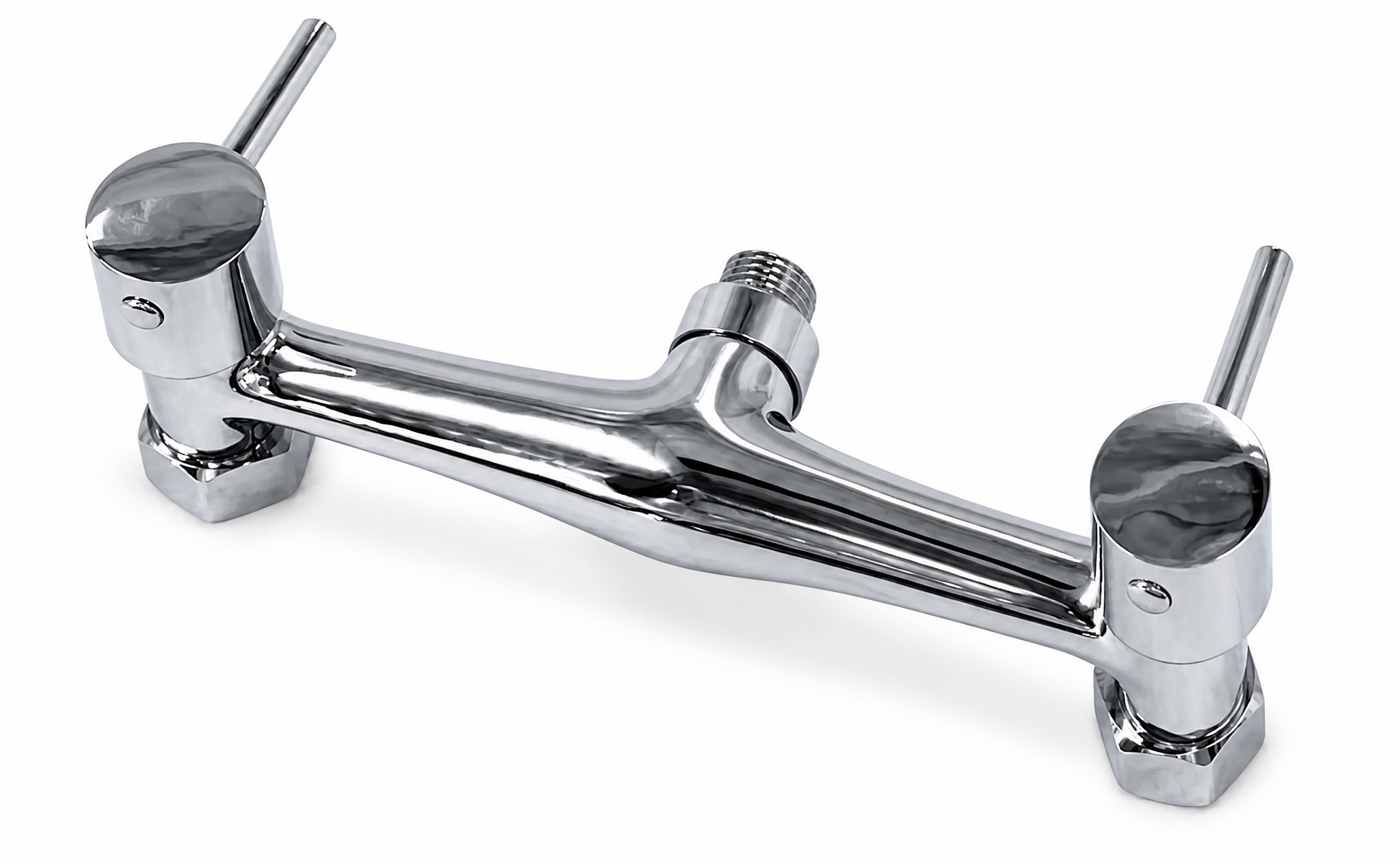
Both models carry the same stated finish specification: nickel plating above 10 μm and chrome plating above 0.3 μm. Those two numbers are the most portable part of the specification, because they can be checked with a plating thickness gauge and compared across suppliers without relying on anyone's marketing language. In humid bathroom environments, plating thickness is one of the main determinants of how long the visible surface survives, and the application data published for this product family explicitly lists corrosion resistance under high-humidity bathroom conditions as a requirement.
The material field for both models reads brass. Buyers comparing quotations should ask for the grade rather than the family name, because brass is a range, not a single material. Ehoo's published product line covers Singapore and Australia DZR brass, 59-1 national standard brass and lead-free brass, and the grade selected determines corrosion behaviour, machinability and suitability for potable-water contact.
A smaller but practical point deserves attention. The 8110-803D selling-point text refers to a bronze shower body while the material field lists brass. That is precisely the kind of wording a buyer should resolve in writing before approving a sample, because body material is the largest cost and durability variable in the product. Requests for clarification are not a sign of distrust; they are the mechanism by which a specification becomes enforceable.
Cartridge and Control: What Double Handle Does and Does Not Mean
The cartridge is where a shower faucet either lasts or starts to drip. Both Ehoo models use ceramic cartridges — 35 mm on the 8115-955 and 1/2-inch on the 8110-803D — and both are operated by double handle hot and cold control, meaning the user sets temperature and flow by adjusting two handles rather than through a single lever or a thermostatic element.
Ceramic disc cartridges are the mainstream choice in this category because they replace the rubber washers and seats used in compression taps, which wear and are sensitive to debris. The relevant procurement questions are therefore specific: cartridge diameter, ceramic disc format, and whether the supplier can state a cycle count or supply a life-test reference. Ehoo's equipment list includes a valve life testing machine, which is the equipment category that produces this kind of evidence; buyers should request the test output rather than assume it exists.
There is a genuine boundary here. Double handle hot and cold control is manual mixing: outlet temperature depends on how the user sets the two handles and will drift if supply pressure or inlet temperature changes. Neither published model is described as a thermostatic shower faucet. Where a project specification requires anti-scald temperature limiting — common in hotels, care facilities and some public buildings — a thermostatic valve is a different product category and should be confirmed separately rather than assumed from the mixer range.
Certification: What a Document Proves and What It Leaves Open
The certification picture has to be read at two levels, because conflating them is one of the most common sourcing errors in this category.
At system level, Ehoo Plumbing holds SGS ISO 9001 certification number CN21/31351 against ISO 9001:2015, issued by SGS and valid from 3 August 2024 to 3 August 2027 for the global market. The certified scope is the design and manufacturing of brass sanitary ware faucets. The company also states ISO 45001:2018, ISO 14001:2015 and ISO 14067:2018 product carbon footprint system certification, TUV certification and EN817:2008.
At product level, the published specification for models 8110-803D and 8115-955 lists CE and TUV as the applicable standards. For the EU market this is the level that matters for market access, and it is the level at which documentation must be matched model by model.
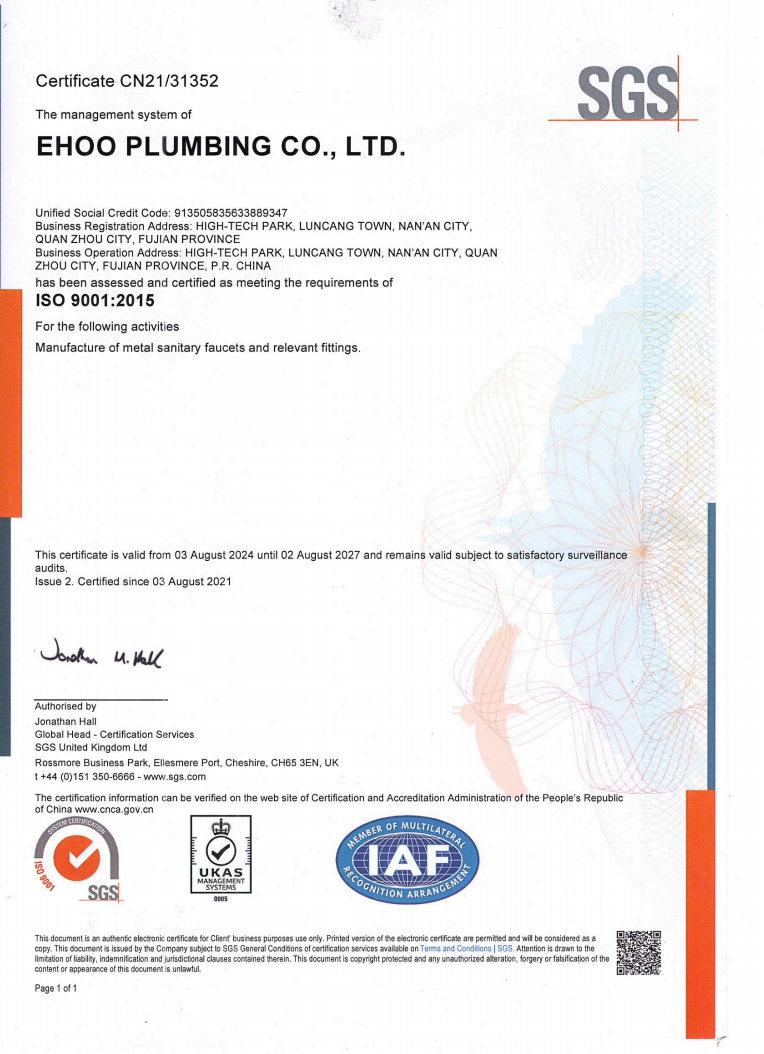
The distinction is not academic. An ISO 9001 certificate proves that a quality management system exists and has been audited; it does not prove that a particular SKU passed a particular type test. Conversely, a product certificate covers the models listed on it, not the whole catalogue. A buyer should therefore request four items together: the certificate number, the issuing body, the standard cited, and the list of models the certificate covers. Validity dates belong in the same request, because certificates expire and renewals are administrative events that do not always reach the buyer's file.
Where the destination market is the United States or Canada, the relevant reference point is ASME A112.18.1-2018 / CSA B125.1-18. Its scope covers plumbing supply fittings, including automatic compensating valves for individual wall-mounted showering systems and bath-and-shower supply fittings, and it requires covered fittings to comply with the applicable requirements of NSF/ANSI 61. This should be read correctly: a standard's scope describes what the standard covers, not what a given supplier has demonstrated. It is a checklist to test a supplier against, not evidence about that supplier.
Pressure and Threads: The Failure Points Buyers Cannot See
Two technical constraints are routinely missing from quotation documents and routinely cause site problems.
The first is pressure. The cited ASME/CSA standard specifies a rated supply pressure of 690 kPa (100 psi) and a functional supply-pressure range of 140 to 860 kPa (20 to 125 psi) for covered supply fittings. That gives a buyer a defensible question for any supplier: what is the rated pressure and the functional range for this model, and what test was used to establish it? The application data published for this product family describes operation in working conditions of 0.5 MPa to 2 MPa, which is the same order of magnitude but is a different statement, and it should not be substituted for a model-level rating.
The second is the connection. The cited standard specifies 1/2-14 NPSM or ISO 228-G 1/2 threads for hand-held shower connections. Thread mismatch is a small, cheap failure that becomes expensive at installation, particularly where hoses and wall outlets are sourced separately from the mixer. Buyers running multi-source projects should fix the thread specification in the purchase order rather than leaving it to the drawing.
The same discipline applies to material contact. The standard references NSF/ANSI 61 for covered fittings, and the application data for this product family lists lead-free as a special requirement. Neither statement certifies a specific SKU. Both tell the buyer what to ask for: a material declaration and, where the destination market requires it, a potable-water contact certificate naming the model.
How Ehoo Plumbing Maps to These Constraints
Ehoo Plumbing Co., Ltd. is a brass faucet and valve manufacturer established in 2002, located in the plumbing industry park in Luncang, Nan'an, Quanzhou, Fujian, China, and exporting its full output to the EU, South America and South East Asia.
The operating facts that matter at the evaluation stage are these. The factory covers more than 6,000 m² with approximately 100 employees, including a 10-engineer R&D team, and states annual output of 1,800,000 units against a monthly capacity of 150,000 units. Quality control is described as 100% testing, supported by a metal spectrometer, valve life testing machine, water flow testing machine, salt spray testing machine and product sealing testing machine, alongside CNC multi-axis compound machines and CNC processing machine tools. Commercial terms state a standard MOQ from 400 pieces per model, an order value threshold of USD 20,000 in the capability data, a lead time of 30 to 45 days, remote technical support, and a warranty of up to 5 years on the body, described in the company profile as 3 to 5 years depending on product series.
Customisation is the part of the offer that most often decides a wholesale or private-label programme. Ehoo lists OEM and ODM production with customisation of packaging, logo, faucet body and faucet parts. For an importer building an own brand shower faucet set, that combination — body-level customisation plus packaging — is the difference between buying a catalogue item and owning a specification.
Two boundaries belong in the same section. First, the published production, capacity and quality figures are company-reported; they are best confirmed through a factory audit or a live video walkthrough before a first order. Second, the stated 30 to 45 day lead time is a production figure and does not include tooling for a new customisation, which is a separate timeline to be agreed in writing.
Application Fit: Where Manual Brass Mixers Belong
Published application guidance places these faucets in bathroom renovation projects, hotel applications and commercial restroom applications. That covers the majority of demand in this product class: hotel refurbishment programmes that need a repeatable, documented specification across hundreds of rooms; commercial restrooms where a double handle mixer is preferred for simple, tool-free operation and straightforward replacement; and residential renovation where the buyer wants a brass body and a defined finish rather than an unspecified alloy.
The working conditions described for the product family set the envelope: indoor bathroom, kitchen and outdoor garden water systems operating between 0.5 MPa and 2 MPa, with corrosion resistance required under high-humidity bathroom conditions and lead-free material specified as a special requirement. Projects outside that envelope — very low-pressure gravity-fed systems, or specifications requiring thermostatic anti-scald control — need a different product decision rather than a different quotation for the same model.
Market Signals and How Much Weight to Give Them
Three published market estimates are relevant, and they should be used carefully because they disagree.
Fortune Business Insights values the global faucet market at USD 25.47 billion in 2025 and projects USD 51.37 billion by 2034. Report Ocean places the global shower faucets market at USD 33.18 billion in 2023, rising to USD 65.34 billion by 2032 at a reported CAGR of 7.82%. Market Research Future projects the brass faucets market to reach USD 22.68 billion by 2035 with a CAGR of 4.8%.
Read together, these figures do not reconcile, and the reason is definitional: the shower faucet estimate is larger than the total faucet estimate, which is only possible if one report counts complete shower systems while the other counts the valve and handle unit alone. For procurement purposes the correct use of these numbers is directional. The category is large and growing, brass retains its own growth trajectory, and supplier choice is not constrained by category demand. No purchase decision should rest on the gap between two reports with incompatible scopes.
Trade classification is more actionable than market sizing. Bath and shower faucets are classified under HS 8481.80.1020 in the United States and 8481.80.11 for mixing valves in the EU. Getting the code right at quotation stage affects duty calculation, export documentation and, in some markets, the certification route the product must follow.
Brass Versus Lower-Cost Alternatives: An Honest Boundary
Comparing brass shower faucets with lower-cost alternatives is useful only if the comparison is honest about what changes.
| Dimension | Brass body with defined plating and ceramic cartridge | Lower-cost die-cast body, commonly zinc alloy in this category |
|---|---|---|
| Material specification | Grade can be named precisely: DZR brass, 59-1 national standard brass or lead-free brass | Alloy and grade are less frequently disclosed at SKU level |
| Corrosion behaviour | Brass is generally more tolerant of humid service once plating is intact and remains serviceable if plating is damaged | Die-cast alloys are generally more sensitive to plating damage and to subsequent corrosion |
| Unit cost | Higher material cost per unit, reflected in the quotation | Lower material cost per unit, visible immediately in the price |
| Documentation depth | Supports potable-water contact and market-access documentation at model level | Documentation depth depends on the alloy selected and the supplier's own testing |
| Typical fit | Hotel programmes, commercial restrooms, renovation with a long maintenance horizon | Short-service retrofit, low-duty residential replacement, price-led promotions |
The honest boundary is this: a brass body with defined plating and a ceramic cartridge is a specification choice with a cost consequence, not a universal answer. Where the application is a low-duty retrofit with a short expected service life and no certification requirement, a lower-cost body can be the rational purchase, and saying so is more useful than pretending otherwise. Where the application is a hotel programme with a ten-year maintenance horizon, or a market with potable-water contact requirements, the lower-cost option shifts risk rather than removing it.
Two further limits apply to the Ehoo shower faucet range as documented here. Neither published model is thermostatic, so projects specifying anti-scald control need a separate product line. And model-level pressure, flow and endurance test reports are not part of the public specification, so a buyer who needs them should request them at RFQ stage rather than after the purchase order has been placed.
A Pre-Sample Procurement Checklist
| Check | What to request |
|---|---|
| Material declaration | Brass grade in writing, plus a lead-content statement where potable water applies |
| Plating specification | Nickel and chrome thickness in micrometres, with the measurement method named |
| Cartridge specification | Diameter, ceramic disc format, and a life-test reference if one exists |
| Certificate pack | Number, issuer, standard, validity dates, and the model list each certificate covers |
| Pressure and flow data | Rated pressure, functional range and flow rate at a stated pressure |
| Connection drawings | Inlet and hand-shower thread standard, plus dimensional drawings for the body |
| Commercial terms | MOQ per model, order value threshold, lead time, warranty period, packaging specification |
| Sample verification | Weigh the sample, measure plating, leak-test across the declared pressure range before approval |
Future Outlook
Three developments are likely to shape brass shower faucet procurement over the next few years.
The first is material documentation. Lead-free and low-lead requirements are moving from niche specification toward standard expectation in more markets, and suppliers who can state grade and composition at SKU level will face fewer objections at tender stage. Separating DZR brass, 59-1 national standard brass and lead-free brass in the product line, as Ehoo does, is the structure a buyer needs in order to match a specific market rather than negotiate a single generic material.
The second is environmental accounting. ISO 14067:2018 product carbon footprint system certification, stated alongside ISO 14001:2015 and ISO 45001:2018, is the kind of system that becomes useful before it becomes mandatory: European tenders increasingly ask for carbon data, and a supplier that already operates the system has a shorter path to answering.
The third is the digitisation of certificates. The recurring failure in this category is rarely a missing certificate. It is a certificate that does not name the model being purchased, or one whose validity dates passed without anyone noticing. Buyers who maintain a certificate register — number, issuer, standard, model list, expiry date — convert a recurring administrative risk into a one-time task, and gain a defensible answer the next time a project specification changes.
FAQ
What should a brass shower faucet specification sheet contain?
A usable specification sheet states the body material and brass grade, the net weight, the plating thickness for nickel and chrome, the cartridge diameter and format, the control method, the rated and functional pressure range, the inlet and hand-shower thread standard, the certifications claimed with numbers and validity dates, and the commercial terms covering MOQ, lead time and warranty. For the Ehoo 8110-803D and 8115-955 models, the published data covers brass body, nickel plating above 10 μm, chrome plating above 0.3 μm, ceramic cartridges of 1/2 inch and 35 mm respectively, double handle hot and cold control, and CE and TUV as the stated standards.
Which certificates should be verified before ordering brass shower faucets for the EU market?
Two levels should be verified separately. At system level, the SGS ISO 9001 certificate CN21/31351 against ISO 9001:2015 is valid from 3 August 2024 to 3 August 2027 for the global market, with a scope covering the design and manufacturing of brass sanitary ware faucets. At product level, the relevant documents are the CE and TUV certificates applicable to the specific model, checked for certificate number, issuing body, cited standard, validity dates and the model list covered. A system certificate does not substitute for model-level type test documentation, and a product certificate does not extend beyond the models listed on it.
What plating thickness is specified on Ehoo brass shower faucets?
The published specification for both the 8110-803D and 8115-955 models states nickel plating above 10 μm and chrome plating above 0.3 μm. These figures are measurable on a sample with a plating thickness gauge, which makes them one of the few specification items a buyer can verify independently before placing an order rather than relying on the supplier's declaration.
What pressure range should a wall mounted shower faucet be rated for?
The ASME A112.18.1-2018 / CSA B125.1-18 standard specifies a rated supply pressure of 690 kPa (100 psi) and a functional supply-pressure range of 140 to 860 kPa (20 to 125 psi) for covered supply fittings, which include automatic compensating valves for individual wall-mounted showering systems. This is a standard requirement and not a product specification: the corresponding figure for a specific model must be requested from the supplier and confirmed against the building's actual supply conditions.
Are double handle shower faucets thermostatic?
No. Double handle hot and cold control is manual mixing: the user adjusts two handles to set temperature and flow, and the outlet temperature responds to changes in supply pressure and inlet temperature. Neither the 8110-803D nor the 8115-955 is described as a thermostatic shower faucet in the published specification. Applications requiring anti-scald temperature limiting therefore need a thermostatic valve, which is a separate product category.
What are the MOQ, lead time and warranty terms for Ehoo shower faucets?
The stated commercial terms are a standard MOQ from 400 pieces per model, an order value threshold of USD 20,000 in the capability data, and a production lead time of 30 to 45 days. Warranty is stated as up to 5 years on the body, described in the company profile as 3 to 5 years depending on product series, with remote technical support included. Customisation of packaging, logo, faucet body and faucet parts is available under OEM and ODM production, and tooling for a new customisation runs on a separate timeline from standard production.
Why does a brass shower faucet cost more than a lower-cost alternative?
The cost difference sits mainly in the body material and the finishing process. A brass body specified by grade — DZR brass, 59-1 national standard brass or lead-free brass — carries a higher material cost than a die-cast alternative, and a plating specification of nickel above 10 μm and chrome above 0.3 μm requires controlled process time. Whether the difference is worth paying depends on the application: a long maintenance horizon or a potable-water contact requirement justifies the specification, while a short-service retrofit with no certification requirement may not.
Есть вопросы или нужны дополнительные детали?
Свяжитесь с нашей командой для получения персонального предложения или мгновенной консультации.
Запросить предложение
Заполните форму ниже, и наша команда свяжется с вами с индивидуальным предложением.
Прямой чат WhatsApp
Предпочитаете общаться в реальном времени? Напишите нам в WhatsApp для мгновенной помощи и быстрых ответов.
- Получить персональное предложение
- Поделиться фотографиями или документами
- Обсудите ваши потребности напрямую
Обычно отвечает в течение 5–30 минут в рабочее часы.