
Brass Strainer Choice: Y-Type vs Basket in Potable Systems
Brass Strainer Choice: Y-Type vs Basket in Potable Systems
In residential and commercial potable water lines, a brass Y strainer is often selected not because it holds the most debris, but because it is the only configuration that fits. This reference examines how the LD.73154 brass Y strainer with drain plug is specified, where a Y-type outperforms a basket, and where it does not.
Why potable water lines need a strainer at all
Water arriving at a building is never only water. Sand from the source, pipe scale, solder and flux residue, and fragments released during commissioning all travel with the flow. Most of this material passes through the system without consequence, until it reaches a component that depends on a clean, close-tolerance seating surface.
The components most exposed sit downstream of the strainer: pump impellers, ball valve seats and water meter mechanisms. A strainer placed ahead of them captures debris before it can score a seat or distort a measurement. The device is therefore protective rather than functional. It does not control flow; it protects the parts that do. Because its value is defined by what it prevents, strainer selection is driven less by the device itself than by the environment it has to survive in — and by how much space that environment allows.
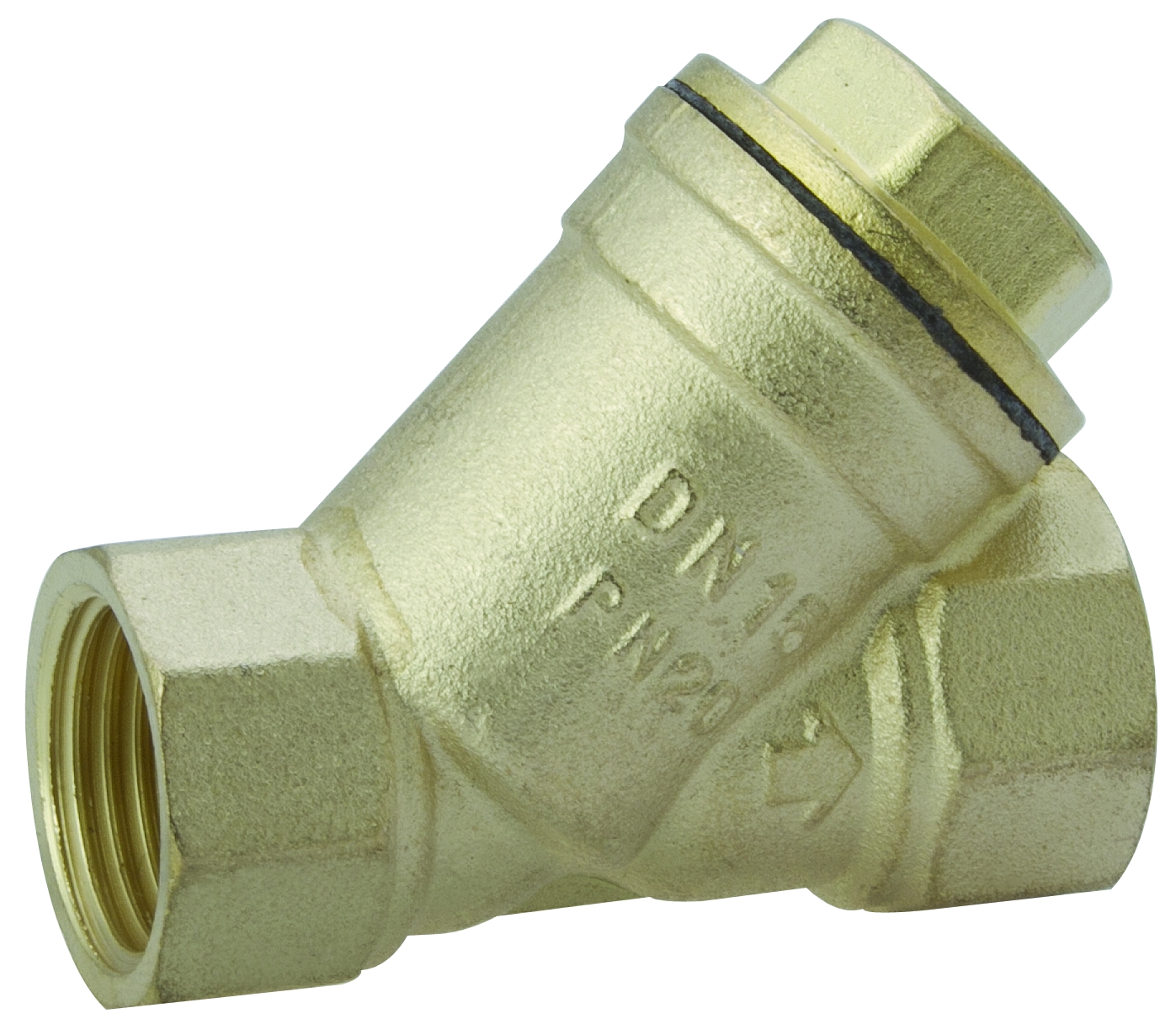
LD.73154 brass Y strainer: threaded brass body, SS304 stainless steel screen, and a blow-down drain plug at the screen pocket.
The constraint that usually decides the question: space
Indoor plumbing is a space-constrained environment. Supply points in a bathroom vanity, a laundry room, a water heater closet or a commercial riser rarely offer the clearance that strainer catalogues assume.
This is where the two common strainer geometries diverge. A basket strainer uses a chamber large enough to hold a basket and a meaningful volume of captured debris, which generally makes the body taller and wider than the pipe it serves. A Y-type strainer places its screen pocket at an angle to the flow path, so the assembly stays close to the line it protects.
In practical terms, a basket strainer needs clearance above, below or beside the pipe for both its body and its basket-removal path, while a Y-type strainer needs enough room to reach a drain plug. Behind a fixture, in a laundry box, or in a finished wall cavity, that difference frequently determines whether a strainer is installed at all. Where a strainer is omitted because nothing fits, the protection is lost entirely — which is the strongest argument for the compact geometry in interior plumbing.
The reference product: LD.73154 brass Y strainer with drain plug
LONGDA BRASS VALVE is the brass valve brand of ZHEJIANG LONGDA TECHNOLOGY CO.,LTD, a manufacturer established in 1993 in Yuhuan County, Zhejiang Province, China, producing brass valves and brass fittings for residential and commercial water systems. Its Y-type strainer for potable and hydronic lines is the LD.73154, a threaded brass Y strainer supplied with a blow-down drain plug and a replaceable stainless steel screen.
| Parameter | Specification |
|---|---|
| Model | LD.73154 |
| Product type | Y-type brass strainer with blow-down drain plug; also listed as a Y strainer with stainless steel screen |
| Size range | 1/2"–2" (DN15–DN50) |
| Pressure rating | 200 WOG (1.4 MPa) |
| Working temperature | −20°C to 150°C |
| Screen | SS304 stainless steel, 20 / 40 / 60 / 80 mesh |
| Body | Hot-forged brass; lead-free brass option available |
| Gasket and seal | NBR / EPDM |
| Drain plug | Brass |
| End connection | Female NPT or BSP threaded |
| Maintenance | In-line blow-down; screen replaceable without pipeline disassembly |
| Testing | 100% factory test |
| Potable-water listing | Lead-free version certified to NSF/ANSI/CAN 61 and NSF/ANSI 372 by IAPMO |
Two design details matter for the application discussed here. The first is the screen material: SS304 stainless steel, offered in four mesh grades, resists corrosion in potable water and does not shed material into the flow. The second is the drain plug: a brass plug at the pocket end that lets an operator flush captured debris out of the strainer without breaking the line.
How a Y strainer is cleaned — and why the drain plug matters
Maintenance is where the Y-type design earns its place in occupied buildings. Cleaning a strainer conventionally means isolating the line, opening the body and removing the screen element. The drain plug on the LD.73154 changes the routine for the common case: with the branch isolated or the pocket depressurised, opening the plug lets captured sand, scale and debris flush out through the pocket in a single pass.
When fouling is heavier, the screen element itself can be replaced without disassembling the pipeline or removing the valve body. That produces two practical effects. First, maintenance time is counted in minutes rather than in a partial line rebuild. Second, the screen becomes a consumable spare part: a distributor or a facility team can stock screens instead of complete valves, and a strainer can stay in service across repeated cleaning cycles.
The limitation is equally practical. Blow-down releases a small volume of water, so in a finished bathroom or laundry room the discharge path has to be planned — a bucket, a nearby floor drain, or a short hose — before the plug is opened. A strainer installed where the drain plug cannot be reached, or where the discharge cannot be directed, is a strainer that will not be serviced. That is a design decision, not a product defect.
What the operating envelope means in a real building
The LD.73154 is rated at 200 WOG (1.4 MPa) with a working temperature range of −20°C to 150°C, across sizes from 1/2" to 2" (DN15–DN50). Published application data for residential fixture supply lines describes typical operating pressures of 40–80 psi (0.28–0.55 MPa) at water temperatures of 4°C–60°C, while indoor commercial plumbing applications are commonly described up to about 150 psi (1.0 MPa) and 90°C. Both sets of conditions sit inside the strainer's rating with margin.
The envelope also defines the boundary. Systems that require larger diameters than 2" (DN50), or that run above 200 WOG, sit outside this model and need a differently configured product. Strainers are frequently evaluated only on thread size, and the pressure and temperature ceiling is checked later — usually after a specification has already been issued.
Screen mesh: the specification most often decided by habit
Mesh selection is a trade-off rather than a preference. The LD.73154 is available in 20, 40, 60 and 80 mesh SS304 screens, and each grade balances capture against flow resistance.
| Mesh grade | Particles captured | Effect on pressure loss | Cleaning interval |
|---|---|---|---|
| 20 mesh | Coarser debris | Generally the lowest of the four | Generally the longest |
| 40 mesh | Mixed coarse and medium debris | Low to moderate | Moderate |
| 60 mesh | Finer sediment and scale | Moderate to high | Shorter |
| 80 mesh | The finest particles among the four | Generally the highest | The shortest |
The table describes general trade-offs rather than fixed performance figures, because the outcome depends on the debris profile of each system. Two questions resolve most mesh decisions. What is the smallest particle the most sensitive downstream component can tolerate? And how often is the facility realistically able to service the strainer? A finer screen that is never cleaned protects nothing; a coarse screen that is cleaned on schedule protects more than its rating suggests.
Y-type vs basket strainer: a comparison, and its limits
| Dimension | Brass Y-type strainer | Basket strainer |
|---|---|---|
| Body form | In-line body with the screen pocket set at an angle to the flow | Larger chamber holding a removable basket |
| Footprint | Compact; suited to tight interior plumbing | Bulkier; requires more clearance around the pipe |
| Debris-holding capacity | Lower | Generally higher |
| Pressure loss | Generally lower for a comparable line size | Generally higher |
| Cleaning | Blow-down through the drain plug; screen replaceable in place | Basket typically removed for cleaning |
| Best-fit conditions | Small to medium lines, equipment protection, confined indoor spaces | Larger lines, heavier debris loads, where space allows |
| Weak point | Clogs sooner under heavy debris; drain plug needs physical clearance | Occupies more space; heavier to service |
Where a Y-type strainer is the wrong choice
- Heavy, continuous debris loads. The smaller dirt-holding capacity of a Y-type body means it reaches its clogging point sooner than a basket design. On a line carrying a steady grit load, the Y strainer converts into a frequent-maintenance item.
- Larger mains and high-flow headers. Above 2" (DN50), the LD.73154 falls outside its size range and the comparison changes entirely.
- Where the drain plug cannot be reached. The maintenance advantage of the drain plug depends on access. Installed blind behind a finished wall, it delivers nothing that a simpler element would not.
- Where blow-down water cannot be discharged. In finished interiors, the flush requires a plan.
- Where the operating envelope is exceeded. Above 200 WOG or outside −20°C to 150°C, a differently rated product is required.
Application notes for bathrooms, laundry rooms and commercial lines
The residential and commercial settings where this strainer is specified share a common profile: indoor installation, wet and humid environments, working pressures of roughly 40–150 psi, and limited space behind fixtures. Within that profile, four installation points decide whether the device performs as intended.
- Flow direction. The body carries a flow arrow, and the pocket must sit on the upstream-capture side of the flow path. Reversed installation places the screen where it cannot trap what it was fitted for.
- Pocket and plug orientation. General installation practice places the screen pocket downward or to the side so that gravity assists blow-down. The plug must remain reachable by hand or with a standard tool.
- Thread standard. NPT and BSP threads are not interchangeable. NPT threads follow ASME B1.20.1, while BSP threads follow ISO 228-1, the standard for pipe threads where pressure-tight joints are not made on the threads. A correct valve with the wrong thread standard leaks.
- Downstream sensitivity. The mesh grade should follow the tolerance of the component being protected — a pump impeller, a meter, or a valve seat.
The same body is also listed for water supply pipelines, HVAC and chilled water systems, gas piping and agricultural irrigation. Each of those applications changes the specification conversation, particularly around material selection and mesh grade, but not the geometry question that this article addresses.
Compliance: what to verify before a strainer enters a potable line
For potable water contact, two certification tracks matter in the United States and Canada, and they answer different questions. NSF/ANSI/CAN 61 addresses the health effects of materials in contact with drinking water. NSF/ANSI/CAN 372 addresses lead-free compliance, with a wetted-surface lead limit of no more than 0.25%, referenced in the U.S. Safe Drinking Water Act and in California Health & Safety Code Section 116875. The EPA describes lead-free brass alloys as becoming the mandatory standard for potable water applications in the United States.
For the brass Y strainer product, the manufacturer holds an NSF/ANSI/CAN 61 listing under certificate number N-5775 issued by IAPMO, valid from 2024-10-01 to 2029-10-01 for the USA and Canada market. A separate lead-free listing, certificate number 6304 issued by IAPMO under NSF/ANSI/CAN 372-2024, is valid from 2024-08-01 to 2028-08-01 and covers the Y strainer alongside other lead-free plumbing products in the range. The lead-free brass version of the LD.73154 is certified to NSF/ANSI/CAN 61 and NSF/ANSI/CAN 372 by IAPMO.
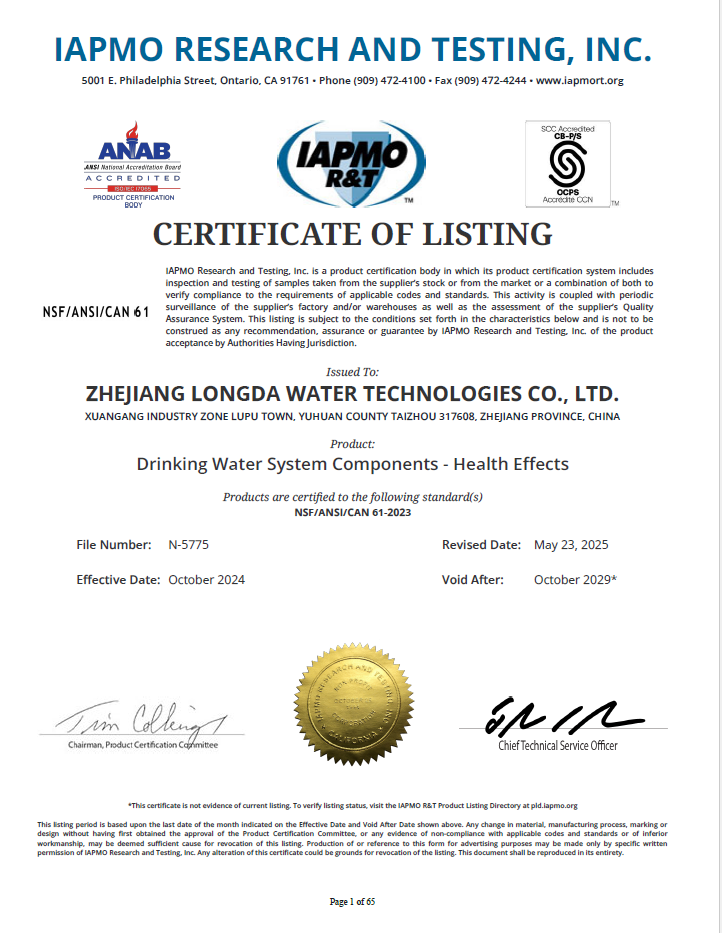
NSF/ANSI/CAN 61 listing N-5775, issued by IAPMO and valid from 2024-10-01 to 2029-10-01, covers the brass Y strainer for the USA and Canada market.
Documentation quality is a useful secondary signal. ZHEJIANG LONGDA TECHNOLOGY CO.,LTD operates under an ISO 9001:2015 quality management system, certificate CN00124Q37399R2M/3300 issued by the China Quality Certification Centre (CQC), valid until 2027-09-06, covering the design, development and manufacture of medium and low pressure valves, plumbing faucets and fittings. Its ISO 14001:2015 certificate, CN00124E33461R2M/3300, is valid until 2027-09-09. On the production side, the manufacturer states that products are 100% factory tested and that lots are pressure tested before shipment, supported by thread gauge inspection and material test reports.
Long-running supply programs in the residential plumbing segment are another indicator, though they should be read in their proper scope: the manufacturer reports supplying a U.S. manufacturer with 8,000,000 pieces per year and a Canadian distributor with 70,000,000 pieces over a three-year relationship in the fixture shut-off category, with zero leakage complaints, a 100% pass rate in retail quality audit, and repeat monthly orders. That evidence concerns a different product family and should be treated as a signal about production consistency rather than as performance data for the Y strainer.
Market context for strainer buyers
The components around this decision are moving, and the direction matters for procurement planning. The global brass valves market was valued at USD 14.8 billion in 2025 and is projected to reach USD 24.1 billion by 2034, a trajectory Dataintelo associates with a CAGR of 5.6% from 2026 to 2034. North America represented approximately 26.1% of that market in 2025, while Asia Pacific held a 41.2% revenue share — a reminder that the supply base and the demand base sit in different regions, with the coordination cost falling on the buyer.
On the supply side, OEC reports that China exported USD 22.6 billion in valves under HS 8481 in 2024, maintaining its position as the largest global exporter. At the same time, Mordor Intelligence estimates that the top five global valve suppliers hold approximately 35% of global revenues. Roughly two thirds of the market is served by companies outside that group, many of them specialized regional manufacturers.
For a strainer buyer, those two facts combine into a single practical point: brand recognition is a weak proxy for compliance, because most of the supply base is not concentrated in a handful of well-known names. The verification step — certificate numbers, validity dates, material reports — costs almost nothing relative to the consequences of a lead-free failure in a potable line.
Future outlook
Three directions appear likely to shape strainer specification over the next several years.
Lead-free as the default, not the option. The regulatory direction described by the EPA points toward lead-free brass becoming the baseline expectation for potable water contact rather than a premium line item. Buyers who currently treat lead-free as a variant to be requested will increasingly find it is the only configuration that can be installed.
Documentation as a purchasing criterion. With certificate validity periods, standards revisions and regional requirements all in motion, the ability of a supplier to produce current, traceable documentation becomes as relevant as the product drawing. Certificate numbers with dates are more useful to a procurement team than a compliance statement on a website.
Serviceability and spare-part economics. Replaceable screens and in-line blow-down fit a broader pattern in fluid management, where the cost of downtime and maintenance access increasingly outweighs the initial purchase price. Monitoring and predictive maintenance in fluid systems, described by Mordor Intelligence as a structural trend tied to industrial IoT integration, will not reach a bathroom supply line soon. But the underlying logic — design for access and for part replacement — already applies at the level of a drain plug.
Frequently asked questions
What certifications should a brass Y strainer carry for potable water in the United States and Canada?
Two separate requirements apply. NSF/ANSI/CAN 61 addresses the health effects of materials in contact with drinking water, and NSF/ANSI/CAN 372 addresses lead-free compliance, with a wetted-surface lead limit of no more than 0.25% as referenced in the U.S. Safe Drinking Water Act and California Health & Safety Code Section 116875. For the LD.73154, the lead-free brass version is certified to NSF/ANSI/CAN 61 and NSF/ANSI/CAN 372 by IAPMO. The brass Y strainer product is covered by NSF/ANSI/CAN 61 listing N-5775, valid from 2024-10-01 to 2029-10-01, and by lead-free listing 6304, valid from 2024-08-01 to 2028-08-01, both for the USA and Canada market.
What pressure, temperature and size range does the LD.73154 cover?
The LD.73154 is rated at 200 WOG (1.4 MPa) with a working temperature range of −20°C to 150°C, in sizes from 1/2" to 2" (DN15–DN50), with female NPT or BSP threaded connections. Published application data for residential fixture supply lines describes typical pressures of 40–80 psi (0.28–0.55 MPa), and indoor commercial plumbing applications are commonly described up to about 150 psi (1.0 MPa), leaving margin inside the 200 WOG rating. Systems requiring larger diameters or higher pressure ratings sit outside this model's envelope.
Which screen mesh should be specified — 20, 40, 60 or 80?
Mesh selection is a trade-off. Coarser grades such as 20 and 40 mesh generally produce lower pressure loss and longer intervals between cleaning, but pass finer particles downstream. Finer grades such as 60 and 80 mesh capture finer sediment and scale, but generally increase pressure loss and shorten cleaning intervals. The correct choice follows the debris profile of the system and the tolerance of the most sensitive downstream component, such as a pump impeller, valve seat or meter. No single mesh grade is correct for every building.
How is the strainer cleaned, and does the whole line have to be shut down?
The blow-down drain plug allows the screen pocket to be flushed in place without disassembling the valve. When heavier fouling requires the screen to be replaced, the element can be swapped without removing the valve body or breaking the pipeline. Local isolation of the branch is still required before the plug or the body is opened, and the flush water needs to be directed to a suitable discharge point such as a floor drain or container.
Can a Y strainer be installed in any orientation in a bathroom or laundry room?
Installation must respect the flow-direction arrow on the body, and the screen pocket and drain plug must remain reachable so that captured debris can be flushed out. General installation practice places the pocket downward or to the side so that gravity assists blow-down. Where the drain plug cannot be accessed, the maintenance advantage of the design is lost, and a different configuration or a relocated access point may be required.
When is a basket strainer the better choice?
A basket strainer is generally the better fit when the debris load is heavy or when the line size is large enough that space is no longer the binding constraint. Its larger chamber generally provides higher debris-holding capacity, which extends the interval between services. The trade-offs are a larger body, greater clearance requirements around the pipe, and generally higher pressure loss for a comparable line size.
What documentation should a procurement team request?
Certificate copies showing numbers and validity dates are the starting point: for this brass Y strainer, NSF/ANSI/CAN 61 listing N-5775 and lead-free listing 6304, both issued by IAPMO. A material test report for the brass confirms the alloy supplied. Evidence that units are pressure tested before shipment addresses assembly quality. Quality and environmental management certificates add a system-level view, for example ISO 9001:2015 certificate CN00124Q37399R2M/3300 valid until 2027-09-06, and ISO 14001:2015 certificate CN00124E33461R2M/3300 valid until 2027-09-09.
About the manufacturer: ZHEJIANG LONGDA TECHNOLOGY CO.,LTD was established in 1993 and manufactures brass valves and brass fittings in Yuhuan County, Zhejiang Province, China, across a 30,000 m² facility with approximately 200 employees and an annual output of 7,500 tons. Around 95% of production is exported to markets including the EU, USA, Canada and South America, supported by in-house tooling, design, hot-forging and testing, and by OEM/ODM and private-label customization including thread type (NPT/BSP), logo printing, packaging and certification support.
Reference material: the company catalogue is available for download at catalogue Longda-Global (PDF). Product information is published at www.ld-valve.com.