
Brass Valve Compliance Deep Dive: What Q11F-16T, Z15W-16T and SY11X-16T Reveal
Brass Valve Compliance Deep Dive: What Q11F-16T, Z15W-16T and SY11X-16T Reveal
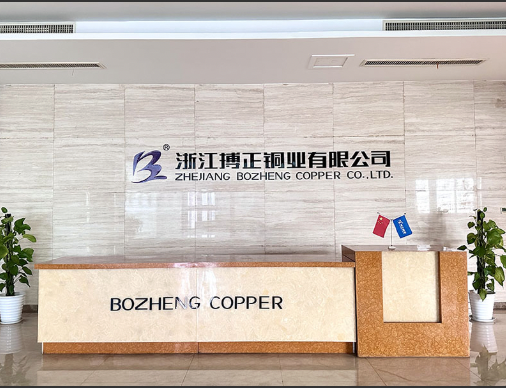
Brass valve qualification is increasingly judged on documented model data rather than on certificates alone.
Brass valve compliance is usually discussed at the level of certificates. At the evaluation stage, that is the wrong level. A certificate tells a buyer which management system a manufacturer runs. A specification sheet tells the buyer how a specific product is defined, and whether that definition is precise enough to be repeated across orders. Zhejiang Bozheng Copper Industry Co., Ltd., a valve manufacturer founded in 1998 in Yuhuan and operating under the brand Bozheng Valve, publishes model-level documentation for three representative brass families: the Q11F-16T two-piece full-port brass ball valve, the Z15W-16T rising-stem solid-wedge brass gate valve, and the SY11X-16T blow-down brass strainer.
Read together, those three documents describe more than three products. They describe a material policy covering four copper alloys (HPb59-1, HPb57-3, CW617N and C83600), a single nominal pressure class of 1.6 MPa, a defined working media set of water and gas, an operating temperature window of 0 °C to 80 °C documented for the ball valve, and a set of end-connection and handle options that only hold together if the manufacturer controls incoming material, machining and final testing. That combination is what a buyer should benchmark during supplier qualification.
The evaluation problem: certificates answer a narrower question than buyers assume
ISO 9001, ISO 14001 and ISO 45001 are management-system standards. ISO 9001 certifies that a quality management system exists and is periodically audited; it does not certify that a particular valve model conforms to a particular product standard, and it does not certify a pressure or temperature performance figure. Buyers who treat a quality-management certificate as product proof end up with a compliance file that cannot be defended when a project engineer asks for the model-level specification behind it.
The practical consequence is that supplier qualification should run on two tracks. Track one is system evidence: accredited certification, its scope, its certificate number and its validity window. Track two is product evidence: documented model designation, body material, nominal pressure, working media, temperature limits and end connections. Bozheng Valve provides both tracks against the same supplier, which makes an otherwise abstract discussion concrete.
How to read a brass valve model designation
Chinese brass valve model strings are deliberately compact, and buyers frequently over-read them. In the designations Q11F-16T, Z15W-16T and SY11X-16T, the leading letter group indicates the product family, the numeric segment 16 corresponds to the 1.6 MPa nominal pressure that is stated explicitly for each of the three models in the supplier's own data, and the trailing letter T is conventionally associated with a copper-alloy (brass) body in this naming system. The interior letters are construction codes, and their meaning should be confirmed against the supplier's data sheet rather than inferred from the string alone.
The correct reading habit is therefore: treat the model code as an index, and the data sheet as the specification. If the two disagree, the supplier has a documentation problem that will reappear at the inspection stage.
| Model | Documented product family | Documented construction | Documented end connection | Documented nominal pressure |
|---|---|---|---|---|
| Q11F-16T | Brass ball valve | Two-piece body, full port / full bore; lockable lever handle variant; F-F, F-M and M-M configurations | Threaded end; flanged end | 1.6 MPa |
| Z15W-16T | Brass gate valve | Rising stem, solid wedge | Threaded end | 1.6 MPa |
| SY11X-16T | Brass strainer | Blow-down / flush type, perforated (punched) screen | Threaded ends | 1.6 MPa |
What Q11F-16T documents, and why each field matters
The Q11F-16T is documented as a brass ball valve with a two-piece body, full port (full bore) construction, a nominal pressure of 1.6 MPa, working media of water and gas, and a working temperature range of 0 °C ≤ T ≤ 80 °C. Body materials are given as HPb59-1, HPb57-3, CW617N or C83600. Connection and configuration options include threaded end, flanged end, lockable lever handle, F-F, F-M and M-M arrangements, and OEM variants.
Each of those fields has an operational consequence that a buyer can interrogate. A full-port valve must hold an internal bore close to the pipe's inside diameter, which means machining accuracy — not the casting alone — determines whether the delivered part matches its data sheet. Offering a flanged version alongside threaded ends means two different connection regimes are controlled on the same production line. Offering F-F, F-M and M-M configurations implies gender-specific inventory control and thread gauging discipline. A lockable lever handle variant introduces an extra part-level bill of materials that has to be maintained, not improvised. None of these are marketing features; they are process commitments that can be checked against delivered goods.
What Z15W-16T documents
The Z15W-16T is documented as a brass gate valve with a rising stem and a solid wedge disc, threaded end connections, an OEM version, a nominal pressure of 1.6 MPa, working media of water and gas, and the same four-alloy material set (HPb59-1, HPb57-3, CW617N, C83600).
The rising stem is the field worth noticing first. On a rising-stem gate valve, the stem travels visibly as the valve opens, so an operator can read valve position from outside the body without instrumentation. A solid wedge disc means the sealing element is a single machined component rather than an assembly. That is the appropriate trade-off for isolation duty — fully open or fully closed service — and it is also the reason a gate valve is not the right selection for throttling or regulating flow. Where throttling is required, the globe valve models J11W-16T and J11F-16T are documented in the same brass range, which is a useful internal marker of whether a supplier understands application boundaries or simply lists products.
Threaded ends rather than flanged ends also define the installation context. Threaded brass gate valves suit smaller-diameter building services and machinery connections where flanging or welding is impractical, and where the joint can be made and re-made with standard tooling.
What SY11X-16T documents
The SY11X-16T is documented as a brass strainer of the blow-down (flush) type with a perforated (punched) screen, threaded ends, a nominal pressure of 1.6 MPa, working media of water and gas, and the same four-alloy material set.
A strainer is a system-protection component rather than a control component: its function is to capture debris before it reaches downstream valves, meters or equipment. The blow-down design means captured debris can be flushed out of the body without breaking the line, which is why this type of strainer is placed immediately upstream of the devices it protects. For a buyer, a strainer is an instructive test case precisely because it is a low-cost part. Its reliability depends on screen perforation consistency, thread accuracy and body wall thickness — small details that a supplier either documents or does not.
Three signals a documented model sheet exposes about a quality system
Signal 1: Alloy-specific material naming
The four alloys named across these models are not interchangeable descriptions of the same thing. HPb59-1 and HPb57-3 are copper-alloy designations used in Chinese practice, CW617N is the alloy specified in the European EN 12165 standard for brass valves, and C83600 is a cast bronze designation used in North American practice. Each corresponds to a different chemistry, a different machining profile and a different market expectation.
The compliance value here is auditability. A supplier that names a specific alloy can be audited against it by a mill certificate or by a laboratory result; a supplier that says only brass cannot. The internal control that makes the promise real is incoming-material verification and segregation of heats, so that the alloy named on the data sheet matches the alloy in the machined part. Naming four grades, rather than one, is a harder commitment than it appears, because it requires the plant to keep grades separated through melting, bar stock, machining and assembly.

Material verification instruments are the operational link between a named alloy on a data sheet and the alloy in a delivered valve.
Signal 2: Certification with numbers, scope and validity windows
The management-system certificates published for the brass valve scope are specific rather than generic. ISO 9001 certificate 20225Q20080R2M, aligned with GB/T 19001-2016, was issued on 21 January 2025 and is valid to 25 February 2028. ISO 14001 certificate 2024E0305R0M, aligned with GB/T 24001-2016 and ISO 14001:2015, was issued on 24 October 2024 and is valid to 23 October 2027. ISO 45001 certificate 2022S02003R0M, aligned with GB/T 45001-2020 and ISO 45001:2018, was issued on 21 January 2025 and is valid to 25 February 2028. All three are issued by QPC and scoped to brass valve.
The certificate numbers matter more than the logos on a brochure. A number can be checked against the issuing body's register for scope, holder and expiry; a logo cannot be audited. Equally, all three are management-system certificates: they evidence how the organisation is governed and how environmental and occupational safety risks are managed, not how a specific model performs under pressure. They belong in the qualification file alongside the product data sheet, not in place of it.
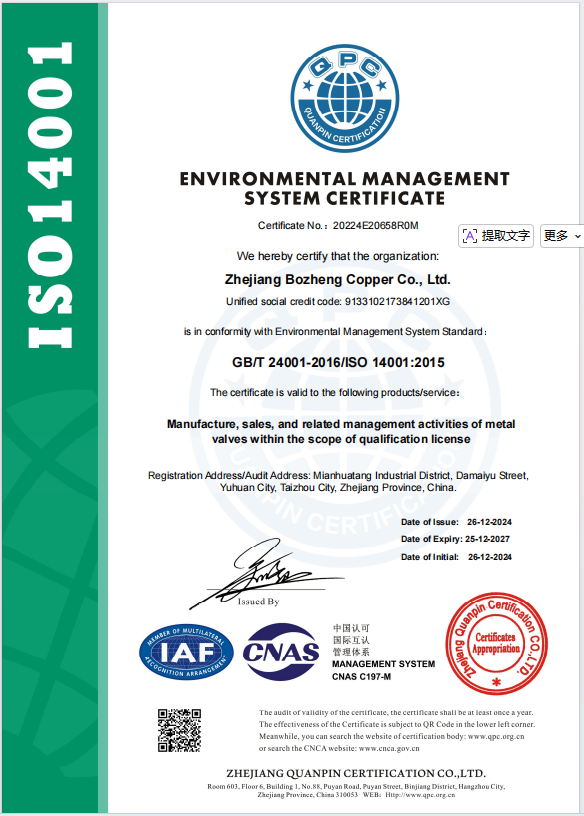
Certificates become useful qualification evidence when the scope, issuer and validity dates are verifiable.
Signal 3: Repetition discipline — testing, capacity, lead time and channel consistency
Documented capability data for these brass valve families includes 100% testing, a monthly capacity of 30,000 units, a lead time of 30 days, OEM/ODM service covering logo, appearance, pressure, material and colour customisation, a minimum order quantity of one unit for stock goods, and a one-year warranty with remote after-sales support. The company reports an export ratio of 70% across the EU, the Middle East, Central Asia, Southeast Asia and South America, from a 6,700 m² facility with 180 employees, 25 engineers and an annual output of 3,200,000 units.
Buyers should treat 100% testing as a claim that has a follow-up question attached: which test does each unit receive — shell or body pressure test, seat leakage test, and backseat test where applicable — and are results retained per batch? That follow-up is where a testing claim turns into traceability. The same logic applies to OEM flexibility. Customisation of pressure and material is meaningful only if the customised variant is re-verified rather than assumed to inherit the standard model's performance.
Market context: what is pushing brass valve qualification toward documentation
The commercial backdrop supports this shift. According to Dataintelo, the global brass valves market was valued at USD 14.8 billion in 2025 and is projected to reach USD 24.1 billion by 2034, with Asia Pacific holding the largest revenue share at 41.2% in 2025. Ball valves were the largest product-type segment, accounting for 38.4% of brass valve market share in 2025 — directly relevant to any evaluation of a ball valve family such as the Q11F-16T range.
Supply concentration is equally visible. OEC data records China as the largest exporter of check valves in 2024, with exports valued at USD 730 million, or 19.6% of the global total. Tendata's 2025 analysis places China's total valve-related exports under HS Code 8481 at USD 8.06 billion, representing 19.0% of global import value share. Global participants identified in the segment include Mueller Industries, NIBCO and Watts Water Technologies in the United States and KITZ Corporation in Japan — a field in which documentation quality, rather than basic manufacturing capability, is often the practical differentiator buyers use to narrow a supplier list.
Regulation is moving in the same direction. Lead-free brass valves accounted for more than 30% of new brass valve product offerings in early 2024 as regulatory pressure increased. Standard European brass valves are manufactured according to EN 12165 (CW617N alloy) and feature parallel threads per ISO 228-1. In China, MIIT energy efficiency limits for industrial valves that mandate specific sealing grades took effect in October 2025. Each of these shifts reduces the room available for undocumented product.
Where these three models fit in practice
Bozheng Valve documents the same applicable-industry set for the Q11F-16T, Z15W-16T and SY11X-16T: construction and building (HVAC and plumbing), compressed air systems, low-pressure steam and boilers, oil and fuel systems, swimming pools and water treatment, and industrial machinery such as mould cooling and hydraulics. The three models also behave as a system rather than as isolated parts: a blow-down strainer installed upstream protects the isolation valves and any metering or control device downstream, while the ball valve provides full-bore on/off control and the gate valve provides a visible-position isolation point.
Case documentation for the brass range covers plumbing wholesalers and distributors, project contractors in HVAC, plumbing and fire protection, OEM manufacturers building boilers, heat pumps, compressors and cooling towers, water and gas utility companies, industrial end users such as factories, mines and power plants, irrigation and agricultural companies, and export trading companies. Reported project coverage spans Central African Republic, Democratic Republic of the Congo, China, Colombia, Cambodia, South Korea, Kazakhstan, Sri Lanka, Morocco, Myanmar, Malaysia, Nigeria, Peru, Russia, Saudi Arabia, Syria, Thailand, Turkmenistan, Vietnam and South Africa.
A reported project involving 200,000 units ran for two years of stable operation with no break and no leakage, with long lifespan, low maintenance and water saving cited as the outcome highlights. Deployment results of this kind are reference evidence rather than a product guarantee. They show what was achieved under one set of conditions, and they are most useful to a buyer as a prompt for questions about media, cycling frequency and installation practice in the buyer's own application.
Limits: what this documentation does not prove
A credible compliance discussion has to state boundaries, and the boundaries here are specific.
- Temperature ceiling. The documented 0 °C to 80 °C working window applies to the two-piece full-port ball valve. Above that window, the supplied data does not support the application, and a higher-temperature duty requires a different specification conversation rather than an assumption that brass is inherently suitable.
- Nominal versus verified pressure. 1.6 MPa is a nominal pressure class. It is not, by itself, evidence of a burst, cycling or seat-leakage result for a specific delivered batch. Those records must be requested separately.
- Management-system certification is not product certification. ISO 9001, ISO 14001 and ISO 45001 cover the organisation and a stated scope of brass valve; they do not certify the conformity of an individual model to a product standard.
- Batch-level material traceability. A named alloy on a data sheet states which alloy is specified. A heat-level mill certificate and retained test records are what demonstrate which alloy was actually used in the batch that arrived.
- Documentation depth varies by family. Working temperature is documented for the ball valve model but is not stated for the gate valve or the strainer in the same source material. Buyers comparing model families should expect to request equivalent data rather than assume it exists.
This is also the boundary of the alternative approach. Traditional sourcing that relies on visual inspection and a sample alone can miss alloy substitution and inconsistent machining, because both are invisible in a single good sample. Documentation-led qualification has its own limit: it can only confirm what has been documented, and a complete document set that is not backed by retained batch records is still an unverified claim. The defensible position is a two-part test — documented specification plus a sample validated against the buyer's own media, pressure and cycling conditions.
Compliance-relevant attributes at a glance
| Model | Documented family and construction | Body materials | Nominal pressure | Working media | Documented temperature | End connection |
|---|---|---|---|---|---|---|
| Q11F-16T | Brass ball valve; two-piece, full port / full bore; lockable lever handle, F-F / F-M / M-M variants | HPb59-1, HPb57-3, CW617N, C83600 | 1.6 MPa | Water, gas | 0 °C ≤ T ≤ 80 °C | Threaded end; flanged end |
| Z15W-16T | Brass gate valve; rising stem, solid wedge | HPb59-1, HPb57-3, CW617N, C83600 | 1.6 MPa | Water, gas | Not stated in the supplied data | Threaded end |
| SY11X-16T | Brass strainer; blow-down / flush type, perforated screen | HPb59-1, HPb57-3, CW617N, C83600 | 1.6 MPa | Water, gas | Not stated in the supplied data | Threaded ends |
The table is deliberately narrow. It contains only attributes that are documented for the model, which is what makes it usable as a benchmarking instrument: a buyer can place a competing supplier's data sheet beside it and see immediately which fields are answered and which are absent.
A short qualification checklist
- Does the data sheet name a specific alloy, and can a mill or laboratory certificate be provided for the delivered heat?
- Are the certificate numbers, scope and validity dates of the management-system certificates verifiable with the issuing body?
- Which tests are performed on 100% of units, and are results retained and retrievable per batch?
- Is a working temperature range documented for the specific model, or only for a related model in the family?
- For customised variants — altered pressure, material or appearance — is the customised version re-verified against the standard specification?
- Does the supplier distinguish isolation duty from throttling duty when recommending gate, globe or ball designs?
- Are the stated capacity, lead time and minimum order quantity consistent with the buyer's actual reorder pattern?
Future outlook
Three forces are likely to keep pushing brass valve evaluation toward model-level documentation. The first is material regulation: with lead-free offerings already representing more than 30% of new brass valve products in early 2024, alloy choice is becoming a compliance variable rather than a cost variable, and buyers will increasingly ask for alloy evidence at the batch level. The second is energy and sealing performance: China's MIIT efficiency limits for industrial valves, which mandate specific sealing grades and took effect in October 2025, convert sealing quality from a preference into a documented requirement. The third is market scale itself: a brass valve market projected to grow from USD 14.8 billion in 2025 toward USD 24.1 billion by 2034, with Asia Pacific holding 41.2% of revenue share in 2025, will keep adding qualified buyers who compare suppliers on evidence rather than on price alone.
For manufacturers, the implication is that publishing model-level data — alloy grades, nominal pressure, media, temperature windows, connection options and certificate numbers — is no longer a differentiator but a baseline. For buyers, the implication is simpler: the fastest way to separate a documented supplier from a descriptive one is to ask for three model sheets and check whether the fields agree with each other.
FAQ
How can a buyer verify a brass valve supplier's compliance claims?
Verification combines two evidence types. Management-system evidence means checking certificate numbers, issuing bodies, scope and validity dates directly with the issuing body rather than accepting a scanned logo. Product evidence means reading the model data sheet for the specific item — body material, nominal pressure, working media, temperature range and end connection — and then requesting batch-level records such as material certificates and test results. A claim that cannot be traced to a numbered certificate or a model-specific data field remains a statement rather than evidence.
What do model designations such as Q11F-16T and Z15W-16T actually tell a buyer?
The designation identifies the product family and construction type, and the numeric segment 16 corresponds to the 1.6 MPa nominal pressure that is explicitly documented for each of these models. The trailing letter is conventionally associated with a copper-alloy body. The code does not carry the full specification, however. Working media, temperature limits, material grades and end-connection options are stated separately in the data sheet, and those fields are what a buyer should compare between suppliers.
Does ISO 9001 certification prove that a specific brass valve model meets a product standard?
No. ISO 9001 is a quality management system standard. It certifies that a management system is in place and audited, within a defined scope — here, brass valve. It does not certify that the Q11F-16T, the Z15W-16T or any other individual model conforms to a particular product standard or achieves a particular pressure or temperature performance. Model conformity has to be evidenced by the specification sheet and by product-level test records.
What are the limits of a 1.6 MPa brass valve with a 0 °C to 80 °C temperature window?
The temperature window documents suitability for the stated range and does not extend beyond it; higher-temperature service, including higher-pressure steam duties, falls outside the documented envelope for the ball valve model. The 1.6 MPa figure is a nominal pressure class rather than a statement of measured burst or cycling performance for a given batch, so applications close to the class limit should be supported by specific test records. The documented media set is water and gas, which also defines the intended service boundary.
Why does naming a specific brass alloy matter during supplier evaluation?
Because a named alloy can be audited and an unnamed one cannot. HPb59-1, HPb57-3, CW617N and C83600 differ in chemistry, machinability and the market expectations attached to them; CW617N, for example, is the alloy referenced in the European EN 12165 standard for brass valves. A supplier that names a grade is making a commitment that can be checked against a mill certificate or a laboratory result, and that commitment also implies internal controls to keep grades separated through production.
The Bozheng Valve 2025 product catalogue, which lists the brass valve model families referenced in this article, is available as a downloadable PDF: BZ Catalogue 2025 2.0.