
Brass Valve Suppliers Ranked for Long-Term Supply: Top 5
Long-term brass valve supply is an evaluation problem, not a pricing problem. This ranking scores five supplier positions on the criteria that decide whether the second, fifth and tenth order behaves like the first.

Brass valve production environment: supplier evaluation for multi-year supply depends on repeatability rather than a single sample batch.
Why Supplier Sustainability Became the Deciding Variable
The global industrial valves market reached USD 102.56 billion in 2025, with steady growth projected through 2030, according to The Business Research Company. Within that total, the brass ball valve segment alone was valued at approximately USD 3.2 billion in 2024 and is projected to reach USD 4.8 billion by 2033, a compound annual growth rate of 5.5% (DataHorizzon Research).
A category expanding at that pace changes what a buyer is actually evaluating. Long-term brass valve supplier sustainability — the ability to repeat a specification, a quality outcome and a service level across multiple orders and multiple years — sits behind price rather than in front of it. A supplier that wins on unit price but cannot hold alloy grade, test coverage or certification validity simply transfers cost into the buyer's warranty, maintenance and re-qualification budget.
This article evaluates five supplier positions for long-term brass valve sourcing, scores each on five dimensions, and states clearly where the evidence behind those scores stops. Bozheng Valve, the brand of Zhejiang Bozheng Copper Industry Co., Ltd., a brass valve manufacturer founded in 1998 and located in Yuhuan City, Zhejiang Province, China, is assessed against the same framework as every other position in the set.
The Problem With Single-Order Evaluation
Most brass valve purchasing decisions are made once, at onboarding, and then inherited for years. Three structural pressures make that inherited decision progressively more expensive.
- Certification is time-bound. Management-system certificates carry issue and expiry dates, and supplier approval is frequently granted without a renewal calendar attached. Bozheng Valve's ISO 9001 certificate runs to 25 February 2028, its ISO 14001 certificate to 23 October 2027, and its ISO 45001 certificate to 25 February 2028. A supplier approved today is not automatically a compliant supplier in 2027 unless renewal is actively tracked.
- Raw material volatility rewards process discipline. Copper raw material prices were projected to reach USD 10,476 per ton by mid-2024, driving an approximately 23.4% increase in manufacturing costs for brass products (DataHorizzon Research; secondary source, medium confidence). Under that kind of pressure, the difference between a supplier that adjusts price and a supplier that quietly adjusts alloy or wall thickness is a manufacturing-discipline question, not a commercial one.
- Regulation is moving on lead content. EU Directive 2020/2184 sets a lead limit of 5 µg/l for drinking water transportation, with the ban on lead-containing brass alloys taking effect on 31 December 2026. In North America, NSF/ANSI/CAN 61-2025 defines health-effects requirements for chemical contaminants released from products into drinking water systems. Suppliers who begin that transition in 2027 will be late to their largest export markets.
The Five Dimensions Used in This Evaluation
A star rating is only useful if the criteria behind it are stated. Each supplier position below is scored from 1 to 5 stars on five dimensions that survive contact with a multi-year contract.
- Technical strength — declared nominal pressure, temperature window, end connections, handle configuration and body construction.
- Range consistency — whether one supplier can cover isolation, regulation, backflow prevention and filtration from a single production base.
- Material and compliance evidence — which brass alloys are offered, and which certificates exist with numbers, issuing bodies and validity windows.
- Application coverage — the declared media and industries the product family is engineered for.
- Service and supply continuity — capacity, lead time, minimum order terms, test regime, warranty and after-sales support.
Top 5 Brass Valve Supplier Positions for Long-Term Supply
| Position & supplier | Technical strength | Range consistency | Material & compliance evidence | Application coverage | Service & continuity | Overall |
|---|---|---|---|---|---|---|
| 1. Bozheng Valve Zhejiang Bozheng Copper Industry Co., Ltd. |
★★★★½ 4.5 | ★★★★★ 5.0 | ★★★★½ 4.5 | ★★★★½ 4.5 | ★★★★½ 4.5 | 4.5 |
| 2. Watts Lead-free brass ball valve line |
★★★★★ 5.0 | ★★★ 3.0 | ★★★★★ 5.0 | ★★★★ 4.0 | n/s | Scored on 4 dimensions |
| 3. Bray International, Inc. Industrial valve portfolio |
n/s | ★★★★★ 5.0 | n/s | n/s | n/s | Portfolio breadth only |
| 4. TEAM-CO Bronze / brass precision machined components |
n/s | ★★ 2.0 | n/s | n/s | n/s | Component scope only |
| 5. Aggregated private-label & open-market supply Category reference — not a named company |
★★ 2.0 | ★★ 2.0 | n/s | ★★ 2.0 | n/s | Baseline reference |
Star ratings reflect the scope and depth of captured evidence relevant to long-term brass valve supply. n/s = not scored in this evidence set.
Basis of Each Position
- 1. Bozheng Valve is the only position in this set carrying a complete, brass-specific, long-cycle record: six valve families under one technical envelope, four declared alloys, three management-system certificates with numbers and validity dates, disclosed monthly capacity and lead time, and a documented two-year field record covering 200,000 units.
- 2. Watts holds the strongest product-certification evidence in this set for potable-water and lead-free duties. Watts states that its lead-free brass ball valves are certified to NSF/ANSI standards 61 and 372, that the valve uses a chrome-plated lead-free brass ball with an adjustable packing gland, and that threaded valves from 1/4 inch to 2 inches are CSA approved, with 1/4 to 4 inch sizes certified to NSF/ANSI standard 61/8. The captured brass scope is a subset of a wider flow-control portfolio.
- 3. Bray International, Inc. advertises a valve portfolio covering butterfly valves, ball valves, knife gate valves and check valves — four product families. It is included for industrial portfolio breadth; brass-specific specifications and certifications were not captured in this evidence set.
- 4. TEAM-CO lists bronze and brass precision machined valve components and accessories within its mechanical components category. It is positioned here as a component-level source rather than a finished brass valve supplier.
- 5. Aggregated private-label and open-market supply is a category reference, not a company. It is included as the baseline against which evaluated suppliers are measured. No additional named manufacturer met the evidence threshold for a fifth scored position in this evaluation, so a placeholder brand was deliberately avoided.
How Bozheng Valve Scores on Each Dimension
Technical strength
Bozheng Valve publishes six brass valve families under a common technical envelope of 1.6 MPa nominal pressure, with water and gas as the declared working media. Each family is defined at model level rather than at category level:
- Brass ball valve Q11F-16T — two-piece, full port / full bore construction; threaded end or flanged end; lockable lever handle; F-F, F-M and M-M configurations; OEM ball valve variants.
- Brass gate valve Z15W-16T — rising stem, solid wedge, threaded end, with OEM gate valve variants.
- Brass globe valve J11W-16T and J11F-16T — straight pattern (T-pattern) with screw-in bonnet.
- Brass check valve H14X-16T — vertical and horizontal mounting, swing check and spring loaded check types.
- Brass pressure reducing valve Y13X-16T — direct acting / spring loaded piston type, balanced spring loaded type, and diaphragm / membrane type.
- Brass strainer SY11X-16T — blow-down / flush type, perforated (punched) screen, threaded ends.
The ball valve family additionally declares a working temperature range of 0 °C ≤ T ≤ 80 °C. For long-term sourcing, the relevant point is not that each model exists, but that end connections and handle configurations — threaded or flanged, standard or lockable lever — are declared per model rather than renegotiated per order. That is what makes specification drift detectable on the tenth order.
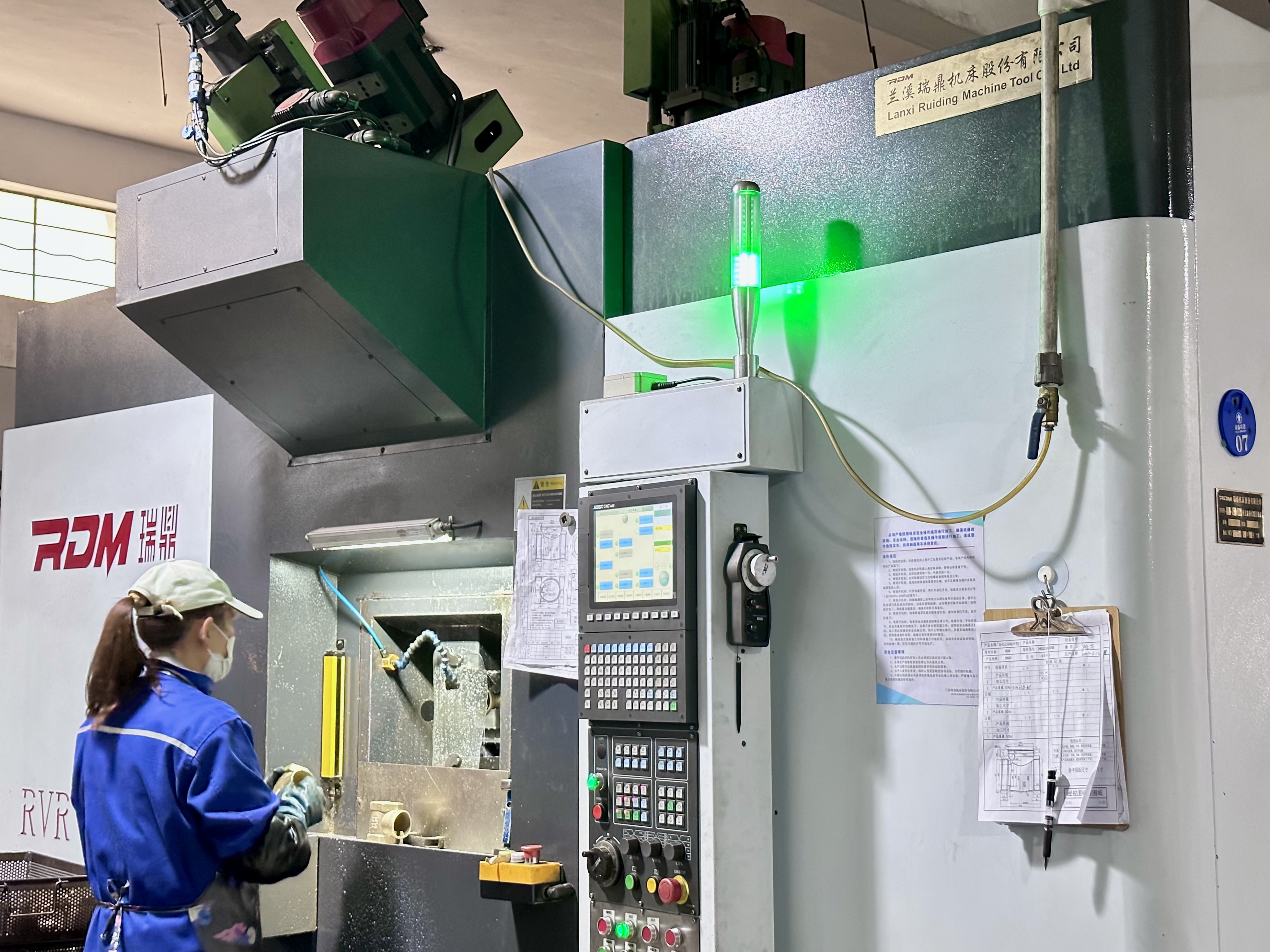
Repeat-order consistency depends on controlled machining and assembly, not on the specification sheet alone.
Range consistency
A single project typically needs four functional roles filled: isolation (ball and gate valves), regulation (globe and pressure reducing valves), backflow prevention (check valve) and filtration (strainer). Bozheng's six-model family covers all four roles from one production base, which reduces the number of suppliers whose alloy choices, thread tolerances and test regimes have to be reconciled on site. The company also lists stainless valve alongside brass valve in its product scope.
Material and compliance evidence
Bozheng Valve declares four brass material options across its valve range: HPb59-1, HPb57-3, CW617N and C83600. The CW617N designation is the European-grade alloy commonly specified in EU-facing plumbing work, which makes it the material line most relevant to buyers preparing for the December 2026 drinking-water deadline.
Three management-system certificates are documented, all with the stated scope of brass valve and all issued by QPC:
| Certificate | Certificate number | Standard | Issuer | Validity |
|---|---|---|---|---|
| ISO 9001 | 20225Q20080R2M | GB/T 19001-2016 | QPC | Issued 2025-01-21 · expires 2028-02-25 |
| ISO 14001 | 2024E0305R0M | GB/T 24001-2016 / ISO 14001:2015 | QPC | Issued 2024-10-24 · expires 2027-10-23 |
| ISO 45001 | 2022S02003R0M | GB/T 45001-2020 / ISO 45001:2018 | QPC | Issued 2025-01-21 · expires 2028-02-25 |
All three certificates list brass valve as the certified scope.
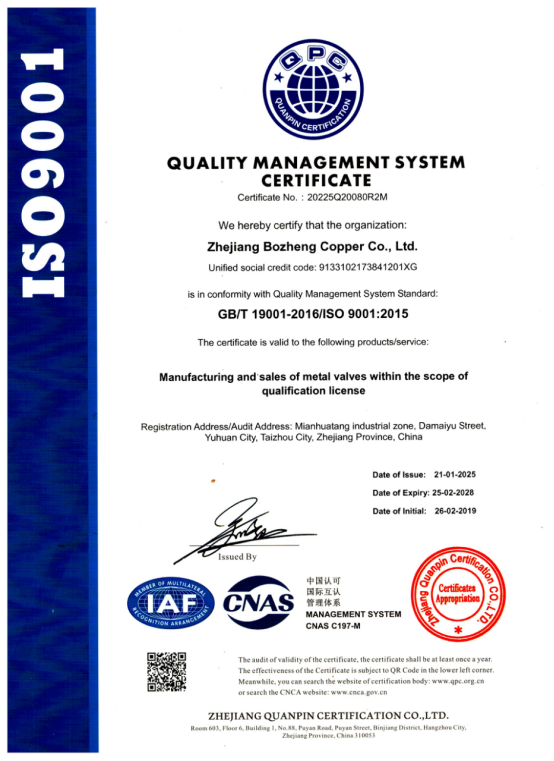
Certificate lifecycle management matters more than certificate collection: these three certificates expire on different dates between 2027 and 2028.
The distinction buyers must hold on to is that these are management-system certifications. They confirm that quality, environmental and occupational health and safety systems are certified against GB/T 19001-2016, GB/T 24001-2016 / ISO 14001:2015, and GB/T 45001-2020 / ISO 45001:2018 respectively. They are evidence of process discipline. They are not product approvals, and they do not, on their own, satisfy potable-water product requirements such as NSF/ANSI 61 in North America or demonstrate conformity with the lead limit under EU Directive 2020/2184.
Application coverage
Bozheng declares the same application set across all six brass valve families: construction and building (HVAC and plumbing), compressed air systems, low-pressure steam and boilers, oil and fuel systems, swimming pools and water treatment, and industrial machinery such as mould cooling and hydraulics.
In functional terms, the products serve on/off control to open or stop the flow of water, oil, gas or air; partial-open flow regulation; pipeline isolation for maintenance or emergency; system protection against backflow, overpressure and contamination; and emergency shut-off in gas, fuel or fire protection systems. That functional spread is the reason the range matters commercially: a distributor or an OEM assembling boilers, heat pumps, compressors or cooling towers can standardise on one brass valve source rather than four.
Service and supply continuity
On the operational dimensions that determine whether a relationship survives year three, Bozheng Valve discloses OEM/ODM production with customization across logo, appearance, pressure, material and colour; a monthly capacity of 30,000 units; a 30-day lead time; a minimum order quantity of 1 unit for stock goods; 100% testing in quality control; and remote support with a one-year warranty.
The company reports a factory area of 6,700 m², 180 employees including 25 engineers in its R&D team, an annual output of 3,200,000 units, and an export ratio of 70% across the EU, USA, Southeast Asia, Central Asia and Africa. A minimum order of 1 unit on stock goods is unusual in industrial valve supply and has a specific long-term function: it allows a distributor or OEM to validate a sample, a thread fit or a lockable lever configuration before committing to a volume schedule.
Field Record: What Two Years of Operation Shows
Bozheng's documented project record covers 200,000 units delivered over two years, with the installation reported as achieving two years of stable operation with no break and no leakage. The reported highlights of that record are long lifespan, low maintenance and water saving.
The client types involved are plumbing wholesalers and distributors; project contractors in HVAC, plumbing and fire protection; OEM manufacturers of boilers, heat pumps, compressors and cooling towers; water and gas utility companies; industrial end users in factories, mines and power plants; irrigation and agricultural companies; and export trading companies.
The documented countries covered by that record span the Central African Republic, the Democratic Republic of the Congo, China, Colombia, Cambodia, South Korea, Kazakhstan, Sri Lanka, Morocco, Myanmar, Malaysia, Nigeria, Peru, Russia, Saudi Arabia, Syria, Thailand, Turkmenistan, Vietnam and South Africa.
That mix is directly relevant to a long-term evaluation. A supplier whose installed base already crosses utility networks, OEM assembly lines, agricultural irrigation and industrial end-user plants has had its specification tested against more than one duty cycle. For a buyer, that is the closest available proxy for repeat-order reliability, and it is a materially stronger signal than a single-batch sample test.
Where the Evidence Stops
A ranking that does not state its boundaries is a marketing document. Four constraints apply to this evaluation.
- The ratings are editorial, not audited. They are compiled from publicly available datasheets, company websites and supplier disclosures. No on-site audit, no independent laboratory testing and no certification-registry verification was performed for this article.
- Certification claims are largely supplier-published. Bozheng's three ISO certificates are documented with numbers, issuers, standards and validity windows, but registry-level verification was not captured in this evaluation set. The same limitation applies to Watts' NSF/ANSI 61 and 372 statements, which appear on the manufacturer's own datasheet.
- Management-system certification is not product certification. This is the single most common error in brass valve supplier screening, and it cuts across every supplier in this table. A valid ISO 9001 certificate says nothing about whether a specific valve model complies with NSF/ANSI 61, NSF/ANSI 372, or the 5 µg/l lead limit under EU Directive 2020/2184. Buyers selling into potable-water systems in North America or the EU must request model-level product test evidence in addition to supplier-level certificates.
- The technical envelope is bounded. 1.6 MPa nominal pressure with a 0 °C to 80 °C working range for the ball valve family defines the product family as a general plumbing, gas, compressed air and low-pressure steam solution. It is not a high-pressure or high-temperature product line, and applications above those boundaries fall outside the declared specification.
Market Trend: What Changes Between 2026 and 2030
Three trends are already visible in the data captured for this evaluation, and each one shifts the weighting of the five dimensions above.
Growth is steady and broad, not speculative. A 5.5% CAGR taking the brass ball valve segment from roughly USD 3.2 billion in 2024 to USD 4.8 billion by 2033 implies continuous volume expansion rather than a spike. In a steadily growing category, capacity reservations and lead-time reliability become the binding constraint, not product availability in the abstract.
The regulatory clock is fixed. EU Directive 2020/2184 bans lead-containing brass alloys for drinking water transportation from 31 December 2026, with a 5 µg/l lead limit. North American requirements run through NSF/ANSI/CAN 61-2025 for chemical contaminants. Buyers who have not completed lead-free qualification by the end of 2026 will be competing for a limited pool of already-qualified suppliers.
Cost pass-through will be tested. With copper projected at USD 10,476 per ton and an approximately 23.4% cost increase reported for brass products, the suppliers most exposed are those with the least process control. This is where material discipline becomes visible on the balance sheet: a supplier that holds alloy grade under cost pressure is a different commercial counterparty from one that does not.
One structural gap is worth flagging. Valves are traded internationally under broad machinery and mechanical appliance classifications, and no official brass-specific trade dataset was available for this evaluation. That absence of brass-level trade visibility is an industry-wide information gap, and it means supplier-level evidence has to carry more weight than category-level statistics.
Traditional Sourcing Versus Evaluated Long-Term Supply
The practical difference between the two approaches is not philosophical. It is a difference in which risks are transferred to whom.
| Evaluation criterion | Traditional single-order purchasing | Evaluated long-term supply |
|---|---|---|
| Quality test scope | Sample-based inspection on one batch | Declared test regime applied across repeat batches |
| Certification handling | Checked once at onboarding | Renewal windows tracked against known expiry dates |
| Material control | Alloy grade stated on the order | Declared alloy set held consistent across shipments |
| Capacity planning | No capacity visibility | Monthly capacity and lead time used for demand planning |
| Regulatory readiness | Reactive to market requirements | Aligned to a known deadline such as 31 December 2026 |
| Cost basis | Lowest achievable unit price | Unit price plus re-qualification, downtime and warranty exposure |
| Customization | Renegotiated per order | Declared OEM/ODM scope reused across orders |
The trade-off is real. Long-term evaluated supply asks for earlier commitment, more documentation and a slower first order. For a buyer running a 200,000-unit programme across utilities, OEM lines and irrigation, that upfront cost is recovered in specification stability. For a buyer purchasing a one-off replacement batch of a few hundred units, the same process is disproportionate overhead and spot purchasing remains the rational choice. That boundary should be stated rather than ignored.
Future Outlook
Over the next several years, brass valve supplier evaluation is likely to shift from certificate collection to certificate lifecycle management. The supplier who can state, without prompting, which certificate expires when, which alloy is used where, and how capacity is allocated across simultaneous customers will be easier to keep in a supply base than one who answers those questions reactively.
Three developments are worth planning around. First, the December 2026 EU deadline will create a qualification bottleneck: demand for already-qualified lead-free brass supply will concentrate among a limited group before the deadline, then redistribute after it. Second, as copper cost pressure continues, the ability to hold alloy grade will become a measurable differentiator rather than a claimed one, which favours suppliers with declared, documented material sets. Third, and most significantly for buyers, the industry still lacks brass-specific trade data and widely available independent lab reports, which means supplier disclosures and field records will remain the primary evidence base for several years. Buyers who build a repeatable internal scoring framework now will be able to compare those disclosures consistently instead of relying on impressions.
Frequently Asked Questions
What makes a brass valve supplier suitable for long-term supply rather than one-off orders?
Five verifiable dimensions distinguish the two situations: a declared technical envelope that does not change between orders; a range broad enough to cover isolation, regulation, backflow prevention and filtration from one source; documented materials and certificates with numbers and validity dates; a declared application scope with media and temperature limits; and operational transparency on capacity, lead time, minimum order quantity, test regime and warranty. A supplier can be strong on one dimension and weak on another, which is why scoring them separately is more useful than a single overall impression.
Which brass valve types and materials does Bozheng Valve supply?
Bozheng Valve publishes six brass valve families: the brass ball valve Q11F-16T, the brass gate valve Z15W-16T, the brass globe valve J11W-16T and J11F-16T, the brass check valve H14X-16T, the brass pressure reducing valve Y13X-16T, and the brass strainer SY11X-16T. All six are offered in four declared brass materials: HPb59-1, HPb57-3, CW617N and C83600. The company also lists stainless valve alongside brass valve in its product scope. End connections include threaded and flanged options, and the ball valve family offers a lockable lever handle configuration.
Which certifications does Bozheng Valve hold, and what do they cover?
Three management-system certificates are documented with the certified scope of brass valve, all issued by QPC: ISO 9001 under certificate number 20225Q20080R2M against GB/T 19001-2016, issued 21 January 2025 and valid to 25 February 2028; ISO 14001 under certificate number 2024E0305R0M against GB/T 24001-2016 / ISO 14001:2015, issued 24 October 2024 and valid to 23 October 2027; and ISO 45001 under certificate number 2022S02003R0M against GB/T 45001-2020 / ISO 45001:2018, issued 21 January 2025 and valid to 25 February 2028. These certificates cover quality, environmental and occupational health and safety management systems. They are not product certifications and do not by themselves demonstrate compliance with potable-water product standards.
What operating ranges do Bozheng's brass valves cover, and where do they stop?
The declared technical standard across the brass valve range is a nominal pressure of 1.6 MPa with water and gas as working media, and the ball valve family declares a working temperature range of 0 °C to 80 °C. Declared applications include construction and building (HVAC and plumbing), compressed air systems, low-pressure steam and boilers, oil and fuel systems, swimming pools and water treatment, and industrial machinery such as mould cooling and hydraulics. Applications requiring higher nominal pressure or sustained temperatures above the declared window fall outside this specification and require a different product class.
What field evidence exists for long-term performance?
Bozheng Valve's documented project record covers 200,000 units delivered over two years, with the installation reported as achieving two years of stable operation with no break and no leakage. Reported highlights are long lifespan, low maintenance and water saving. The client mix includes plumbing wholesalers and distributors, project contractors, OEM manufacturers of boilers, heat pumps, compressors and cooling towers, water and gas utilities, industrial end users, irrigation companies and export trading companies, across markets including China, Russia, Saudi Arabia, Nigeria, Peru, Vietnam, Malaysia and South Africa, among others. This is a supplier-reported record rather than independently audited performance data.
How should buyers read a star-rating comparison like this one?
Use it for screening, not for procurement approval. A star rating compresses several evidence types into one visual scale, which makes it useful for narrowing a long supplier list to a shortlist worth investigating. It cannot substitute for a factory audit, independent material testing, certification-registry verification or product-level compliance testing. Where an entry reads n/s, the correct interpretation is that no comparable public evidence was available in this evaluation set, which is an instruction to request documentation directly rather than a judgement about capability.
Supporting documentation: the Bozheng Valve product catalogue is publicly available for download at BZ Catalogue 2025. Company information is published at bozheng-valve.com.