
Brushless Cordless Impact Wrench: Spec Checks Before You Buy

Cordless power tool manufacturing at Ningbo TMG Power Tools Co., Ltd.
In professional maintenance and assembly work, the shift of bolted-joint and wheel-nut tasks from air lines and power cords to battery power is largely settled. Cordless fastening is no longer a novelty purchase; it is a platform decision. What remains genuinely difficult is specification, meaning the process of deciding which brushless cordless impact wrench configuration satisfies a defined set of operating constraints, and whether a given supplier can repeat that configuration across repeat orders.
Buyer friction usually sits between the headline specification and the job. A catalogue page will state a torque figure and a voltage class. It rarely states whether that torque is fastening torque or breakaway torque, which drive the anvil accepts, whether the battery is shared with the rest of the fleet, or which conformity documents travel with the shipment. Each of those gaps is paid for later, in re-tests, in duplicated socket inventory, or in a container held at port.
This reference treats the brushless impact wrench and the brushless impact driver as specification problems rather than shopping comparisons. It sets out the constraints that decide fit, and uses the cordless programme of Ningbo TMG Power Tools Co., Ltd., a manufacturer of lithium-ion power tools and outdoor power equipment based in Cixi, Ningbo, China, as a documented example of how manufacturing facts turn into procurement criteria.
The specification gap that costs buyers money
Two suppliers can both describe a tool as '20V brushless, high torque' and still deliver products that are not interchangeable on a workshop floor. The difference is rarely visible in a photograph. It sits in the measurement basis of the torque figure, the anvil size, the pack interface and the paperwork.
Closing that gap is not complicated, but it requires the buyer to convert an application into constraints before comparing products. A maintenance contractor buying for truck wheel nuts, an importer building a private-label line and a workshop standardising its battery platform are all specifying the same category of tool, but against different constraint sets. The first cares about breakaway torque and duty cycle, the second about minimum order quantity and customisation, the third about pack compatibility and spare-part coverage.
The opportunity is that constraint-based specification shortens evaluation rather than lengthening it. Once drive size, torque basis, voltage class, documentation and supply terms are fixed, the number of genuinely comparable options usually falls sharply, and the remaining differences are price, service and lead time.
The manufacturing base behind a cordless fastening programme
TMG Power Tools, formally Ningbo TMG Power Tools Co., Ltd., was established in 2014 and manufactures lithium-ion cordless power tools and outdoor power equipment. The product programme includes brushless drills, brushless hammer drills, brushless impact wrenches, brushless impact drivers, brushless angle grinders and garden tools. Its operations run across a 58,000 m2 site that integrates research and development, precision moulding, brushless motor production, intelligent battery pack assembly and quality testing under one roof, supported by an 18-person R&D team whose experience in lithium DC power tools spans more than two decades.
The commercial profile is export-led. Around 90% of output is exported, with South America, Eastern Europe and North America listed as the main markets, and annual output of 6,600,000 units produced by a workforce of 210 people. For a buyer, the relevant reading of those facts is not scale alone. It is that motor production, pack assembly and final testing sit inside the same organisation, which is where specification consistency across repeat orders is usually won or lost. A supplier that buys motors and packs from third parties has less control over whether the tenth container matches the first.
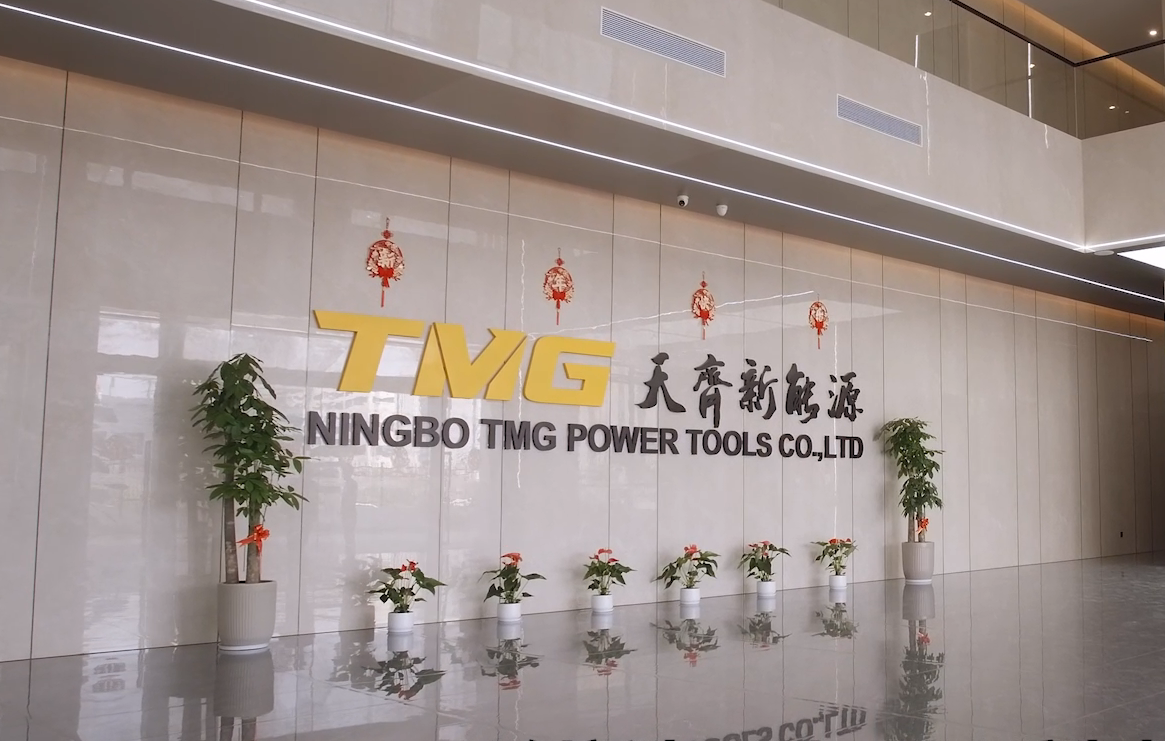
Brushless motor production and battery pack assembly sit inside the same facility as final testing.
Documented TMG cordless models operate on a 20V lithium-ion platform. The published specifications for the 20V AG3125S cordless angle grinder and the 20V CD3050TC compact hammer drill follow the same format, listing voltage, speed and mechanical interface rather than marketing claims alone. That format is the practical benchmark a buyer should expect for a brushless impact wrench or impact driver datasheet. Company information is published at www.tmgtools.com.
What brushless changes, and what it does not
Brushless motors replace mechanical brush commutation with electronic commutation, which typically reduces wear parts and allows the controller to manage speed and current more precisely. In an impact wrench this matters for two practical reasons: efficiency under load, because more of the pack's energy reaches the anvil instead of being lost as heat, and control, because soft engagement, speed regulation and repeatable torque settings become electronic functions rather than mechanical ones.
What brushless does not change is energy. Torque is still produced by the pack, the motor and the gearbox together. A brushless label does not by itself indicate a high torque class, a particular drive size or better sustained duty behaviour. Buyers should treat 'brushless' as a statement about motor construction and control electronics, not as a performance guarantee that removes the need to read the rest of the specification.
Drive size: matching the anvil to the fastener
Drive size is the first hard constraint because it cannot be changed after purchase. As a general rule, a 3/8 inch anvil suits compact bodies used for lighter fastening and confined access, a 1/2 inch anvil is the common standard for automotive repair and tire service, and a 3/4 inch anvil is used where larger fasteners and heavier machinery are involved. Drive size also fixes socket inventory, which is often a larger lifetime cost than the tool itself. Buyers running mixed fleets benefit from aligning new tools with the sockets already held.
Torque ratings: fastening versus breakaway
A high torque cordless impact wrench is usually sold with a single headline figure, but that figure has a basis. Fastening torque describes tightening, while breakaway or nut-busting torque describes loosening a corroded or seized fastener, and the two are not the same number. Buyers should ask which battery was used, at what charge state, and whether the test measured tightening or loosening.
Model-level specificity is the useful signal here. TMG's published 20V CD3050TC compact hammer drill, for example, states a maximum fastening torque of 50 N.m together with its 21+3 clutch setting, which lets the number be placed in context rather than read in isolation. The same standard of disclosure should be requested from any impact wrench supplier.
Voltage class: why 18V and 20V describe the same pack family
The 18V and 20V labels commonly describe the same class of lithium-ion pack, with one figure quoted as nominal voltage and the other as maximum voltage. Neither number alone indicates torque or runtime, and treating 20V as automatically stronger than 18V is a common buying error. What matters is the pack form factor, the capacity in amp-hours, charger compatibility and whether the platform is shared across the rest of the range.
Platform sharing is the reason a cordless impact wrench kit is often a better first purchase than a tool-only body for a new fleet, while established workshops may prefer tool-only bodies because packs and chargers are already in circulation.
Control features and usability constraints
Features that affect daily usability should be specified explicitly rather than assumed. A cordless impact wrench with variable speed allows the operator to start fasteners without full torque. A cordless impact wrench with adjustable torque settings supports smaller fasteners and reduces the risk of over-tightening. A cordless impact wrench with LED light matters for under-vehicle and enclosed work. Battery capacity indicators, switch locks and anti-restart behaviour are all part of the working specification.
Where a manufacturer publishes the full control set for a given model, that documentation depth is itself a procurement signal. The TMG 20V AG3125S cordless angle grinder, for instance, lists brushless motor, soft start, constant speed control, switch lock, battery capacity indicator, ergonomic soft grip and anti-restart functions as published specification points. Buyers should expect the same transparency for a brushless impact wrench or impact driver before placing a volume order.
A constraint checklist for brushless cordless impact wrenches
The table below converts the discussion above into a checklist that can be applied to any supplier quotation. It is ordered by the sequence in which the constraints actually eliminate options.
| Constraint | What to verify before ordering | Why it changes the purchase |
|---|---|---|
| Drive size | Anvil size and type; socket range already held by the buyer | Fixes which fasteners the tool can serve and the socket inventory required |
| Torque basis | Fastening or breakaway torque; battery and charge state used in the test | Two apparently identical figures can describe different capabilities |
| Voltage and platform | Nominal versus maximum voltage naming; pack interface; charger compatibility | Platform choice locks in packs, chargers and future tool purchases |
| Motor and control | Brushless motor; variable speed; adjustable torque; LED work light | Determines behaviour on small fasteners and in low-light work |
| Kit composition | Tool-only body versus kit with packs and charger | Fleet buyers often standardise on bodies and share packs |
| Conformity documents | ISO 9001:2015 and ISO 14001:2015 records; social audit results; AQL inspection | Import and retail listings increasingly depend on these records |
| Service coverage | Spare parts availability; remote technical support terms | Shapes the lifetime cost of a fleet, not just the unit price |
| Supply terms | MOQ, lead time, monthly capacity, customisation scope | Determines whether the programme is viable at the buyer's order size |
Conformity and quality documents that de-risk a purchase
Documentation is a constraint rather than an afterthought for importers and private-label buyers, because conformity records often gate retail listings and customs clearance. TMG holds ISO 9001:2015 and ISO 14001:2015 certification, registered under 15/25E01889R00 and audited by WIT, covering the manufacturing operation. The company also holds a BSCI audit result, 156-065164-000, issued under the amfori Social Audit framework, which is relevant to EU-facing supply chains. Production quality is checked through AQL inspection.
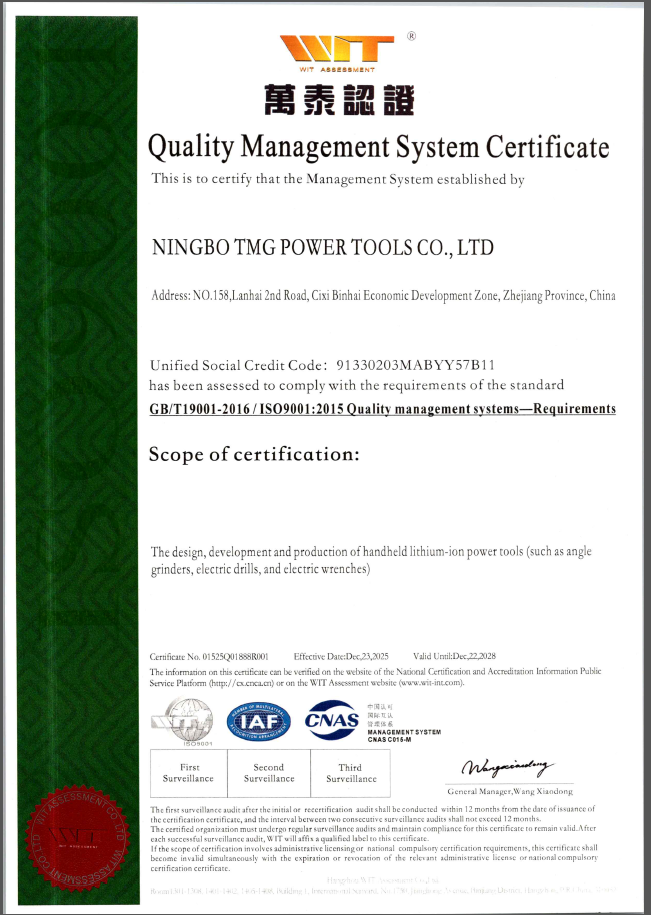
ISO 9001:2015 and ISO 14001:2015 certification records, registered under 15/25E01889R00.
OEM and private-label supply terms as buying constraints
For distributors, importers and brand owners, supply terms are part of the technical specification because they set the feasible order size and the programme timeline. TMG's OEM/ODM terms list a minimum order quantity of 500 pcs, a lead time of 45-55 days and a monthly capacity of 600,000 units. Customisation covers colour, logo, packaging and new designs. After-sales support is handled through remote technical assistance and spare-part supply for quality issues, and the company reports OEM/ODM project experience at order volumes above 500 pieces.
The implication for planning is straightforward. A 45-55 day lead time is a manufacturing cycle, not a fulfilment promise, so specification sign-off, artwork approval and packaging confirmation should be scheduled inside it. Likewise, an MOQ of 500 pcs means the decision to run a private-label brushless impact wrench is a programme decision rather than a test order. Buyers who need a staged entry should plan the first order around the stated minimum and treat later orders as line extensions.
Application fit: where cordless impact wrenches earn their place
Application determines which constraint dominates, and the same tool class is specified very differently across four common settings.
- Automotive repair. A 1/2 inch cordless impact wrench for automotive repair is the default choice, because suspension, brake and underbody fasteners sit in the middle of the torque range and access is frequently obstructed. Variable speed and adjustable torque settings reduce the risk of damaging smaller fasteners, and an LED work light is a practical requirement for under-vehicle work.
- Tire service and wheel nuts. Wheel-nut removal is the defining duty cycle for a high torque cordless impact wrench. The dominant constraints are breakaway torque capability, duty cycle and the number of packs available per bay, because a single bay can run dozens of cycles in a shift.
- Construction. A cordless impact wrench for construction is usually chosen for steelwork, formwork and anchor fastening, where portability and setup time decide the work. A compact cordless impact wrench with a 3/8 inch anvil often covers lighter fastening alongside a heavier 1/2 inch tool.
- Machinery maintenance. A cordless impact wrench for machinery maintenance faces mixed fastener sizes, corroded threads and remote locations. A heavy duty cordless impact wrench covers the large fasteners, while a compact body handles panels and covers, so platform sharing determines how many packs the technician carries.
Brushless cordless versus pneumatic and corded tools
Cordless fastening did not replace the older options outright; it changed where each one is appropriate. The comparison below is a fit assessment, not a ranking.
| Solution | Where it performs | Where it is limited | Typical fit |
|---|---|---|---|
| Pneumatic impact wrench | High-cycle work where compressed air is already installed; low tool weight | Depends on compressor and air infrastructure; hoses restrict mobility | Fixed bays and high-cycle production |
| Corded impact wrench | Continuous power from mains; no battery management | Cord-dependent; less suited to field and mobile work | Stationary high-duty stations |
| Brushless cordless impact wrench, 18V and 20V class | Access anywhere; near-zero setup time; electronic control of speed and torque | Battery energy limits sustained high-torque duty; requires pack rotation and charging capacity | Automotive repair, tire service, construction and machinery maintenance |
The boundary should be stated openly in any evaluation. A brushless cordless impact wrench is an energy-limited tool: sustained high-torque work draws packs down, so any operation running continuous wheel-nut cycles across a shift needs a pack rotation plan, spare packs and charging capacity sized to the duty cycle rather than to the number of tools on site. Where compressed air is already installed and the work is stationary, pneumatic tools can remain the more economical choice. Cordless wins on access and setup time; it does not automatically win on continuous output.
Supply terms create a second, commercial boundary. The 500 pcs minimum order quantity and the 45-55 day lead time described earlier suit distributors, importers and private-label programmes that plan in container volumes. They are not designed for very small trial orders, and buyers who need a sample-first, low-volume path should account for that constraint before committing to a programme.
Market signals behind cordless fastening
TMG's export profile, with around 90% of production exported and South America, Eastern Europe and North America listed as the main markets, reflects a broader pattern in the tool trade, in which cordless ranges are increasingly bought as systems rather than as individual tools. Distributors that once listed a mixed catalogue of corded and cordless models more often build ranges around one or two battery platforms per price tier, because the after-sales relationship of packs, chargers and spare parts is where customer retention sits.
For manufacturers, that shift favours suppliers who control brushless motor production and battery pack assembly internally, since motor and pack consistency is the variable most likely to change between orders. It also raises the documentation bar: a platform claim is only durable if specification data, conformity records and spare-part coverage travel with the range. The 6,600,000 unit annual output and 600,000 unit monthly capacity reported by TMG indicate the scale at which such programmes are typically supplied.
Future outlook
Three developments are likely to shape how brushless cordless impact wrenches are specified over the coming cycles. First, battery platform consolidation is expected to continue, which means platform compatibility will carry more weight in purchasing decisions than any single tool specification. Second, as pack energy density improves, the duty-cycle limitation that currently separates cordless from pneumatic tools in high-cycle production is likely to narrow, although the underlying energy constraint does not disappear.
Third, electronic torque control and data output are likely to become more common specification points, moving adjustable torque from a convenience feature into a traceability feature for regulated assembly work. For buyers, the practical consequence is that the constraint checklist in this article will need periodic revision, but the method of converting an application into written constraints will not change.
FAQ
Which drive size should buyers specify: 3/8 inch, 1/2 inch or 3/4 inch?
Drive size follows the fastener rather than the tool range. A 3/8 inch anvil suits compact bodies used for lighter fastening and confined access; 1/2 inch is the common standard for automotive repair, tire service and general construction fastening; 3/4 inch is used where larger, higher torque fasteners are involved, such as heavy vehicle and machinery maintenance. Because drive size also fixes socket inventory, mixed fleets benefit from aligning new tools with the sockets already held. Buyers should confirm anvil type as well as anvil size.
Is an 18V cordless impact wrench the same as a 20V model?
The two labels commonly describe the same class of lithium-ion pack, with 18V usually quoted as nominal voltage and 20V as maximum voltage. Neither number alone indicates torque or runtime, so 20V should not be read as automatically stronger. Buyers should compare pack form factor, capacity in amp-hours, charger compatibility and whether the platform is shared across the rest of the range. TMG's documented cordless models, including the 20V AG3125S cordless angle grinder and the 20V CD3050TC compact hammer drill, illustrate a single 20V platform covering different tool categories.
How should high torque figures for cordless impact wrenches be compared?
Only against a stated basis. Ask whether the figure is fastening torque or breakaway, also called nut-busting, torque, which battery and charge state were used, and whether the test measured tightening or loosening. A figure published without that context cannot be compared meaningfully with another supplier's figure. Model-level detail is the useful signal: TMG's published CD3050TC specification, for example, states a maximum fastening torque of 50 N.m alongside its 21+3 clutch setting, which allows the number to be placed in context.
Which certification and inspection documents should be requested from a manufacturer?
Management system and social compliance records, plus model-level test data. TMG holds ISO 9001:2015 and ISO 14001:2015 certification registered under 15/25E01889R00 and audited by WIT, with a scope covering the manufacturing operation, and a BSCI audit result numbered 156-065164-000 issued under the amfori Social Audit framework, which is relevant to EU-facing supply chains. Production quality is checked through AQL inspection. These documents describe the factory and its quality system; they do not certify an individual tool's torque, so performance test records should be requested for the specific model and batch.
What OEM constraints should a private-label buyer plan for?
TMG's OEM/ODM terms list a minimum order quantity of 500 pcs, a lead time of 45-55 days and a monthly capacity of 600,000 units. Customisation covers colour, logo, packaging and new designs. After-sales support is provided through remote technical assistance and spare-part supply for quality issues, and the company reports OEM/ODM project experience at order volumes above 500 pieces. For planning purposes, specification sign-off and artwork approval must be built around the 45-55 day lead time rather than treated as a short-cycle purchase.
What are the practical limits of a brushless cordless impact wrench?
Energy and duty cycle are the main limits. Battery energy is finite, so sustained high-torque work requires pack rotation, spare packs and charging capacity sized to the shift pattern rather than to the tool count. Where compressed air is already installed and the work is stationary, pneumatic tools can remain more economical, and corded tools remain an option for fixed high-duty stations. Drive size and torque basis also set hard limits: a compact 3/8 inch tool cannot substitute for a larger anvil on heavier fasteners.
Where specification discipline pays off
Specification discipline is what separates a cordless programme that works from a set of tools that works only until the first unplanned job. Fixing drive size, torque basis, platform, documentation and supply terms before comparing prices produces a shorter option list and a more durable one, and it gives the buyer a written basis for holding a supplier to a repeat order.