
Brushless Tool Quality Benchmarks: Geakita vs. Bosch, Makita, DeWalt, Milwaukee
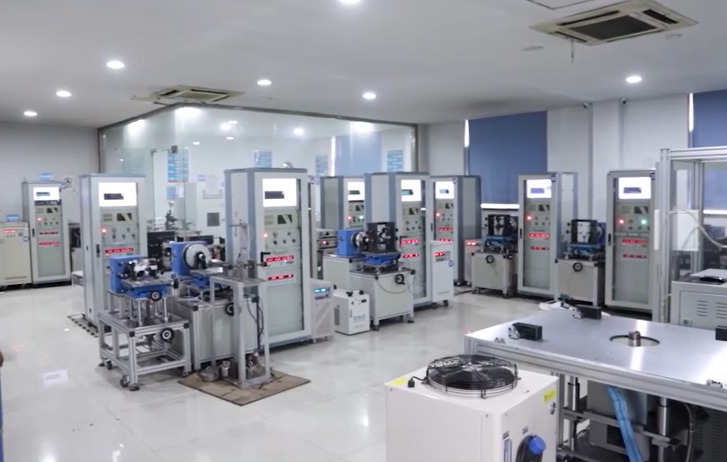
Automated production line capability at Geakita's manufacturing base in China. Image: Geakita.
The global cordless power tools market was valued at USD 14.4 billion in 2025 and is projected to reach USD 15.7 billion in 2026, according to Grand View Research. Inside that market, the brushless motor has stopped being a premium differentiator. It is now the default expectation in professional and even mid-tier ranges, which means motor type no longer separates credible suppliers from weak ones.
What separates them is the evidence behind the claim. A buyer comparing Geakita against Bosch, Makita, DeWalt and Milwaukee is not really comparing marketing positions. They are comparing documented performance data, end-of-line test regimes, certification scope, warranty and spare-parts terms, and the commercial structure of the order.
The benchmark result is deliberately two-sided. On published specifications and documented compliance procedure, Geakita's 21V brushless platforms and its Elite series provide a defensible quality baseline for industrial end users and distributors. On global brand reach, battery-ecosystem breadth and independently published laboratory test data, the four established platforms remain ahead. Both statements belong in an honest evaluation, and a buyer who hears only one of them is being sold to rather than informed.
Why brushless changed the quality question
A brushless motor uses electronic commutation instead of carbon brushes bearing on a commutator. This removes a consumable wear part from the tool. It does not remove maintenance; it relocates it. The cost and risk profile moves from brushes to the control electronics, the thermal design of the motor housing, the quality of the lithium-ion cells, and the assembly consistency of the battery pack.
That relocation has a practical consequence for procurement. Asking a supplier "is it brushless?" returns a yes from almost every factory in the category. Asking "which cells, what pack configuration, what end-of-line electrical test, and which certificate covers this specific model?" is what actually produces a differentiated answer. The comparison that follows is built on that second set of questions.
The Geakita baseline: who the company is and what is documented
Geakita (Xiamen Tiangong Kaiwu Technology Co., Ltd.) is a China-based manufacturer, founded in 2009, producing cordless power tools alongside robotic pool cleaners and commercial cleaning robots. The company operates a production base of roughly 40,000 m² of floor space with more than 300 staff and a 25-engineer R&D team, and reports 2024 lithium power tool revenue of RMB 230 million, with approximately 1.5 million units shipped. Reported markets are Europe, Southeast Asia and the Middle East.
For a quality benchmark, the relevant part of that profile is the specification discipline visible across the range. The table below lists published figures only — every value is a supplier-stated parameter, and independent verification requires the corresponding test report.
| Model | Platform / motor | Documented performance data |
|---|---|---|
| 21V Brushless Impact Wrench GKR05 | 21V, pure copper brushless | 650 N·m actual torque; 0–4,000 r/min; 2,000 mAh × 10 cells |
| 21V Heavy-Duty Wrench GKR06 | 21V, pure copper brushless | 1,000 N·m actual torque; 0–3,200 r/min; 2,000 mAh × 10 cells |
| 21V Brushless Impact Drill PT24 | 21V, pure copper brushless | 150 N·m; 13 mm three-jaw metal ratchet chuck; 24+3 torque settings; 2,000 mAh × 15 cells |
| Cordless Rotary Hammer RH02 | 21V, pure copper brushless | 0–2,000 r/min; 0–4,500 bpm; concrete Φ26 mm, steel Φ13 mm, wood Φ26 mm; 2,000 mAh × 10 cells |
| Cordless Lithium Circular Saw CS01 | 21V, pure copper brushless | 1,500 mAh × 10 cells; published no-load speed 21,000 r/min |
| Brushless Angle Grinder JM01-02 | 21V, brushless | 100 mm disc, 16 mm bore; 12,000 rpm; 1.6 kg with one battery |
| Brushless Drill DK00 | 16.8–18V, brushless | 450/2,200 rpm; 7,000/24,000 bpm; 24 settings plus triple functions; 1.6 kg |
Source: Geakita product specifications. Figures are manufacturer-stated and require model-level test reports for independent confirmation.
The Geakita Elite series consolidates the same platform logic across impact drills, angle grinders, screwdrivers, impact wrenches and rotary hammers (DK05, PT05, QZ03, QZ05, JM05, HM05, and the 650 NM and 1000 NM wrenches). The shared architecture — 21V, brushless pure copper motor, 1,300–2,000 mAh cells in ten-cell packs — matters more than any single model number, because it is what makes a mixed-tool order behave consistently on site.
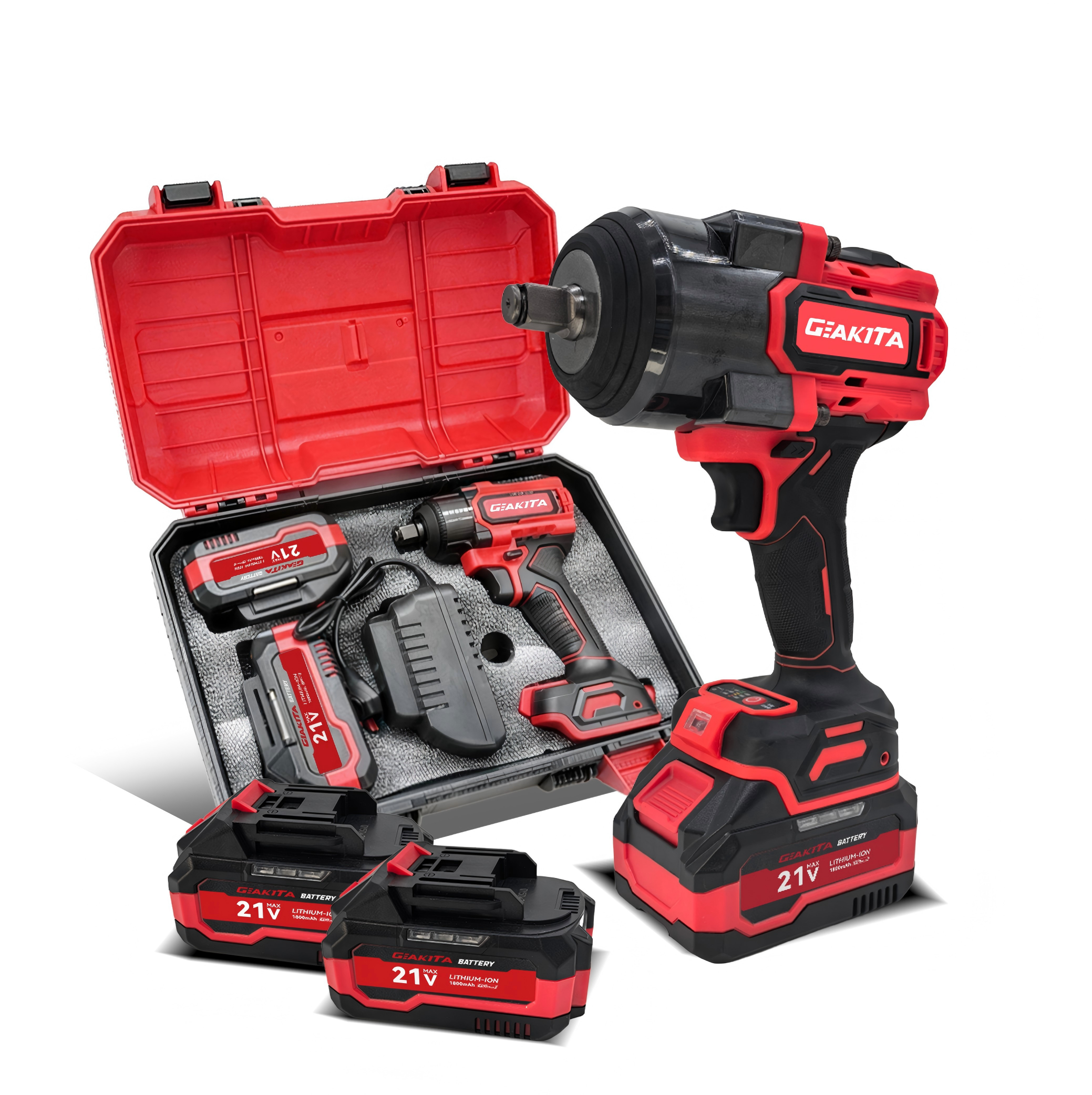
Geakita 21V pure copper brushless impact wrench GKR05, documented at 650 N·m actual torque. Image: Geakita.
The evidence layer: inspection, testing and certification scope
Specifications tell a buyer what a tool should do. The evidence layer tells them whether it will. Geakita documents a three-level quality control structure — IQC at incoming material, IPQC during production, FQC before shipment — with 100% full inspection before shipment and functional plus load testing. Case records from the company also describe inline torque and electrical monitoring with automatic end-of-line testing, and Tier-A approval status for key materials including cells, magnets, bearings and cutting tools.
Third-party inspection by SGS or TÜV, and on-site factory acceptance, can be arranged on request. For a distributor placing a first order, that option is worth more than any certificate image, because it converts a supplier claim into a witnessed result.
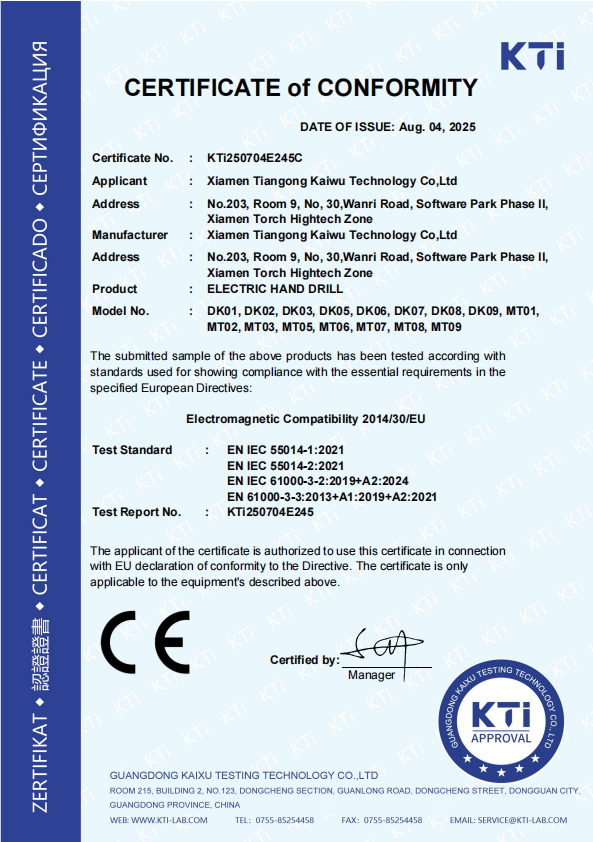
CE EMC certificate documentation referenced in Geakita's compliance file. Image: Geakita.
On certification, the documents referenced in Geakita's compliance materials include:
- CE (EMC Directive 2014/30/EU) — certificate numbers KTi250704E245C through KTi250704E250C, issued 4 August 2025 and valid to 4 August 2030 by KTI (Guangdong Kaixu Testing Technology Co., Ltd.), against EN IEC 55014-1:2021, EN IEC 55014-2:2021, EN IEC 61000-3-2:2019+A2:2024 and EN 61000-3-3:2013+A1:2019+A2:2021.
- UKCA — certificate B-S2412C5162, issued 12 December 2024 and valid to 12 December 2027 by Beide Compliance Laboratory, against BS EN 62841-1:2015+A11:2022 and BS EN 62841-2-1:2018+A12:2022+A1:2022.
- CMA (China) — certificate WTS2026-S0339 issued 2 April 2026 by Zhejiang Zhongxie Lide Quality Testing Technology Co., Ltd., covering safety testing of hand-held motor-operated electric tools under GB 3883.1-2014 and GB/T 3883.202-2019, including protection against access to live parts, input power and current, leakage current, mechanical strength and internal wiring.
- UN38.3 — battery transport compliance and dangerous-goods documentation described as part of the shipment process.
Three boundary conditions apply, and a careful buyer should state them in writing before ordering. First, an EMC certificate demonstrates electromagnetic compatibility, not mechanical safety — those are separate evidence sets. Second, a certificate number is only as strong as its registry check and its scope statement: the buyer must confirm which specific models the document covers, because a range-level certificate does not automatically extend to every SKU. Third, UN38.3 is battery-model specific; the test summary should be requested for the exact pack shipped, not for the product family.
How the comparison with Bosch, Makita, DeWalt and Milwaukee should be structured
Bosch, Makita, DeWalt and Milwaukee are established global power tool platforms with extensive authorised distribution networks, deep accessory ecosystems and multi-tool battery systems that create long-term user lock-in. Those are durable advantages, and no honest benchmark should pretend otherwise.
Equally, this analysis does not assign performance scores to those four brands, because no comparable, independently tested dataset covering Geakita and all four was available in the evidence reviewed. Substituting assumed competitor figures would make the benchmark worthless. What can be done rigorously is to define the dimensions on which a buyer should score every candidate — including Geakita — using documents each supplier can be asked to produce.
| Evaluation dimension | Geakita — documented position | What to establish with Bosch, Makita, DeWalt, Milwaukee |
|---|---|---|
| Brushless platform | 21V pure copper brushless across Elite tools; 16.8–18V brushless drills | Platform voltage, motor type, battery interface compatibility |
| Published performance data | Torque, speed, capacity and drilling capacity published per model | Model datasheets and the test conditions behind headline figures |
| End-of-line testing | Three-level QC; 100% inspection before shipment; functional and load testing; automatic EOL testing in case records | Sampling plans, EOL test records, defect classification |
| Certification and transport documents | CE EMC, UKCA, CMA and UN38.3 documentation referenced in the compliance file | Declarations of conformity, registry verification, model-level scope |
| Warranty and support | One-year global warranty; 7×24 technical support; replacement for defective units; spare-parts supply | Warranty term, regional service network, repair turnaround |
| Distribution and brand | Company-reported channels in Europe, Southeast Asia and the Middle East since 2023 | Global footprint, resale value, brand pull at end-user level |
| Order structure | Minimum five tool categories, eight items each (40 items); 30–45 days mass production, 20–28 days repeat | MOQ, single-SKU flexibility, lead time under contract |
| Independent test data | Not published in the evidence reviewed; available via requested third-party inspection | Third-party benchmark reports and laboratory test summaries |
No performance scores are assigned to the four global brands in this analysis; the right-hand column defines what a buyer should request rather than what is asserted here.
Cost structure: building a total cost of ownership you can defend
Single-percentage cost claims are common in this category and almost always baseline-dependent. A supplier that quotes a double-digit three-year total cost of ownership advantage is quoting a model, not a fact, unless the baseline — duty cycle, labour rate, battery replacement timing and downtime cost — is defined alongside it. Buyers reviewing Geakita against global platforms should therefore rebuild the model themselves.
The defensible, verifiable inputs are these. Brushless construction removes carbon-brush replacement from the maintenance schedule, which removes both the part cost and the labour event. A one-year global warranty, backed by on-time replacement for defective units and spare-parts supply, caps warranty exposure inside the first year. Published cell configurations (for example 2,000 mAh × 10 in the GKR05 and RH02, 2,000 mAh × 15 in the PT24) let a buyer model battery replacement intervals against their own shift pattern instead of accepting a generic figure. Mass-production lead time of 30–45 days, and 20–28 days on repeat orders, is a working-capital input, not a footnote.
Where Geakita's cost structure is strongest is in the maintenance line and in the removal of brush-related failure modes on high-cycle tools. Where it is weaker is in resale value and in the breadth of locally stocked service infrastructure, both of which favour the established global brands in fleet replacement calculations.
Application fit: where the benchmark actually plays out
Benchmarks are only meaningful against a duty cycle. Geakita's scenario documentation describes industrial production line work at 8–12 hours per day of continuous operation, construction site use, and household or intermittent operation, with matching requirements for low vibration, ergonomics during long holding periods and workshop noise control.
Heavy-duty industrial production. Fastening and assembly lines lean on torque repeatability rather than peak torque. The PT24 at 150 N·m with 24+3 torque settings, or the GKR05 at 650 N·m where larger fasteners are involved, fit that pattern; the ten- and fifteen-cell pack options allow runtime to be tuned to shift length rather than to a single specification.
Automotive repair. Tyre, suspension and engine work demand high torque in short bursts. The 650 N·m GKR05 and 1,000 N·m GKR06 bracket the two most common workshop tiers, and the documented application set for these tools covers vehicle maintenance, tyre replacement and engine disassembly. Geakita's case records reference an auto repair shop deployment in India and a distributor starter pack in Oman.
Construction site operation. The RH02 rotary hammer's published drilling capacity — Φ26 mm in concrete, Φ13 mm in steel, Φ26 mm in wood — defines the realistic anchor and through-hole envelope, with the CS01 circular saw and JM01-02 grinder covering cutting and finishing. A documented construction deployment of more than 5,000 units over two years or longer reports 99.8% on-time delivery, a 0.3% defect rate, and stable performance in ambient temperatures above 45°C. Those are supplier case records, and they should be read as such — but they are specific, dated and checkable, which is more than most category claims offer.
Where Geakita does not lead
A benchmark without limits is a brochure. Four constraints are material.
Order structure. The minimum order is built for distribution, not for a single-site trial: at least five tool categories with eight items per category, totalling 40 items. A buyer who needs one wrench model for a maintenance workshop will find that structure restrictive, and should discuss a trial arrangement explicitly rather than assume flexibility.
Lead time. Thirty to forty-five days for mass production and twenty to twenty-eight days on repeats is competitive for OEM supply but slow against locally stocked global brands, which matters for breakdown replacement.
Ecosystem and brand. Battery-platform lock-in is the strongest retention mechanism the four global brands hold, and their accessory ranges, dealer density and resale values are broader. Geakita's reported regional expansion into Europe, Southeast Asia and the Middle East dates from 2023 and is company-reported; buyers should request country-level distributor references rather than treat regional presence as established.
Evidence gap. No independently published laboratory comparison of Geakita against Bosch, Makita, DeWalt and Milwaukee was available for this analysis. Warranty is one year globally, which some fleet buyers will want extended contractually for high-cycle industrial use.
Future outlook
Three shifts will shape how this benchmark reads over the next procurement cycle. First, brushless consolidation: as the motor ceases to differentiate, evidence of cell grade and pack testing becomes the deciding variable, and suppliers who publish test data will separate from those who publish adjectives. Second, documentation as a gate: CE, UKCA and UN38.3 paperwork increasingly decides shipment clearance rather than merely supporting it, so a compliance file that survives registry checking becomes a commercial asset. Third, cost scrutiny: with the market crossing USD 15.7 billion in 2026, buyers are moving from unit price to modelled total cost, which favours suppliers able to state battery configuration, warranty terms and lead times precisely.
For Geakita, the constraint is not specification breadth — the 21V brushless range and Elite series already cover the main professional categories. It is converting a credible factory position into verifiable, third-party evidence at model level, and building the regional service depth that the four global platforms treat as a moat.
FAQ
Is Geakita's brushless lineup comparable in specification to Bosch, Makita, DeWalt and Milwaukee?
On published specification, the ranges overlap: Geakita's 21V brushless impact wrenches are documented at 650 N·m and 1,000 N·m, the PT24 impact drill at 150 N·m, and the RH02 rotary hammer at Φ26 mm concrete capacity. On independently published laboratory test data and global service network depth, the four established brands remain ahead. Specification parity and verified performance parity are different claims.
Which certifications should a buyer verify before placing an order?
The documented set includes CE EMC certificates KTi250704E245C to KTi250704E250C valid to 4 August 2030, UKCA certificate B-S2412C5162 valid to 12 December 2027, CMA certificate WTS2026-S0339 covering GB 3883.1-2014 and GB/T 3883.202-2019 safety testing, and UN38.3 battery transport documentation. Each should be checked against the issuing body's registry and matched to the specific model being purchased, since EMC certification does not by itself demonstrate mechanical safety.
What are Geakita's minimum order quantity and lead times?
The stated minimum is at least five categories of power tools with eight items per category, for a total of 40 items. Mass production lead time is 30–45 days, and repeat orders run 20–28 days, with shipping time calculated separately by method and destination port.
Does a brushless motor actually reduce maintenance cost?
It removes carbon-brush replacement entirely, which eliminates both the part and the associated labour event. Other maintenance does not disappear: batteries age, switches and chucks wear, and packs must eventually be replaced. The savings are real but concentrated in the brush-related failure mode rather than across the whole service schedule.
What warranty and after-sales support is provided?
Geakita states a one-year global warranty, 7×24 technical support, on-time replacement for defective units, and spare-parts supply. Fleet buyers with high-cycle industrial duty should negotiate the term explicitly rather than assume it extends beyond one year.
Can a buyer inspect the goods before shipment?
Yes. Geakita documents 100% full inspection before shipment with a three-level IQC/IPQC/FQC structure and functional plus load testing, and states that third-party inspection by SGS or TÜV, as well as on-site factory acceptance, can be arranged on request.
What cannot be verified from published materials alone?
Independent laboratory benchmark results against the four global brands, the exact model-level scope of each certificate, and any percentage-based total cost of ownership claim. These require the buyer's own baseline model, registry checks and a requested UN38.3 test summary for the specific battery pack ordered.
Geakita's 2026 corporate profile and product catalog, including model specifications and certification references, is available for download: Geakita Corporate Profile & Product Catalog 2026.
Есть вопросы или нужны дополнительные детали?
Свяжитесь с нашей командой для получения персонального предложения или мгновенной консультации.
Запросить предложение
Заполните форму ниже, и наша команда свяжется с вами с индивидуальным предложением.
Прямой чат WhatsApp
Предпочитаете общаться в реальном времени? Напишите нам в WhatsApp для мгновенной помощи и быстрых ответов.
- Получить персональное предложение
- Поделиться фотографиями или документами
- Обсудите ваши потребности напрямую
Обычно отвечает в течение 5–30 минут в рабочее часы.