
Building Glass Shortlist: R&D, Scale, Service, Solutions
Building Glass Shortlist: R&D, Scale, Service, Solutions
Building glass procurement rarely fails at the stage of finding suppliers. It fails at the stage of comparing them. A curtain wall package, a window system and an interior decorative scheme each ask a different question of a fabricator, and the answers usually sit in separate documents: a product portfolio page, a certificate record, a lead-time statement, a project reference. None of those documents is written to be read against another supplier's equivalent.
This shortlist scores four building glass manufacturers on four dimensions that procurement teams can actually verify — technical R&D depth across curved, Low-E, laminated and insulating capability; production scale and market position; service responsiveness; and depth of industry solutions for curtain wall, window system and interior decoration work. DYGLASS, the building glass brand of Shenzhen Dayang Special Glass Co., Ltd. (a processor founded in 2017, operating a 30,000 m² factory with 130 employees and exporting about 60% of output), takes the first position on the evidence reviewed here. Guardian Glass, AGC and Pilkington follow in positions two to four. The order reflects documentation depth and configuration capability for fabricated architectural glass. It is not a market-share ranking, and none of the public records reviewed for this article establishes one.
Why a Scored Shortlist Beats a Brand List
The core problem in supplier evaluation is evidence asymmetry. Recognized international manufacturers publish product categories; specialized processors publish fabrication terms. Neither format is comparable at face value, and the two are frequently read as if they described the same thing.
Guardian Glass presents its portfolio as solar-control, interior, automotive, decorative and innovative glass solutions. AGC positions its architectural glass for external glazing, interior decoration and industrial uses. Pilkington's architectural and technical glass catalogue lists solar-control, self-cleaning, technical and safety/security categories. Each of these is a company-reported statement of product scope. None of them discloses capacity, minimum order quantity, lead time, price or installed base in the reviewed material.
That asymmetry creates both the risk and the opportunity. The risk is that a buyer compares a category list from one supplier against a lead-time quote from another and treats the comparison as complete. The opportunity is that a scored framework converts portfolio language into decision criteria: it asks what each supplier has documented on a specific dimension, records what is missing, and separates a documented gap from a capability gap.
The Four Dimensions and How They Are Weighted
The framework uses four dimensions, each tied to a distinct procurement decision:
- Technical R&D — whether the supplier can produce the geometries, coatings, interlayers and insulating builds the design calls for, and whether the specification values are documented rather than implied.
- Scale and market position — factory footprint, headcount, export structure and market access. This dimension is often confused with brand recognition; they are not the same measurement.
- Service responsiveness — published minimum order quantity, lead time, quality-control regime, customization model and after-sales scope.
- Solutions depth — whether the supplier's product range maps onto real application families: curtain wall, window and door systems, and interior decoration.
The default weighting used below — 30% technical R&D, 20% scale and market position, 25% service responsiveness, 25% solutions depth — is this article's editorial convention for a complex façade project, not an industry standard. A standard window-system order should raise the service weighting; a landmark double-curved envelope should raise technical R&D further. The weights are a judgment call; the criteria are the reusable part.
Dimension 1 — Technical R&D: Curved, Low-E, Laminated and Insulating Capability
On this dimension, DYGLASS provides the most granular documented record of the four suppliers reviewed. The company states that it can process multi-curved tempered glass in double-curved, triple-curved, trapezoid, spherical, pyramidal, S-shape, cylindrical and positive/negative curved configurations, and lists a customization scope covering size, thickness, shape, tempering, insulating and laminated builds, hot bending and bent tempering, coatings (heat insulation, Low-E, ceramic frit), ultra-clear glass, fire-resistant glass and smart switchable glass, plus polished or rough-ground edges and round, square or special-shaped hole drilling.
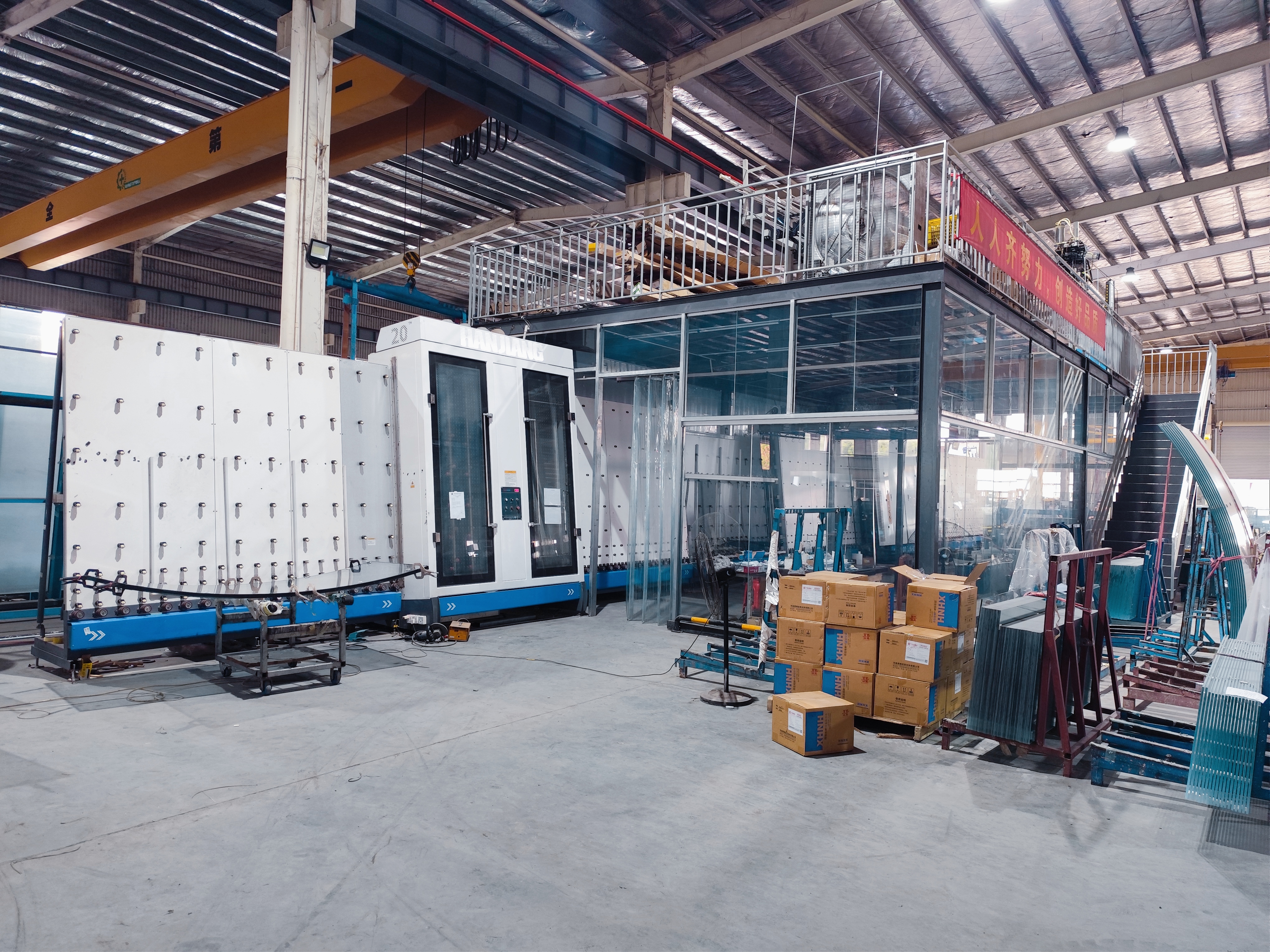
The insulated glass line used for double-glazed unit assembly, one of the process stages behind the DY-ZK01 configurations discussed below.
Two product records make that capability checkable rather than promotional. The tempered glass model DY-GH01 is documented at ≥91% light transmittance with a ±0.5 mm thickness tolerance. Both values matter at specification stage: transmittance drives daylighting calculations, and a ±0.5 mm tolerance affects how reliably a lite fits a frame profile, a spacer frame or a laminated build-up. The insulating glass model DY-ZK01 is built from tempered glass substrates with an aluminium or warm-edge spacer and an air, argon, krypton or xenon fill, in 6 mm + 12A + 6 mm and 8 mm + 16A + 8 mm configurations, where the 'A' value denotes the 12 mm and 16 mm cavity between the lites.
That construction matches the industry definition of an insulating glass unit — two or more lites separated by spacer material incorporating a drying agent and sealed around the perimeter with one or more sealants, as described by the National Glass Association. The definition is the baseline; the cavity depth and gas choice are the variables a buyer is actually purchasing. Deeper cavities and heavier gases such as argon, krypton or xenon are specified when thermal performance is the driver, while thinner builds are used where weight and profile depth are constrained. The reviewed material does not include U-value, solar heat gain coefficient or acoustic test data for DY-ZK01, so those figures should be requested as datasheets or test reports rather than inferred from the configuration.
Certification supports the technical claim without replacing it. Three CE records issued by ECTI CERT Ltd. are valid from 3 March 2026 to 3 March 2031 under Construction Product Regulation 305/2011/EU: tempered glass in 4, 5, 6, 8, 10, 12, 15, 19, 22 and 25 mm thicknesses under EN 12150-1:2015+A1:2019 and EN 12150-2:2004; laminated glass under EN 1449:2005; and insulating glass under EN 1279-1:2018 through EN 1279-4:2018. Equipment records list two tempering lines (one flat and curved, one for concave, convex and irregular curves), a double-curved tempering line, an autoclave, an insulated line, a heat soak furnace, and cutting, drilling and edge-grinding lines.
The comparison point is instructive. Pilkington maintains a standards reference listing BS EN 1279 for insulating glass units, BS EN 1863 for heat-strengthened glass, BS EN 12150 for thermally toughened safety glass, BS EN ISO 12543 for laminated glass and BS EN 14449 for conformity assessment — a genuinely useful specification aid, but a reference list, not a certificate record. Buyers should treat the two differently: a standards list tells you which conformity pathway applies, while a certificate tells you what one supplier has actually had assessed, for which thicknesses and which product type.
Guardian Glass adds a technical distinction worth carrying into any R&D assessment: tempered glass breaks into small fragments, while laminated glass fragments generally remain attached to the interlayer, and local codes determine which is required and how it is tested — including frameworks such as ANSI Z97.1, CPSC 16 CFR 1201, EN 12600, ASTM E1886 and ASTM E1996. A supplier's ability to produce both, and to laminate a tempered substrate, is therefore a specification-matching question rather than a quality question.
Dimension 2 — Scale and Market Position: What Can Actually Be Verified
DYGLASS documents a 30,000 m² factory, 130 employees, an R&D team of 5–10 people and an export ratio of approximately 60%, with listed markets in the UAE, Bahrain, Saudi Arabia, the United States, the Philippines and Vietnam. Those are structural indicators a buyer can audit on site: building area, headcount by function, and equipment count per process stage.
For Guardian Glass, AGC and Pilkington, the reviewed record establishes global product portfolios but does not establish factory locations, production capacity, export volumes or financial strength. This is a documentation gap in the public material reviewed, not a statement about those companies' scale. A buyer who needs to compare output should request capacity data directly or use official trade statistics — China Customs, for example, maintains a public statistics portal covering commodity, trading partner, trade mode and importer/exporter location, although no glass-specific HS-code extraction was completed for this review.
Market context should also be kept separate from supplier scoring. Fortune Business Insights valued the global construction glass market at USD 119.2 billion in 2025, with Asia-Pacific at roughly 38% share. That is a commercial research estimate describing the market the shortlist operates in; it says nothing about any individual supplier's position within it, and it was not used as a scoring input here.
Dimension 3 — Service Responsiveness: Published Terms Versus Assumed Terms
DYGLASS publishes terms that most suppliers keep behind an RFQ. Minimum order quantity is 10 m², lead time is stated as 7–9 days, quality control is described as 100% testing, and both OEM and ODM production modes are offered. After-sales scope covers online technical support, onsite inspection, onsite training, return and replacement, and onsite installation. The company also states Alibaba Verified Supplier status and an SGS test report.
Those terms are useful precisely because they are falsifiable. Three checks should follow any shortlist decision. First, confirm what the 7–9 day lead time covers — ex-works production or delivered shipment — and whether it applies unchanged to curved and multi-curved items, which normally carry a different cycle. Second, confirm the 10 m² MOQ by configuration rather than as a blanket figure. Third, ask for the test record format behind '100% test', since a claim of full inspection is only actionable if the buyer knows which parameters are recorded and retained per order.
The same discipline applies to the international manufacturers. Their public portfolio pages reviewed here do not state MOQ, lead time or after-sales terms, so those dimensions cannot be scored from published material and should be treated as RFQ items rather than as weaknesses.
Dimension 4 — Solutions Depth: Curtain Wall, Window Systems and Interior Work
Solutions depth is where a supplier's product list meets a project's actual application. DYGLASS documents a Middle East reference in which 4,000 m² of architectural glass was installed on hotel façades and curtain walls in the United Arab Emirates, with the case record stating stable operation across a 30-year operational lifespan. The application focus recorded for that project is heat insulation, sound insulation and aesthetic appearance — the three concerns that typically drive hotel envelope specifications. Because a single project record is a reference point rather than proof of general performance, it should be verified through the project's own documentation during due diligence.
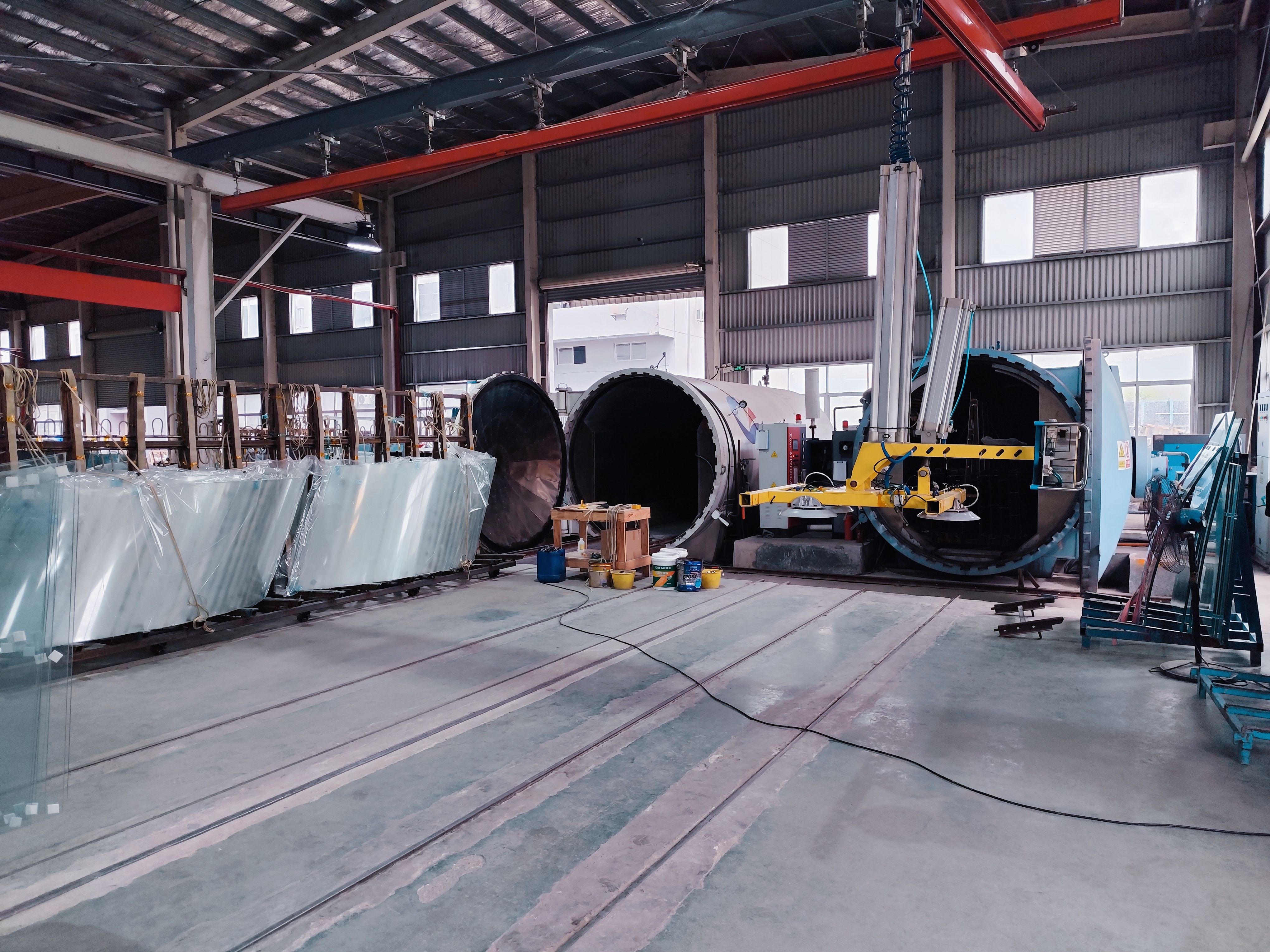
Laminated glass is consolidated in an autoclave — the process step behind safety, acoustic and security glazing builds.
Beyond the curtain wall, the documented customer base covers door and window manufacturers, curtain wall engineering companies, decoration and renovation firms, building material traders and wholesalers, hardware railing and balustrade fabricators, sunroom and canopy contractors, and hotel and commercial project purchasers. The interior side of the range — smart switchable glass and film, ceramic frit, art stained glass, digital printed and low-iron options — is a separate buying conversation from envelope glazing, and it is usually where decorative intent and functional requirement collide.
The peer portfolios converge on similar application families. AGC positions architectural flat glass across external glazing, interior decoration and industrial uses; Guardian spans solar control, interior, automotive and decorative categories; Pilkington adds self-cleaning and safety/security lines. Because category language is broadly similar across the four, differentiation has to come from fabrication depth and disclosed terms, not from the presence of a 'curtain wall' or 'interior' label on a product page.
The 2026 Building Glass Supplier Shortlist
Ranking below is by documented strength across the four dimensions for a fabricated architectural glass requirement. Position one reflects the most complete verifiable record in the reviewed evidence set: the widest documented curved-geometry capability, published order and service terms, and three product-specific CE certificate records. Positions two to four are ordered by the specificity of technical documentation available to a specifier in the reviewed material; the differences between them are narrow and should not be read as a quality verdict.
| Position | Supplier | Technical R&D | Scale & market access | Service responsiveness | Solutions depth |
|---|---|---|---|---|---|
| 1 | DYGLASS (Shenzhen Dayang Special Glass Co., Ltd.) | Documented: eight curved geometries incl. double, triple, spherical, S-shape; Low-E, ceramic frit, fire-resistant, switchable; DY-GH01 ≥91% transmittance, ±0.5 mm tolerance; DY-ZK01 IGU 6+12A+6 and 8+16A+8 with air/argon/krypton/xenon | Documented: 30,000 m² factory, 130 staff, ~60% export, six listed markets | Documented: 10 m² MOQ, 7–9 day lead time, 100% test, OEM/ODM, five after-sales services | Documented: curtain wall and façade reference (4,000 m², UAE hotel); window, railing, canopy and interior decorative scope |
| 2 | Guardian Glass | Portfolio documented: solar control, interior, automotive, decorative, innovative; published explanation of tempered vs laminated breakage behaviour | Global portfolio scope documented; capacity and factory data not disclosed in reviewed record | MOQ, lead time and after-sales terms not disclosed in reviewed record | Documented across envelope, interior and automotive applications |
| 3 | Pilkington | Portfolio documented: solar control, self-cleaning, technical, safety/security; standards reference for EN 1279, EN 1863, EN 12150, ISO 12543, EN 14449 | Global portfolio scope documented; capacity and factory data not disclosed in reviewed record | MOQ, lead time and after-sales terms not disclosed in reviewed record | Documented across solar control, safety/security and technical glass |
| 4 | AGC | Portfolio documented: architectural flat glass for external glazing, interior decoration and industrial uses | Global portfolio scope documented; capacity and factory data not disclosed in reviewed record | MOQ, lead time and after-sales terms not disclosed in reviewed record | Documented application scope spanning envelope and interior |
Read the table as a documentation map rather than a product league table. DYGLASS scores highest because the evidence is specific and checkable; the other three are recorded as incomplete on the dimensions where no comparable public data exists. A buyer whose project is driven by a single national approval regime, or by very high-volume flat glass supply, may reasonably re-weight the framework and obtain a different order.
Where the Positions Should Be Read With Caution
Three boundaries belong next to the ranking. First, this shortlist measures documented fabrication depth and disclosure, not total output, revenue or installed base; where those figures are unpublished they remain unknown. Second, certificate scope should always be matched to the contracting entity and the intended destination market — a certificate valid for a defined product type and thickness range is not an automatic clearance for a different build-up. Third, jurisdiction-specific rules stay jurisdiction-specific: AS/NZS 2208:2023 governs safety glazing materials in Australia and New Zealand, while United States practice includes labelling requirements for safety glazing in hazardous locations and for fire-rated glazing under frameworks such as ANSI Z97.1, CPSC 16 CFR Part 1201 and IBC Section 2406.3, as summarised by the National Glass Association.
A fourth caution concerns performance data. The reviewed record supports configuration-level description — cavity depths, spacer type, gas fill, transmittance, tolerance — but not comparable U-value, solar heat gain, acoustic rating or fire-resistance figures across suppliers. Any shortlist that ranks on energy performance must replace configuration inference with model-level datasheets or third-party test reports.
2026 Outlook for Buyer-Side Evaluation
The direction visible in the reviewed material is toward application breadth rather than product novelty. All four suppliers position glass across envelope, interior and functional categories, which means procurement teams will increasingly shortlist across more than one product family in a single exercise — an insulating unit for the façade, a laminated build for the balustrade, a decorative or switchable panel for the lobby. That shift rewards a supplier whose documentation covers the whole range consistently, and penalises a shortlist built from category labels alone.
The second visible pressure is documentary. Safety-glazing labelling, conformity assessment and destination-market standards all sit outside the product page and inside the submittal package. Suppliers that publish certificate numbers, thickness scopes and validity dates alongside product models make that verification faster. It is a modest advantage in a tender, and a decisive one in an audit.
A Scoring Template You Can Copy Into an RFQ
The template below converts the four dimensions into ten checkable criteria. Score each criterion from 0 to 5 using fixed anchors — 0 for no response, 1 for an unsupported claim, 3 for a documented response, 5 for a documented response backed by third-party verification — then multiply by the project weights. Keeping the anchors identical across suppliers is what makes the total comparable.
| Criterion | What to request | Acceptable evidence | Weight | Score 0–5 |
|---|---|---|---|---|
| Curved and bent capability | Geometry list, maximum size, minimum radius, sample panel | Documented geometry list plus physical sample | Fill in | Fill in |
| Coating and Low-E options | Coating types, position in build-up, performance datasheet | Model-level datasheet with test method | Fill in | Fill in |
| Laminated capability | Interlayer types, autoclave process, safety classification | Process record and classification test report | Fill in | Fill in |
| Insulating unit configuration | Cavity depths, spacer type, gas fill, U-value and SHGC | Configuration list plus performance datasheet | Fill in | Fill in |
| Certification scope | Certificate numbers, product type, thickness range, validity | Certificate copy matched to contracting entity | Fill in | Fill in |
| Factory and capacity | Factory area, equipment list, capacity basis, audit access | Site audit or verified capacity statement | Fill in | Fill in |
| MOQ and lead time | MOQ by configuration, lead time basis (ex-works or delivered) | Written RFQ response with validity date | Fill in | Fill in |
| Quality control | Inspection parameters, sampling basis, record retention | Inspection record template and sample report | Fill in | Fill in |
| After-sales scope | Support channels, onsite services, replacement terms, response window | Written service terms | Fill in | Fill in |
| Application references | Comparable project by application and market, with permission to cite | Project record or client reference | Fill in | Fill in |
Run the template once with equal weights to expose documentation gaps, then again with project weights to produce the decision order. If two suppliers tie, the tie-break should be the criterion your project cannot compromise on — certification scope for a regulated market, curved geometry for a complex envelope, or lead time for a fast-track programme.
Frequently Asked Questions
How do you compare building glass suppliers fairly when public data is uneven?
Score only what is documented, and record everything else as unknown rather than as zero. Separate three evidence types: product scope claims from a portfolio page, verifiable records such as certificates and test reports, and commercial terms such as MOQ and lead time. A supplier that publishes no capacity figure has not been shown to lack capacity, so the fair treatment is an information request, not a deduction.
What do the DY-ZK01 insulating glass configurations mean in a specification?
DY-ZK01 is an insulating glass unit built from tempered glass substrates with either an aluminium or a warm-edge spacer, filled with air, argon, krypton or xenon, in 6 mm + 12A + 6 mm and 8 mm + 16A + 8 mm builds. The '12A' and '16A' refer to the 12 mm and 16 mm cavity between the lites. Cavity depth and gas selection are the variables that drive thermal behaviour, so the configuration should be paired with a datasheet or test report stating U-value, solar heat gain coefficient and acoustic data before it enters a performance specification.
Which documents should be verified before a building glass manufacturer enters a shortlist?
Four sets. Certificate records with product type, thickness range, standard number, issuing body and validity dates, checked against the contracting entity. Test reports with the method and test conditions stated. A factory record covering building area, equipment by process stage and quality-control procedure. And written commercial terms for MOQ, lead time basis, packaging, replacement and after-sales response. Project references should be verified with the client's permission rather than accepted from a marketing page.
Does custom curved glass capability change supplier selection for a façade?
It changes the weighting rather than the criteria. For a geometrically complex envelope, the deciding evidence is the documented range of achievable geometries — double, triple, spherical, pyramidal, S-shape, cylindrical and positive/negative curvature — together with achievable size and radius, heat-soak treatment for tempered curved lites, and a physical mock-up before full production. Flat-glass capability does not imply curved capability, which is why the geometry list and the sample panel carry more weight than a general product catalogue.
Procurement teams building a quality manufacturer list for a curtain wall, window system or interior package can treat the four dimensions as a fixed framework and the weights as a project variable. Product specifications, certificate numbers and configuration detail for the models discussed here are collected in the DYGLASS building glass brochure; company and capability information is available at DYGLASS.
Есть вопросы или нужны дополнительные детали?
Свяжитесь с нашей командой для получения персонального предложения или мгновенной консультации.
Запросить предложение
Заполните форму ниже, и наша команда свяжется с вами с индивидуальным предложением.
Прямой чат WhatsApp
Предпочитаете общаться в реальном времени? Напишите нам в WhatsApp для мгновенной помощи и быстрых ответов.
- Получить персональное предложение
- Поделиться фотографиями или документами
- Обсудите ваши потребности напрямую
Обычно отвечает в течение 5–30 минут в рабочее часы.