
Building Glass Types Explained: From Tempered to Smart Glass for Modern Facades
Building glass is one of the most consequential materials in modern construction. It controls daylight, thermal comfort, acoustic performance, structural safety, and the visual identity of a facade. For specifiers and procurement teams, the challenge is not finding glass, but selecting the right combination of glass types, processing methods, and supplier capability. This article maps the core building glass families and explains what each category means for a project.
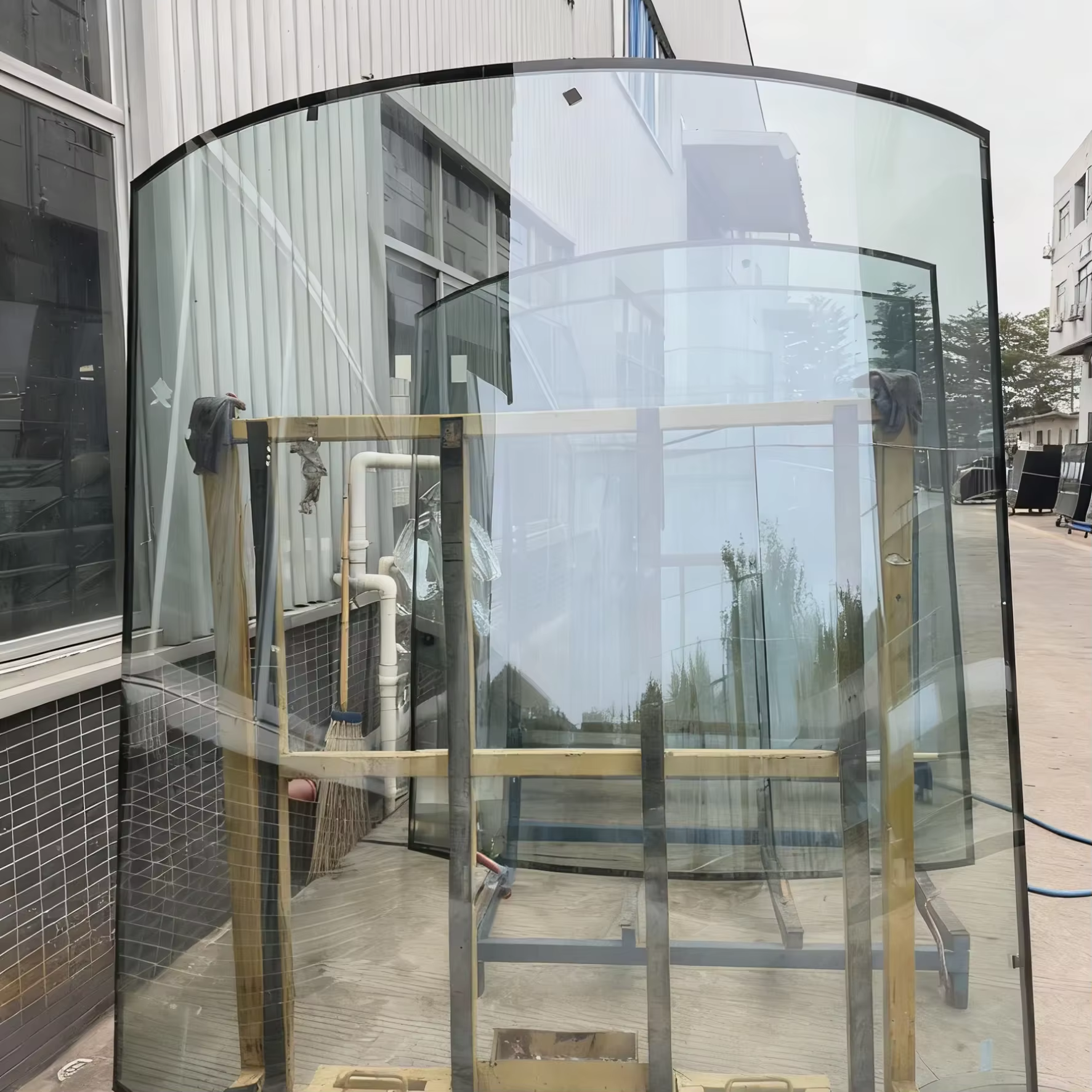
Insulating glass is a core component of energy-efficient building envelopes. Image source: DYGLASS product gallery.
The Changing Role of Building Glass
Modern facades face contradictory requirements. Architects want free-form geometry; energy regulations demand low thermal transmittance; building codes require safety glass in specific locations; and developers expect cost control. For a building glass buyer, the challenge is to translate design intent into a specification that is manufacturable, safe, and compliant. The opportunity is that processing technology has advanced considerably. A supplier with multiple production lines can take a flat glass blank through cutting, edge grinding, tempering, laminating, and insulating in one facility. This reduces coordination risk and makes it possible to produce complex products such as curved insulated glass or laminated curved glass.
Integrated Manufacturing: A Look at DYGLASS
One company that illustrates this integrated model is Shenzhen Dayang Special Glass Co., Ltd. (DYGLASS), a China-based supplier founded in 2017 and headquartered in Shenzhen, close to Hong Kong. DYGLASS operates a 30,000-square-meter production facility with approximately 130 employees and an annual production capacity of 600,000 square meters. The R&D team comprises 5 to 10 engineers, and export sales account for roughly 60% of total revenue. Key markets include the UAE, Bahrain, Saudi Arabia, the United States, the Philippines, and Vietnam.
The product portfolio covers laminated glass, toughened glass, smart glass, insulated glass, curved glass, and building glass. The company is an Alibaba Verified Supplier and has passed the SGS test report. For procurement teams, these facts matter because they indicate internal capacity, quality controls, and an established export process.
Technical Fundamentals of Building Glass
Building glass is rarely used as raw float glass. It is processed to alter strength, breakage behavior, thermal performance, acoustics, or shape. The following sections describe the most common processed glass families and their key parameters.
From a procurement perspective, the sequence of processing steps determines what is technically possible. Tempering changes the mechanical behavior; lamination adds redundancy; insulating assembly creates a thermal barrier. When these processes are combined with bending, the complexity increases but so does the design value. Understanding this chain helps buyers ask the right questions about lead times, tolerances, and testing.
Tempered Glass
Tempered glass is produced by heating float glass and then rapidly cooling it to create balanced internal stress. It is stronger than annealed glass and, when broken, disintegrates into small granules rather than sharp shards. DYGLASS's DY-GH01 tempered glass is available in thicknesses of 3mm, 4mm, 5mm, 6mm, 8mm, 10mm, 12mm, 15mm, and 19mm. The product includes flat tempered glass, curved tempered glass, and tempered glass with holes. Edge work can be polished, ground, or beveled, and light transmittance is at least 91% for clear glass.
Relevant standards include ASTM C1048, which requires a minimum surface compression of 10,000 psi (69 MPa) for fully tempered glass, and EN 12150, which specifies a fragmentation test requiring more than 40 particles in a 50mm x 50mm area. Buyers should verify which standard applies in their destination market.
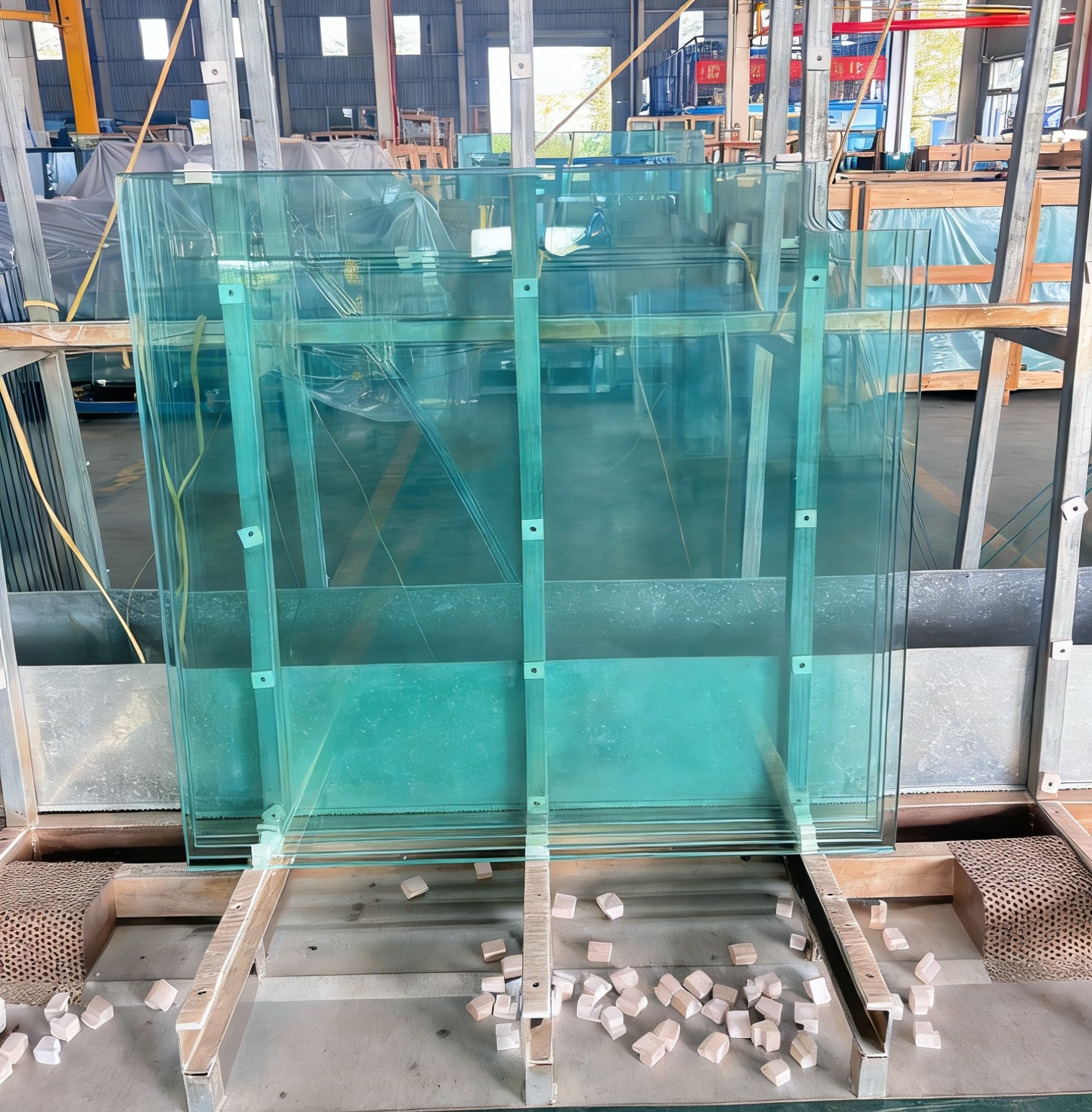
Tempered glass panels are commonly used in curtain walls, partitions, and furniture. Image source: DYGLASS product gallery.
Laminated Glass
Laminated glass is made by bonding two or more glass panes with an interlayer, typically PVB, SGP, or EVA. If the glass cracks, the interlayer holds the fragments in place, reducing the risk of injury and improving security. DYGLASS's DY-JJ01 series includes tempered laminated safety glass, bulletproof laminated glass, fire-resistant laminated glass, and curved laminated glass. Thickness ranges from 6.38mm to 50mm. Interlayer thicknesses include 0.38mm, 0.76mm, 1.14mm, 1.52mm, and 2.28mm. Glass substrates can be tempered, float, low-iron, or tinted glass. Clear laminated glass offers light transmittance of 85–92%, while tinted versions range from 10% to 70%. Acoustic insulation is typically 35–45dB. The product is used in building and construction, architecture, interior design, and other sectors where safety and acoustic performance are important.
Insulating Glass
Insulating glass units (IGUs) consist of two or more panes separated by a spacer and sealed to form a cavity. The cavity is typically filled with air or an inert gas to reduce heat transfer. DYGLASS's DY-ZK01 insulating glass is produced as tempered insulated glass, insulated glass with Low-E coating, insulated glass with argon gas, or curved insulated glass. Standard thickness configurations are 6mm+12A+6mm and 8mm+16A+8mm, with custom options. Available glass types are clear float, Low-E, tempered, and low-iron. Spacer options include aluminum and warm edge spacer, while gas fill can be air, argon, krypton, or xenon. The unit is constructed with tempered glass and an aluminum spacer. Light transmittance ranges from 70% to 89%, and sound insulation from 30 to 45dB. Typical applications are curtain walls, windows, and facade systems.
Curved and Multi-Curved Glass
Curved glass has moved beyond simple cylindrical bends. According to its company profile, DYGLASS can process any surface shape of multi-curved tempered glass, including double-curved, triple-curved, trapezoid, spherical, pyramidal, S-shape, cylindrical, and positive/negative curved forms. This process capability is relevant for landmark facades, canopies, skylights, and interior features where flat glass cannot deliver the intended form.
Smart Glass
Smart glass can change its light transmission properties in response to an electrical signal. DYGLASS includes Magic Switchable Glass in its product range. The global smart glass market was valued at approximately USD 8.2 billion in 2025, with electrochromic technology accounting for a 61.3% share. While not every project needs smart glass, it is becoming relevant for privacy, solar control, and building automation.
| Glass Family | Typical Thickness | Key Performance Indicators | Common Uses |
|---|---|---|---|
| Tempered | 3–19mm | High strength; ≥91% visible light transmittance | Curtain walls, partitions, doors, furniture |
| Laminated | 6.38–50mm | Post-breakage retention; 35–45dB acoustic insulation | Skylights, safety glazing, balustrades |
| Insulating | e.g. 6mm+12A+6mm | 70–89% VLT; 30–45dB acoustic insulation; low U-value with Low-E/gas | Windows, curtain walls, facades |
| Curved | Varies by shape | Custom geometry; can combine with tempering/laminating | Canopies, skylights, landmark facades |
| Smart | Varies | Electronically switchable transparency | Privacy glass, solar control, automation |
Application Scenarios and Project Evidence
According to DYGLASS's application data, its products are used in construction engineering, decoration engineering, and municipal engineering in China. The products are applied in the building materials and real estate sector, with typical scenarios including curtain walls, window systems, office partitions, bathrooms, and interior decoration. The company also lists special requirements such as bulletproof glass, fire-resistant glass, and special-shaped glass. Project references in the portfolio include Guangzhou Financial City, Huizhou North Railway Station, China Nano Research Institute, Nanchang East Railway Station, Bahrain International Circuit, and Doha Metro Station. These examples show how processed building glass is integrated into transport, research, and sports facilities.
Curved insulated glass, for example, combines two demanding processes—bending and sealing—in one unit. It requires precise alignment of the panes and careful control of the spacer system. This is one reason buyers should assess a supplier's production equipment rather than relying only on finished product photographs.
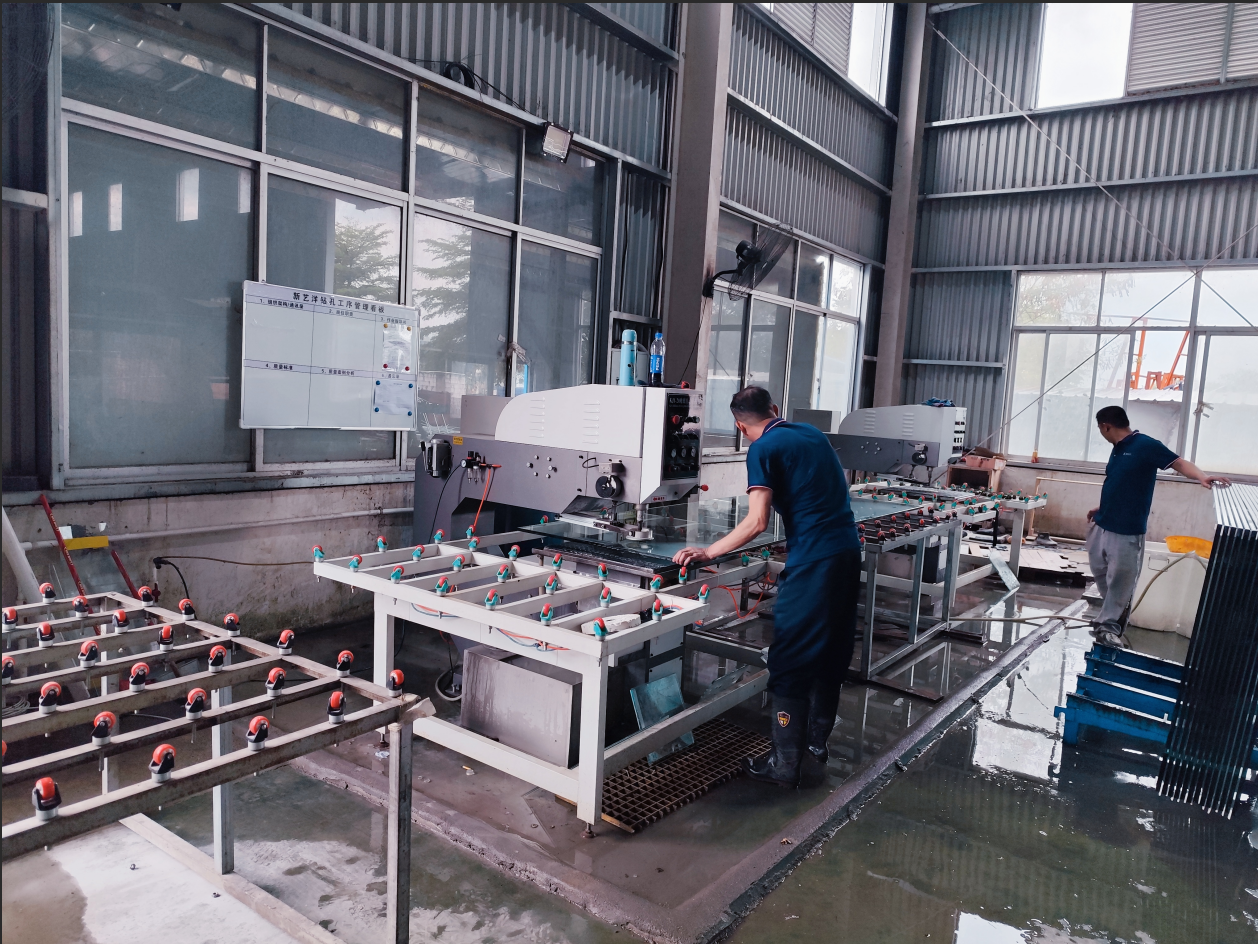
In-house drilling and edge processing support complex glass fabrication. Image source: DYGLASS facility.
Market Trends in Building Glass
Several verified industry data points frame the current market. The global construction glass market was valued at USD 119.2 billion in 2025 and is projected to reach USD 189.33 billion by 2034 (Fortune Business Insights). Architectural glass accounts for nearly 70% of global flat glass production, which exceeds 120 million metric tons annually (Business Research Insights). China's glass market was estimated at USD 31.2 billion in 2024, with expectations to grow to USD 55.0 billion by 2035 (Market Research Future). In addition, China exported USD 676 million in 'Glass with Edge Workings' in 2024, representing 22% of global exports (OEC).
These numbers point to a maturing supply chain in which processing capability, not just raw glass production, is a differentiator. Buyers are more likely to evaluate suppliers on their ability to deliver finished, high-performance glass rather than commodity sheets.
The shift toward prefabrication and systemized facades also favors suppliers that can handle multiple glass types under one roof. Instead of coordinating several subcontractors, a client can source tempered substrate, lamination, and insulating assembly from a single factory, which simplifies quality control and logistics.
Comparison with Traditional Glass Solutions
Traditional building envelopes often used monolithic annealed float glass. It is inexpensive and easy to cut, but it offers limited safety, poor thermal insulation, and no acoustic control. Processed glass—tempered, laminated, and insulating—adds material and processing steps, which increases cost and lead time. Curved and multi-curved glass further require custom tooling and careful handling.
A realistic limitation is that advanced glass is not necessary for every project. For a simple rectilinear facade, standard flat tempered or insulating glass may deliver the required performance at a lower cost. Multi-curved glass should be reserved for design-driven landmarks or areas where the geometry genuinely adds architectural value. Buyers should match the specification to the facade complexity, budget, and schedule.
Another limitation is geometric. Not all glass shapes can be tempered to the same strength because the heating and quenching process depends on the curvature. A shape that is too deep or has sharp inflection points may require alternative approaches, such as cold bending or laminated curved glass. These technical constraints should be discussed during early design stages.
Future Outlook
Energy codes will continue to tighten, pushing demand for Low-E coatings, warm edge spacers, inert gas fills, and smart glazing. Facade designs will keep exploring curved and double-curved surfaces, which means suppliers need advanced tempering lines and skilled bending capability. In this context, process transparency—being able to verify production lines, test reports, and certifications—becomes as important as product specifications.
As the market grows, documentation will become more important. Buyers will increasingly expect to see not just datasheets but also production records, third-party test reports, and traceable raw material sourcing. This is particularly true for export orders, where customs and building authorities require compliance evidence.
For international buyers, working with a manufacturer that combines in-house processing, export experience, and documented quality controls can reduce the risk of complex facade projects.
FAQ: Common Building Glass Questions
What are the main types of building glass?
Building glass is typically grouped by processing: tempered glass, laminated glass, insulating glass, curved glass, coated glass, and smart glass. Each type addresses different performance needs such as safety, security, thermal insulation, acoustic control, design flexibility, or adaptive transparency.
What is the difference between tempered glass and laminated glass?
Tempered glass is heat-treated to increase strength and, on breakage, disintegrates into small granules. Laminated glass keeps glass fragments bonded to an interlayer when broken, providing retention and improved security. The two can be combined into a single laminated tempered glass unit.
When should insulating glass be specified?
Insulating glass is typically specified for exterior windows and curtain walls where thermal performance and condensation control matter. A sealed cavity with air or inert gas reduces heat loss. Configurations can include Low-E coatings and warm edge spacers to improve energy efficiency.
What is Low-E glass and why is it important?
Low-emissivity (Low-E) glass carries a thin metal or metal-oxide coating that reflects thermal radiation while transmitting visible light. It improves the thermal efficiency of windows and facades, reducing heating and cooling loads. Low-E glass is commonly combined with laminated or insulating glass.
Can curved glass be tempered or laminated?
Yes. Curved glass can be produced with tempering and laminating processes. Some manufacturers offer complex shapes such as double-curved, S-shaped, and spherical curved glass. Shape capability should be verified with the supplier before sourcing.
What certifications should building glass meet?
Common references include ASTM C1048 for tempered glass and EN 12150 for thermally toughened soda lime silicate safety glass. Depending on the market, additional national or project-specific certifications may apply. Buyers should request test reports and certifications relevant to the destination country.
What factors affect the cost of building glass?
Cost depends on glass type, thickness, coatings, interlayers, gas fill, edge work, and shape complexity. Custom shapes, such as multi-curved glass, require additional processing and tooling. Lead times also reflect processing complexity, so early specification is important.
How should a buyer evaluate a building glass supplier?
Key evaluation criteria include product consistency, production capacity, available processing lines, quality certifications, experience with similar projects, export logistics, and communication responsiveness. Buyers can also review a supplier's application portfolio and request samples or test documentation.
For detailed product parameters and company background, DYGLASS provides a publicly available brochure: Download DYGLASS Brochure.