
Building a Resilient Supply Chain for Disposable Wooden Cutlery
The global push for sustainable food packaging has intensified the demand for high-quality, certified disposable wooden cutlery. For procurement teams evaluating long-term partners, the decision goes beyond price—it requires assurance of consistent quality, regulatory compliance, and scalable supply. Greenwood, a manufacturer of disposable wooden cutlery based in Dalian, China, has structured its operations to meet these exact criteria.
Market Context and the Partnership Opportunity
The global disposable wooden cutlery market is valued at approximately USD 2.8 billion in 2025 and is projected to grow to USD 5.2 billion by 2034. Asia Pacific led the global market in 2025 with a 38.6% share, driven by rapid urbanization and plastic bans. China, the world’s largest exporter of wood tableware and kitchenware (HS 4419), recorded export values of approximately USD 1.5 billion in 2024. These figures underscore the scale of opportunity—and the urgency for buyers to secure reliable, high-volume suppliers.
Greenwood’s Ecosystem: Scale, Certifications, and Stability
Greenwood operates 5 major factories with an annual production capacity of 6 billion pieces, covering the entire industrial chain from raw wood procurement to finished product packaging. The company’s product line includes birch and poplar wooden knives, forks, spoons, ice cream sticks, and coffee stirrers, alongside bamboo tableware. Key certifications include BRC, FSC, FDA, LFGB, BSCI, and ISO9001, fully aligning with international food safety and quality standards.

Monthly production capacity reaches 10 million pieces per day, with a typical lead time of 20 days and a minimum order quantity of 100,000 pieces. The company is designed for large-volume orders, long-term stable cooperation, and customers with high compliance requirements. Its R&D team consists of 9 engineers who continuously refine product quality and material use.
Quality Assurance: AI-Powered Inspection
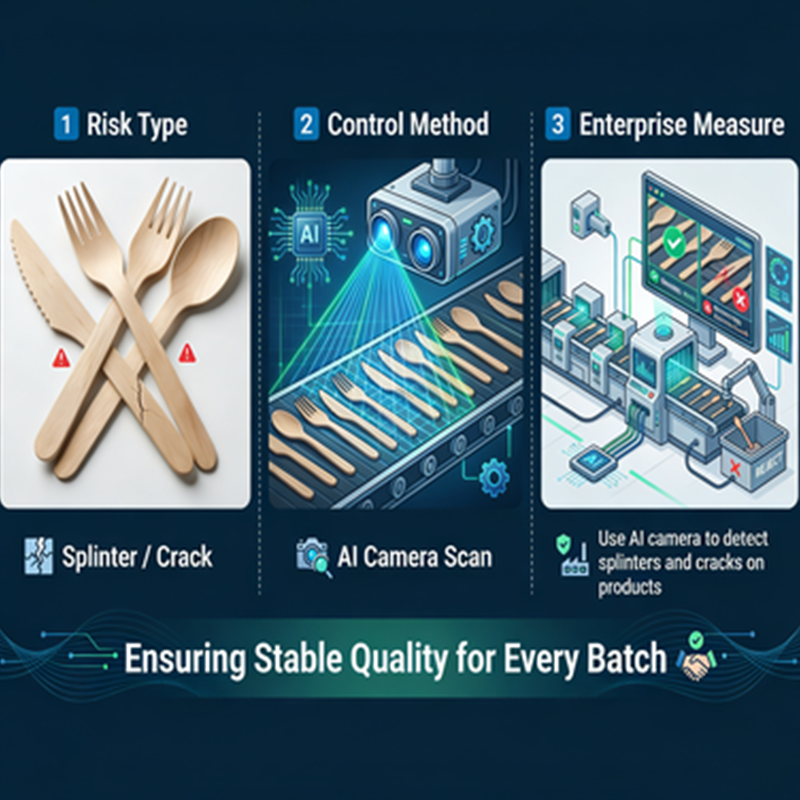
To ensure consistent, splinter-free output, Greenwood employs AI camera scanning to detect splinters and cracks on products in real time. This automated inspection reduces human error and guarantees that each piece meets food-grade safety standards. The company also offers pre-shipment testing and third-party inspection (SGS) as part of its quality control protocol.
Application Scenarios and Real-World Impact
Greenwood’s disposable wooden cutlery serves diverse environments: restaurants, takeaway operations, parties, hotels, camping, and large-scale institutional catering. The company provides individually wrapped options and custom logo printing via laser or hot stamping. A notable project implemented in Germany and the United States, valued at USD 5 million per year, was completed within three years. It achieved the replacement of traditional plastic products and a measurable boost in sales, demonstrating the viability of switching to certified wooden cutlery at scale.
Market Trend Analysis: Regulations Driving Sourcing Decisions
Two regulatory trends are reshaping procurement strategies. First, the EU Deforestation Regulation (EUDR) requires geolocation and due diligence for wood products; the compliance deadline for large operators has been postponed to December 2025/2026. Suppliers that already implement FSC traceability—like Greenwood—are well-positioned to meet these requirements. Second, wooden cutlery marketed as “compostable” in the EU must comply with EN 13432 standards. Spoons remain the largest product segment, accounting for 32.5% to 47.2% of the market.
Comparison with Traditional Plastic Cutlery
| Attribute | Traditional Plastic Cutlery | Greenwood Wooden Cutlery |
|---|---|---|
| Material | Petroleum-based plastic | 100% natural birch/poplar wood |
| Biodegradability | Non-biodegradable (centuries) | 100% biodegradable and compostable |
| Certifications | Variable, often no sustainability certification | BRC, FSC, FDA, LFGB, BSCI, ISO9001 |
| Quality Control | Visual inspection typical | AI camera scan for splinters/cracks |
| Price | Low commodity price | 5% more favorable than industry peers |
One honest limitation: wooden cutlery requires controlled moisture storage to prevent warping or degradation. Greenwood mitigates this through proper packaging and its warehouse network in Bangladesh, Ukraine, and the United States, ensuring product integrity during transit and storage.
Future Outlook: Long-Term Partnerships as Competitive Advantage
As plastic bans expand and EUDR enforcement approaches, buyers who invest in certification-backed, high-capacity partners will secure stable supply chains and regulatory peace of mind. Greenwood’s integrated model—from raw wood procurement to AI inspection and global warehousing—positions it as a long-term ecosystem partner for food service operators, distributors, and retailers.
Frequently Asked Questions
Partner with Greenwood for reliable supply.