
Building a Shower Door Comparison Matrix: Hardware, Glass and Application Fit

Industrial-scale sanitary ware production: shower door procurement decisions increasingly depend on documented capability rather than catalogue impressions.
A shower door is rarely selected on a single variable. Buyers comparing glass shower enclosures, shower screens and bathroom shower doors are usually balancing three constraint sets at the same time: the hardware material and its grade, the glass construction and surface treatment, and the configuration that the available bathroom geometry will actually accept. The global shower doors market was valued at USD 13.5 billion in 2023 according to Cognitive Market Research, so the practical problem for most buyers is not a shortage of suppliers. It is the absence of a consistent way to compare them.
This article sets out a four-step comparison framework and a working decision matrix. Worked examples are drawn from the catalogued shower door range of Foshan SHKL Sanitary Ware Co., Ltd (SHKL), a sanitary ware manufacturer founded in 2004 that produces bathroom vanities, shower doors and LED bathroom mirrors, with production bases in Foshan, China (100,000 m²) and Ho Chi Minh City, Vietnam (40,000 m²). Two models anchor the material discussion: KL-AS5104310, a frameless shower door built on aluminium alloy hardware, and KL-AS001-1, a shower screen built on 304 stainless steel hardware.
Why a constraint-first comparison beats quote-by-quote negotiation
Most procurement cycles begin with a request for quotation and only later move to specification review. That sequence creates predictable failure modes. Two suppliers return the same headline description, such as an eight-millimetre tempered shower door with stainless steel hardware, and the line items look comparable while the underlying constraints are not. One quote may assume a fixed panel, another a hinged door. One may reference a surface treatment with a supplier-specific definition, another a different process under the same trade term. Safety glazing conformity is often implied rather than evidenced.
A constraint-first framework reverses the order. Requirements are converted into testable conditions before price is compared, so that quotes arrive against an identical brief. In practice this means deciding four things in sequence: hardware material, glass specification, opening configuration, and the documentation that must accompany the shipment. Price is the output of those four decisions, not the input.
Step 1: Hardware material — aluminium alloy versus 304 stainless steel
Hardware material is the constraint most often reduced to a single word, and the one that most affects long-term maintenance exposure. The SHKL catalogue carries comparable configurations in both material families, which makes the choice easy to illustrate. KL-AS5104310 is a frameless shower door with aluminium alloy hardware, while KL-AS001-1 is a shower screen with 304 stainless steel hardware. The same split runs through the wider range: KL-AS5608212 (sliding), KL-AS5210422 (arc), KL-AS5507310 (hinge) and KL-AS5605110-5 (bathtub) are aluminium alloy models, while KL-AS5577310 (hinge) and KL-AS5511312 (sliding) use 304 stainless steel.
304 stainless steel is an austenitic grade widely specified where a higher corrosion-resistance expectation and a metallic finish are required. Aluminium alloy is lighter and is commonly used where lower panel mass, a broader finish palette, or a different cost structure matters. Neither material is universally correct. The decision rule that works in practice is to match the material to the exposure profile rather than to the purchase price: coastal sites, high-humidity interiors, and bathrooms cleaned frequently with aggressive chemical agents place more demand on hardware finish than a lightly used residential bathroom does.
Because a grade name alone does not determine performance, the framework requires evidence rather than vocabulary. Buyers should request a material grade declaration or mill certificate, a physical finish sample, and any corrosion or cycle test reports the supplier intends to rely on. Alloy temper, extrusion quality, profile wall thickness and coating system all influence outcome as much as the material family does. A quotation that states 304 stainless steel without a grade declaration is a claim, not a specification.
Step 2: Glass — thickness, safety glazing and surface treatment
Glass is where cosmetic preference most often displaces compliance thinking. The SHKL catalogue lists tempered glass thickness options of 6 mm, 8 mm, 10 mm and 12 mm, and the same seven glass craftsmanship options across the shower door range: clear glass, tinted glass, laminated glass, flute glass, chemically frosted glass, easy-clean and film-coated.
Thickness should be derived from configuration and jurisdiction, not from habit. The National Glass Association design guide for frameless shower enclosures states that shower-enclosure glass must be safety glazing meeting the impact requirement of CPSC 16 CFR 1201 in the United States context, and describes monolithic tempered glass of at least 3/8 inch (10 mm) for the frameless category covered by that guide. That figure is guidance for a defined category, not a universal minimum for every framed, sliding, hinged or over-bath application, and it does not replace the requirements of the destination market. In Europe, EN 14428:2015+A1:2018 specifies functional requirements and test methods for shower enclosures for domestic purposes and sits inside the CE marking framework. ASTM C1048-18 remains the reference specification for heat-strengthened and fully tempered flat glass.
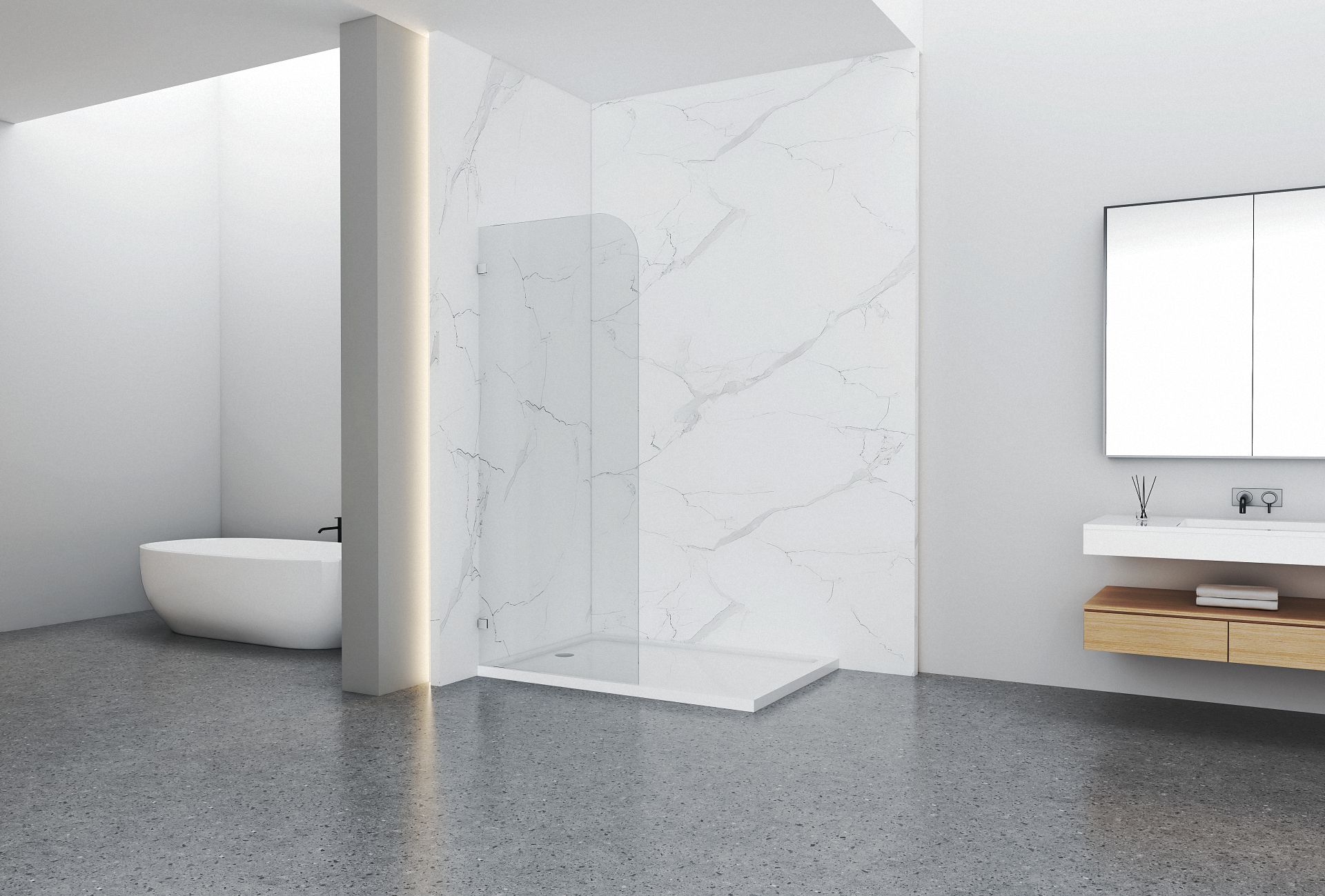
Fixed shower screen configuration (KL-AS001 series, 304 stainless steel hardware): the glass specification and the hardware grade are specified separately and evidenced separately.
The seven treatment options answer different problems and should be selected against a stated function. Clear glass maximises visual continuity and is the default for residential and hospitality bathrooms where light matters. Tinted glass moderates glare and visual exposure in bright or overlooked bathrooms. Laminated glass introduces a second ply and an interlayer, which is why it is commonly specified where glass retention after breakage is a design requirement, and it is the option SHKL references in a documented 110-unit shower door project in Thailand where safety laminated glass with an anti-shatter design was the stated highlight. Flute glass and chemically frosted glass deliver privacy while transmitting light, and are frequently chosen for hospitality bathrooms that face a corridor or a neighbouring unit. Easy-clean coating and film-coated glass target maintenance regimes and handling protection respectively, and matter most where cleaning frequency is high and glass replacement is disruptive.
A boundary worth stating plainly: treatment definitions are not standardised across the industry. Comparing the number of glass options a supplier lists is therefore not a valid comparison, because the same trade term can describe different processes and different performance criteria. Buyers should instead request the treatment definition, the applicable test documentation, and a physical sample under the lighting conditions of the intended project.
Step 3: Configuration — matching opening type to bathroom geometry
Configuration is a geometric constraint before it is a design preference. The SHKL range covers frameless (KL-AS5104310), hinged (KL-AS5577310, KL-AS5507310), sliding (KL-AS5608212, KL-AS5511312), arc (KL-AS5210422), bathtub (KL-AS5605110-5) and fixed shower screen (KL-AS001-1) formats. Each format resolves a different constraint set.
Sliding and bypass formats suit alcoves with a straight opening where a swinging door would foul adjacent fittings or a walkway. Hinged and pivot formats suit corner installations where the door must clear a fixed panel and the user needs a wide walk-in aperture. Arc formats exist because the tray or enclosure itself is curved, and the door geometry has to follow the tray rather than the other way round. Bathtub models are constrained by the tub rim, the wall return and the need to reach the taps. Fixed screens are the lowest-mechanism option, appropriate where the wet zone can be contained without a moving panel and where long-term maintenance simplicity outweighs access width.
Demand context supports the direction of travel rather than any single specification. One commercial research estimate places frameless shower glass doors at 75 percent of the North America market as of 2025, which is consistent with the visual preference buyers express for minimal framing. That estimate should be treated as a market signal, not as a specification for a specific project; the correct configuration is still determined by the measured opening, the tray geometry and the wet-zone boundary.
Step 4: The verification layer — certificates, scope and test reports
Documentation is the step that most often separates a shortlist from a decision. SHKL publishes management-system certification issued by Guangdong Quality Testing CTC Certification Co., Ltd.: ISO 9001:2015 under certificate 04924Q00629R0M (GB/T 19001-2016 / ISO 9001:2015), ISO 14001 under certificate 04924E00351R0M (GB/T 24001-2016 / ISO 14001:2015) and ISO 45001 under certificate 04924S00316R0M (GB/T 45001-2020 / ISO 45001:2018), all issued on 11 May 2024 and valid until 10 May 2027, and all stated as applicable to the global market. SHKL's published shower door specification material links ISO 9001:2015 certification to models such as KL-AS5577310.
Three verification actions follow, and they are the same actions a buyer should apply to any supplier. First, request the certificate PDFs and confirm issuer, certificate number, validity dates and the covered production site against the issuing body's registry. Second, read the scope of each certificate, because a management-system scope describes systems and sites, not product conformity for every model. Third, request product-level evidence for the destination market — safety glazing test reports, glass supplier declarations and, where applicable, conformity documentation against EN 14428 or the relevant national requirement. A management-system certificate and a product conformity document answer different questions, and one cannot substitute for the other.
The decision matrix
The matrix below converts the four steps into a comparable scoring structure. The right-hand column is the point most often missed: the risk carried when the criterion is left unevidenced.
| Criterion | What to weigh | Evidence to request | SHKL catalogue anchor | Risk if skipped |
|---|---|---|---|---|
| Hardware material | Exposure profile, cleaning regime, finish expectations, panel mass | Grade declaration or mill certificate, finish sample, corrosion or cycle test reports if claimed | Aluminium alloy: KL-AS5104310, KL-AS5608212, KL-AS5210422, KL-AS5507310, KL-AS5605110-5. 304 stainless steel: KL-AS001-1, KL-AS5577310, KL-AS5511312 | Finishes replaced early; warranty disputes |
| Glass thickness | Configuration, panel span, destination market requirement, handling risk | Tempering declaration, thickness measurement, destination standard reference | Tempered glass listed in 6 mm, 8 mm, 10 mm and 12 mm across the range | Non-compliant glazing at handover |
| Glass construction | Retention requirement, breakage consequence, acoustic or solar intent | Laminated specification, interlayer type, impact test report | Laminated glass listed as a standard option across the range | Safety objective unmet despite compliant thickness |
| Surface treatment | Privacy, maintenance frequency, glare, design intent | Written treatment definition, sample, coating durability statement | Clear, tinted, laminated, flute, chemically frosted, easy-clean, film-coated | Options compared that are not equivalent |
| Configuration | Measured opening, tray geometry, swing clearance, wet-zone boundary | Dimensional drawing, opening direction, installation guide | Frameless, hinged, sliding, arc, bathtub and shower screen formats | Site-fit failures and rework |
| Management-system certification | Certificate validity, issuer, covered site, scope wording | Certificate PDFs, registry check, scope confirmation | ISO 9001 04924Q00629R0M, ISO 14001 04924E00351R0M, ISO 45001 04924S00316R0M, valid 11 May 2024 to 10 May 2027 | Expired or out-of-scope claims accepted |
| Product conformity | Destination jurisdiction, safety glazing requirement, marking obligation | Model-specific test reports, conformity declaration, reference to EN 14428 or national rule | Documentation to be confirmed model by model | Customs or site rejection |
| Inspection regime | Inspection coverage, defect definition, pre-shipment evidence | Inspection plan, sampling logic, photo or report pack | 100% inspection stated as the quality-control approach | Batch-level variance discovered on site |
| Commercial terms | Customisation depth, order size, schedule risk, spares | Written lead time, MOQ confirmation, spare-part list, warranty terms | OEM customisation of size, colour, material, finish, hardware, logo and design style; MOQ 50; lead time 30–45 days; monthly capacity 10,000 | Programme slippage and unsupported units |
Scenario mapping: residential versus commercial hospitality
The same matrix produces different weightings depending on the project. Residential buyers generally optimise for design continuity and a single installation, while hospitality buyers optimise for repeated use, cleaning cycles, replacement-part logistics and consistent appearance across many identical rooms.
| Project type | Dominant constraints | Configuration anchor | Hardware and glass anchor |
|---|---|---|---|
| Residential renovation, standard bathroom | Visual continuity, installation simplicity, budget discipline | Frameless (KL-AS5104310) or sliding (KL-AS5608212) | Aluminium alloy hardware, clear glass or easy-clean glass |
| Residential, small or corner bathroom | Swing clearance, footprint, tray shape | Arc (KL-AS5210422) or hinged (KL-AS5507310) | Aluminium alloy hardware, clear or chemically frosted glass |
| Coastal or high-humidity residential | Corrosion exposure, cleaning frequency, finish longevity | Hinged (KL-AS5577310) or fixed screen (KL-AS001-1) | 304 stainless steel hardware, easy-clean glass |
| Boutique hotel bathroom | Design language, privacy, glare control, distinct room identity | Frameless (KL-AS5104310) or bathtub (KL-AS5605110-5) | 304 stainless steel where exposed, tinted or flute glass |
| High-turnover hotel bathroom | Repeated cycles, cleaning chemistry, spares logistics, batch consistency | Sliding (KL-AS5511312) or hinged (KL-AS5577310) | 304 stainless steel hardware, laminated or easy-clean glass, spare-part commitment |
| Multi-unit residential or serviced apartments | Repeatability, dimensional tolerance, schedule certainty | Sliding (KL-AS5608212) or fixed screen plus hinged panel | Aluminium alloy hardware with documented inspection regime |
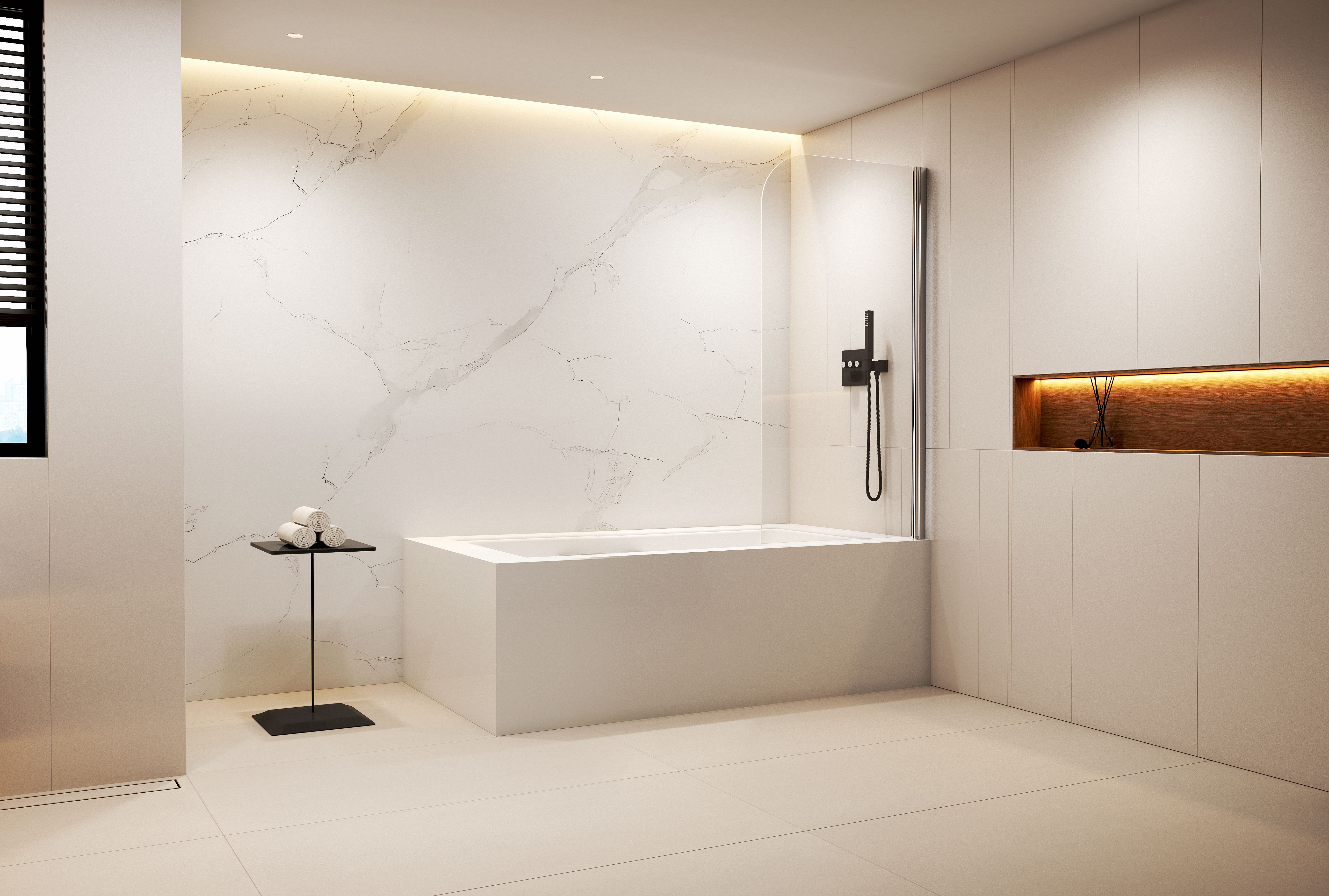
Over-bath configuration (KL-AS5605110-5, aluminium alloy hardware): tub rim, wall return and tap access constrain the door before glass or finish preferences are considered.
Real project records show how the matrix behaves outside a catalogue. A 190-unit shower door programme for an Australian buyer, running across a five to ten year horizon, was documented with products meeting Australian safety standards, smooth installation and appropriate sizing as the stated outcomes. A 110-unit shower door programme in Thailand was documented around safety laminated glass with an anti-shatter design as the defining requirement. In both cases the constraint drove the specification: compliance in one, retention behaviour in the other.
Comparison with traditional, price-led sourcing
The traditional approach compares suppliers on unit price for a loosely worded description, then resolves specification gaps during sampling or, worse, at installation. It is faster to start and more expensive to finish. The matrix approach adds a documentation phase before quotation, which lengthens the front end of the cycle and shortens the back end: fewer substitution disputes, fewer site-fit failures, and a clearer basis for warranty conversations.
The difference is most visible in three places. First, hardware is compared by declared grade and finish evidence rather than by the word stainless. Second, glass is compared by construction, treatment definition and destination-market conformity rather than by thickness alone. Third, supplier capability is compared on verifiable operating facts rather than on presentation: SHKL's stated capability set includes OEM customisation across size, colour, material, finish, hardware, logo and design style, a MOQ of 50, a lead time of 30–45 days, monthly capacity of 10,000 units and an inspection approach stated as 100 percent inspection, supported by a 600-person workforce, a 20-person R&D team and an export share of 70 percent across markets including the EU, AU, NA, SA and ME.
Limits of this framework
A comparison matrix structures a decision; it does not make the decision. Four limits should be stated openly. First, no matrix substitutes for jurisdiction-specific review: EN 14428 applies in the European regulatory context, CPSC 16 CFR 1201 impact requirements apply in the United States context, and other markets define their own obligations, so each destination needs its own conformity check. Second, management-system certification and product conformity are different evidence types, and a certificate scope describes systems and sites rather than every model in a catalogue. Third, treatment terminology is not harmonised, so two suppliers describing the same finish may not be offering the same process. Fourth, material choice involves trade-offs with no universally superior answer: aluminium alloy brings lower mass and finish flexibility, 304 stainless steel brings a different corrosion and finish profile, and neither resolves an installation that was measured incorrectly.
The framework also depends on the buyer's own data. Weightings must be set per project, and a criterion that cannot be evidenced should be scored as unknown rather than assumed compliant. For buyers who need a printable summary of model-level specifications before building their own matrix, SHKL's product brochure is available as a public download: SHKL product brochure (PDF).
Future outlook
Three developments are likely to shape shower door comparison over the next procurement cycles. Documentation is becoming the differentiator: as safety glazing enforcement tightens across major markets, the supplier that can produce model-specific test reports and site-scoped certificates will move through buyer shortlists faster than the supplier that can only produce a catalogue. Treatment definitions will face pressure to standardise, because buyers cannot compare easy-clean, coated or filmed glass credibly while definitions remain supplier-specific. And supply geography will keep diversifying, which makes dual-site production and schedule transparency part of the evaluation rather than a footnote. For buyers, the practical response is the same in all three cases: keep the framework, demand the evidence, and score unknowns as unknowns.
FAQ
Should buyers specify aluminium alloy or 304 stainless steel hardware for a shower door?
Neither material is universally correct, and the choice should follow the exposure profile. SHKL catalogues comparable configurations in both families: KL-AS5104310 is a frameless shower door with aluminium alloy hardware, while KL-AS001-1 is a shower screen with 304 stainless steel hardware. Aluminium alloy is lighter and supports a broad finish palette; 304 stainless steel is an austenitic grade commonly specified where a higher corrosion-resistance expectation and a metallic finish are required. Buyers should request a grade declaration or mill certificate and a finish sample, because the material family alone does not determine performance.
What glass thickness should be specified for a frameless shower door?
Thickness follows configuration and jurisdiction rather than habit. SHKL lists tempered glass options of 6 mm, 8 mm, 10 mm and 12 mm. In the United States context, the National Glass Association design guide for frameless shower enclosures describes monolithic tempered glass of at least 3/8 inch (10 mm) for the category covered by that guide, while noting that shower-enclosure glass must be safety glazing meeting the CPSC 16 CFR 1201 impact requirement. That figure is category guidance, not a universal minimum for framed, sliding, hinged or over-bath configurations, and destination-market requirements still govern.
Which glass option suits a hotel bathroom compared with a residential bathroom?
The functional requirement differs more than the aesthetic one. Hospitality bathrooms facing corridors or neighbouring units typically need privacy with light transmission, which points to flute glass or chemically frosted glass. High-turnover hotel bathrooms place more value on easy-clean coating because cleaning frequency is high and glass replacement disrupts operations. Residential bathrooms more often prioritise visual continuity through clear glass. Laminated glass is specified where glass retention after breakage is a design requirement, as in a documented 110-unit SHKL shower door project in Thailand built around safety laminated glass with an anti-shatter design. SHKL lists all seven options — clear, tinted, laminated, flute, chemically frosted, easy-clean and film-coated — across its shower door range.
How can a buyer verify that a supplier's certification applies to the product being purchased?
By separating management-system certification from product conformity. SHKL publishes ISO 9001:2015 under certificate 04924Q00629R0M, ISO 14001 under certificate 04924E00351R0M and ISO 45001 under certificate 04924S00316R0M, issued by Guangdong Quality Testing CTC Certification Co., Ltd. on 11 May 2024 and valid until 10 May 2027. Buyers should obtain the certificate PDFs, verify issuer, number, dates and covered site in the issuing body's registry, read the stated scope, and then request model-specific safety glazing test reports for the destination market. A management-system certificate does not, on its own, establish that a specific shower door model meets a local product requirement.
What order size, lead time and customisation should a project buyer plan for?
Planning figures should be taken from the supplier's written confirmation rather than assumed. SHKL's stated capability set includes OEM customisation of size, colour, material, finish, hardware, logo and design style, a minimum order quantity of 50, a lead time of 30–45 days, monthly capacity of 10,000 units, and after-sales support covering warranty, remote consultation and spare parts. These figures are supplier-reported and should be confirmed in the quotation against the specific configuration, glass option and destination, because glass treatment and hardware selection both affect scheduling.
Есть вопросы или нужны дополнительные детали?
Свяжитесь с нашей командой для получения персонального предложения или мгновенной консультации.
Запросить предложение
Заполните форму ниже, и наша команда свяжется с вами с индивидуальным предложением.
Прямой чат WhatsApp
Предпочитаете общаться в реальном времени? Напишите нам в WhatsApp для мгновенной помощи и быстрых ответов.
- Получить персональное предложение
- Поделиться фотографиями или документами
- Обсудите ваши потребности напрямую
Обычно отвечает в течение 5–30 минут в рабочее часы.