
Building a Tender-Ready Chandelier Compliance Dossier
Building a Tender-Ready Chandelier Compliance Dossier
A tender-ready compliance dossier for a custom-made hotel lobby chandelier is not one certificate, and it is not a folder of every PDF a supplier owns. It is a short, structured document set in which each file answers one specific question that a hotel owner, operator or design consultant will ask during tender review. Submissions rarely fail because a supplier has nothing to send. They stall because three different kinds of evidence are mixed together: product safety conformity, restricted-substance conformity, and management-system certification.
For a bespoke suspended fixture in a double-height lobby, a banquet hall or a high-ceiling atrium, procurement teams usually need all three types — but for different reasons, at different review stages, and with different limits on what each one can prove. This reference sets out how that evidence is organised for the yz10002 hotel lighting range from YZ ART LIGHT (Zhongshan YZ ART LIGHT Co.,Ltd.), and what hotel buyers should request before the submission deadline rather than during a clarification round.
Why tender reviews stall on documentation, not on design
Design intent for a lobby chandelier is usually resolved early. The hard part arrives when the package moves from the interior designer's concept to the owner's technical reviewer, who has to verify that the fixture offered is a compliant fixed luminaire rather than an artistic object with a lamp inside it. At that point, three questions appear in sequence.
First, is the electrical construction of this specific fixture type supported by product safety evidence? Second, are the materials restricted under substance-regulation rules addressed by test evidence? Third, is the manufacturer's production system stable enough for the factory to repeat the same result across the whole order, including spares and later replacement units? A single ISO certificate cannot answer the first two questions, and a single CE document cannot answer the third. When a dossier treats them as interchangeable, the reviewer either rejects the package or raises a clarification that pushes the award date.
The practical answer is to organise the dossier so that each document sits in one layer, with its scope, issuer, standard list and validity dates visible on the same page as the document itself.
Three layers that answer three different questions
For commercial decorative lighting in hospitality projects, the dossier separates cleanly into a product layer, a materials layer and a system layer. The product layer contains the Low Voltage Directive conformity evidence for the fixed luminaire. The materials layer contains the RoHS conformity evidence with its test-method list. The system layer contains the ISO management-system certificates, which describe how the factory is run rather than what the fixture is.
A fourth, non-certification layer sits alongside them: the manufacturer's qualification certificates, bidding documents and project portfolio. These are commercial and capability records, not conformity records, and they belong in a different tab of the submission. Keeping that boundary visible is what makes a dossier readable in a fifteen-minute review.
Layer one: LVD-CE Verification of Conformity for the fixed luminaire
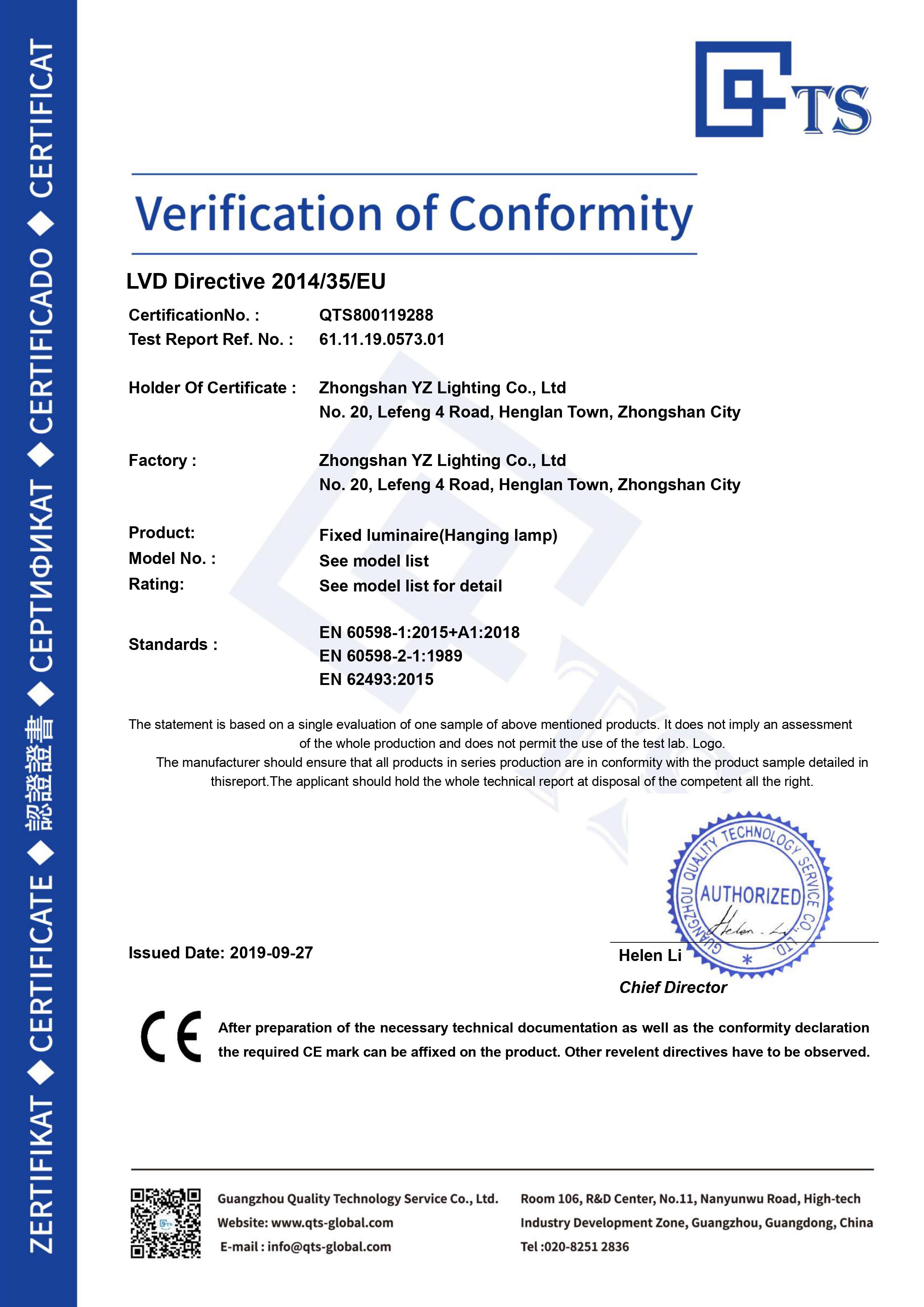
The core product-safety document is a Verification of Conformity issued by Guangzhou Quality Technology Service Co., Ltd. (QTS), certificate number QTS800119288, with Test Report Ref. No. 61.11.19.0573.01. It is stated for the EU market, and its scope is a fixed luminaire (hanging lamp) — which is the correct category for a suspended hotel chandelier. The certificate records an issue date of 2019-09-27 and an expiry date of 2028-09-02.
Three standards are listed, and each does a distinct job:
- EN 60598-1:2015+A1:2018 — the general requirements and tests for luminaires, which set out construction, wiring, insulation, thermal behaviour and protection-against-electric-shock expectations for luminaires generally, including the amendment incorporated in 2018.
- EN 60598-2-1:1989 — the particular requirements for fixed general purpose luminaires, which apply the general requirements to fixtures that are permanently fixed in place rather than portable.
- EN 62493:2015 — the assessment of lighting equipment in relation to human exposure to electromagnetic fields.
The value of this combination is that it addresses both the generic safety of the luminaire and the specific installation condition of a fixed hanging fixture, while adding the electromagnetic-field assessment that a reviewer may otherwise raise separately. If a submission contains only the general standard and no fixed-luminaire particular requirement, expect a clarification.
How to read the fields, not just the logo
Reviewers should read four fields before the certificate number. The scope line tells you which product category was assessed — here a fixed luminaire (hanging lamp). The standard block tells you which tests were applied. The issue date and report reference allow a test house to trace the underlying report. The expiry date tells you whether the document is still live at the tender submission date.
Because the issue date (2019) and the validity end date (2028) are far apart, a sensible buyer asks one further question in writing: whether the certificate and its test report still describe the construction being ordered. That is not an accusation; it is a configuration check, and it is exactly the kind of question a hotel project's technical reviewer is paid to ask.
Layer two: CE-RoHS certificate QTS800519289 and the IEC 62321 method set
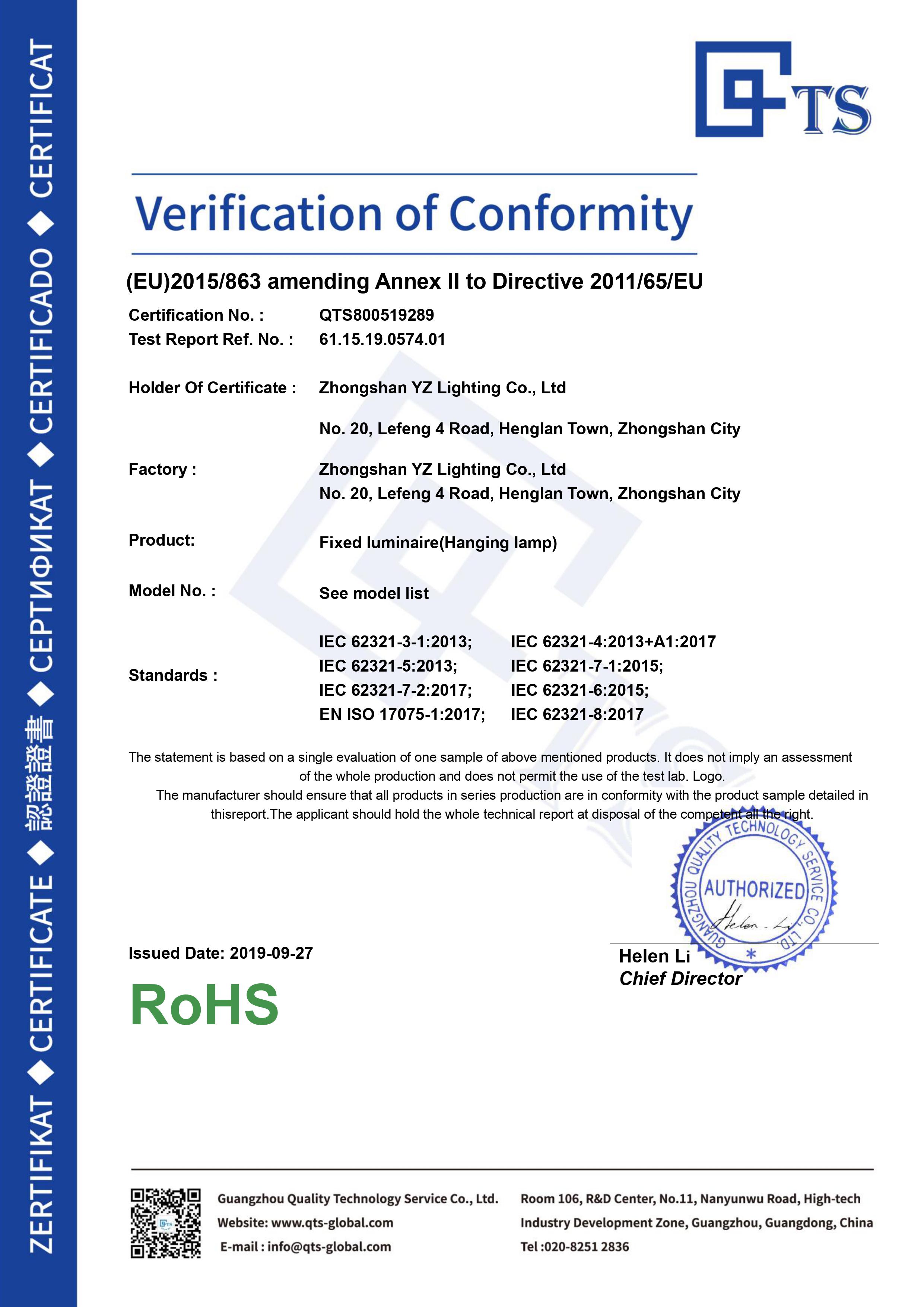
Substance compliance is a separate file with a separate logic. The CE-RoHS Verification of Conformity here is certificate number QTS800519289, Test Report Ref. No. 61.15.19.0574.01, again issued by Guangzhou Quality Technology Service Co., Ltd. (QTS) and stated for the EU market. Its scope matches the safety document: a fixed luminaire (hanging lamp). The issue date is 2019-09-27 and the expiry date is 2028-09-27 — a slightly later end date than the LVD document, which is why the two should be tracked separately rather than assumed to share one validity period.
The standard block is the part reviewers skim and should not. It lists eight referenced methods: IEC 62321-3-1:2013; IEC 62321-4:2013+A1:2017; IEC 62321-5:2013; IEC 62321-6:2015; IEC 62321-7-1:2015; IEC 62321-7-2:2017; IEC 62321-8:2017; and EN ISO 17075-1:2017. These belong to the IEC 62321 series on the determination of certain substances in electrotechnical products, together with a supplementary method reference. Their function is to identify which analytical route the laboratory used — screening by X-ray fluorescence, elemental analysis by techniques such as ICP, and the specific methods for particular substance families are not interchangeable, and a reviewer who knows the series will look at whether the listed parts cover the materials actually present in the fixture.
For the buyer, the practical reading is simple. The RoHS file answers one question — restricted substances — and answers it for the same product scope as the safety file. It does not demonstrate electrical safety, it does not demonstrate photometric performance, and it does not demonstrate that the production process is controlled. Those belong to the other two layers.
One useful rigour point: because the certificate lists a defined method set, a buyer with an unusual material specification — an unusual surface finish, an added textile or leather element, a mixed-material assembly — should ask the manufacturer or the test house to confirm that the method set remains appropriate for the configuration ordered. Asking does not weaken the dossier; it shows the reviewer understood it.
Layer three: ISO 9001, ISO 14001 and ISO 45001 issued by ZTZL
The management-system layer is where most confusion occurs, because these certificates carry familiar logos and are easy to over-read. All three in this dossier are issued by Zhongtai Zhilian Certification (ZTZL) and share an issue date of 2025-09-03 and an expiry date of 2028-09-02.
- ISO 9001 quality management system — certificate ZTZL28025Q1464R0S, standard GB/T 19001-2016 / ISO 9001:2015, scope: production of fixed-type lamps and portable-type lamps within the valid CCC scope. The certificate is stated as applicable for worldwide business, with specific applicable countries and limitations to be confirmed.
- ISO 14001 environmental management system — certificate ZTZL28025E0851R0S, standard GB/T 24001-2016 / ISO 14001:2015, scope: environmental-management activities for the production of fixed fixtures and portable fixtures within the scope of valid CCC. Stated as applicable to export and global sales, with specific countries and limitations to be confirmed.
- ISO 45001 occupational health and safety management system — certificate ZTZL28025S0801R0S, standard GB/T 45001-2020 / ISO 45001:2018, scope: occupational health and safety management activities for the production of fixed fixtures and portable fixtures within the scope of valid CCC. Same market statement and confirmation caveat.
What these three certificates do not establish
None of the three certifies that a lobby chandelier is electrically safe, and none replaces the LVD-CE or RoHS files. What they show is that the production site operates a documented quality system covering fixed and portable lamp production, an environmental management system for the same production activities, and an occupational health and safety system for those activities. For a hotel project, that translates into repeatability: incoming material control, in-process inspection and final testing that are defined rather than improvised.
The scope wording also matters. These certificates describe production activities within the valid CCC scope and are stated as applicable to global sales with country-specific limitations to be confirmed. A diligent submission does not hide that qualifier; it states it, and lets the buyer confirm applicability for the destination market rather than discovering the gap later.
Document matrix: what each file answers
The table below is the one-page summary that belongs at the front of a tender submission. Its purpose is to stop a reviewer from asking a management-system certificate to do a product-safety job.
| Document | Issuer / number | Stated scope | Question it answers | What it does not establish |
|---|---|---|---|---|
| LVD-CE Verification of Conformity | QTS, QTS800119288 | Fixed luminaire (hanging lamp), EU | Is the fixture type supported by safety testing to EN 60598-1, EN 60598-2-1 and EN 62493? | Substance compliance, factory process control, photometric output |
| CE-RoHS Verification of Conformity | QTS, QTS800519289 | Fixed luminaire (hanging lamp), EU | Are restricted substances addressed, and by which IEC 62321 methods? | Electrical safety, durability, system stability |
| ISO 9001 certificate | ZTZL, ZTZL28025Q1464R0S | Production of fixed-type and portable-type lamps within valid CCC scope | Is production governed by a documented quality system? | Conformity of any individual fixture |
| ISO 14001 certificate | ZTZL, ZTZL28025E0851R0S | Environmental-management activities for fixed and portable fixture production | Are environmental aspects of production managed under a system? | Product material content, market certification |
| ISO 45001 certificate | ZTZL, ZTZL28025S0801R0S | Occupational health and safety management activities for the same production scope | Are site health and safety risks managed under a system? | Installation safety at the hotel, product conformity |
| Qualification certificates, bidding documents, project portfolio | Manufacturer | Company and project capability | Can this supplier execute and document a project of this scale? | Any conformity claim in the product layers |
Mapping the dossier to hotel lighting model yz10002
The certification set is linked to the yz10002 hotel lighting range, which covers chandeliers, art glass chandeliers, wall lamps, floor lamps, table lamps and outdoor lights, with parameters provided per series or custom order. That range-level structure has a direct consequence for dossier work, and it is the point most often missed in a tender submission.
The LVD-CE and RoHS certificates are scoped to a fixed luminaire (hanging lamp). That is the right scope for a lobby or banquet hall chandelier, which is fixed in place and suspended. It is not the same product category as a portable table lamp or floor lamp in a guest room package. The ISO 9001 scope, by contrast, explicitly covers production of both fixed-type and portable-type lamps. A reviewer who notices that difference is not being difficult; they are checking that each item in the package is supported by the evidence that applies to it.
The practical instruction for a hotel project that mixes a chandelier with table, wall and floor lamps is therefore to ask, in writing, which conformity evidence covers the portable items, rather than assuming the hanging-lamp certificate covers the whole lighting package. This is a normal clarification, and a supplier who can answer it precisely is demonstrating the document control the ISO layer is supposed to describe.
The second mapping point is customisation. Where dimensions, materials, colour temperature, finish, mounting structure, dimming or lampshade material are altered for a bespoke chandelier, the dossier should state which evidence remains applicable to the altered configuration and which items require project-specific confirmation. For oversized lobby chandeliers in high-ceiling spaces, structural load calculation, sample approval and installation guidance sit alongside the certificates as project documents — they are not conformity certificates, and they should be filed as a separate, clearly labelled set.
What hotel buyers should request before tender submission
The following request list can be sent to a shortlisted decorative lighting manufacturer at the research stage, before the bid is finalised, so that the response arrives as a dossier rather than as a set of attachments across several emails.
- The LVD-CE Verification of Conformity, complete and unredacted on the fields that matter — certificate number, test report reference, issuing body, scope, standard list, issue date and expiry date, shown on one page.
- The CE-RoHS Verification of Conformity with the full method list, so the reviewer can see which IEC 62321 parts were applied, and a statement that the scope matches the fixture type being ordered.
- The three ISO certificates with scope wording and validity dates intact, plus a one-line statement of which production site and which product categories they cover.
- Written confirmation of applicability to the ordered configuration — including any custom size, wattage, colour temperature, dimming system, material substitution or suspension change.
- A statement of which evidence applies to non-hanging items in the package, such as guest room table lamps and floor lamps, which sit outside a fixed-luminaire scope.
- The manufacturer's qualification certificates, bidding documents and project portfolio, filed as the capability layer rather than blended into the conformity layer.
- Quality and delivery records that connect to the system certificates — for example, the pre-shipment inspection routine and the quality-approval checklist that accompanies each order.
- Date-checked validity at the submission date and at the expected handover date, because a certificate that is live today may not be live when the project completes.
Suppliers who work regularly with hotel tenders tend to answer most of this without prompting. In this case, the supporting commercial records include a standard lead time of 30–40 working days, a minimum order of one piece, and 100% full inspection before shipment with a quality-approval checklist attached — details that give the management-system certificates something concrete to refer to.
Where the dossier matters most: lobby, banquet hall and high-ceiling applications
Documentation intensity follows installation complexity. A guest room bedside lamp is low-risk and low-visibility. A suspended chandelier over a hotel lobby atrium is neither: it is fixed, it is large, it is installed at height, and it is the first object a guest sees on arrival. That is why hotel lobby chandeliers, banquet hall chandeliers and double-height atrium installations attract the most document requests from owners and their consultants.
For these applications, the dossier also functions as a design-coordination tool. When the fixture is custom-made to match a specific ceiling condition, the package needs to show which parameters are fixed by certification scope and which are project variables to be confirmed at shop-drawing stage. A banquet hall chandelier with an unusual suspension arrangement can be fully compliant as a luminaire type while still requiring a separate structural check for the specific ceiling interface — two different documents, two different reviewers.
The same logic applies across the wider decorative lighting scope: modern luxury lighting for a five-star hotel lobby, designer hotel lighting for a club lounge, or large project chandeliers for a convention hotel. The certified product category stays constant; the project-specific engineering package changes.
Complete dossier versus claims-only submission
The difference between a strong and a weak submission is rarely the number of logos. It is whether each claim can be traced to a document with a scope, an issuer, a standard reference and a validity date. A claims-only packet typically offers general statements such as "CE certified" or "ISO factory" without attaching the underlying certificate pages, without naming the issuing body, and without showing scope.
A document-led packet does the opposite. It names the certificate number, the test report reference and the standards, then states plainly what the document does and does not cover. For a hotel buyer in the evaluation stage, that transparency is more useful than an unqualified assurance, because it lets the reviewer close the file instead of opening a clarification thread. It also protects the supplier: a dossier that declares its own boundaries cannot later be accused of overstating coverage.
Boundaries: where the evidence stops
Stated honestly, the limits of this document set are as follows. The product-level certificates cover a fixed luminaire (hanging lamp) for the EU market; they are not a universal market approval for every destination, and the ISO certificates themselves note that specific applicable countries and limitations should be confirmed. Parameters for the yz10002 range are provided per series or custom order, so dimensions, wattage and colour temperature require model-level confirmation rather than inference from a range description. Custom configurations require the applicability statement described above. And no certificate in this set replaces the project's own site requirements: ceiling load verification, electrical connection by qualified personnel, commissioning checks and acceptance testing remain the project team's responsibility.
A reviewer who understands these boundaries will use the dossier correctly: as evidence of a controlled product type and a controlled production system, not as a guarantee of installation outcomes.
Outlook: documentation as a selection criterion
Where a hotel operator's procurement manual requires document-level traceability, the dossier stops being an administrative appendix and becomes part of the technical evaluation. The practical consequence for decorative lighting suppliers is that certificate management becomes a product feature: knowing which document covers which fixture category, keeping validity periods visible, and being able to state scope limits in one sentence. For buyers, the consequence is simpler. Asking for the structured set at the research stage costs one email and typically shortens the evaluation stage, because the questions that would otherwise appear after award are answered before the bid is compared.
Frequently asked questions
What documents belong in a hotel chandelier compliance dossier?
A complete set contains three conformity layers plus one capability layer. The conformity layers are the LVD-CE Verification of Conformity for the fixed luminaire with its standard list, the CE-RoHS Verification of Conformity with its IEC 62321 method references, and the ISO 9001, ISO 14001 and ISO 45001 management-system certificates with scope and validity dates. The capability layer contains the manufacturer's qualification certificates, bidding documents and project portfolio.
Does an ISO 9001 certificate prove that a chandelier is electrically safe?
No. An ISO 9001 certificate addresses the quality management system governing production, and in this case its stated scope is the production of fixed-type and portable-type lamps within the valid CCC scope. Electrical safety of the fixture type is addressed by the LVD-CE Verification of Conformity, which cites EN 60598-1:2015+A1:2018, EN 60598-2-1:1989 and EN 62493:2015. The two documents answer different questions and should be filed separately.
Which standards are listed on the LVD-CE certificate for the fixed hanging luminaire?
The certificate, numbered QTS800119288 with Test Report Ref. No. 61.11.19.0573.01, lists EN 60598-1:2015+A1:2018 for general luminaire requirements and tests, EN 60598-2-1:1989 for fixed general purpose luminaires, and EN 62493:2015 for the assessment of lighting equipment in relation to human exposure to electromagnetic fields. Its stated scope is a fixed luminaire (hanging lamp) for the EU market.
How current must LVD-CE and RoHS evidence be at tender submission?
Check the expiry date of each document individually rather than assuming a shared validity period. In this dossier the LVD-CE certificate runs to 2028-09-02, the CE-RoHS certificate to 2028-09-27, and the three ISO certificates to 2028-09-02, all issued between 2019 and 2025. A buyer should also confirm that the certificate still describes the configuration being ordered, since a valid certificate attached to a different construction is not useful evidence.
What should a buyer confirm about a custom variant before accepting the dossier?
Confirm, in writing, which documents remain applicable when dimensions, materials, colour temperature, dimming, mounting structure or finish are changed for a bespoke chandelier, and which items require project-specific verification. For a package that also includes portable lamps, confirm which evidence covers those items, because the LVD-CE and RoHS certificates in this set are scoped to a fixed luminaire (hanging lamp) rather than to portable luminaires.
The full company profile and document set are available in the YZ ART LIGHT company brochure, which can be downloaded and circulated to a tender review team alongside the certificate pages referenced above.
Есть вопросы или нужны дополнительные детали?
Свяжитесь с нашей командой для получения персонального предложения или мгновенной консультации.
Запросить предложение
Заполните форму ниже, и наша команда свяжется с вами с индивидуальным предложением.
Прямой чат WhatsApp
Предпочитаете общаться в реальном времени? Напишите нам в WhatsApp для мгновенной помощи и быстрых ответов.
- Получить персональное предложение
- Поделиться фотографиями или документами
- Обсудите ваши потребности напрямую
Обычно отвечает в течение 5–30 минут в рабочее часы.