
Building an EVA Film Compliance File: What Buyers Verify
Building an EVA Film Compliance File: What Buyers Verify
A compliance file for EVA interlayer film is an assembled evidence package, not a single certificate. It has to answer two separate questions: whether the supplier operates a managed quality, environmental and occupational-safety system, and whether the film itself meets the substance and market requirements applying to the destination project. SHENGDING HIGHTECH MATERIALS CO., LTD, a Rizhao-based manufacturer of TPU and EVA film founded in 2018, states that it holds ISO 9001, ISO 14001 and ISO 45001 certifications and that its product performance complies with European REACH and RoHS regulations and U.S. FDA quality requirements. Those statements are where a dossier begins. The work of the dossier is to attach scope, issuer, validity and test basis to each claim, and to stop the management-system layer and the product layer from standing in for each other.
Why a certificate cannot cover both layers
ISO 9001, ISO 14001 and ISO 45001 are management-system standards. Each certifies that a defined set of processes has been audited against a standard within a stated scope: quality management, environmental management, or occupational health and safety management. None of them tests the film. A quality-management certificate therefore cannot tell a buyer whether a specific roll contains a substance above a regulatory threshold, and a REACH declaration cannot tell a buyer whether an extrusion line holds its tolerances batch after batch.
Buyers who treat the two layers as interchangeable tend to run into one of two failures. Either the file contains a certificate that never answers the project question, or a supplier holding adequate evidence is rejected for missing a document that nobody on the buying side defined. The practical fix is to spec the file before requesting it: name each document, the layer it belongs to, and the decision it is meant to support.
Layer one: reading the ISO certificates by scope, issuer and date
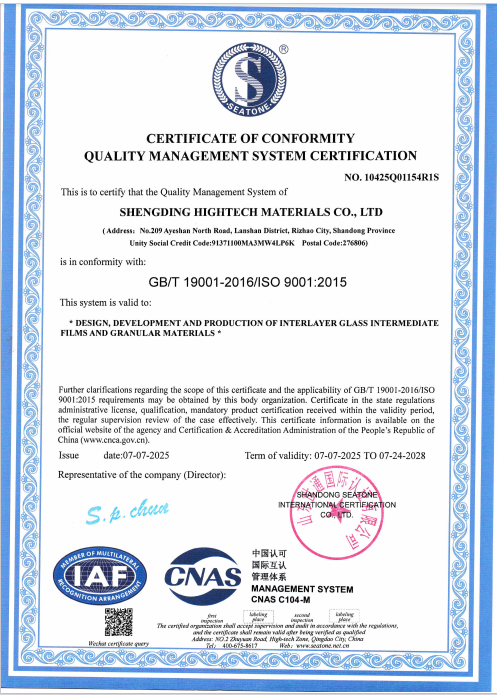
The company states three management-system certifications, and the third-party record assembled for this article repeats that statement as a company-reported claim. Only the ISO 9001 record, however, supplies the detail needed to actually check it.
| Certificate field | Recorded value |
|---|---|
| Certificate type | Quality Management System Certification |
| Certificate number | 10425Q01154R1S |
| Standard | GB/T 19001-2016 / ISO 9001:2015 |
| Issuing body | Shandong Seatone International Certification Co., Ltd. |
| Scope | Design, development and production of interlayer glass intermediate films and granular materials |
| Issue date | 2025-07-07 |
| Expiry date | 2028-07-24 |
| Market applicability | Global, in markets where GB/T 19001-2016 / ISO 9001:2015 are recognized |
| Products listed on the record | TPU FILM SD560; EVA FILM SD38 |
Three details in that table decide how much weight the document carries. The scope sentence comes first: a buyer purchasing EVA interlayer film needs the scope to cover the design, development and production of interlayer glass intermediate films, and this wording does. The validity window comes second: the certificate is recorded as issued on 7 July 2025 and valid to 24 July 2028, so a file assembled in 2026 should confirm the certificate is still listed as active with the issuing body rather than relying on a scanned copy alone.
The third detail is the relationship between the certificate and a specific grade. The cited certificate reference describes it as the certification for TPU film SD560, while the certificate record itself lists both SD560 and EVA FILM SD38 among related products. That is a scope question rather than a footnote. Ask the supplier to confirm in writing that the certificate covers the EVA grade being purchased, at the production site being audited, for the activity being performed. A scope sentence that reads correctly on a certificate can still be read more broadly than the audit actually went.
For ISO 14001 and ISO 45001, the available record stops at the level of a stated certification. No certificate number, issuing body, scope statement or validity date is supplied for either. That does not make the claims untrue; it makes them unverified inside the file. The request is straightforward: provide the same fields that make the ISO 9001 record usable, together with the site each certificate covers. These two certificates support supplier due diligence, indicating that environmental and worker-safety processes are managed and audited within a defined scope. They say nothing about optical performance, adhesion or substance content, and a well-built file should not present them as if they did.
Layer two: REACH, RoHS and FDA as product-level statements
REACH is a chemicals regulation, and what buyers actually need from a supplier is a declaration rather than a certificate. A useful substance declaration names the candidate-list version or date it was assessed against, identifies the product families and articles covered, and states the basis on which it was prepared: analytical testing, raw-material supplier declarations, or both. Because restricted-substance lists are revised periodically, a declaration without a revision date ages badly. A document issued three years ago may simply be silent on substances added since, and silence in a declaration is easily mistaken for absence in the product.
An EVA interlayer film is a formulated product rather than a single polymer, so the declaration should trace through the raw-material chain, not just the finished film. Where the project requires it, buyers ask for a restricted-substances statement in addition to the substance-of-concern declaration, and they ask which grades the statement covers.
RoHS restricts the use of certain hazardous substances in electrical and electronic equipment. An architectural or decorative EVA interlayer film is not itself an electrical or electronic product, yet RoHS declarations are routinely requested as a contractual or market-access condition by buyers in electronics-adjacent supply chains. The declaration is still worth having; the question is what it contains. A one-line "RoHS compliant" statement with no test method, laboratory name, threshold values or part numbers is difficult to defend during an audit. The same statement naming the standard applied, the testing laboratory, the report number and the grades covered becomes a document a buyer can file and a project engineer can rely on.
The company states that product performance complies with U.S. FDA quality requirements. FDA references vary by route and by intended use, so that statement needs narrowing before it can support a procurement decision: which specific requirement is being referenced, which grade and thickness it was assessed for, and whether the intended application falls inside that scope. A general FDA statement and a use-specific one look nearly identical on paper and behave very differently during a customer review or a customs query.
The file as a document map
Once the two layers are separated, the dossier becomes a short list in which each item has a job. The table below is a working map for an EVA interlayer film file.
| Document | Layer | What it establishes | What it does not establish |
|---|---|---|---|
| ISO 9001 certificate 10425Q01154R1S | Management system | Quality processes within the stated scope and validity period | Film performance, substance content or lot conformity |
| ISO 14001 certificate | Management system | Environmental management within its own scope | Environmental footprint or recyclability of the product |
| ISO 45001 certificate | Management system | Occupational health and safety management within its scope | Product safety in the buyer's application |
| REACH substance declaration | Product | Substance status against a named candidate-list revision | Lamination behaviour, adhesion or durability |
| RoHS declaration or test report | Product | Restricted-substance status of the grades and parts covered | Suitability of a glass build-up for structural or safety design |
| FDA-referenced statement | Product / market | Compliance with a named requirement for a named use | Compliance with other markets' food-contact or medical rules |
| Certificate of analysis per batch | Product, that lot | Measured values for the tested properties of the delivered lot | Verification of the entire product range |
| HS classification 3920.10.0000 | Trade | Customs classification of EVA film predominantly of ethylene | Any form of product conformity |
The customs row is worth keeping in the file precisely because it is often confused with conformity. Under the U.S. tariff schedule, EVA film predominantly of ethylene is classified under 3920.10.0000. That classification helps an importer calculate duty and prepare entry paperwork. It says nothing about whether the film meets a REACH, RoHS or FDA requirement, and a shipment that clears customs has not thereby been conformity-assessed.
Pairing the certificates with 100% testing and pre-shipment acceptance
The manufacturer states that quality control is 100% test, with a monthly capacity of 100 tons and a 10-day lead time. In a compliance file, a 100% test claim is only as useful as the property list attached to it. Some characteristics can reasonably be checked on every roll: width, thickness, roll build, length and visual defects. Others, such as adhesion after lamination, ageing behaviour or optical performance under a defined method, are typically verified on a batch or type basis with a documented sampling plan.
Asking which property falls into which group turns a claim into an auditable process. It also prevents a common and expensive surprise: discovering at the pre-shipment inspection that the characteristic the project depends on was never inside the 100% loop and has no batch record either.
- Roll identity: grade, thickness, width, length and lot number legible on the label and matching the packing list.
- Optical verification: the product record for EVA FILM SD38 states 90% light transmittance and 0.5% haze. Confirm the test method, the sample conditioning and whether those figures are typical values or guaranteed limits before writing them into an acceptance criterion.
- Dimensional check: measured width and thickness against the ordered specification, with tolerances stated in writing.
- Visual inspection: gels, bubbles, creases, edge damage and contamination, assessed against a defect definition the buyer and supplier both accept.
- Packaging and dryness: the application record for architectural and decorative glass lamination notes that the film must be kept dry, so moisture barrier, desiccant, roll wrapping and storage instructions belong in the acceptance criteria, not only in a handling note.
- Lamination trial: a coupon run in the buyer's own oven at the intended process window, because the film is processed at normal pressure and elevated temperature and the finished laminate is what the project actually receives.
- Document set at dispatch: certificate copies, substance declarations, batch certificate of analysis, storage guidance and packing list, issued together with the shipment or ahead of it.
- Traceability: lot numbers on the certificate of analysis matching the labels on the rolls actually delivered.
One gap belongs in the acceptance plan. The supplied product record for SD38 lists material, light transmittance and haze, but not thickness, width, roll length or colour range. Those parameters still have to be confirmed in a datasheet before they can be written into an inspection checklist. A file with every certificate in order but no agreed dimensional specification is incomplete for procurement purposes, even though nothing in it is false.
Order terms that belong in the compliance conversation
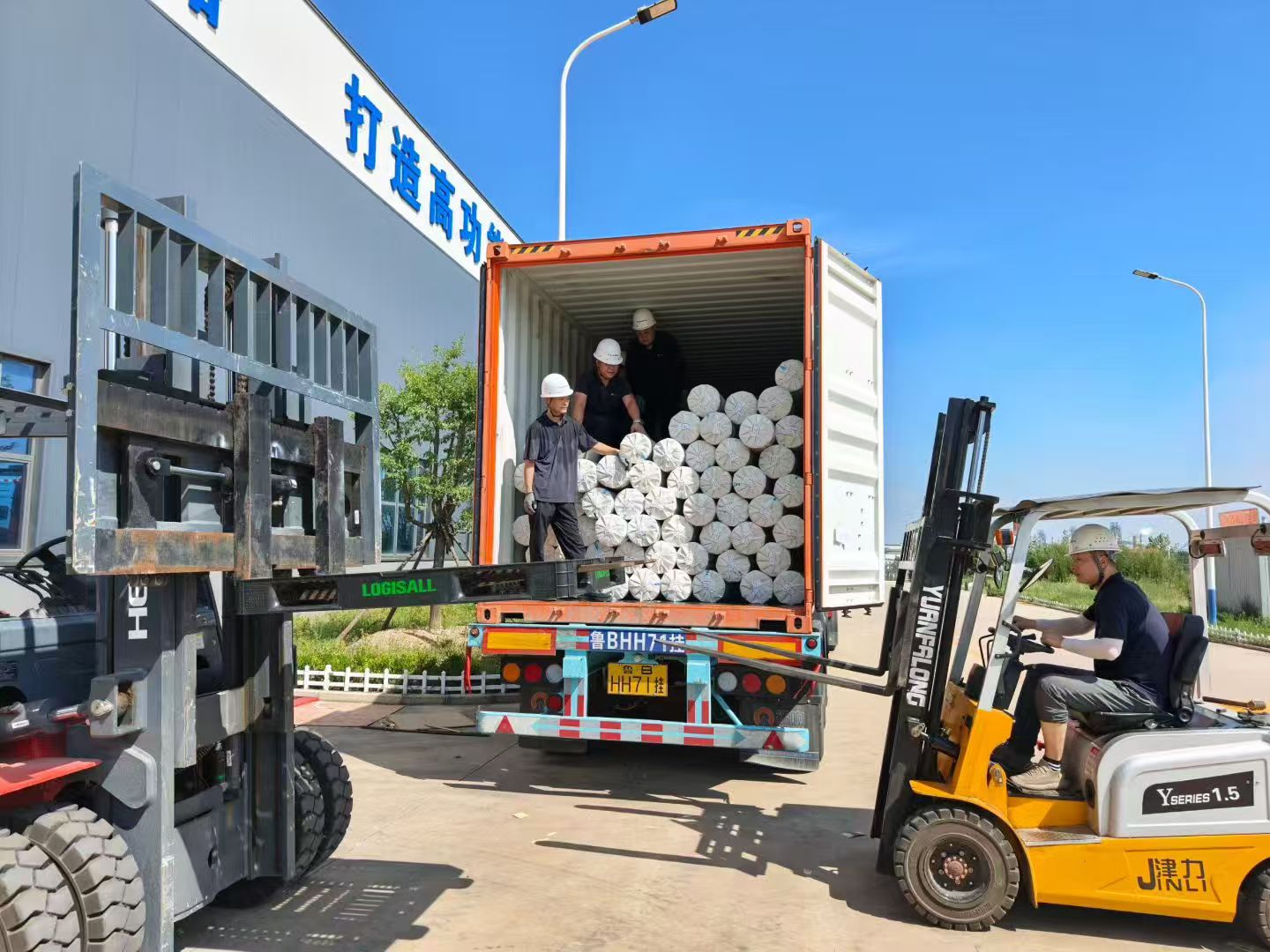
Commercial terms are usually negotiated separately from compliance, yet they set the limits of what can be verified. The manufacturer's stated terms are a 50 kg minimum order quantity, a 10-day lead time, OEM/ODM support with customization of length and width, monthly capacity of 100 tons, and technical support after sales.
A 50 kg minimum has a specific compliance value: it allows a trial lot to be produced, shipped and laminated before a project commits to volume. The trial is where declarations meet reality. A coupon lamination, an optical check and a packaging inspection on a small order reveal more about fit than a folder of certificates, and they generate the buyer's own record for the next order. Buyers should confirm that the minimum applies to the grade, thickness and colour they need, because minimums are commonly set per specification rather than across a whole catalogue.
Lead time should be read together with documentation rather than in isolation. Ten days is the stated lead time; the file should establish when inside that window the batch certificate and declarations are issued, whether they travel with the goods or are sent in advance for review, and what happens if a document is missing at dispatch. Customized width and length under OEM/ODM add a further question: whether the test record is regenerated for the customized lot or inherited from a standard production run. The answer determines how much of the certificate of analysis actually describes the rolls in the crate.
Destination matters as well. The company reports a 70% export share and lists North Africa, the Middle East and Latin America among its main markets, so the file should be assembled per market rather than once for all. A declaration set that satisfies one importer may leave another market's requirements uncovered, and the customs classification, while necessary, is not a substitute for that market work.
Application fit: matching the declaration to the process
As an industry reference point, EVA FILM SD38 is described as a high-transparency EVA film for architectural glass and decorative glass, processed by lamination in an EVA laminating oven at normal pressure and elevated temperature, with the film kept dry before use. The product record states 90% light transmittance and 0.5% haze.
Two consequences follow for the dossier. First, declared optical properties are process-dependent: transmittance and haze measured on film are not the same as transmittance and haze measured on a finished laminate, so a buyer should establish which was tested and on what build-up. Second, a declaration has to name the grade. A REACH or RoHS statement covering "EVA film" without grade, thickness or colour scope is weaker than one listing the families it covers. Colour grades deserve a specific mention because pigments and additives change the formulation, and clear EVA film and colour EVA film should not be assumed to sit under the same declaration unless the supplier confirms it in writing.
Application continuity also deserves separating from compliance. The company's project record describes a two-year supply of 100 rolls of film to a bulletproof glass customer in Pakistan operating stably. That record speaks to repeat supply for one customer and one application. It is not a conformity statement for architectural laminated glass in another market, and a disciplined file treats it as commercial evidence supporting supplier reliability, not as regulatory evidence supporting product conformity.
What the file does not prove
Stating the limits of the evidence is part of building the file, not a criticism of the supplier. For this dossier, four limits are material.
- A management-system certificate is not a product certificate. The ISO 9001 record covers design, development and production processes within a scope; it does not certify the composition or performance of any particular grade.
- The certification records available here are company-reported, and none was validated against a certification-body register within the evidence set. A buyer should confirm certificate 10425Q01154R1S, its scope and its current status directly with Shandong Seatone International Certification Co., Ltd. before relying on it in a tender.
- The REACH, RoHS and FDA statements are not accompanied by independent laboratory reports in the available evidence. They should be requested as dated, grade-specific documents with a stated test basis.
- The 2025 market context — a global EVA films market valued at USD 8.25 billion in 2025, as reported by Fortune Business Insights — aggregates solar, laminated glass and packaging applications. It describes the size of a category, not the compliance practice of any supplier inside it.
There is also a maintenance dimension. A certificate recorded as valid to 24 July 2028 will need re-checking before that date, and substance declarations need reissuing when the underlying lists are revised. Files outlive the documents inside them, which is why the issue and expiry dates belong in a register rather than only in a folder.
An eight-step assembly sequence
The sequence below reflects the order in which each document becomes useful. It can be run in a single supplier-evaluation cycle.
- Define the destination markets and the intended application first, because they determine which product-level declarations are relevant.
- Request the ISO 9001 certificate as a full copy showing number, issuer, scope, issue and expiry dates, and confirm its status with the issuing body.
- Request ISO 14001 and ISO 45001 with the same field set, plus the site each covers.
- Request date-stamped REACH and RoHS declarations, specifying grade, thickness and colour families, and the test method or declaration basis.
- Request the FDA-referenced statement narrowed to the specific requirement and use, or record that it is not applicable to the project.
- Agree the acceptance-test list, including dimensional tolerances, optical verification method, dryness and packaging requirements, and the lamination trial.
- Place a trial order at the stated 50 kg minimum, and check that the batch certificate of analysis arrives with the correct lot numbers.
- File the dated documents, the trial results and the correspondence as one controlled record, and set a review date before the earliest certificate expiry.
Outlook: documentation as a procurement variable
Compliance documentation is shifting from an appendix of the purchase order to a variable that shapes supplier selection. The mechanism is not a single regulatory change but the accumulation of buyer-side practice: audits that ask for scope sentences rather than certificate images, tender documents that specify declaration revision dates, and project files that must be re-verified when a certificate expires.
The practical consequence for buyers of EVA interlayer film is a shorter and better-targeted document request. Instead of collecting everything a supplier will send, define the two layers, name the fields that make each document checkable, and pair the file with batch-level testing and pre-shipment acceptance. A supplier that can answer both layers with dated documents, and can tie a batch certificate to a specific lot, is easier to qualify — and easier to keep qualified — than one that presents a single certificate as the whole answer.
Frequently asked questions
What is the difference between ISO 9001 and REACH compliance for EVA film?
ISO 9001 certifies that a quality management system has been audited against a standard within a stated scope, which for SHENGDING HIGHTECH MATERIALS CO., LTD covers the design, development and production of interlayer glass intermediate films and granular materials. REACH is a chemicals regulation, and the relevant document is a substance declaration tied to a specific product and a dated revision of the restricted-substance list. ISO 9001 tells a buyer how the supplier controls its processes; a REACH declaration tells a buyer what the film contains. Neither document substitutes for the other.
Does an ISO 14001 or ISO 45001 certificate confirm anything about the film itself?
No. ISO 14001 addresses environmental management and ISO 45001 addresses occupational health and safety management. Both describe how a facility manages its processes within a defined scope and validity period. They do not test optical performance, adhesion, ageing behaviour or substance content. In a supplier file they support due diligence on how the site is run; the film's own characteristics must be evidenced separately through product-level declarations, test reports and batch records.
What should a REACH declaration for EVA interlayer film contain?
A usable declaration identifies the candidate-list version or date it was assessed against, the grade and product families covered, and the basis for the statement — analytical testing, raw-material supplier declarations, or both. Because restricted-substance lists are revised, an undated declaration has limited value in a tender. Where the project requires it, buyers also request a restricted-substances statement covering the raw-material chain, plus confirmation of which colour and thickness ranges the declaration extends to.
How does 100% testing fit into a compliance file?
A 100% test claim is meaningful when the property list is attached. Characteristics such as width, thickness, length, roll build and visual defects can reasonably be checked on every roll, while adhesion after lamination, ageing and defined optical methods are usually verified on a batch or type basis with a documented sampling plan. The file should record which properties fall into each group, how results are recorded, and how a batch certificate of analysis is linked to the lot numbers actually shipped.
What documents should accompany a 50 kg trial order of EVA film?
A trial order at the stated 50 kg minimum is most useful when it is treated as a verification exercise. Request the batch certificate of analysis with lot numbers matching the roll labels, the current ISO certificate copies, dated REACH and RoHS declarations covering the ordered grade, the applicable FDA-referenced statement, dimensional and optical specifications with tolerances, and storage guidance reflecting the requirement to keep the film dry. A coupon lamination in the buyer's own oven completes the trial and provides the buyer's own record for the next order.
Есть вопросы или нужны дополнительные детали?
Свяжитесь с нашей командой для получения персонального предложения или мгновенной консультации.
Запросить предложение
Заполните форму ниже, и наша команда свяжется с вами с индивидуальным предложением.
Прямой чат WhatsApp
Предпочитаете общаться в реальном времени? Напишите нам в WhatsApp для мгновенной помощи и быстрых ответов.
- Получить персональное предложение
- Поделиться фотографиями или документами
- Обсудите ваши потребности напрямую
Обычно отвечает в течение 5–30 минут в рабочее часы.