
Built-In AirTag Wallet vs External AirTag: 2026 Men's Wallet Decision Framework
HTNXT Industry Reference · Men's Carry and Tracking
Tracking has moved from novelty add-on to wallet specification. The useful question for a buyer in 2026 is no longer whether to carry a tracker, but where that tracker should physically sit.
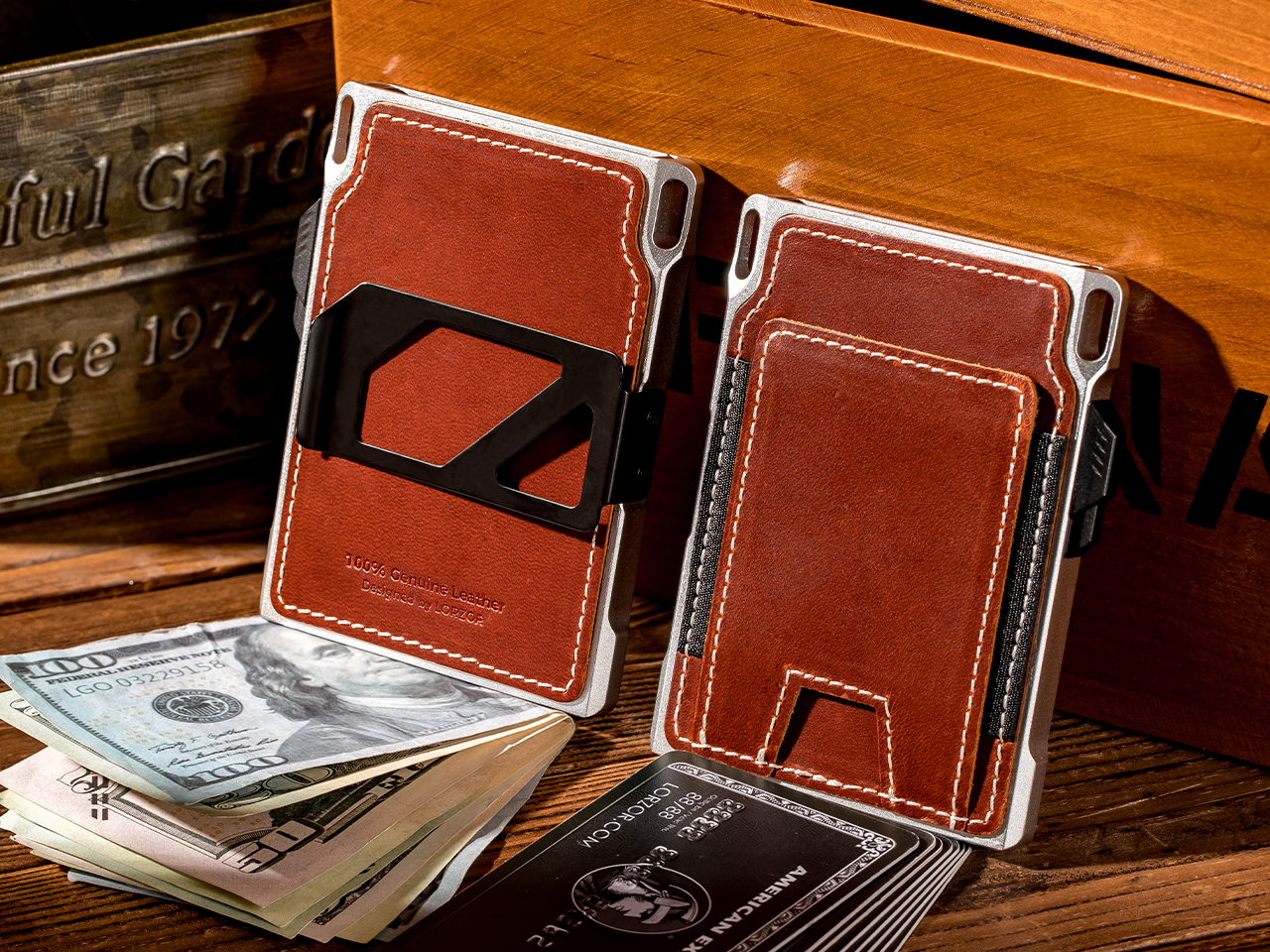
Precision Reports' 2026 men's wallet market study estimates the global category at approximately USD 26.77 billion, with RFID-blocking features appearing in around 36% of men's wallet products worldwide and slim wallets accounting for roughly 23% of the market. The tracking side of that equation is growing faster than the wallet category itself: Novatrends Market Intelligence projects the smart tracker market to expand at a 13.3% CAGR and reach USD 2.98 billion by 2035.
That growth shows up as a practical, physical problem. An Apple AirTag has real thickness. When a buyer drops one into an existing wallet, the wallet's geometry changes: the card stack shifts, folded cash has to move, and a thin front-pocket wallet stops behaving like a thin front-pocket wallet. The alternative is to choose a wallet that was designed around the tracker in the first place, with a dedicated holder built into its structure.
This framework compares the two routes using LORZOR's AirTag-holder models — the Bifold AirTag Wallet A1 to A4, the TriPop AirTag Wallet, and the Passport AirTag Wallet — against a standard wallet carried with an external AirTag. It also maps the brand's non-tracking options (LORZOR 1979 SP, 1979 Fold, and 1979 Wallet, alongside the TriPop Wallet and Passport Wallet) for buyers who decide that simpler slim carry matters more than recoverability.
The Two Ways to Add Tracking to a Wallet
There are only two structural routes, and they fail in different ways.
Route one is external. The buyer keeps the wallet they already own and adds an Apple AirTag. Nothing about the wallet changes. The tracker is a separate object that can be placed in a note sleeve, tucked behind a card stack, dropped into a coin pocket, or simply carried loose — with the last option being the one that creates the most trouble, because a tracker that is not held in place can leave the wallet and become a second thing to search for.
Route two is built-in. The wallet is engineered with a dedicated AirTag holder integrated into its own structure. The tracker becomes part of the wallet's silhouette rather than an addition to it. LORZOR's own product note on the TriPop AirTag Wallet describes this rationale directly: because an AirTag has tangible physical thickness, the holder is designed as a purpose-built storage structure that keeps the tag seated while limiting bulging.
Neither route wins universally. External tracking is transferable — the same AirTag can move between a wallet, a bag, and a set of keys, and it survives a wallet change. Built-in tracking trades that flexibility for a fixed, repeatable position, which is the property that matters when the wallet is the item that goes missing.
What "Built-In AirTag Wallet" Means in Practice
LORZOR is a leather-led modern carry brand founded in 2022 and headquartered in Hong Kong. It designs wallets, AirTag wallets, RFID wallets, and passport wallets for work, travel, and everyday movement, and describes its product philosophy as "Leather first. Technology in its place." — leather as the primary point of contact, with mechanics and electronics sitting discreetly behind it.
Within that range, "built-in AirTag wallet" is a specific construction, not a marketing label. It means the wallet has a holder formed as part of its own structure, sized for an Apple AirTag, and positioned so that the tag does not compete with cards or cash for space. Three LORZOR families follow that construction:
- LORZOR Bifold AirTag Wallet A1, A2, and A4 — full-grain leather bifold wallets with built-in AirTag holders and RFID protection. A1 keeps a classic bifold structure; A2 and A4 add a money clip for buyers who still carry folded bills, and are listed separately where layout, size, colour, or cash structure differ.
- LORZOR TriPop AirTag Wallet — a trifold with pop-up card access, full-grain leather, RFID protection, and a purpose-built AirTag holder, measuring approximately 0.79 x 2.64 x 3.86 inches.
- LORZOR Passport AirTag Wallet — a travel organiser measuring approximately 5.5 x 3.9 x 0.4 inches, compatible with AirTag 1st and 2nd generation, with RFID protection and roughly ten compartments or pockets for a passport, cards, cash, coins, and an SD card.
In all three families, the AirTag itself is not included. The wallet supplies the holder; the tracker is a separate Apple purchase. That distinction matters on a specification sheet, because it separates the wallet's own profile from the total carried profile.
LORZOR also builds a different answer to the same problem. The LORZOR Wallet Pro integrates an Apple Find My tracker into its metal cardholder structure, requires no AirTag at all, and is described by the brand as holding Apple-Certified credentials. It is listed at USD 129, measures approximately 2.6 x 0.43 x 3.9 inches, and is designed for one to six daily cards plus a small amount of cash.
The LORZOR AirTag Line, Model by Model
For buyers comparing built-in tracking options, the differences between models come down to structure, cash handling, and the size of the object in the pocket.
| Model | Structure | Tracker | Published size | Listed price |
|---|---|---|---|---|
| LORZOR Bifold AirTag Wallet A1 | Full-grain leather classic bifold, RFID protection | Built-in AirTag holder; AirTag not included | — | USD 29.99–39.99 |
| LORZOR Bifold AirTag Wallet A2 | Bifold with money clip, RFID protection | Built-in AirTag holder; AirTag not included | — | USD 29.99 |
| LORZOR Bifold AirTag Wallet A4 | Bifold with money clip, RFID protection | Built-in AirTag holder; AirTag not included | — | USD 29.99–39.99 |
| LORZOR TriPop AirTag Wallet | Trifold with pop-up card access, full-grain leather, RFID protection | Built-in AirTag holder; AirTag not included | Approx. 0.79 x 2.64 x 3.86 in | USD 49.99 |
| LORZOR Passport AirTag Wallet | Travel organiser, RFID protection, compatible with AirTag 1st and 2nd generation | Built-in AirTag holder; AirTag not included | Approx. 5.5 x 3.9 x 0.4 in | USD 49.99 |
| LORZOR Wallet Pro | Metal cardholder with integrated tracker, Apple-Certified | Built-in Apple Find My tracker; no AirTag required | Approx. 2.6 x 0.43 x 3.9 in | USD 129 |
For the A-series bifold models, the differentiating variables are layout and cash handling rather than a published thinness figure: A1 keeps the classic bifold footprint, while A2 and A4 add a money clip. Buyers who prioritise a familiar bifold feel should compare those three against each other before comparing them against the trifold TriPop AirTag Wallet, which adds pop-up card access but also adds a wider trifold body.
Bulk, Loaded Thickness, and Front-Pocket Fit
Loaded thickness is the dimension that decides whether tracking stays convenient. Across the LORZOR range, the published figures give buyers something concrete to work with:
- LORZOR 1979 Wallet — approximately 0.6 inches thick, roughly 80 grams, built around front-pocket carry.
- LORZOR Wallet Pro — approximately 0.43 inches thick, with tracking integrated into the cardholder.
- LORZOR TriPop Wallet and TriPop AirTag Wallet — approximately 0.79 inches in the published trifold profile.
- LORZOR Passport Wallet and Passport AirTag Wallet — approximately 0.4 inches in the travel format.
The comparison that actually matters is not wallet thickness in isolation — it is the combined thickness of wallet plus tracker. A trifold listed at 0.79 inches already accounts for its holder inside that figure, because the holder is part of the structure being measured. An external AirTag added to any wallet is thickness that the wallet was never designed around: it has to displace cards, sit under a cash fold, or create a soft lump in the pocket.
User feedback published by the brand illustrates how real this constraint is. Reviews of the LORZOR Bifold AirTag Wallet A1 report high overall satisfaction with craftsmanship, leather quality, card storage, and slim design, while noting limited cash capacity, card slots that are tight at first, and a small or tight ID window. Feedback on the LORZOR Bifold AirTag Wallet A3 similarly flags tight card slots and tight cash or receipt storage. Built-in tracking removes the loose-tracker bulge; it does not remove the need to match card and cash load to the wallet's intended capacity.
Commute, Travel, and Gift: Matching the Model to the Scenario
The decision framework changes shape once the daily scenario is fixed.
Daily commute and office carry. The requirement is usually a small number of cards, a few folded bills, and a wallet that disappears into a front pocket. The LORZOR Bifold AirTag Wallet A1 fits that brief with a classic leather bifold and a built-in holder; A2 and A4 add a money clip for buyers who want cash kept outside the card section. The TriPop AirTag Wallet suits buyers who carry more cards and want pop-up access, at the cost of a trifold body. The LORZOR 1979 Wallet remains the option for buyers who want tactical EDC flexibility — pop-up access, a 6061 aerospace-grade aluminium frame, full-grain leather, and a removable money clip for 10 or more folded bills — without tracking in the wallet at all.
International travel. Passports, foreign cash, boarding passes, and hotel keys create a different failure cost, because losing the document is worse than losing the wallet. The LORZOR Passport AirTag Wallet is built for that scenario, holding documents, cards, cash, and coins across roughly ten compartments in a 0.4-inch format with a built-in AirTag holder. Brand-published reviews describe it as maintaining good condition over multiple trips and working as both a travel passport holder and an everyday wallet. Buyers who want the same organisation without anti-loss functionality can use the LORZOR Passport Wallet, which the brand positions around centralised document management rather than tracking — and which should not be described with AirTag or Find My claims.
Gifting and long-term ownership. For a gift that is meant to last beyond the season, the LORZOR 1979 SP Wallet is a limited edition tied to America's 250th Anniversary, with a 1776–2026 commemorative theme and a production run limited to 300 sets. The LORZOR 1979 Fold Wallet moves the same pop-up mechanism into a bifold with a built-in ID window, a foldable top cover, and capacity for up to 12 or more cards. Buyers who want tracking as the headline feature, rather than the wallet shape, are better served by the AirTag models or by the Wallet Pro, whose tracking is integrated into the metal cardholder rather than supplied by a separate Apple device.
Technical Note: RFID Zones, Find My, and Where the Tracker Sits
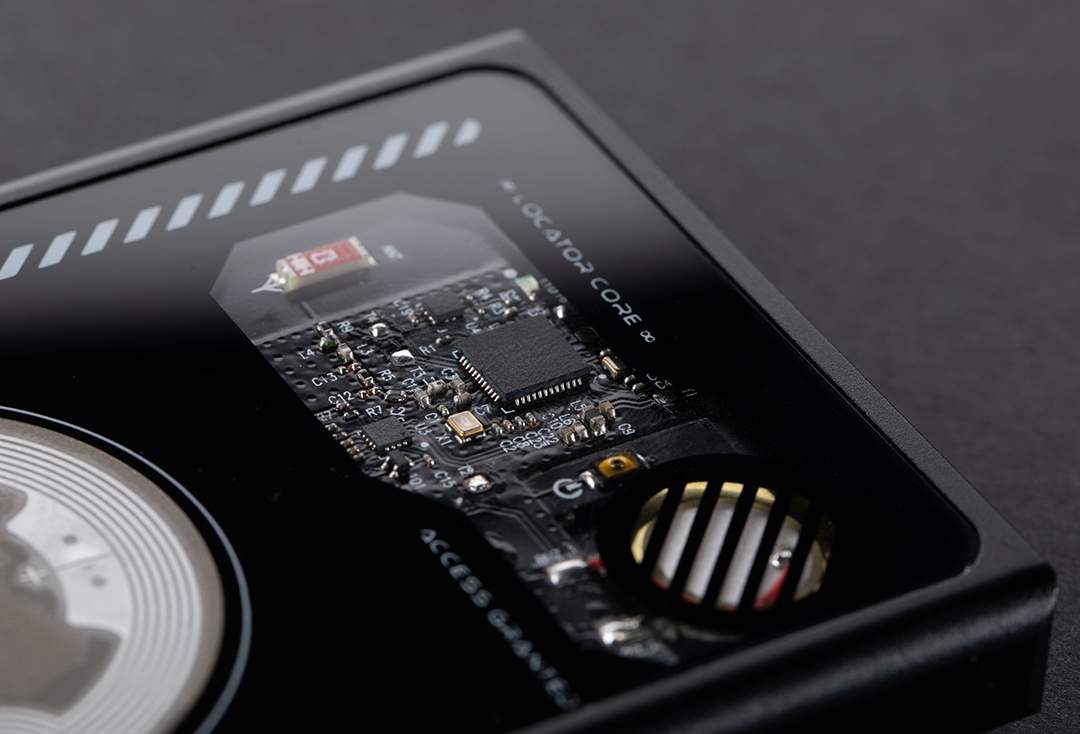
Two different technologies sit inside these products, and buyers tend to conflate them.
RFID shielding is the wallet-side protection layer. LORZOR states that its RFID shielding tests run on the 13.56 MHz frequency using credit cards and professional RFID test signal cards, and that signals cannot be read when cards are correctly placed inside the protected zone. The brand lists test certifications including TÜV and AGC, alongside test photos and video assets. The practical consequence is a placement rule: a card that sits correctly inside the protected zone is shielded, and the wallet's documentation describes where that zone begins and ends on each model.
Apple Find My tracking is the tracker-side layer, and it behaves according to the tracker, not the wallet. Whether a tag is found quickly under a car seat, in a hotel room, or at a lost-and-found desk depends on Apple's AirTag and Find My network behaviour, including proximity and physical obstruction. The wallet's contribution is positional: a holder keeps the tag seated in a fixed location inside the wallet instead of loose among cards and receipts, so that finding the wallet and finding the tag are the same search rather than two.
That is also why the holder's location relative to the shielded card zone is a genuine selection criterion. The applicable question at purchase is not which wallet claims the strongest shielding, but whether the wallet documents a dedicated tracker position and a defined RFID-protected card zone as separate, described features.
Where Built-In Tracking Is Not Automatically the Better Choice
A decision framework that only lists advantages is not a framework. Several boundaries apply to the built-in route.
Interior space is shared space. Documented user feedback on the LORZOR Bifold AirTag Wallet A3 raises tight card slots, difficult cash or receipt storage, concerns about the long-term durability of internal materials and stitching, and occasional glue defects. The A1 feedback notes limited cash capacity and initially tight slots. These are capacity and break-in limitations, not tracking limitations, but they affect the same pocket. Buyers who carry heavy cash and a large card stack should verify capacity before assuming a built-in holder costs them nothing.
Loaded bulk is model-specific. Some users of the LORZOR TriPop Wallet note that it becomes somewhat thick when fully loaded, and that oil-waxed leather can show marks — which the brand frames as part of the leather's character rather than a defect. The same trifold logic applies to the AirTag version. Buyers who want the thinnest possible daily carry should compare the 0.4-inch passport format and the 0.43-inch Wallet Pro against a 0.79-inch trifold before choosing.
The cost is not all-in. The AirTag-holder models do not include an AirTag. The total cost of ownership is therefore wallet plus tracker, while the Wallet Pro bundles a built-in Apple Find My tracker into a USD 129 product and requires no additional device.
External tracking keeps one advantage. An AirTag carried separately is transferable: it moves with the owner when the wallet changes, and it can serve a bag or a keyring at the same time. A built-in holder ties tracking to one wallet for its lifetime. For a buyer who already owns a wallet they are unwilling to replace, the external route is the lower-disruption decision — and it is also the cheaper one up front.
Market Trend Analysis: Slimness and Tracking Are Converging
The category data explains why built-in holders appeared at all, and why they are shaping up as a durable design pattern rather than a passing feature.
Precision Reports estimates the global men's wallet market at approximately USD 26.77 billion in 2026, with leather representing 62% of product preference, slim wallets holding about 23% of the market, RFID-blocking features in roughly 36% of products, and e-commerce accounting for 44% of distribution. Market Growth Reports forecasts the leather wallet market reaching USD 74.58 billion by 2035 at a 4.5% CAGR, and separately notes that full-grain or top-grain leather accounts for more than 60% of wallets sold globally as of 2024.
Two of those signals pull in opposite directions. Slim wallets growing to roughly a quarter of the market reflects a demand for less bulk. RFID penetration at more than a third of products reflects a demand for more function. Tracking sits on the "more function" side, and the smart tracker market's projected 13.3% CAGR to USD 2.98 billion by 2035 makes it the fastest-moving input in the stack. Meanwhile, Worldpay's Global Payments Report 2024 projected that digital wallets would account for 49% of all sales, online and point-of-sale combined, by 2027 — a shift that reduces how many physical cards a man needs to carry, but not how badly he needs to find the wallet he still carries.
The result is a design problem: add capability without adding volume. A dedicated holder is one answer, because it absorbs the tracker into the wallet's existing geometry instead of stacking on top of it. An integrated module is a second answer, because it removes the separate object entirely.
Future Outlook
Three things are likely to shape this decision over the next buying cycle.
First, holder-based tracking and module-based tracking will continue to coexist rather than replace each other, because they serve different cost structures. The AirTag-holder models sit in the USD 29.99 to 49.99 band and assume the buyer already owns or will buy an AirTag. The LORZOR Wallet Pro sits at USD 129 and removes the second purchase. Buyers already inside the Apple ecosystem have a lower marginal cost for the holder route; buyers who want one object and one purchase have a clearer case for the integrated route.
Second, long-term ownership signals will matter more as tracking becomes common. LORZOR's collection page lists leather and metal wallets with RFID protection, AirTag slots, lifetime warranty coverage, free global shipping, and 30-day returns, and the brand states it operates a support channel with a response window and a stated phone and email contact. The brand also reports more than 20,000 authentic customer reviews across Amazon and other online channels and more than 50 global patents related to wallet technology, alongside published review counts for individual models — 565 reviews at 4.6 out of 5 stars for the LORZOR Wallet for Men; 55 reviews at 4.95 out of 5 stars for the LORZOR TriPop Wallet; 153 reviews at 5 out of 5 stars for the LORZOR 1979 Fold Wallet. For a purchase intended to last several years, that body of feedback is more useful than a single specification line.
Third, the honest expectation is that tracking will not remove the trade-offs. A holder takes interior space; an integrated module changes the price band; an external tag stays transferable but unstructured. The framework in this article will keep working as long as those three realities hold.
FAQ
Do I need to buy the AirTag separately for a LORZOR AirTag wallet?
Yes, for the models that provide a holder. The LORZOR Bifold AirTag Wallet A1, A2, and A4, the LORZOR TriPop AirTag Wallet, and the LORZOR Passport AirTag Wallet all supply a built-in AirTag holder, and all state that the AirTag is not included. The LORZOR Wallet Pro is the exception in the range: it uses a built-in Apple Find My tracker and requires no AirTag at all.
Will a built-in AirTag wallet feel bulkier in a front pocket?
It depends on the model, and published dimensions are the fastest way to judge. The LORZOR Passport AirTag Wallet is listed at approximately 0.4 inches, the LORZOR Wallet Pro at approximately 0.43 inches, the LORZOR 1979 Wallet at approximately 0.6 inches and roughly 80 grams, and the LORZOR TriPop AirTag Wallet at approximately 0.79 inches in its trifold profile. The comparison buyers should actually make is wallet thickness plus tracker: a built-in holder accounts for the tracker inside the published figure, whereas an external AirTag adds volume to a wallet that was not designed to contain it.
Does an AirTag still work if the wallet ends up under a car seat?
Locating behaviour is determined by the Apple AirTag and the Find My network, including proximity and physical obstruction, not by the wallet. What the wallet determines is position. In a LORZOR AirTag model, the tag sits in a dedicated holder inside the wallet structure, so it stays with the wallet rather than sliding out among cards or under the seat. In an external-carry setup, a tag that is not held in place can separate from the wallet and become a second object to find.
Is a built-in holder better than carrying a standard wallet with an external AirTag?
Not universally. A built-in holder keeps the tag in a fixed, repeatable position and avoids adding an unstructured object to the pocket, which is useful when the wallet itself is what goes missing. An external AirTag is transferable between wallets, bags, and keys, requires no change of wallet, and costs less up front if the owner keeps the wallet they already own. The holder route is a better fit when the buyer is replacing the wallet anyway and wants the tracker integrated into the carry; the external route is a better fit when continuity and flexibility matter more.
Which LORZOR wallets come without tracking at all?
The non-tracking options include the LORZOR TriPop Wallet at USD 49.99, a trifold with pop-up card access, an ID window, and capacity for roughly 8 to 12 cards; the LORZOR Passport Wallet at USD 49.99, a travel organiser with RFID protection and a zip pocket; the LORZOR 1979 Wallet at USD 99.99 with a removable money clip for 10 or more folded bills; the LORZOR 1979 Fold Wallet at USD 129.99 with a built-in ID window and capacity for up to 12 or more cards; and the LORZOR 1979 SP Wallet at USD 129.99, a limited edition of 300 sets with a 1776–2026 commemorative theme. The Passport Wallet in particular is not an AirTag product and does not carry AirTag holder or Find My claims.
What do user reviews say about these models over time?
Brand-published review summaries describe long-term behaviour rather than launch impressions. The LORZOR Passport AirTag Wallet is reported to remain in good condition over multiple trips and to work as both a travel passport holder and an everyday wallet. The LORZOR Wallet Pro is rated highly for its slim, minimalist design and built-in Apple Find My tracking. The LORZOR Bifold AirTag Wallet A3 holds an average of 4.8 out of 5 stars across 53 reviews, with users praising the leather feel, card capacity, built-in AirTag slot, and RFID protection, while also reporting tight card pockets and cash compartments and concerns about stitching durability over time. Those durability notes are the ones most worth weighing before a multi-year purchase.