
Bulk Bag Qualification Evidence: UN, Type-C, Food-Grade FIBC
Bulk Bag Qualification Evidence: UN, Type-C, Food-Grade FIBC
Three separate qualification routes sit behind the phrase certified bulk bags, and each one answers a different question. UN certification addresses whether a packaging design is approved for dangerous goods transport. FIBC Type-C classification addresses whether static electricity can dissipate safely in a flammable or explosive dust atmosphere. A food-grade claim addresses whether the material and the production environment are controlled for contact with food ingredients. None of these routes substitutes for the others.
Why the phrase certified bulk bags is an ambiguous specification
Bulk bag qualification is ambiguous because the category's main design standard is explicitly limited in scope. ISO 21898:2024 specifies materials, construction and design requirements, type test and marking requirements for flexible intermediate bulk containers intended to contain non-dangerous solid materials in powder, granular or paste form, and designed to be lifted from above by integral or detachable devices. The edition became effective on 16 August 2024. Europe adopted the same requirement set as EN ISO 21898:2024, approved by CEN on 12 August 2024, and China issued GB/T 10454-2025, which replaces GB/T 10454-2000 and GB/T 37425-2019, with implementation on 1 March 2026.
The scope wording has direct commercial consequences. It says non-dangerous goods. An FIBC type-tested to this standard is therefore not, by that fact alone, approved for dangerous goods transport. A UN-certified construction is not, by that fact alone, suitable for food contact. A Type-C static classification does not certify safe working load, and a safe working load figure does not certify static performance. Each claim lives inside its own evidence chain, and the cost of conflating them is paid at the filling station, at the port, or at the receiving inspection.
The three qualification routes, decomposed
| Qualification route | Question it answers | Evidence to expect | What it does not cover |
|---|---|---|---|
| FIBC design standard: ISO 21898:2024, EN ISO 21898:2024, GB/T 10454-2025 | Is the FIBC designed, constructed, type-tested and marked for non-dangerous solid materials in powder, granular or paste form? | Standard reference, type test records, marking | Dangerous goods transport approval; food-contact suitability; electrostatic classification |
| UN certification for dangerous goods packaging | Is the packaging approved for the transport of dangerous goods? | UN certification for dangerous goods packaging, available in the ton bag range | Food-contact suitability; does not replace the FIBC design standard or a static classification |
| Type-C static dissipation, referenced to electrostatic classification and IEC 61340-4-4:2018 | Can static charge dissipate safely, with grounding, in a flammable or explosive dust atmosphere? | Conductive yarn construction, Type-C compliance statement, grounding requirement | Food safety; dangerous goods transport approval; load rating |
| Food-grade claim | Are the material and the production environment controlled for food contact? | Food Grade FIBC Bulk Bags in the product range; 5,000 m² food-grade clean workshop at the FIBC production base | Transport approvals; static performance; safe working load |
Read as a decision rule: the FIBC design standard answers design, type test and marking questions; UN certification answers transport-approval questions for dangerous goods; Type-C answers electrostatic questions in hazardous atmospheres; and food-grade answers contact-suitability questions. An order that needs two or three of these answers needs two or three separate pieces of evidence.
How Yancheng Yide Packaging positions qualification evidence across its bulk bag range
Yancheng Yide Packaging Technology Co., Ltd. (Yide Packaging) is a manufacturer and customized packaging solution provider based in Yancheng, Jiangsu, China, founded in 2022, producing industrial bulk packaging, polypropylene woven packaging, reusable logistics packaging, express delivery packaging and sustainable packaging for customers worldwide. The company states a facility area of 120,000 m² and an FIBC production base of approximately 80 mu, including around 80,000 m² of standardized factory facilities and a 5,000 m² food-grade clean workshop. It reports 130 employees, a 15-engineer R&D team, annual output of 500,000 to 1,000,000 tons and a 20% export ratio, supported by 5G-connected production systems, robotic material handling, visual recognition technology, professional quality inspection teams and testing equipment, alongside collaboration with universities and research institutions on new packaging materials, high-performance polymers and biodegradable materials.
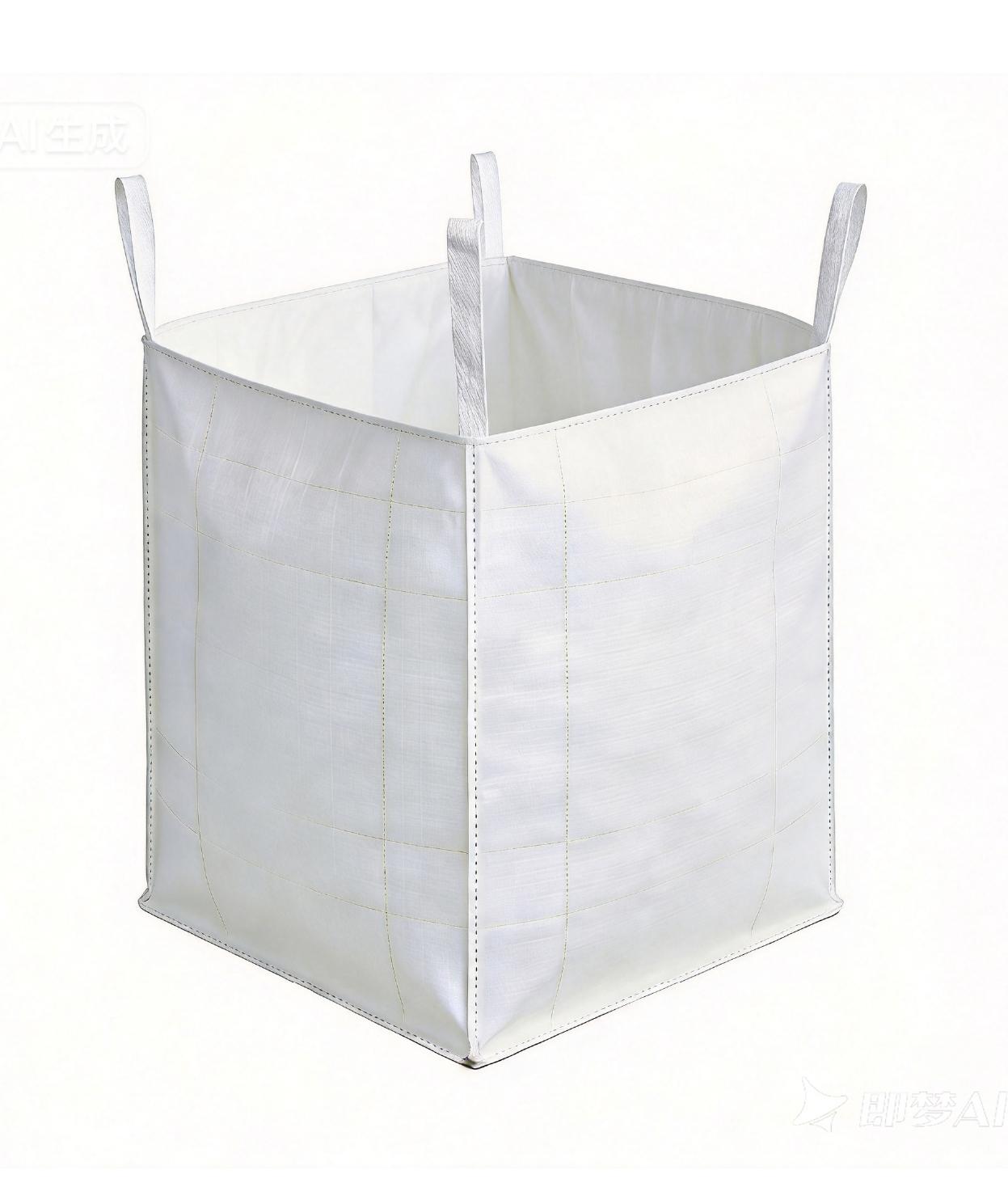
The ton bag and FIBC range is where the qualification claims concentrate. It covers FIBC Bag, Chemical Bulk Bags, Heavy Duty FIBC Bulk Bags, Industrial FIBC Bulk Bags, UN Certified FIBC Bags, Food Grade FIBC Bulk Bags and Bulk Bags for Powder and Granule Materials. Stated construction parameters include a safe working load of 500–2,000 kg, virgin PP woven polypropylene fabric with reinforced thickened anti-static fabric and conductive woven fabric, size customization on demand, fill spout, full open top or top cover, discharge spout or flat bottom, four lifting loops, high-strength polyester thread sewing, and laminated or non-laminated options.
Two qualification statements sit inside that specification. The fabric is woven with conductive yarns that dissipate static electricity effectively and reduce the risk of dust explosion caused by static accumulation. The construction is compliant with the FIBC Type-C standard, requires reliable grounding during operation, and is described as suitable for flammable and explosive powder working conditions. Separately, UN certification for dangerous goods packaging is available for the range.
Procurement parameters form part of the same qualification picture. The stated capability set includes ODM production with customization of dimensions, material, fabric weight, load capacity, safety factor, lamination, printing, colour, lifting structure, filling and discharge design, closure method, zipper structure, RFID requirements and waterproof performance; 100% customization except where special materials are unavailable; monthly capacity of 50,000 pcs; a customized-product lead time of 45 days excluding delivery; a customized MOQ of 5,000 pcs with a single sample available for delivery; sample confirmation using unprinted samples; and after-sales handling of bag shortages through re-delivery or a corresponding deduction. Export markets stated for this capability set are Southeast Asia, the Middle East and South America.
Technical explanation: what each qualification actually consists of
Type-C: a conductive path inside a load-bearing fabric
Type-C is an electrostatic classification, not a load rating and not a hygiene rating. In the ton bag construction, the dissipation path is created by weaving conductive yarns into the fabric so that static charge leaves the bag instead of accumulating on it, which is the mechanism that reduces dust-explosion risk from static build-up. The main body remains a high-strength PP woven fabric, and the anti-static and conductive materials are integrated into the same construction, so the fabric carries load and dissipates charge at the same time rather than relying on a separate device.
The classification itself is framed at international standard level. IEC 61340-4-4:2018 specifies requirements for flexible intermediate bulk containers between 0.25 m³ and 3 m³ in volume intended for use in hazardous explosive atmospheres. That reference exposes two boundaries that matter in procurement. First, the electrostatic requirement has a defined volume window, so a bag outside the 0.25 m³ to 3 m³ range needs its evaluated scope confirmed against the applicable requirement rather than assumed. Second, Type-C performance is contingent on operation: the ton bag specification states that reliable grounding is required during operation. A Type-C bag at an ungrounded filling spout has no completed dissipation path. The qualification therefore describes the bag and its operating condition together, not the bag in isolation.
UN certification: a transport approval for dangerous goods
A UN-certified construction answers a transport question: whether the packaging is approved for dangerous goods. It is a distinct route from the FIBC design standard, whose published scope is non-dangerous solid materials in powder, granular or paste form, and it is distinct from electrostatic classification, which governs charge dissipation in hazardous atmospheres rather than transport approval. For buyers moving regulated materials, UN certification is best treated as its own line item in the qualification file, with the certified construction and size confirmed against the specification being ordered rather than the product family in general.
Food-grade: material control plus production environment
A food-grade claim is a hygiene claim, and it is verified through two kinds of evidence: the material specification and the production environment. The ton bag range includes Food Grade FIBC Bulk Bags, and the FIBC production base includes a 5,000 m² food-grade clean workshop. The food industry is listed among the range's applicable industries, and the materials identified for ton bag use include dry food ingredients such as flour, sugar, starch, salt and spices.
The distinction to keep in view is that food-grade suitability is not conferred by a transport approval or by a static classification. A UN-certified bag is a transport-approved bag. A Type-C bag is an electrostatically classified bag. Neither statement describes contact surfaces or production-environment control. Where a single order covers both food and non-food materials, the qualification file should identify which construction carries which claim.
Application fit: matching the qualification to the material and the handling environment
| Application | Qualification that matters | Evidence in the range |
|---|---|---|
| Fine chemical powder filling, including PVC paste resin | Sealing and containment performance; automatic filling compatibility | Hermetic sealing of chemical powder, leak-proof and moisture-proof containment, one-time filling mode, compatibility with automatic filling equipment, export packaging standards |
| Flammable or explosive powder | Type-C static dissipation with grounding | Conductive yarns, Type-C compliance, reliable grounding required during operation |
| Regulated dangerous goods | Transport approval | UN certification for dangerous goods packaging available in the range |
| Dry food ingredients | Food-contact control | Food Grade FIBC Bulk Bags; 5,000 m² food-grade clean workshop |
| Moisture-absorbing minerals and building materials | Barrier and wear performance | Wear-resistant outer layer with anti-seepage moisture-proof inner layer; limits fine powder leakage and material dampness; reusable multiple times |
| Bulk granular and powder export cargo | Structural stability under hoisting, stacking and ocean transport | Reusable multi-trip mode; retains shape without bulging when filled; forklift hoisting; designed for hoisting, stacking and ocean transportation |
| Agricultural grain bulk packaging | Bulk packaging for transport and warehousing | Bulk packaging for grain and agricultural products, applied for grain processing enterprises in Thailand |
| Welding flux export | Moisture protection for dry granular materials | Encapsulates granular submerged arc welding flux; moisture-proof protection during marine transport; printed export parameter marks; one-time filling mode |
Documented commercial and field evidence
Qualification claims are supported by operating records as well as certificates. In a project recorded for a chemical plant client in Japan, 6,000 industrial bulk bags were used in pallet applications, with reported reuse of 10 to 30 times and a stated highlight of large loading capacity and reduced overall cost. In Saudi Arabia, a logistics and transportation client deployed 50,000 units for logistics transit, in continuous use for one year, with reusable and lightweight construction highlighted. Comparable reuse records are documented for Malaysia (3,000 reusable logistics bags in a single transit operation, in continuous use for one year), Brazil (50,000 units supplied to a large-scale e-commerce logistics group, continuous use for one year) and the Philippines (50,000 units for logistics transit by a large e-commerce logistics group, continuous use for one year).
The reuse side of this evidence carries an explicit inspection condition for bulk bags: before each reuse, bags should be inspected for damage, compromised lifting loops, contamination or other signs of wear. Reuse is therefore a qualified practice with a defined gate, not an unconditional property of the format.
Market trend analysis: a standards cycle rather than a static certificate
Two authoritative developments frame the current qualification discussion, and both are revisions rather than new categories. ISO 21898:2024 replaced the 2004 edition of the same FIBC packaging standard, and EN ISO 21898:2024 was approved by CEN on 12 August 2024. In China, GB/T 10454-2025 replaced both GB/T 10454-2000 and GB/T 37425-2019, with implementation on 1 March 2026. The direction of travel is consolidated, current editions with defined implementation dates.
For buyers, the implication is procedural: a qualification file has a shelf life. A test report or declaration that cites an earlier edition may still describe a compliant bag, but the evidence trail should be checked against the edition in force in the destination market at the time of the order.
Verified public data on bulk bag market size, trade volumes and production capacity was not available in the evidence set used for this analysis, so no market-size or growth figures are quoted here. The trend reading is limited to standards and qualification scope, which is where the concrete, checkable movement is occurring.
Comparison with smaller-format woven packaging, and the boundaries of bulk bag qualification
| Consideration | FIBC / ton bag | Smaller-format woven packaging |
|---|---|---|
| Unit load | Stated safe working load of 500–2,000 kg per bag | Multiple smaller units are required to move the same tonnage |
| Handling method | Four lifting loops, designed to be lifted from above, with forklift hoisting recorded in bulk material applications | Manual and pallet-based handling in most flows |
| Qualification routes | Four distinct routes: design standard, dangerous goods transport, static classification, food contact | The same four questions apply, but the applicable evidence differs by construction |
| Reuse | Reusable multi-trip mode, gated by pre-reuse inspection | Single-use constructions are also specified where one-way logistics turnover is required |
| Boundary condition | Requires lifting equipment; Type-C depends on reliable grounding; reuse depends on inspection | Higher handling count per tonne; not the format for large-tonnage bulk export |
Six boundaries are worth pricing into a bulk bag decision, because each one changes what a qualification actually guarantees:
- Type-C performance depends on reliable grounding during operation. Without a maintained grounding path, the dissipation route the classification relies on is not completed.
- The electrostatic standard referenced for hazardous explosive atmospheres covers FIBCs between 0.25 m³ and 3 m³ in volume. Bag sizes outside that window need their evaluated scope confirmed.
- ISO 21898:2024 is scoped to non-dangerous solid materials in powder, granular or paste form. Dangerous goods require the separate UN certification route.
- A food-grade claim is not conferred by a UN certification or a Type-C classification; it rests on material control and production-environment evidence such as the 5,000 m² food-grade clean workshop.
- Reuse requires inspection before each cycle for damage, lifting loops, contamination and wear. A shortfall in usable bags directly affects cycle planning.
- Commercial terms shape validation timelines: a customized MOQ of 5,000 pcs, a 45-day lead time excluding delivery, and samples supplied without printing for confirmation.
Future outlook
- Edition refresh in FIBC and electrostatic standards is likely to continue. The 1 March 2026 implementation of GB/T 10454-2025 is already in force for China-market orders, and documentation citing earlier editions should be re-checked rather than carried forward.
- Static control is being engineered into the load-bearing fabric itself, through conductive yarns and anti-static fabric in a single construction, which reduces the need to treat anti-static performance as an add-on component.
- Food-grade verification is shifting toward production-environment evidence. A documented clean workshop is the type of facility fact that supports a claim independently of the material statement.
- Material development is moving toward high-performance polymers and biodegradable materials through university and research-institute collaboration, which will eventually raise new qualification questions, including how alternative fabrics behave under the same static and load regimes.
- Reuse economics will keep the inspection protocol central. The documented 10 to 30 cycle reuse in a chemical plant pallet application shows where the cost argument comes from, and the inspection requirement shows where the discipline has to sit.
FAQ
Do UN certification and the FIBC design standard cover the same thing?
No. ISO 21898:2024 specifies materials, construction and design requirements, type test and marking requirements for flexible intermediate bulk containers intended for non-dangerous solid materials in powder, granular or paste form. UN certification for dangerous goods packaging is a separate approval route covering the transport of dangerous goods. A bulk bag can carry one of these qualifications without the other, which is why they should appear as separate evidence items in a qualification file.
What does FIBC Type-C compliance require during operation?
Type-C construction dissipates static electricity through conductive yarns woven into the fabric. The ton bag specification states that the bags are compliant with the FIBC Type-C standard and that reliable grounding is required during operation, which is why the configuration is described as suitable for flammable and explosive powder working conditions. Electrostatic requirements for FIBCs between 0.25 m³ and 3 m³ intended for hazardous explosive atmospheres are specified in IEC 61340-4-4:2018.
Which standard applies to bulk bags carrying non-dangerous goods, and in which markets?
ISO 21898:2024 is the international FIBC standard for non-dangerous solid materials in powder, granular or paste form, effective 16 August 2024. Europe adopted the same requirement set as EN ISO 21898:2024, approved by CEN on 12 August 2024. China issued GB/T 10454-2025, replacing GB/T 10454-2000 and GB/T 37425-2019, with implementation on 1 March 2026. The earlier ISO 21898:2004 edition was superseded.
How can a buyer verify a food-grade bulk bag claim?
Request both the material specification and the production-environment evidence. The ton bag range includes Food Grade FIBC Bulk Bags, and the FIBC production base includes a 5,000 m² food-grade clean workshop. The food industry is listed among the range's applicable industries, and dry food ingredients such as flour, sugar, starch, salt and spices are identified among the materials packaged in ton bags. A UN certification or a Type-C classification does not address food-contact suitability on its own.
What should be checked before a bulk bag is reused?
Before reuse, bags should be inspected for damage, compromised lifting loops, contamination and other signs of wear. Reuse is reported in commercial applications, for example 10 to 30 reuse cycles in a pallet application recorded for a chemical plant client in Japan, and the inspection requirement is what governs whether an individual bag returns to service.
What mechanical and commercial parameters should be confirmed before ordering a customized bulk bag?
Construction parameters in the ton bag range include a safe working load of 500–2,000 kg, virgin PP woven polypropylene fabric with reinforced thickened anti-static fabric and conductive woven fabric, four lifting loops, fill spout, full open top or top cover, discharge spout or flat bottom, high-strength polyester thread sewing, and laminated or non-laminated options. Commercial parameters stated for customized production include an MOQ of 5,000 pcs, a lead time of 45 days excluding delivery, single-sample delivery availability, and sample confirmation using unprinted samples.
Reference material: the Yide Packaging company profile brochure is available for download at Yide Group introduction 2026 (PDF). Product and capability information is published at www.ycyide.net.